Allergy Blood Test (IgE): What It Shows, How It Compares With Skin Tests and What Results Mean

Updated: 2 days ago
Written and medically reviewed by Dr. Baraa Alnahhal, MD · Last reviewed: November 2026 · How we review
Quick Answer
An allergy blood test is a blood test that measures immunoglobulin E (IgE) antibodies in the blood. It needs only a routine blood draw, no preparation, and you can keep taking antihistamines. A positive result shows sensitization, not necessarily an allergy: many people with positive tests have no symptoms, so results are always read together with your history.
What the research says
Component tests are very specific for some foods: a meta-analysis of 149 studies and 24,489 patients found specific IgE to individual allergen components was highly specific, for example 92% for peanut Ara h 2, 95% for hazelnut Cor a 14, 94% for cashew Ana o 3 and 93% for milk casein, while skin prick testing with fresh milk or raw egg was the most sensitive (90% and 94%) (Riggioni C et al., Allergy, 2024) [2]
Not every component test is reliable: a systematic review of 15 studies and 2,395 people found IgE tests for lipid transfer proteins, such as peanut Ara h 9 and hazelnut Cor a 8, had low and variable sensitivity (6–61% and 11–43%), so a negative result doesn't rule out these allergies (Bellia C et al., International Journal of Molecular Sciences, 2024) [3]
Key takeaways
Measures total IgE or IgE specific to foods, pollens, pets, dust mites, molds, venoms and medicines.
Useful when skin testing isn't possible: skin conditions, antihistamine use, darker skin or high anaphylaxis risk.
No preparation; routine blood draw; results in a few days.
A positive test shows sensitization, not proof of allergy; about half of positives aren't true allergies.
Results don't predict how severe a reaction will be.
What is an allergy blood test?
In an allergy, your immune system makes IgE antibodies against a normally harmless substance. When you meet that substance again, IgE triggers the release of histamine and other chemicals that cause symptoms. An allergy blood test detects these antibodies. Sources: [1]
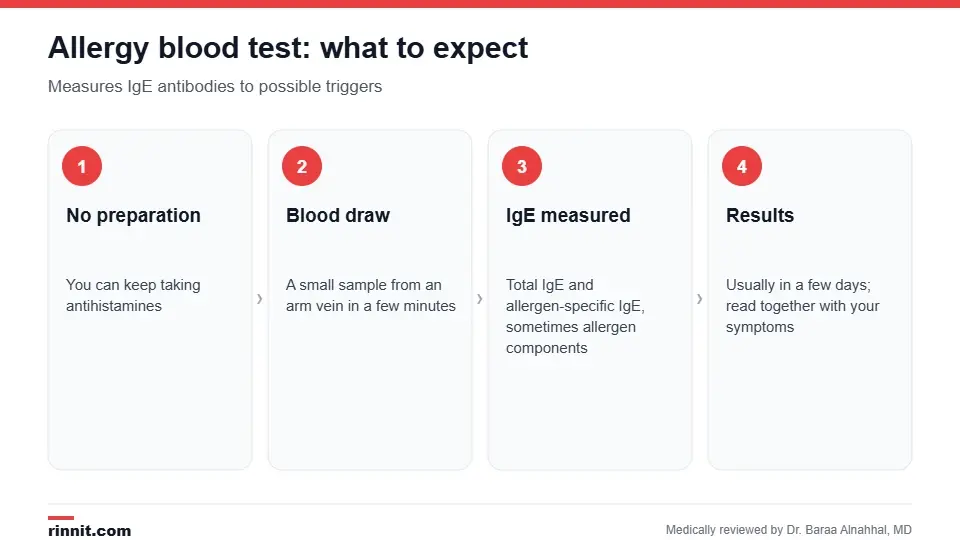
An allergy blood test is a routine blood draw.
Total IgE: measures all IgE; high levels suggest an allergic tendency but don't show what you're allergic to.
Specific IgE: measures IgE against individual allergens and is more useful for diagnosis.
Component-resolved testing: measures IgE to individual proteins within a food, for example peanut Ara h 2, which helps separate true allergy from cross-reactivity. Sources: [1, 2]
Why is it done?
Your provider may order it to help diagnose allergic rhinitis (hay fever), food allergies, pet allergy, insect venom allergy, some drug allergies, asthma triggers, or after an episode of anaphylaxis. It is part of broader allergy testing. Sources: [1]
Blood test vs skin test
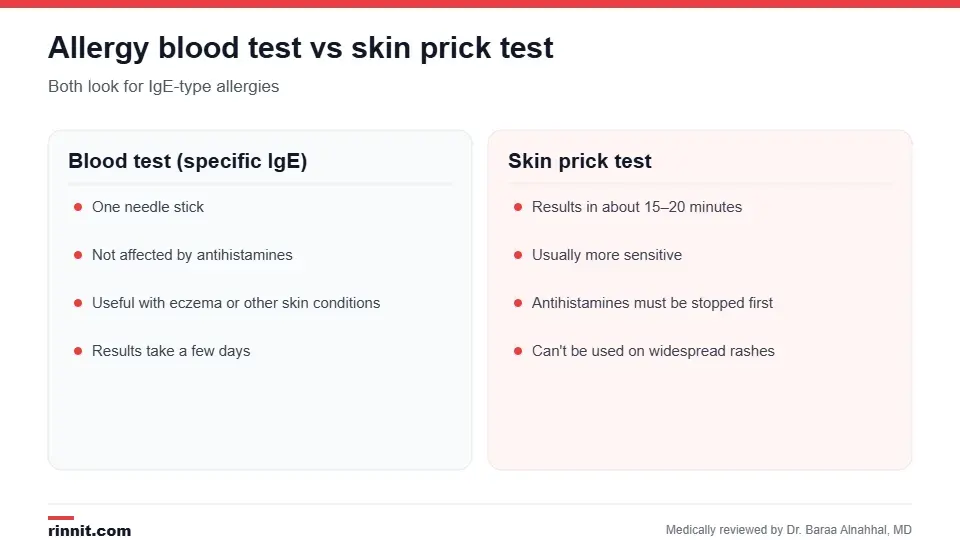
Both tests detect IgE; each has advantages.
Feature | Blood test | Skin prick test |
What it measures | IgE in blood | Skin reaction to allergen |
Results | A few days | About 15–20 minutes |
Antihistamines | Can continue | Must stop beforehand |
Skin conditions | Not affected | Eczema or dermatographism can interfere |
Sensitivity | Generally a little lower | Generally higher |
Risk | Bruising only | Small risk of a reaction |
Skin tests are usually faster and slightly more sensitive. Blood tests are preferred when you can't stop antihistamines, have widespread eczema or other skin conditions, have darker skin where reactions are harder to read, or have a history of severe reactions. Sources: [1, 2]
How do I prepare?
No preparation is needed. You don't need to fast or stop antihistamines. Tell your provider about all medicines you take. Sources: [1]
What happens during the test?
A provider cleans the skin and draws blood from a vein in your arm.
In young children, a finger stick may be used.
The sample goes to a lab, which tests it against the allergens your provider chose. Sources: [1]
Understanding your results
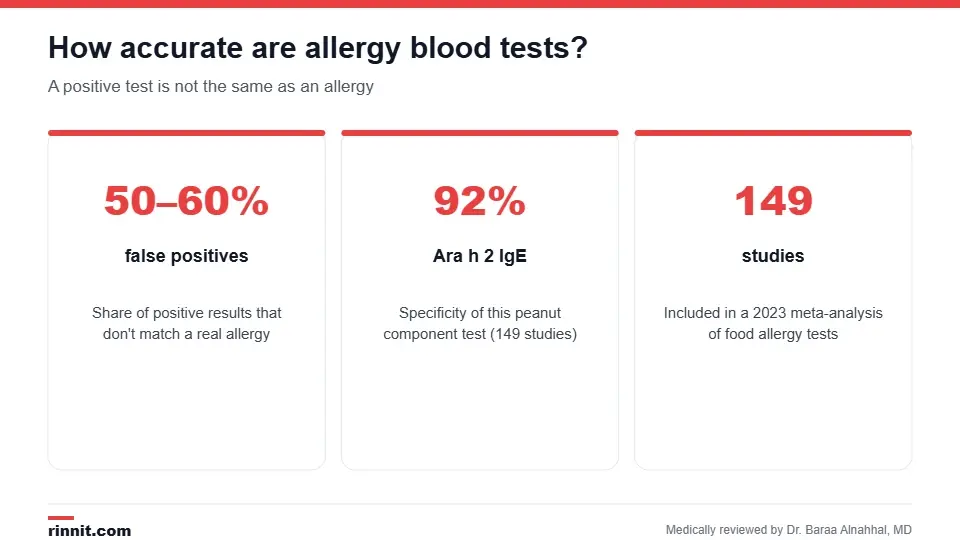
Component tests can be highly specific for some foods.
Results usually take a few days. Labs report specific IgE as a level (often in kU/L) or as a class, and different labs use different scales. A higher level makes a true allergy more likely, but it doesn't predict how severe a reaction will be. Sources: [1]
Negative: you're unlikely to be allergic to that substance, though some low-sensitivity tests can miss allergies.
Positive: you're sensitized. If you have symptoms when exposed, this supports an allergy diagnosis.
Positive without symptoms: common. About 50–60% of positive results don't reflect a true allergy, so testing should be guided by your history. Sources: [1, 3]
If results are unclear for a food, your allergist may recommend a supervised oral food challenge. If you're at risk of anaphylaxis, you may be prescribed an epinephrine auto-injector. Treatment can include avoidance, medicines, allergy shots or oral immunotherapy for some food allergies. Sources: [1]
Risks
The risks are those of any blood draw: brief pain and mild bruising. Unlike skin testing, there's no risk of an allergic reaction from the test. Sources: [1]
Conclusion
An allergy blood test is a safe, convenient way to look for IgE sensitization, especially when skin testing isn't suitable. Its results only make sense alongside your symptoms, so avoid broad "panel" testing without a clear reason, and have an allergist interpret results before cutting foods from your diet.
Keep learning: read about penicillin allergy and our overview of allergy testing.
Frequently asked questions
What does an allergy blood test measure?
IgE antibodies, either total IgE or IgE to specific allergens.
Do I need to stop antihistamines?
No. Antihistamines don't affect blood test results.
Do I need to fast?
No. No preparation is needed.
How long do results take?
Usually a few days.
Is a blood test as accurate as a skin test?
Skin tests are generally a little more sensitive, but blood tests are a good alternative when skin testing isn't possible.
Can a positive test mean I'm not allergic?
Yes. About half of positive results don't reflect a true allergy, so your symptoms matter.
Does a higher IgE level mean a worse reaction?
Not necessarily. Levels suggest likelihood of allergy, not reaction severity.
What is component testing?
Testing IgE to individual proteins in a food, which helps tell a true allergy from cross-reactivity.
Can a blood test diagnose a food allergy on its own?
No. It's combined with your history, and sometimes a supervised oral food challenge.
Is the test safe for children?
Yes. It's a simple blood draw with no risk of an allergic reaction.
Related Reading
Allergy Testing: Types, How to Prepare and What Results Mean an overview of skin, blood and challenge tests.
Penicillin Allergy: The Complete Guide a common drug allergy and how it's tested.
Allergic Rhinitis (Hay Fever): Symptoms, Triggers, and Treatment That Actually Works a common condition this test helps diagnose.
Pet Allergy: The Complete Guide allergies to pet dander.
Oral Immunotherapy (OIT) for Food Allergies: How It Works, Risks, and Results a treatment option for some food allergies.
Allergy Skin Test: Prick, Intradermal and Patch Tests, Preparation and Results explains the prick, intradermal and patch tests used to find allergies.
References
Cleveland Clinic. Allergy Blood Test: What It Is, Purpose, Procedure & Results. Cleveland Clinic. Last updated November 7, 2024. https://my.clevelandclinic.org/health/diagnostics/allergy-blood-test
Riggioni C, Ricci C, Moya B, et al. Systematic review and meta-analyses on the accuracy of diagnostic tests for IgE-mediated food allergy. Allergy. 2024;79(2):324-352. PMID 38009299. https://doi.org/10.1111/all.15939
Bellia C, Sardina DS, Scazzone C, et al. Diagnostic accuracy of lipid transfer proteins (LTPs) specific IgE assay in food allergy: a systematic review. International Journal of Molecular Sciences. 2024;25(23):12925. PMID 39684636. https://doi.org/10.3390/ijms252312925
Medical disclaimer
This article is for general education only and does not replace advice from a qualified healthcare professional. Talk to your doctor about your own diagnosis and treatment, and seek emergency care right away for severe or sudden symptoms.



Comments