Penicillin Allergy: The Complete Guide

Updated: 3 days ago
Medically reviewed by Dr. Baraa Alnahhal, MD · Last reviewed: October 2026
Quick Answer
Penicillin allergy is an immune system reaction to the antibiotic penicillin. It may cause hives, rash and itching, and a serious reaction can include anaphylaxis, a life-threatening condition with throat swelling and trouble breathing. Reactions usually appear within an hour of taking the drug, but many reported penicillin allergies are over-reported, so an accurate diagnosis matters.
What the research says
Most reported penicillin allergies are not true allergies. A JAMA review reports that about 10% of the US population has reported a penicillin allergy, yet clinically significant IgE- or T-cell-mediated penicillin hypersensitivity is uncommon (under 5%), and IgE-mediated penicillin allergy wanes over time, with 80% of patients becoming tolerant after a decade. (Shenoy et al., JAMA, 2019) [3]
Testing is reliable, and cross-reactivity is lower than once thought. The same review reports that penicillin skin testing has a negative predictive value above 95% (approaching 100% when combined with an amoxicillin challenge), and that cross-reactivity between penicillin and cephalosporins occurs in about 2% of cases, down from the 8% reported previously. (Shenoy et al., JAMA, 2019) [3]
An unconfirmed label has real costs. A review of penicillin allergy delabeling explains that unconfirmed allergy labels harm personal and public health, including the emergence and spread of resistant bacteria and higher health care costs, and that evaluations (history, then drug challenge, sometimes after skin testing) can be expanded beyond allergy specialists. (Samarakoon et al., Ann Allergy Asthma Immunol, 2023) [4]
Penicillin Allergy at a Glance
Key Question | Answer |
What is it? | An immune system reaction to the antibiotic penicillin |
What does penicillin treat? | Bacterial infections |
When do reactions start? | Usually within an hour; sometimes days or weeks later |
Is it an emergency? | Rarely — but anaphylaxis requires immediate 911 care |
Often confused with | Ordinary side effects like nausea, diarrhea, headache |
How is it confirmed? | Skin test and graded challenge by an allergist |
Best prevention | Avoidance, telling all healthcare workers, medical alert bracelet |

What Is a Penicillin Allergy?
Penicillin allergy is a reaction of the immune system to the antibiotic medicine penicillin, which is used to treat bacterial infections.
Penicillin allergy may cause hives, rash, and itching. A serious reaction can include anaphylaxis — a life-threatening condition that can cause throat swelling and trouble breathing.
Research has shown that penicillin allergies may be over-reported. When allergies are over-reported, it can result in the use of improper and more-expensive antibiotic treatments. Therefore, to ensure the best treatment options in the future, an accurate diagnosis is needed when penicillin allergy is suspected.
Other antibiotics similar to penicillin can also result in allergic reactions.
What are the symptoms of a penicillin allergy?
Symptoms often happen within an hour after taking the antibiotic. Less commonly, reactions can happen hours, days, or weeks later.
Penicillin Allergy Symptom | Description |
Skin rash | A medicine rash usually starts within two weeks of a new medicine, begins as small spots that spread, and can cover large areas |
Hives | Raised, itchy welts |
Itching | Often accompanies rash or hives |
Fever | May signal a more serious reaction |
Swelling | Face, throat, or body |
Breathing | Shortness of breath; wheezing; runny nose |
Eyes | Itchy, watery eyes |
Severe | Anaphylaxis (below) |
Anaphylaxis
Anaphylaxis is a rare, life-threatening allergic reaction that causes problems in multiple parts of the body. Symptoms include:
Anaphylaxis Warning Sign | What Happens |
Breathing | Tightening of the airways and throat, causing breathing problems |
Digestive | Nausea or stomach cramps; vomiting or diarrhea |
Circulation | Weak, rapid pulse; drop in blood pressure |
Brain | Dizziness or lightheadedness; seizures; loss of consciousness |
Call 911 or emergency medical help if you experience symptoms of a serious reaction or possible anaphylaxis after taking penicillin.
Delayed Reactions
Less common reactions happen days or weeks after exposure and may continue for some time after you stop taking the antibiotic:
Delayed Reaction | What It Does |
Serum sickness | Fever, joint pain, rash, swelling, and nausea |
Anemia | Reduced red blood cells — fatigue, irregular heartbeats, shortness of breath |
DRESS (drug reaction with eosinophilia and systemic symptoms) | Rash, high white blood cell counts, general swelling, swollen lymph nodes; can cause hepatitis to return |
Stevens-Johnson syndrome / toxic epidermal necrolysis | Serious blistering and peeling of the skin |
Nephritis (kidney inflammation) | Fever, blood in the urine, general swelling, confusion |
Adverse Events That Are NOT Allergic Reactions
You may experience penicillin side effects that are not an allergic reaction — this happens with other medicines too. Depending on the penicillin type, common side effects include mild nausea or diarrhea, headache, or vaginal itching. Unrelated symptoms, or symptoms of the infection being treated, may also be mistaken for an allergic reaction. This distinction is exactly why an accurate diagnosis matters.
When to See a Doctor
Make an appointment with your healthcare professional if you have any lasting symptoms that worry you. It is important to understand and discuss what is an allergic reaction, what is a typical side effect, and what you can tolerate when taking a medicine.
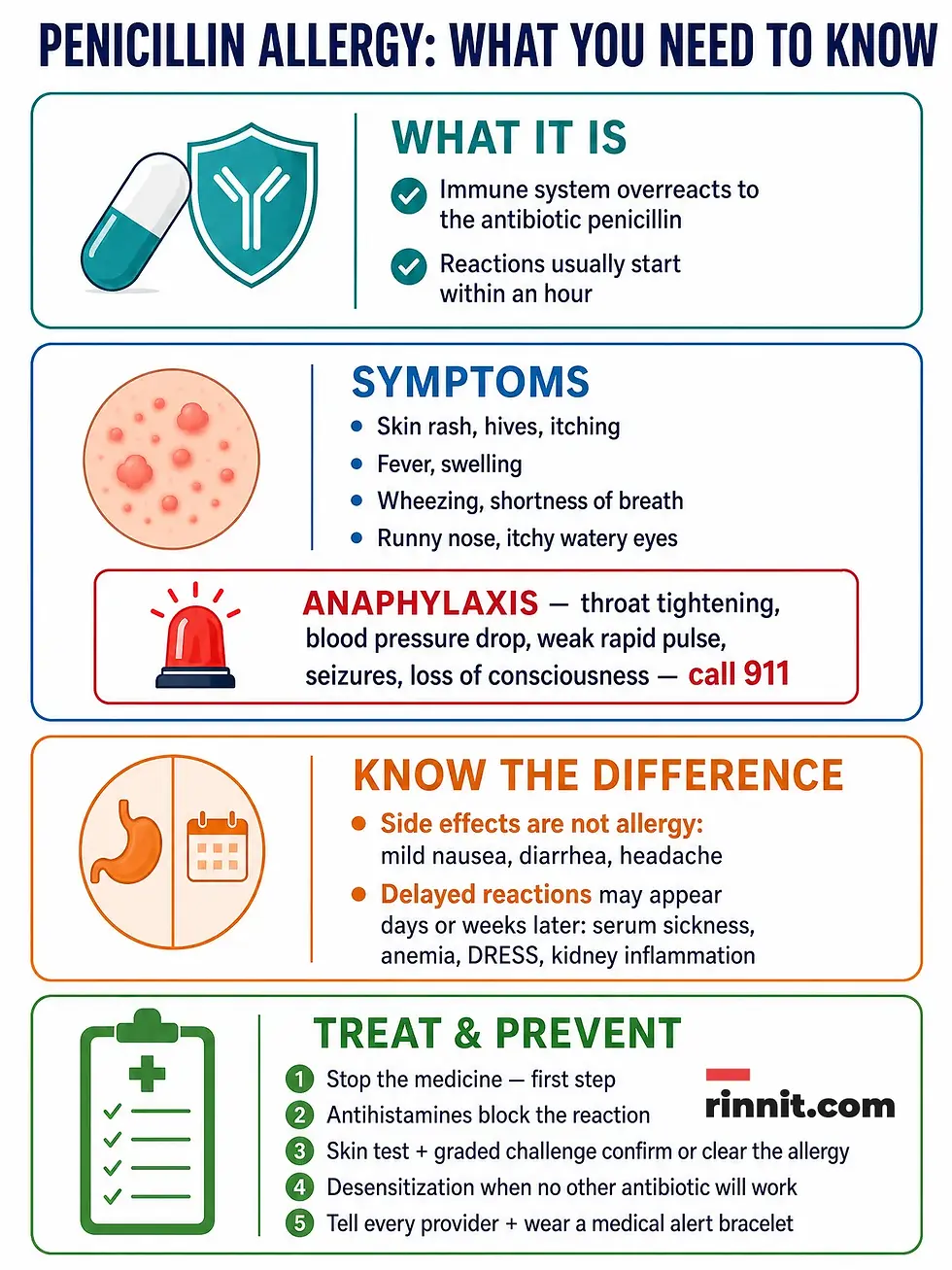
What Causes Penicillin Allergy?
Penicillin allergy happens when the immune system becomes overly sensitive to the antibiotic. The immune system reacts to the medicine as if it were a harmful substance, such as a viral or bacterial infection.
The process takes at least one prior exposure: before the immune system can become sensitive, you must be exposed to penicillin at least once. If and when your immune system decides penicillin is harmful, it develops an antibody to the medicine. The next time you take it, those antibodies flag and attack the substance — and the chemicals released by this activity cause the allergic symptoms.
The earlier exposure may not have been something you noticed — some evidence suggests that very small amounts of penicillin in the food supply may be enough for the immune system to create an antibody.
Penicillins and Related Medicines
Penicillins belong to a class of antibacterial medicines called beta-lactam antibiotics. Although these medicines differ slightly from one another, they generally fight infections by attacking the walls of bacterial cells. Alongside penicillins, the cephalosporins group is also more commonly related to allergic reactions.
If you have had an allergic reaction to one type of penicillin, you could be allergic to other types of penicillin or to some cephalosporins.
Family | Medicines |
Penicillins | Amoxicillin, ampicillin, dicloxacillin, nafcillin, oxacillin, penicillin G, penicillin V, piperacillin, ticarcillin |
Cephalosporins | Cefaclor, cefadroxil, cefazolin, cefdinir, cefepime, cefotetan, cefprozil, cefuroxime, cephalexin |
What are the risk factors for a penicillin allergy?
Anyone can have an allergic reaction to penicillin, but certain factors increase the risk of a penicillin allergy.
Risk Factor | Why It Matters |
A history of other allergies | Food allergy or hay fever raises the risk |
An allergic reaction to another medicine | Prior drug allergy raises the odds |
Family history of medicine allergy | Genetics play a role |
Increased exposure to penicillin | High doses, frequent use, or long treatment periods |
Certain illnesses | HIV infection or Epstein-Barr virus are commonly related to allergic medicine reactions |
How can you prevent a penicillin allergy reaction?
Preventing a penicillin allergy reaction starts with avoiding the medicine, making sure the allergy is in your medical records and wearing a medical alert bracelet. Steps to protect yourself:
Inform healthcare workers. Make sure your penicillin allergy (or any antibiotic allergy) is clearly identified in your medical records, and inform other professionals such as your dentist.
Wear a medical alert bracelet. It identifies your allergy and helps ensure proper treatment in an emergency.
How is a penicillin allergy diagnosed?
A thorough exam and proper diagnostic tests are needed for an accurate diagnosis — a misdiagnosed penicillin allergy may result in improper or more expensive antibiotics. Your healthcare professional conducts a physical exam, asks about your symptoms, and may order tests or refer you to an allergist.
Diagnostic Test | How It Works |
Skin test | A small amount of the suspect penicillin is placed in your skin with a tiny needle. A positive reaction — a discolored, itchy, raised bump — means the likelihood of penicillin allergy is high. A negative result usually means you are not at high risk, but is harder to interpret because some medicine reactions cannot be detected with skin tests |
Graded challenge | If the diagnosis is uncertain, you receive up to five doses of the suspect penicillin, starting small and increasing to the desired dose. Reaching the desired dose with no reaction means you are not allergic to that type and can take it as prescribed |
If you are allergic to one type of penicillin, you may undergo a graded challenge with a penicillin or cephalosporin less likely to cause a reaction — helping your professional find an antibiotic you can safely use. During a graded challenge, you are carefully monitored, and supportive care is available to treat any reaction.
How is a penicillin allergy treated?
Treatments fall into two strategies: treating the current allergy symptoms, and lessening sensitivity to penicillin through desensitization.
Treating Current Symptoms
Treatment | How It Is Used |
Withdrawal of the medicine | Stopping the medicine is the first step |
Antihistamines | Prescription or over-the-counter; block the immune system during an allergic reaction |
Corticosteroids | Oral or injected, for inflammation related to more-serious reactions |
Anaphylaxis treatment | An immediate epinephrine injection plus hospital care to maintain blood pressure and support breathing |
Medicine Desensitization
If no other suitable antibiotic treatment options are available, your healthcare professional may recommend drug desensitization. This allows you to take a course of penicillin to treat an infection:
You receive a very small dose of the medicine.
The dose increases every 15 to 30 minutes over several hours or a few days.
If you reach the desired dose with no reaction, you continue the treatment.
You must take the medicine as directed to maintain tolerance during the entire course.
If you need penicillin in the future, you will likely need to repeat the desensitization.
You are carefully monitored during treatment, and supportive care is available. Note that desensitization is not always successful, and there is a risk of serious reactions.
How should you prepare for a penicillin allergy appointment?
Preparing for a penicillin allergy appointment means being ready to describe your symptoms, the antibiotic you took, other medicines you use and any past reactions or allergies.
What symptoms did you experience, and when did they begin after taking penicillin?
What is the name of the penicillin or other antibiotic you were taking, and why was it prescribed?
Have you had these symptoms in the past when you were not taking the medicine?
How long did the symptoms last, and have you stopped taking the medicine?
What other medicines, herbal medicines, vitamins, or supplements do you take — and at what time of day?
Have you changed dosages of, or stopped, any regular medicine or supplement?
What did you take to treat your symptoms, and what was the effect?
Have you had a reaction to any medicine in the past?
Do you have hay fever, a food allergy, or other allergies?
Is there a family history of penicillin or other medicine allergies?
Tip: Take pictures of any condition — a rash or swelling — to show your healthcare professional. Pictures help if your symptoms have improved by the time of the appointment.
Frequently Asked Questions
What are the symptoms of a penicillin allergy?
Symptoms often appear within an hour of taking the antibiotic and include skin rash, hives, itching, fever, swelling, shortness of breath, wheezing, runny nose, and itchy watery eyes. A serious reaction can include anaphylaxis — throat swelling, trouble breathing, a blood pressure drop, and loss of consciousness.
Can a penicillin allergy cause anaphylaxis?
Yes. Anaphylaxis is a rare but life-threatening reaction involving multiple body systems — airway tightening, vomiting or diarrhea, a weak rapid pulse, dizziness, seizures, and loss of consciousness. Call 911 immediately if you suspect it.
Can a penicillin allergy go away?
Allergies can change over time, and many people who believe they are allergic are not. Because over-reported penicillin allergies lead to improper and more-expensive antibiotics, an accurate diagnosis through skin testing and graded challenge is essential — if you test negative, penicillin remains a safe and affordable option.
What is the difference between a side effect and an allergy?
Side effects are not allergic reactions — they include mild nausea or diarrhea, headache, and vaginal itching depending on the penicillin type. Unrelated symptoms or symptoms of the infection being treated can also be mistaken for an allergy.
What is a graded challenge test?
A graded challenge is used when the diagnosis is uncertain: you receive up to five increasing doses of the suspect penicillin under close medical monitoring. If you reach the desired dose with no reaction, you are not allergic to that type and can take it as prescribed.
What is drug desensitization?
When no other antibiotic will work, desensitization starts with a very small dose that increases every 15 to 30 minutes over hours or days until the full dose is reached without a reaction. Tolerance lasts only through that course, so future penicillin needs usually require repeating the process.
How do I protect myself if I have a penicillin allergy?
Avoid the medicine, make sure the allergy is clearly identified in your medical records, inform every healthcare professional including your dentist, and wear a medical alert bracelet so you receive proper treatment in an emergency.
Can I take cephalosporins if I am allergic to penicillin?
Many people with a penicillin allergy can safely take some cephalosporins, but the risk depends on the specific medicine and how severe your reaction was. Your provider or an allergist can help choose a safe option.
Is amoxicillin a penicillin?
Yes. Amoxicillin belongs to the penicillin family, so avoid it if you have a penicillin allergy unless an allergist has said it is safe for you.
Should I get tested if I was labeled allergic as a child?
It is worth asking about testing. Many people labeled allergic years ago can safely take penicillin after an allergist evaluates them, which gives them more treatment choices.
Conclusion
Three lessons matter most when it comes to penicillin allergy. First, know the difference between an allergy and a side effect: mild nausea, diarrhea, and headache are ordinary side effects — not allergies — and confusing the two is exactly why penicillin allergies are so often over-reported. Second, an accurate diagnosis protects your future: a skin test or graded challenge can clear you to use penicillin again, avoiding the improper and more-expensive antibiotics that over-reporting forces on patients. Third, preparedness saves you in an emergency: if a true allergy exists, avoidance, clear medical records, and a medical alert bracelet keep every future treatment safe.
This guide covered the symptoms, the anaphylaxis emergency, the delayed reactions, the penicillin and cephalosporin drug families, risk factors, accurate diagnosis, treatment, and desensitization so you can navigate antibiotics with confidence.
Disclaimer: This article is for informational purposes only and is not a substitute for professional medical advice, diagnosis, or treatment. Always seek the advice of a qualified healthcare provider with any questions about a medical condition.
Related Reading
Allergy Blood Test (IgE): What It Shows, How It Compares With Skin Tests and What Results Mean explains the IgE blood test used to diagnose allergies.
References
Mayo Clinic Staff. Penicillin allergy - Symptoms & causes. Mayo Clinic. September 20, 2025. https://www.mayoclinic.org/diseases-conditions/penicillin-allergy/symptoms-causes/syc-20376222
Mayo Clinic Staff. Penicillin allergy - Diagnosis & treatment. Mayo Clinic. September 20, 2025. https://www.mayoclinic.org/diseases-conditions/penicillin-allergy/diagnosis-treatment/drc-20376226
Shenoy ES, et al. Evaluation and Management of Penicillin Allergy: A Review. JAMA. 2019;321(2):188-199. PMID 30644987. https://doi.org/10.1001/jama.2018.19283
Samarakoon U, et al. Penicillin allergy delabeling: Opportunities for implementation and dissemination. Ann Allergy Asthma Immunol. 2023;130(5):554-564. PMID 36563744. https://doi.org/10.1016/j.anai.2022.12.023



Comments