Nickel Allergy: The Complete Guide

Updated: 3 days ago
Medically reviewed by Dr. Baraa Alnahhal, MD · Last reviewed: October 17, 2026
Quick Answer
Nickel allergy is an immune system reaction to nickel that usually causes an itchy rash where the metal touches the skin, typically beginning within a couple of days of contact. Treatments can reduce symptoms, but the only way to prevent repeat reactions is avoiding nickel. Jewelry is the usual culprit, but nickel is also in coins, zippers and phones.
What the research says
Nickel is the most frequent cause of contact allergy worldwide. A clinical review reports that nickel allergy affects roughly 8% to 19% of adults and 8% to 10% of children and adolescents in the European general population, with a strong female predominance; jewellery and metal in clothing remain the main causes, even though Europe's nickel regulation was followed by a drop in prevalence. (Ahlström et al., Contact Dermatitis, 2019) [3]
Jobs with metal exposure raise the odds. A systematic review and meta-analysis of 29 studies (5,691 metalworkers) found nickel allergy in 11.0% of European metalworkers with dermatitis referred for patch testing, compared with 6.7% among 13,382 consecutive European men with dermatitis. The authors say this points to an occupational link, though confounders could not be accounted for. (Alinaghi et al., Contact Dermatitis, 2023) [4]
Nickel Allergy at a Glance
Key Question | Answer |
What is it? | An immune system reaction to nickel, usually causing an itchy skin rash |
Most common trigger | Earrings and other jewelry |
When do symptoms start? | Within a couple of days of contact |
Is there a cure? | No — avoidance prevents repeat reactions |
How is it diagnosed? | Patch testing (tiny allergens under a patch for 2 days) |
Main treatment | Avoiding nickel; corticosteroid or nonsteroidal creams |
Highest risk | Piercings, wet-hand jobs, frequent hand washing |

What Is a Nickel Allergy?
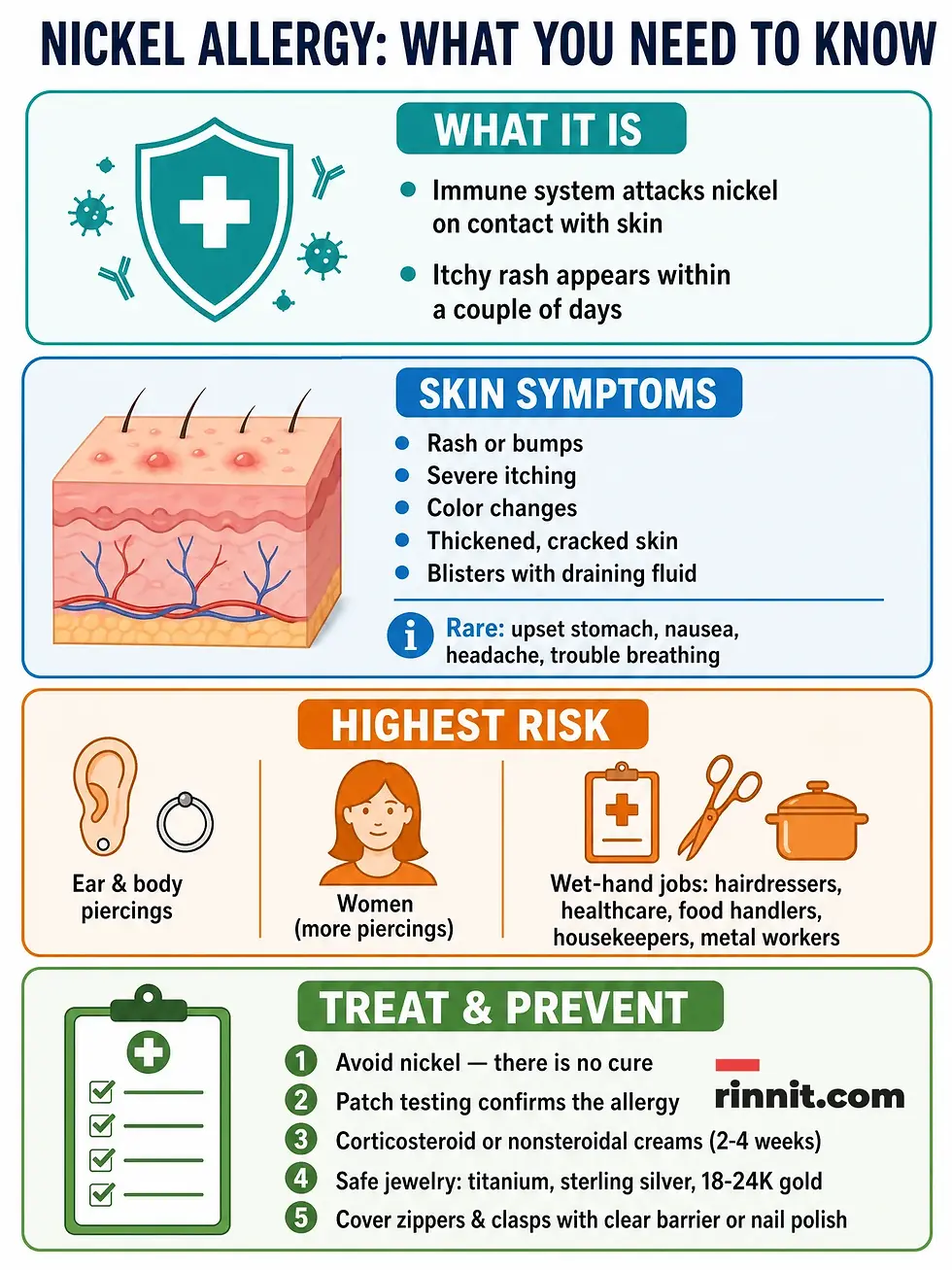
Nickel allergy is an immune system reaction to nickel that usually causes an itchy rash where the metal comes in contact with the skin.
Nickel allergy is usually related to earrings and other jewelry. But nickel can be found in many everyday items, such as coins, zippers, eyeglass frames, metal toys, cosmetics, cellphones, laptops, and other objects.
Nickel allergy happens after exposure to the metal triggers the immune system to act as if nickel is a harmful substance. Treatments can reduce the symptoms, and avoiding nickel prevents repeat allergic reactions.
What are the symptoms of nickel allergy?
An allergic reaction usually begins within a couple of days after contact with nickel. Skin conditions related to nickel allergy may spread out from the point of contact — and less often, they may be more widespread on the body.
Nickel Allergy Skin Symptom | Description |
Rash or bumps | Red, irritated skin where nickel touched |
Severe itching | Intense itch at the contact site |
Skin color changes | The affected skin changes color |
Thickened, leathery, cracked skin | Chronic, repeated-exposure changes |
Blisters and draining fluid | Fluid-filled blisters that may weep |
Beyond widespread skin conditions, other allergic reactions are uncommon — but symptoms may also include upset stomach, nausea, headache, or difficulty breathing. Exposure to nickel from dental or medical devices touching the skin may also result in damage to nearby tissues, pain, or problems with the devices.
Note about food: A small number of people with nickel allergy react to nickel in foods — but the vast majority of people with nickel allergy have no reaction to nickel in foods.
When to See a Doctor
Talk with your healthcare professional if you do not know how you got a skin rash, or if your symptoms are not improving with over-the-counter treatments.
If you think the area may have become infected, see your professional right away. Signs of infection include:
Infection Warning Sign | Description |
Swelling | Increased swelling around the rash |
Warmth | The affected area feels warm |
Pus | Pus in the affected area |
Pain | Increasing pain |
Get emergency care if you have trouble breathing.
What Causes Nickel Allergy?
A nickel allergy develops when the immune system reacts to nickel as if it were a harmful substance. After exposure, the immune system may trigger a reaction that causes a rash — and then continues to trigger disease-fighting activities wherever the body is exposed to nickel.
The immune system activities that are supposed to protect the body actually harm the body's own tissues.
Sources of Nickel Exposure
Nickel is surprisingly widespread. Common items that may expose you to nickel:
Category | Common Nickel Sources |
Jewelry | Jewelry for piercings, rings, bracelets, necklaces, and watches |
Clothing fasteners | Zippers, snaps, bra hooks, and belt buckles |
Eyewear | Eyeglass frames |
Pocket metal | Coins and keys |
Work and home | Metal tools and kitchen utensils; metal toys |
Electronics | Cellphones, laptops, and computer tablets |
Health | Medical and dental devices; e-cigarettes |
Beauty | Cosmetics |
What are the risk factors for nickel allergy?
Ear or body piercings and working with nickel-containing products or tools are the main risk factors for nickel allergy.
Risk Factor | Why It Matters |
Ear or body piercings | Nickel allergy is most often associated with earrings and body-piercing jewelry containing nickel. Women have a higher rate of nickel allergy, probably because they are more likely to have piercings |
Working with nickel-containing products or tools | Constant occupational exposure raises risk — and the risk is higher still in jobs that require getting your hands wet or washing hands often |
People at particular risk include metal workers, hairdressers, food handlers, housekeepers, and healthcare workers.
How can you avoid nickel exposure to prevent nickel allergy?
The best strategy to prevent nickel allergy is to avoid prolonged exposure to nickel-containing items. If you already have a nickel allergy, the best way to prevent a reaction is to avoid contact with the metal — not always easy, since nickel is present in so many products. Home test kits are available to check for nickel in metal items.
These four strategies help:
1. Wear Hypoallergenic Jewelry
Avoid jewelry containing nickel. Look for pieces made from metals unlikely to cause reactions:
Safe Metal Options | Why They Work |
Nickel-free or surgical-grade stainless steel | Formulated without nickel |
Titanium | Naturally nickel-free |
18-, 22-, or 24-karat yellow gold | High karatage reduces nickel content |
Nickel-free white gold | Avoids the nickel alloy in regular white gold |
Sterling silver | Typically nickel-free |
2. Choose a Piercing Studio Carefully
Before getting a piercing, confirm the studio uses sterile, nickel-free or surgical-grade stainless steel needles in sealed packages. Check that the studio sells only hypoallergenic jewelry and can provide documentation of the metal content in its products.
3. Use Substitute Materials
Look for safer substitutes for common nickel-containing items:
Item | Safer Substitute |
Watchbands | Leather, cloth, or plastic bands |
Zippers and clothing fasteners | Plastic or coated metals |
Eyeglass frames | Plastic or titanium frames |
4. Create a Barrier
Use barriers to protect yourself from common nickel-containing items:
Wear gloves when handling tools or nickel-containing products.
Cover electronic devices with a protective barrier.
Apply a clear barrier such as Nickel Guard — or clear nail polish — over snaps, buttons, zippers, and clasps.
Use duct tape or iron-on patches to cover nickel on clothing.
How is nickel allergy diagnosed?
A healthcare professional may diagnose a nickel allergy from your symptoms and a history of exposure to certain metals or other substances. For additional testing, you may be referred to an allergist (an allergy specialist) or a dermatologist (a skin care specialist).
The key test is patch testing:
Step | What Happens |
Application | Tiny amounts of common allergy-causing substances (allergens) are applied to your skin and covered with a patch |
Waiting period | The patches remain on your skin for two days |
Result | If you have a nickel allergy, the skin under the nickel patch is irritated when the patch is removed — or in the days afterward |
Because of the low allergen concentrations used, patch tests are safe even for people with severe allergies.
How is nickel allergy treated?
The first step in treating nickel allergy is avoiding contact with the metal. There is no cure — you will always have an allergic reaction when exposed to nickel.
Treatment | How It Is Used | Side Effects |
Corticosteroid creams | Applied to irritated skin for 2 to 4 weeks | Prolonged use can thin the skin |
Nonsteroidal creams | Tacrolimus (Protopic) as a corticosteroid alternative; also ruxolitinib (Opzelura) and crisaborole (Eucrisa); ruxolitinib cream carries a boxed warning about serious infections, heart problems, cancer and blood clots | Tacrolimus commonly causes short-term burning or stinging |
Oral corticosteroids | Prednisone for severe or widespread symptoms — limited time only | Serious side effects with long-term use |
Oral antihistamines | May provide some relief from itching | Generally mild |
Phototherapy | Controlled artificial ultraviolet light on the skin; reserved for people who do not improve with topical or oral steroids | Requires clinical supervision |
Self-Care at Home
Two home remedies can soothe the rash — if they do not help or the rash worsens, contact your healthcare professional:
Moisturize regularly with creams and lotions to soothe and protect the skin.
Use wet compresses with an aluminum acetate or colloidal oatmeal solution on a damp cloth — products generally available at a pharmacy.
How should you prepare for an appointment about nickel allergy?
You will likely see your primary healthcare professional first for an itchy rash possibly related to nickel allergy.
What You Can Do Beforehand
Write down your symptoms — description, when they first appeared, and whether they occur in a pattern.
List any metal products that touch your skin.
List all medicines, vitamins, and dietary supplements, with doses and reasons for taking each.
Prepare questions to ask your healthcare professional.
Questions to consider asking:
What's the most likely cause of my rash?
What else might cause it?
What side effects can I expect from treatments?
Can I use nonprescription medicines to treat this?
What the Doctor Will Ask
Expect questions about when your symptoms began; where the rash is; your other symptoms; the kind of jewelry you wear; what you do for work; whether symptoms have changed over time; which home treatments you have tried and their effects; and what worsens your symptoms.
Frequently Asked Questions
What is a nickel allergy?
Nickel allergy is an immune system reaction to nickel that usually causes an itchy rash where the metal touches the skin. The reaction typically begins within a couple of days of contact and is most often linked to earrings and body-piercing jewelry.
Is nickel allergy curable?
No. There is no cure — every future exposure to nickel can trigger a reaction. The first step in treatment is avoiding contact with the metal, and avoiding nickel prevents repeat allergic reactions.
Where does nickel hide in everyday life?
Beyond jewelry, nickel is found in clothing fasteners (zippers, snaps, bra hooks, belt buckles), eyeglass frames, coins, keys, metal tools and kitchen utensils, metal toys, cellphones, laptops, tablets, medical and dental devices, cosmetics, and e-cigarettes.
Who is at highest risk for nickel allergy?
Women (who are more likely to have piercings) and people with ear or body piercings face the highest risk. Workers with constant nickel exposure — metal workers, hairdressers, food handlers, housekeepers, and healthcare workers — and anyone whose job requires wet hands or frequent hand washing are also at elevated risk.
How is nickel allergy diagnosed?
Usually from symptoms and exposure history; a healthcare professional may refer you to an allergist or dermatologist for patch testing, where tiny amounts of allergens are placed on the skin under patches for two days. Skin under the nickel patch becomes irritated in allergic people.
What treatments are available for nickel allergy?
Avoidance comes first, followed by corticosteroid creams (2–4 weeks), nonsteroidal creams such as tacrolimus, oral corticosteroids for severe cases, oral antihistamines for itching, and phototherapy for stubborn cases. At home, regular moisturizing and wet compresses with aluminum acetate or colloidal oatmeal can soothe the rash.
Can I still wear jewelry if I have nickel allergy?
Yes — choose hypoallergenic options such as titanium, nickel-free or surgical-grade stainless steel, 18- to 24-karat yellow gold, nickel-free white gold, or sterling silver. You can also create barriers, such as clear nail polish or a commercial barrier coating, over nickel-containing clasps and snaps.
Can you develop a nickel allergy later in life?
Yes. A nickel allergy can start at any age, often after repeated or long contact with nickel. Once it develops, it usually lasts for life.
How long does a nickel allergy rash last?
A rash usually lasts as long as you keep touching the metal and can take a few weeks to clear after contact stops. See a healthcare professional if it is not improving with over-the-counter care.
Is nickel allergy contagious?
No. It is an immune reaction to a metal, so it cannot spread from person to person. Call your provider if the rash becomes warm, more swollen, more painful or starts to ooze pus, since those can be signs of infection.
Conclusion
Three lessons matter most when it comes to nickel allergy. First, your immune system is the culprit — it treats nickel as a threat, and the disease-fighting response ends up harming your own skin tissue, which is why the rash always returns on re-exposure. Second, nickel is everywhere you touch: jewelry, belt buckles, phone cases, coins, and keys — so identifying your personal exposure sources is half the battle. Third, control is realistic: patch testing confirms the diagnosis, corticosteroid and nonsteroidal creams calm the rash, and hypoallergenic jewelry plus simple barriers (clear coating, tape, gloves) let you live comfortably with the allergy.
This guide covered the symptoms, causes, the everyday items carrying nickel, the risk factors, patch testing, treatment, and prevention strategies so you can keep the itch where it belongs — out of your life. If you are navigating another contact-triggered allergy, our latex allergy guide is a natural next read.
Disclaimer: This article is for informational purposes only and is not a substitute for professional medical advice, diagnosis, or treatment. Always seek the advice of a qualified healthcare provider with any questions about a medical condition.
Related Reading
Patch Test for Skin Allergies: How It Works, How to Prepare and What Results Mean explains the skin test that finds the cause of allergic contact dermatitis.
References
Mayo Clinic Staff. Nickel allergy - Symptoms & causes. Mayo Clinic. September 19, 2025. https://www.mayoclinic.org/diseases-conditions/nickel-allergy/symptoms-causes/syc-20351529
Mayo Clinic Staff. Nickel allergy - Diagnosis & treatment. Mayo Clinic. September 19, 2025. https://www.mayoclinic.org/diseases-conditions/nickel-allergy/diagnosis-treatment/drc-20351534
Ahlström MG, et al. Nickel allergy and allergic contact dermatitis: A clinical review of immunology, epidemiology, exposure, and treatment. Contact Dermatitis. 2019;81(4):227-241. PMID 31140194. https://doi.org/10.1111/cod.13327
Alinaghi F, et al. Contact allergy to metals in metalworkers: A systematic review and meta-analysis. Contact Dermatitis. 2023;88(1):1-9. PMID 36208426. https://doi.org/10.1111/cod.14232



Comments