
Eyelid Dermatitis: The Complete Guide to Symptoms, Causes, Treatment and Prevention

Updated: 3 days ago
Medically reviewed by Dr. Baraa Alnahhal, MD · Last reviewed: October 2026
Quick Answer
Eyelid dermatitis is a skin condition caused by eyelid contact with an allergen or irritant, making the skin red and scaly and sometimes swollen, thickened, stinging, burning or itchy. It is not contagious or inherited. Prescribed medications usually ease symptoms within one to three days, and identifying and avoiding the trigger, such as makeup or eye cream, prevents flares.
What the research says
Patch testing is the key to finding the cause. In a retrospective study of 427 patients referred for patch testing, 139 had eyelid dermatitis; allergic contact dermatitis was the most common diagnosis, nickel sulfate was the most common allergen in people whose rash was limited to the eyelids, and the authors concluded that patch testing is the gold-standard tool for identifying the responsible allergen (PubMed: Yazdanparast et al., J Dermatol, 2024 [1]).
What is eyelid dermatitis?
Eyelid dermatitis (also called eyelid eczema, periocular dermatitis or periorbital dermatitis) is a type of contact dermatitis. As that name implies, it is a skin condition caused by your eyelids coming into contact with something — a substance or physical trigger that you are allergic to or irritated by. Your eyelids react by turning red and scaly, and they may swell and thicken. Stinging, burning and itching are common symptoms.
The symptoms are annoying, but they should not interfere with your daily life.
Key Point | What It Means |
|---|---|
Definition | A contact dermatitis caused by an allergen or irritant touching the eyelid skin |
Other names | Eyelid eczema, periocular dermatitis, periorbital dermatitis |
Type breakdown | About 80% of contact dermatitis cases are the irritant type |
How common | About 15% to 20% of people get contact dermatitis at some point in life |
Contagious? | No — it cannot spread from person to person |
Hereditary? | No — though inherited traits like asthma or a weak skin barrier raise risk |
Duration | Symptoms often improve within 1 to 3 days of treatment |

Eyelid dermatitis is one of many forms of contact dermatitis — a broader skin category covered in our guide to dermatitis.
What are the types of eyelid dermatitis?
Eyelid dermatitis is divided into two types: irritant contact dermatitis and allergic contact dermatitis. These names refer to what causes the swelling, scaling and itching — either an allergic reaction or some sort of irritating substance.
Type | What Triggers It | Share of Cases |
|---|---|---|
Irritant contact dermatitis | Physical triggers or irritating substances | About 80% of contact dermatitis cases |
Allergic contact dermatitis | Immune system reaction to an allergen | The remaining cases |
What are the symptoms of eyelid dermatitis?
Eyelid dermatitis can start slowly or hit you suddenly. It usually starts with red skin and itchiness. Whether the cause is an irritant or an allergen, the symptoms on your eyelids are the same.
Symptom | How It Feels or Looks |
|---|---|
Red rash | Red skin on the upper and lower eyelids |
Stinging | A sharp, prickling sensation |
Scaly skin | Flaky, rough eyelid skin |
Burning | A hot, irritated feeling |
Swollen skin | Puffy, thickened eyelids |
Pain | Painful to some people |
Itching | A persistent urge to scratch |
Blistering | Small fluid-filled bumps |
Eyelid dermatitis is painful to some people, and it can also cause stinging and itching.
Three important clarifications. First, do certain foods or drinks affect eyelid dermatitis? No — people sometimes assume something they ate or drank caused or worsened their contact dermatitis, but that usually does not happen. Second, is it a sign of an eye problem? No — since the eyelids are separate from the eyes, eyelid dermatitis does not hurt the eye itself, although scratching your eyelid can make your eye red and sore. Third, is it a sign of skin cancer? No — eyelid dermatitis is a temporary, treatable skin condition, not a sign of skin cancer.
What causes eyelid dermatitis?
The cause depends on which of the two types you have. Irritant contact dermatitis of the eyelid can be caused by either a physical trigger or an external irritant. Allergic contact dermatitis is your immune system reacting to an allergen.
Physical triggers
Physical triggers include extreme heat, extreme cold, extreme humidity, rubbing or scratching, and excessively washing your hands with hot water and soap.
Irritants
Common irritants include dust, cosmetics and makeup (mascara, eyeliner, eye shadow and sunscreen), soaps, detergents and bleach, chemicals such as chlorine, hydrophobic substances (drying agents that repel water), some metals, scratchy wool, and plants like peppers and poinsettias.
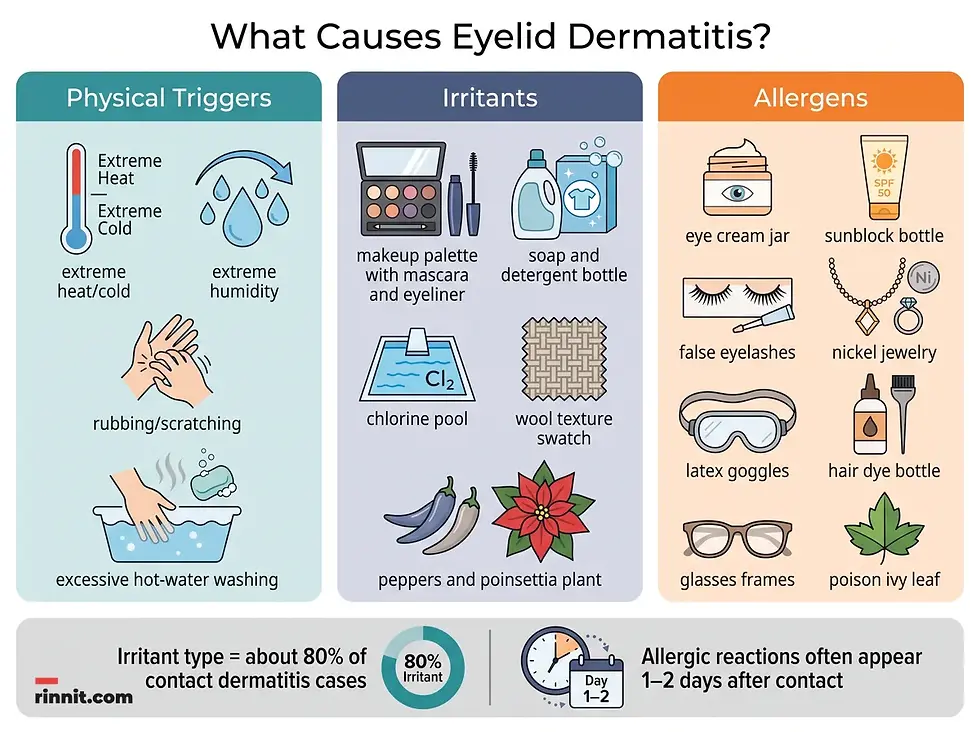
Trigger Category | Examples |
|---|---|
Physical triggers | Extreme heat, extreme cold, extreme humidity, rubbing or scratching, excessive hot-water hand washing |
Irritants | Dust, makeup, soaps, detergents, bleach, chlorine, water-repelling drying agents, some metals, scratchy wool, peppers, poinsettias |
Allergens | Cosmetics, eye creams, topical antibiotics, sunblock, false eyelashes, nickel or gold jewelry, eye drops, contact lens solution, fragrances, glasses frames, latex, hair dye, dust mites, pollen, poison ivy/oak/sumac |
Allergens
You may have no problems using makeup, for example, for a long time and then, suddenly, it causes eyelid dermatitis — usually a day or two after you apply the product. Allergic contact dermatitis is often caused by cosmetics, but other substances can trigger it as well.
These include moisturizers, cleansers, aftershave or eye cream; topical antibiotics; sunblock; false eyelashes or false nails; jewelry made of nickel or gold; eye drops or contact lens solution; fragrances and essential oils; glasses frames; metals like the nickel in tweezers or eyelash curlers; latex found in goggles, condoms, catheters and balloons; hair dye; dust mites; pollen; and poison ivy, oak and sumac.
What are the risk factors for eyelid dermatitis?
Anyone can get eyelid dermatitis, but some people are more vulnerable and at higher risk.
Risk Factor | Why It Raises Risk |
|---|---|
Sensitive skin | More reactive skin barrier |
Asthma | Linked allergic tendency |
History of hay fever | Underlying allergic profile |
History of atopic eczema | Predisposition to skin inflammation |
Any skin inflammation | Compromised skin condition |
Weak skin barrier | Reduced protection against triggers |
Is eyelid dermatitis hereditary? No — it is not inherited from your parents. But you may be predisposed to asthma or a weaker skin barrier, which can put you at a higher risk for dermatitis.
Which conditions can be confused with eyelid dermatitis?
Eyelid dermatitis is frequently mistaken for other conditions. The following comparison helps clarify what it is and is not.
Question | Evidence-Based Answer |
|---|---|
Does it affect the eye itself? | No — the eyelids are separate from the eyes |
Can scratching cause eye problems? | Yes — scratching may make the eye red and sore |
Is it skin cancer? | No — it is temporary and treatable |
Does food or drink cause or worsen it? | Usually not — that assumption is usually wrong |
Does it spread across the body? | No — though the same trigger could irritate other skin |
How Is Eyelid Dermatitis Diagnosed?
Your healthcare provider may examine you for telltale symptoms like red eyelids, scaly skin and swollen eyelids. If you report that your eyelids are itchy, stinging and/or burning, that will help narrow down the diagnosis. Your provider may order a patch test if they think you may have an allergy [1].
Diagnostic Step | What Happens |
|---|---|
Physical examination | Provider looks for red, scaly, swollen eyelids |
Symptom report | Itchiness, stinging and burning narrow the diagnosis |
Patch test | May be ordered if an allergy is suspected [1] |
Which healthcare providers diagnose eyelid dermatitis?
Your primary healthcare provider may be able to diagnose your dermatitis and prescribe treatment. You may also be referred to a dermatologist (who treats skin) or an allergist (who treats allergies).
How Is Eyelid Dermatitis Treated?
Your healthcare provider may treat your eyelid dermatitis with corticosteroids (like hydrocortisone) applied to your skin, oral (taken by mouth) corticosteroids, or calcineurin inhibitors.
Treatment Option | How It Is Given |
|---|---|
Corticosteroids (e.g., hydrocortisone) | Applied to the skin |
Oral corticosteroids | Taken by mouth |
Calcineurin inhibitors | Non-steroid topical medication |
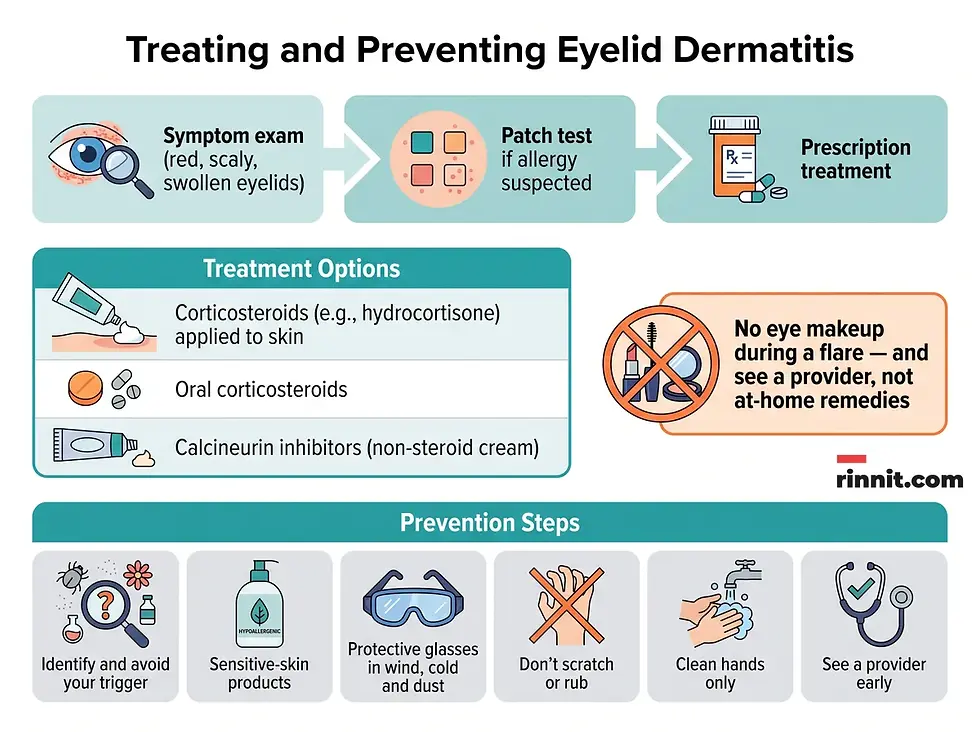
You should not wear eye makeup while you have eyelid dermatitis.
The at-home treatment rule. Unlike some skin conditions, the guidance here is clear: see your healthcare provider for your eyelid dermatitis instead of trying any at-home treatments.
How Long Does Eyelid Dermatitis Last?
With treatment, the symptoms of irritant contact dermatitis may start to feel better after one to two days. If you have allergic contact dermatitis, it might take two to three days of treatment to see improvement.
Type | Time to Improvement With Treatment |
|---|---|
Irritant contact dermatitis | 1 to 2 days |
Allergic contact dermatitis | 2 to 3 days |
What is the outlook for eyelid dermatitis?
Eyelid dermatitis is treatable. Your healthcare provider may prescribe medications to clear up the contact dermatitis. But the condition can come back. It is a good idea to try to figure out what caused it so that you can avoid the trigger.
Dermatitis should not keep you from going about your normal daily activities. If it is so painful and annoying that it interferes with your work or keeps you up at night, be sure to tell your healthcare provider.
Can Eyelid Dermatitis Be Prevented?
You can prevent eyelid dermatitis if you know what caused it and avoid that trigger.
Prevention Step | Why It Helps |
|---|---|
Identify and avoid your trigger | Stops the cause of future flares |
Use products made for sensitive skin | Gentler formulas are less likely to irritate |
Wear protective glasses | Protects eyelids from extreme cold, high wind and dust |
Avoid scratching or rubbing eyelids | Prevents physical trigger and eye irritation |
Touch eyelids with clean hands only | Reduces transfer of irritants |
Skip eye makeup during a flare | Removes a common trigger during healing |
Can my diet help prevent eyelid dermatitis? No — there are no foods or drinks you can ingest that can prevent eyelid dermatitis. What medications might reduce your risk of eyelid dermatitis? There are no known medications that can reduce your risk.
How can people live well with eyelid dermatitis?
Can you live a normal life with eyelid dermatitis? Absolutely — eyelid dermatitis is annoying but should not impact your quality of life. Will eyelid dermatitis affect the rest of your skin? No — it will not spread to the rest of your body. However, keep in mind that what caused your eyelid dermatitis could cause dermatitis on other parts of your body.
When should you contact your healthcare provider? See your healthcare provider as soon as you notice the symptoms of eyelid dermatitis. You will want to get treatment right away before the symptoms get too severe.
Emergency warning: Go to the emergency department right away if your eyelids swell up so much that you can't see. Seek emergency care immediately for unrelated serious signs such as trouble breathing, severe chest pain, loss of consciousness, seizures, severe allergic reaction, heavy bleeding, high fever that does not improve, or stroke symptoms.
Schedule an appointment with a healthcare provider as soon as your eyelids turn red and itchy. A provider can prescribe the right medication, and dermatologists and allergists are available for referral if a patch test is needed to identify your specific trigger [1].
Key Takeaways
Eyelid dermatitis — also called eyelid eczema, periocular dermatitis or periorbital dermatitis — is a common, temporary and treatable skin condition caused when an allergen or irritant contacts the thin skin of your eyelids. About 15% to 20% of people experience contact dermatitis at some point, and it is neither contagious nor hereditary. Symptoms like redness, scaling, stinging, burning, swelling and itching usually improve within one to three days of treatment, but the condition can return if the trigger stays in your life. The single most effective long-term strategy is playing detective: work with your provider to identify whether makeup, eye cream, fragrances, metals, latex, harsh soaps, weather extremes or another trigger is the culprit, then avoid it. Since at-home remedies are not recommended for this condition, see a healthcare provider early — the sooner you treat it, the less severe it gets.
Take the Next Step
If your eyelids are red, scaly and itchy, book an appointment today. And if swelling ever becomes so severe that you cannot see, seek emergency care immediately.
Frequently Asked Questions
1. What is eyelid dermatitis?
Eyelid dermatitis (also called eyelid eczema, periocular dermatitis or periorbital dermatitis) is a type of contact dermatitis. It develops when the folds of skin above and below your eyes come into contact with an allergen or irritant, making the eyelids turn red and scaly.
2. Is eyelid dermatitis contagious?
No. Dermatitis is not contagious. It cannot be spread from person to person.
3. Is eyelid dermatitis hereditary?
No, eyelid dermatitis is not inherited from your parents. However, you may be predisposed to asthma or a weaker skin barrier, which can put you at a higher risk for dermatitis.
4. What are the symptoms of eyelid dermatitis?
Symptoms affecting the eyelids include a red rash, stinging, scaly skin, burning, swollen skin, pain, itching and blistering. It is not a sign of skin cancer and does not harm the eye itself.
5. What causes eyelid dermatitis?
There are two types. Irritant contact dermatitis (about 80% of cases) is caused by physical triggers or irritating substances like makeup, soaps, detergents, chlorine and extreme weather. Allergic contact dermatitis is your immune system reacting to an allergen such as cosmetics, eye cream, fragrances, nickel, latex or hair dye.
6. How common is eyelid dermatitis?
Contact dermatitis is very common — about 15% to 20% of people will experience it at some point during their lives. It is unclear what percentage of those cases are dermatitis of the eyelid.
7. How long does eyelid dermatitis last?
With treatment, irritant contact dermatitis symptoms may start to feel better after one to two days. Allergic contact dermatitis might take two to three days of treatment to show improvement.
8. How is eyelid dermatitis treated?
Treatment may include corticosteroids (like hydrocortisone) applied to the skin, oral corticosteroids, or calcineurin inhibitors. You should not wear eye makeup during a flare, and you should see a healthcare provider rather than trying at-home treatments.
9. Can eyelid dermatitis be prevented?
Yes — if you know what caused it and avoid that trigger. Also use products made for sensitive skin, wear protective glasses in extreme cold, high wind or dust, avoid scratching or rubbing your eyelids, and touch your eyelids with clean hands only.
10. Does diet affect or prevent eyelid dermatitis?
No. Experts note that people sometimes assume something they ate or drank caused or worsened their dermatitis, but that usually does not happen. No foods, drinks or medications are known to prevent it.
11. When should I seek emergency care for eyelid dermatitis?
Go to the emergency department right away if your eyelids swell up so much that you can't see. Seek emergency care immediately for serious unrelated signs like trouble breathing, severe chest pain, or stroke symptoms.
Related Reading
Patch Test for Skin Allergies: How It Works, How to Prepare and What Results Mean explains the skin test that finds the cause of allergic contact dermatitis.
References
Yazdanparast T, Nassiri Kashani M, Shamsipour M, Izadi Heidari F, Amiri F, Firooz A. Contact allergens responsible for eyelid dermatitis in adults. J Dermatol. 2024;51(5):691-695. doi:10.1111/1346-8138.17140. PMID: 38351529.
Medical Disclaimer
This article is for informational purposes only and does not constitute medical advice. Always seek the advice of your physician or other qualified health provider with any questions you may have regarding a medical condition. Never disregard professional medical advice or delay in seeking it because of something you have read here.



Comments