Dermatitis Explained: The Skin Inflammation That 20% of People Experience (Complete Guide to Types, Symptoms, and Treatment)

Updated: 3 days ago
Medically reviewed by Dr. Baraa Alnahhal, MD · Last reviewed: October 2026
Quick Answer
Dermatitis is a general term for conditions that cause inflammation of the skin, most often causing itchiness, redness, and dryness [1]. The word literally means "inflammation of the skin" — "derm" means skin and "itis" means inflammation. It is not contagious [1] [3], and can be managed with trigger avoidance, moisturizing, and prescribed medications such as corticosteroids or biologics [1] [4].
What the research says
Atopic dermatitis is common, especially in children. A systematic review and meta-analysis of 310 studies with 25.5 million individuals found a point prevalence of atopic dermatitis of 11.1% (95% CI 9.4–13.1) in children and adolescents and 6.3% (95% CI 5.0–7.8) in adults, with the proportion of severe cases ranging from 1.9% to 7.2% in children and adolescents and 2.8% to 15.6% in adults (PubMed: Migliavaca et al., Dermatitis, 2025 [6]).
Contact allergy is widespread. A systematic review and meta-analysis of 28 studies covering 20,107 patch-tested people from the general population found a pooled prevalence of contact allergy of 20.1% (95% CI 16.8–23.7). The prevalence was higher in women (27.9%) than in men (13.2%), and nickel was the most common allergen (11.4%) (PubMed: Alinaghi et al., Contact Dermatitis, 2019 [7]).
Topical calcineurin inhibitors did not raise cancer risk. A systematic review and meta-analysis of 110 unique studies including 3.4 million patients with atopic dermatitis found no difference in the absolute risk of any cancer with topical calcineurin inhibitor exposure versus controls (4.70 vs 4.56 per 1000; OR 1.03, 95% credible interval 0.94–1.11; moderate certainty) (PubMed: Devasenapathy et al., Lancet Child Adolesc Health, 2023 [8]).
What Is Dermatitis?
Dermatitis is a word used to describe a number of skin irritations and rashes caused by genetics, an overactive immune system, infections, allergies, irritating substances, and more [1]. In the word "dermatitis," "derm" means "skin" and "itis" means "inflammation," so the whole word means "inflammation of the skin."
Common symptoms include dry skin, redness, and itchiness [1]. The rashes range from mild to severe and can cause a variety of problems depending on their cause.
Two facts often surprise people who receive a dermatitis diagnosis. First, dermatitis causes no serious harm to your body [1]. Second, it is not contagious [1] [3], and it does not mean that your skin is unclean or infected. Treatment methods and medications can manage the symptoms.

Dermatitis vs. Eczema vs. Psoriasis
People frequently confuse dermatitis with other skin conditions. The table below clarifies the most common mix-ups.
Comparison | What to know |
|---|---|
Dermatitis vs. eczema | Eczema is actually a type of dermatitis. It is also known as atopic dermatitis. |
Dermatitis vs. psoriasis | Psoriasis and dermatitis — especially seborrheic dermatitis — can look similar. Both appear as patches of red skin with flakes on and around the redness. In psoriasis, the scales are often thicker and the edges are well-defined. |
Sebopsoriasis | Seborrheic dermatitis and psoriasis can overlap in a condition called "sebopsoriasis," when you have the symptoms of both. |
Dermatitis vs. rosacea | Rosacea can cause red skin that looks like dermatitis. Rosacea can also cause pimples, and the redness is typically on the forehead, nose, chin, and cheeks. |
You can have more than one skin condition at a time, and treatments for one may not work for the other. If you are unsure what your rash is, a provider can examine your skin to determine the exact condition.
How Common Is Dermatitis?
Some types of dermatitis are very common while others are less common. The table below shows how many people are affected.
Type | How many people are affected |
|---|---|
Atopic dermatitis (eczema) | About 6% of adults; about 11% of children and teens |
Contact dermatitis | 15% to 20% of people at some point |
Dermatitis overall | As many as 15% to 20% of people experience some form at some point |
Anyone — young and old — can get dermatitis. Babies can get cradle cap and diaper rash [1]. Atopic dermatitis usually begins in childhood [4], but anyone at any age can get it. Anyone can get contact dermatitis because it simply involves skin-to-substance contact. People with celiac disease are prone to dermatitis herpetiformis [1].
Risk Factors by Type
Type | Who is at higher risk |
|---|---|
Atopic dermatitis | Family history of dermatitis, hay fever, or asthma; being female; being African-American |
Contact dermatitis | People who work around chemicals, such as in a factory, restaurant, or garden |
Periorificial dermatitis | Being female; ages 15 to 45 |
Dyshidrotic dermatitis | Sweating a lot; prolonged exposure to water and/or irritants; living in a warmer climate |
The 9 Types of Dermatitis
Dermatitis is not one condition — it is an umbrella term covering at least nine distinct types [1]. Knowing which type you have matters because the cause, location, and treatment differ for each one.
Type | What it looks like and where it appears |
|---|---|
Atopic dermatitis (eczema) | Damaged skin barrier causes inflamed, red, dry, bumpy, itchy skin; in teens and adults typically on the hands, inner elbows, neck, knees, ankles, feet, and around the eyes |
Contact dermatitis | An allergic or irritant reaction causing a painful or itchy rash, for example from poison ivy or a chemical |
Diaper dermatitis (rash) | Rash on any part of a baby's skin covered by a diaper; wetness, movement, and waste products break down the skin |
Dyshidrotic dermatitis | Itchy blisters on the edges of the fingers, palms, toes, and soles of the feet; blisters can be painful |
Neurodermatitis | Caused by intense itching that irritates the nerve endings of the skin |
Nummular dermatitis | Circular, itchy spots on the skin; skin gets dry and itchy and may develop open sores |
Periorificial dermatitis | Looks like acne or rosacea; develops around the mouth, eyes, nostrils, and sometimes the genitals |
Seborrheic dermatitis (dandruff) | Red, dry, flaky, itchy skin on the scalp and other body parts; in babies it appears as cradle cap (yellow scaly patches surrounded by a red rash) |
Stasis dermatitis | Caused by a problem with blood flow in the veins; ankles may swell, with scaling, itching, pain, and open sores |

What Causes Dermatitis?
Dermatitis is caused by a combination of three main factors: immune system activation, genetics, and environmental triggers [1] [4].
The immune system. Sometimes your immune system overreacts. With atopic dermatitis, the immune system reacts to seemingly small irritants or allergens, which causes inflammation [1] [4].
Genetics. Researchers have observed that if others in your family have dermatitis, you are more likely to have it [1]. Experts have also identified changes to genes that control a protein helping your body maintain healthy skin [1] [4]. Without normal levels of that protein, your skin cannot remain healthy.
The environment. Your environment may cause your immune system to change the protective barrier of your skin. That lets more moisture escape, which can lead to dermatitis. Possible environmental factors include exposure to tobacco smoke and some types of air pollutants [1] [4]. Fragrances in some skin products and soaps are also possible factors [1].
Exposure. Some types of dermatitis are caused by exposure to chemicals and other irritants. Perioral dermatitis, for example, may be caused by exposure to fluoride in water or toothpaste [1].
Conditions Found Alongside Dermatitis
If you have dermatitis, you might also have another condition that does not cause it but is often found alongside it. These include sleep loss, depression, anxiety, asthma, and allergies [1] [4].
Does Stress Cause Dermatitis?
Yes. Stress can cause and/or aggravate some skin conditions, including dermatitis [1]. There are mental and emotional signs of stress as well as physical ones, such as feeling nauseated or dizzy. Stress-reduction habits include deep breathing, daily exercise, plenty of sleep, limiting caffeine and alcohol, eating healthy meals, journaling, and talking with friends, family, or a therapist.
What Are the Symptoms of Dermatitis?
Itchiness and redness are commonly the first signs of dermatitis [1]. The symptoms depend on the type, and you may have one type or several. Each type may include one or more of the symptoms listed below.
Symptom | Description |
|---|---|
Itching | Often the first and most persistent sign |
Red rashes and bumps | Inflamed, irritated skin |
Rashes that look or feel like a burn | Burning sensation varies by person and type |
Dry skin | Moisture escapes through a damaged skin barrier |
Fluid-filled blisters | Common in dyshidrotic dermatitis |
Thickening, hardening, and swelling of skin | From repeated irritation |
Crusting, scaling, and creasing skin | Flaky, cracked patches |
Painful ulcers | Open sores in more severe cases |
Oozing or bleeding when scratched | Broken skin raises infection risk |
Some people feel a burning sensation, others feel itchiness, and some feel both. The sensations vary from person to person and from type to type.
What Makes Dermatitis Worse?
Dermatitis flares up differently in each person, so identifying your personal triggers is a core part of management. Ask yourself: does your dermatitis flare after cleaning with certain chemicals, after exposure to cigarette smoke, after using a new shampoo or perfume, or after wearing a wool sweater?
Other known worsening factors include stress, hot showers, and allergens like pollen and pet dander [1]. Excessive sunlight may make some people's dermatitis better or worse [1]. Find out what worsens your dermatitis and do your best to avoid it.
How Is Dermatitis Diagnosed?
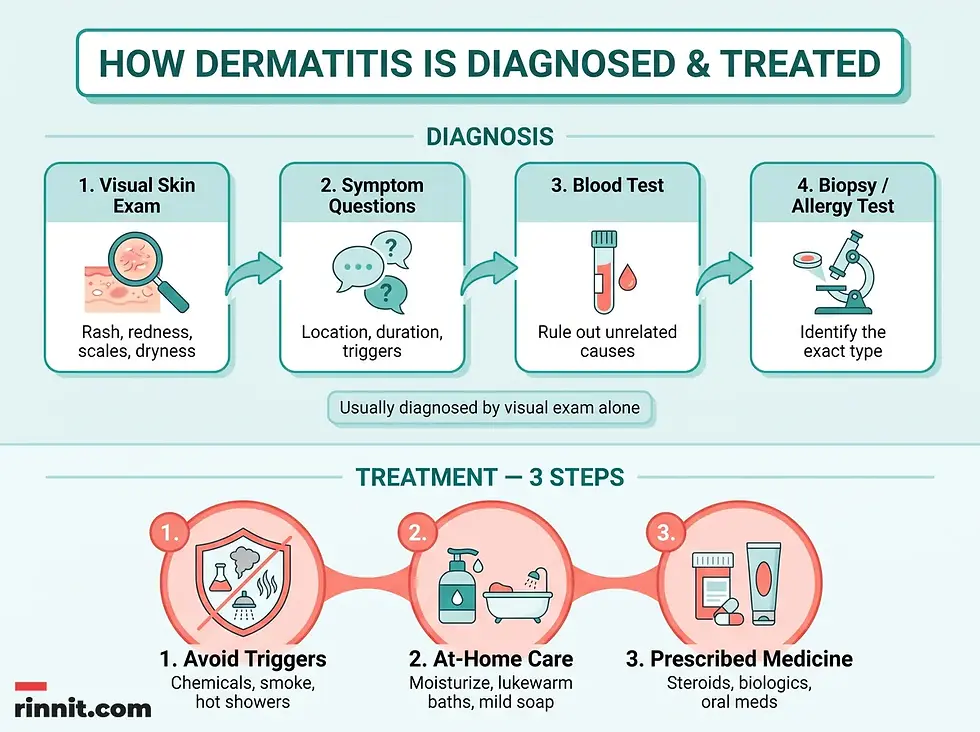
Usually a healthcare provider can diagnose dermatitis based on examining your skin [1] [4]. They look for classic signs such as a rash, redness, scales, and dryness, and they ask about the symptoms you are experiencing — whether you are itchy, whether your skin burns, whether it is dry, and whether you have come into contact with anything that might irritate it.
Diagnostic step | What happens |
|---|---|
Visual skin exam | Provider checks for rash, redness, scales, dryness |
Symptom questions | Location, duration, treatments tried, other conditions (allergies, asthma, celiac disease) |
Trigger review | Soaps, detergents, cigarette smoke, chemicals, recent products |
Impact check | Whether pain or itchiness disrupts sleep, work, or daily life |
When there is doubt, the provider may perform one or more of the following tests.
Test | Why it is used |
|---|---|
Blood test | To check for causes of the rash that might be unrelated to dermatitis |
Skin biopsy | To distinguish one type of dermatitis from another |
Allergy skin test | To identify allergic triggers |
How Is Dermatitis Treated?
The type of treatment depends on the type of dermatitis and its location. Treatment follows three steps: first, avoid whatever triggers the dermatitis (stress, a chemical, tobacco smoke, or other irritants); second, try at-home remedies; and third, use medication prescribed by your provider [1].
At-Home Remedies
Some treatments should only be done with instructions and permission from your healthcare provider.
Remedy (with provider guidance) | Details |
|---|---|
Ultraviolet light | Ultraviolet A or B light waves can help your skin |
Wet wrap therapy | Increases moisture in your skin |
Bleach baths | Diluted bleach, no more than twice a week; check with your provider first |
Other at-home measures require no supervision.
Self-care step | Guidance |
|---|---|
Use moisturizer | Apply right after you shower or bathe to keep skin hydrated |
Don't overheat | Keep your space at a cool temperature and avoid high humidity |
Protect your skin | Stay away from anything that could irritate it, including rough clothing like wool |
Decrease stress | See a therapist for counseling or a psychiatrist for medication if needed |
Bathe in lukewarm water | Avoid hot water; no more than one bath or shower per day |
Use a mild soap | Use unscented soap or cleanser |
Avoid scratching | Scratching irritates dermatitis and can break the skin, risking infection |
Prescribed Medications
Your healthcare provider may prescribe one or more of the following medications.
Medication | How it works |
|---|---|
Moisturizing creams | Hydrate and help restore the skin barrier |
Calcineurin inhibitors | Topical medications that decrease inflammation |
Corticosteroid creams and ointments | Decrease inflammation |
Phosphodiesterase-4 inhibitors | Help with inflammation |
Biologics | Injection that blocks immune system functions that affect dermatitis |
Oral medications | Pills that reduce immune responses that affect dermatitis |
Antihistamines | Sometimes used for contact dermatitis |
Antibiotics | Can be used for people who have perioral dermatitis |
Is There a Cure for Dermatitis?
No treatment can claim to eliminate the symptoms of dermatitis 100% of the time [1]. Treatments manage symptoms with varying degrees of success. Talk to your healthcare provider about the best treatments for you.
Recovery Time
The length of recovery time depends on the type of dermatitis and the treatment you receive. Even with treatment, it can take several weeks or months to improve [1]. Atopic dermatitis can stay with you lifelong [1] [4], but you can reduce the symptoms with treatment.
Can Dermatitis Permanently Damage Skin?
If you scratch your skin too much and too hard, you could possibly leave scars [1]. Getting treatment early helps you avoid this.
Should You See a Dermatologist?
Yes, if your usual healthcare provider is unable to help with your dermatitis. Dermatologists specialize in skin conditions [1].
What Happens If Dermatitis Goes Untreated?
There are complications that come with dermatitis. They do not apply to all types or all people, but they are common.
Complication | Notes |
|---|---|
Viral skin infections | Scratching worsens the infection |
Bacterial skin infections | Scratching worsens the infection |
Sleep loss | Itching disrupts sleep |
Conjunctivitis (pink eye) | Can accompany facial or eye-area dermatitis |
Blepharitis | Inflammation and redness of the eyelid |
Scars | Scratching can lead to infections and scars |
How Long Will You Have Dermatitis?
Dermatitis can be with you lifelong. It can start in infancy and continue through adulthood, or it can start in the teenage years and disappear by young adulthood [1]. Each possibility depends on the person and on the type of dermatitis they have. Living with dermatitis includes "remission" periods when it disappears and "flare-ups" when it gets worse [1] [4].
How Can You Prevent or Reduce the Risk of Dermatitis?
Do your best to avoid what triggers your dermatitis. That might be foods you are sensitive or allergic to, chemicals that irritate your skin, or soaps that do the same. Other prevention steps include moisturizing your skin regularly, not overheating, using a humidifier to keep the air from getting too dry [1], trying not to scratch, and reducing stress.
Foods and Dermatitis
If you have food allergies, one reason you must avoid that food is that it may cause or worsen dermatitis. Almost everyone with dermatitis herpetiformis has celiac disease, a sensitivity to gluten, and up to about 1 in 4 people with celiac disease develop this rash [1]. Common food allergy examples include peanuts, dairy and eggs [1]. Pay attention to what you eat; if your dermatitis flares up after eating a certain food, you might have an allergy. Discuss diet changes with your healthcare provider, and consider seeing a dietitian to help create new meal plans.
When Should You See a Healthcare Provider?
Don't wait until you are so uncomfortable that you cannot sleep before seeing your provider about your skin. See them as soon as symptoms start so you can get treatment. See them especially soon if you think there is an infection or if you are in a lot of pain [1].
Key Takeaways
Dermatitis is a general term for inflammatory skin conditions that cause itchy, red, and dry skin, and it is never contagious. It affects up to 15% to 20% of people at some point, with atopic dermatitis affecting about 1 in 10 children. Nine distinct types exist — from eczema to dandruff to diaper rash — and each behaves differently on the skin. Diagnosis is usually visual, with blood tests, skin biopsy, or allergy testing used when there is doubt. While no cure exists, a three-step approach of avoiding triggers, at-home skin care, and prescribed medications keeps symptoms under control for most people.
If your skin is itchy, red, or painful, book an appointment with your provider or a dermatologist today — early treatment prevents infections and scarring.
Frequently Asked Questions (FAQ)
1. What is dermatitis?
Dermatitis is a general term for conditions that cause inflammation of the skin, with "derm" meaning skin and "itis" meaning inflammation. Common symptoms include dry skin, redness, and itchiness. It is not contagious and does not mean the skin is unclean or infected.
2. Is dermatitis the same as eczema?
Eczema is a type of dermatitis. It is also known as atopic dermatitis, the most common inflammatory skin condition in children, affecting about 11% of children and teens and about 6% of adults.
3. How do you know if it's dermatitis or psoriasis?
Psoriasis and seborrheic dermatitis can look similar — both appear as red patches with flakes. In psoriasis, the scales are often thicker with well-defined edges. A provider can examine your skin to tell them apart.
4. What are the different types of dermatitis?
There are at least nine types: atopic (eczema), contact, diaper, dyshidrotic, neurodermatitis, nummular, periorificial, seborrheic (dandruff), and stasis dermatitis. Each has a different cause and appears in different locations on the body.
5. What are the symptoms of dermatitis?
Symptoms depend on the type and may include itching, red rashes and bumps, rashes that feel like a burn, dry skin, fluid-filled blisters, thickening or swelling of skin, crusting and scaling, painful ulcers, and oozing or bleeding when scratched.
6. What causes dermatitis?
Dermatitis results from a combination of immune system overreaction, genetics (including a family history and skin-protein gene changes), and environmental triggers such as tobacco smoke, air pollutants, and fragrances in skin products.
7. Is dermatitis contagious?
No type of dermatitis is contagious. You cannot catch it from or spread it to another person.
8. Can dermatitis be cured?
No treatment can eliminate dermatitis symptoms 100% of the time. Treatments manage symptoms with varying degrees of success. Atopic dermatitis can be lifelong, but symptoms can be reduced with treatment.
9. What medications treat dermatitis?
Providers may prescribe moisturizing creams, calcineurin inhibitors, corticosteroid creams and ointments, phosphodiesterase-4 inhibitors, biologics (injections), oral medications, antihistamines for contact dermatitis, or antibiotics for perioral dermatitis.
10. How do you get rid of dermatitis at home?
Apply moisturizer right after bathing, bathe in lukewarm (not hot) water once a day, use mild unscented soap, avoid rough clothing like wool, keep your space cool, reduce stress, and avoid scratching — and with provider guidance, consider UV light therapy, wet wraps, or diluted bleach baths.
11. Can stress cause dermatitis?
Yes. Stress can cause and/or aggravate dermatitis and other skin conditions. Reducing stress through exercise, sleep, deep breathing, journaling, and talking with others is part of managing the condition.
12. Does dermatitis ever go away on its own?
Dermatitis can start in the teenage years and disappear by young adulthood, or it can last lifelong — this depends on the person and the type. Periods when dermatitis disappears are called remissions, and periods when it worsens are called flare-ups.
Related Reading
References
Cleveland Clinic. Dermatitis. Cleveland Clinic. Last updated Oct. 29, 2020. https://my.clevelandclinic.org/health/diseases/4089-dermatitis
National Eczema Association. Types of Eczema. National Eczema Association. Accessed October 30, 2026. https://nationaleczema.org/eczema/types-of-eczema/
MedlinePlus. Eczema. MedlinePlus. Last updated June 15, 2025. https://medlineplus.gov/eczema.html
National Institute of Arthritis and Musculoskeletal and Skin Diseases (NIAMS). Overview of Atopic Dermatitis. NIAMS. Accessed October 30, 2026. https://www.niams.nih.gov/health-topics/atopic-dermatitis/advanced
American Academy of Dermatology. Eczema Resource Center. AAD. Accessed October 30, 2026. https://www.aad.org/public/diseases/eczema
Migliavaca CB, Lazzarini R, Stein C, et al. Prevalence of atopic dermatitis: a systematic review and meta-analysis. Dermatitis. 2025;36(6):575-582. doi:10.1089/derm.2024.0165. PMID: 39134072.
Alinaghi F, Bennike NH, Egeberg A, Thyssen JP, Johansen JD. Prevalence of contact allergy in the general population: a systematic review and meta-analysis. Contact Dermatitis. 2019;80(2):77-85. doi:10.1111/cod.13119. PMID: 30370565.
Devasenapathy N, Chu A, Wong M, et al. Cancer risk with topical calcineurin inhibitors, pimecrolimus and tacrolimus, for atopic dermatitis: a systematic review and meta-analysis. Lancet Child Adolesc Health. 2023;7(1):13-25. doi:10.1016/S2352-4642(22)00283-8. PMID: 36370744.
Medical Disclaimer
This article is for informational purposes only and does not constitute medical advice. Always seek the advice of your physician or other qualified health provider with any questions you may have regarding a medical condition. Never disregard professional medical advice or delay in seeking it because of something you have read here.



Comments