Psoriasis: Complete Guide to Symptoms, Types, Causes, and Treatment

Updated: 2 days ago
Medically reviewed by Dr. Baraa Alnahhal, MD · Last reviewed: September 2026
TL;DR
Psoriasis is a common, chronic skin disease with no cure that causes itchy, scaly patches, most often on the knees, elbows, trunk, and scalp. It is caused by an immune system malfunction — infection-fighting cells attack healthy skin cells, making skin grow far too quickly — and it is not contagious. The disease runs in cycles, flaring for weeks or months, then subsiding. Six types exist, with plaque psoriasis the most common. Treatments follow a step-up approach: creams first, then light therapy, then pills or injections. Even after successful treatment, psoriasis usually returns — but daily skin care and trigger avoidance keep most people in control.
Quick Answer
What is psoriasis? A chronic skin disease in which the immune system makes skin cells grow far faster than normal, building up dry, scaly patches. What causes it? Infection-fighting cells attack healthy skin cells by mistake; genetics and environmental triggers both play a role. Is it contagious? No — psoriasis cannot be spread to other people. Is there a cure? No cure exists, but treatments can control symptoms for long periods. How is it treated? Creams and ointments first; light therapy for moderate to severe disease; oral or injected medicines when those fail. When should you see a doctor? If you suspect psoriasis, or if a rash is severe, widespread, painful, or not improving with treatment.
What Is Psoriasis?
Psoriasis is a skin disease that causes a rash with itchy, scaly patches, most commonly on the knees, elbows, trunk, and scalp. It is a common, long-term (chronic) condition with no cure [1].
Psoriasis can be painful. It can interfere with sleep and make it hard to concentrate. The condition also moves through cycles — it flares for a few weeks or months, then subsides for a while [1].
In psoriasis, the life cycle of skin cells greatly accelerates. The rapid turnover leads to a buildup of dead cells on the surface of the epidermis, producing the dry, scaly patches the disease is known for [1].
Key fact: Psoriasis is an immune system problem — infection-fighting cells attack healthy skin cells by mistake. Researchers believe both genetics and environmental factors play a role. The condition is not contagious [1].
Treatments are available to manage symptoms, and lifestyle habits and coping strategies can help you live better with the condition. The rest of this guide walks through what psoriasis looks like, what sets it off, and how treatment actually works.

Figure 1: In psoriasis, immune cells attack healthy skin, accelerating the skin cell life cycle and causing scaly plaques. The disease cycles between flares and remission.
Psoriasis: The Basics at a Glance
What is it? A chronic skin disease causing itchy, scaly patches
Most common spots: Knees, elbows, trunk, and scalp
What causes it? Immune system attacks healthy skin cells; genetics + triggers
Is it contagious? No
Is there a cure? No — but symptoms can be managed
Typical pattern: Cyclic — flares for weeks or months, then subsides
How common? A common disease; about a third of cases begin in childhood
First-line treatment: Creams and ointments for mild disease; light therapy for moderate to severe
Signs and Symptoms of Psoriasis
The Common Pattern
A psoriasis rash varies widely in how it looks from person to person. It can range from spots of dandruff-like scaling to major eruptions over much of the body [1].
Color also depends on skin tone. On brown or Black skin, rashes tend to be shades of purple with gray scale. On white skin, they tend to be pink or red with silver scale [1].
Common signs and symptoms include dry, cracked skin that may bleed; itching, burning, or soreness; and small scaling spots, which are commonly seen in children. The rashes are cyclic — they flare for a few weeks or months and then subside [1].
Answer nugget: On brown or Black skin, psoriasis typically appears as purple patches with gray scale; on lighter skin it appears pink or red with silver scale [1].
The Six Types of Psoriasis
There are several types of psoriasis, each varying in its signs and symptoms [1].
Plaque psoriasis is the most common type. It causes dry, itchy, raised skin patches (plaques) covered with scales. There may be few or many. They usually appear on the elbows, knees, lower back, and scalp. The affected skin might heal with temporary color changes, particularly on brown or Black skin [1].
Nail psoriasis affects fingernails and toenails, causing pitting, abnormal nail growth, and discoloration. Psoriatic nails might loosen and separate from the nail bed (onycholysis). Severe disease may cause the nail to crumble [1].
Guttate psoriasis primarily affects young adults and children. It is usually triggered by a bacterial infection such as strep throat. It is marked by small, drop-shaped, scaling spots on the trunk, arms, or legs [1].
Inverse psoriasis mainly affects the skin folds of the groin, buttocks, and breasts. It causes smooth patches of inflamed skin that worsen with friction and sweating. Fungal infections may trigger this type [1].
Pustular psoriasis, a rare type, causes clearly defined pus-filled blisters. It can occur in widespread patches or on small areas of the palms or soles [1].
Erythrodermic psoriasis is the least common type. It can cover the entire body with a peeling rash that can itch or burn intensely. It can be short-lived (acute) or long-term (chronic) [1].

Figure 2: The six types of psoriasis, from most common (plaque) to least common (erythrodermic), and how rash color varies by skin tone.
What Causes Psoriasis?
Psoriasis is thought to be an immune system problem that causes skin cells to grow faster than usual. In the most common type, plaque psoriasis, this rapid turnover of cells results in dry, scaly patches [1].
The exact cause is not fully understood. Researchers believe both genetics and environmental factors play a role. Importantly, the condition is not contagious [1].
Psoriasis Triggers
Many people who are predisposed to psoriasis may be free of symptoms for years until the disease is triggered by some environmental factor. Common triggers include [1]:
Infections: Strep throat, skin infections
Weather: Especially cold, dry conditions
Skin injury: A cut or scrape, a bug bite, a severe sunburn
Tobacco smoke: Smoking and exposure to secondhand smoke
Alcohol: Heavy alcohol consumption
Medications: Lithium, high blood pressure drugs, antimalarial drugs
Steroid withdrawal: Rapid withdrawal of oral or injected corticosteroids
Risk Factors
Anyone can develop psoriasis, and about a third of instances begin in childhood [1].
Family history matters. The condition runs in families. Having one parent with psoriasis increases your risk, and having two parents with psoriasis increases it even more [1].
Smoking tobacco not only increases the risk of psoriasis but also may increase the severity of the disease [1].
Complications of Psoriasis
Having psoriasis puts you at greater risk of developing other conditions [1]:
Psoriatic arthritis: Pain, stiffness, and swelling in and around the joints
Skin color changes: Temporary post-inflammatory hypopigmentation or hyperpigmentation where plaques healed
Eye conditions: Conjunctivitis, blepharitis, and uveitis
Obesity: Higher risk of excess weight
Type 2 diabetes: Increased diabetes risk
High blood pressure: Elevated blood pressure risk
Cardiovascular disease: Higher heart disease risk
Other autoimmune diseases: Celiac disease, sclerosis, and Crohn's disease
Mental health conditions: Low self-esteem and depression
If your psoriasis is severe or widespread, painful, concerning in appearance, or not improving with treatment, seek medical care [1]. A diagnosis is the first step toward getting symptoms under control.
How Is Psoriasis Diagnosed?
Your health care provider will ask questions about your health and examine your skin, scalp, and nails. Your provider then might take a small sample of skin (biopsy) for examination under a microscope [2].
The biopsy helps determine the type of psoriasis and rule out other disorders. Diagnosis by simple examination is often enough; the biopsy is used when the picture is unclear [2].
Psoriasis Treatment: The Step-Up Approach
Psoriasis treatments aim to stop skin cells from growing so quickly and to remove scales. Options include creams and ointments (topical therapy), light therapy (phototherapy), and oral or injected medications [2].
Which treatments you use depends on how severe the psoriasis is and how responsive it has been to previous treatment and self-care measures. You might need to try different drugs or a combination of treatments before you find an approach that works. Even with successful treatment, usually the disease returns [2].
Answer nugget: The treatment goal is to find the most effective way to slow cell turnover with the fewest possible side effects — starting with the mildest options and moving up only if needed [2].
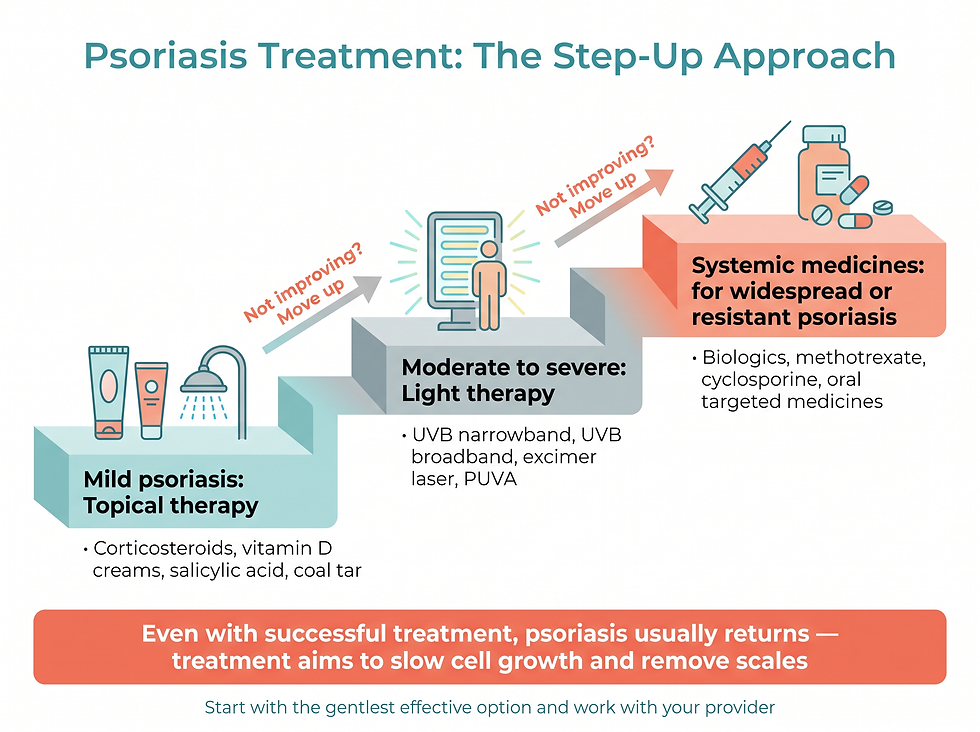
Figure 3: Psoriasis treatment follows a step-up ladder — topicals, then light therapy, then systemic medicines — with the understanding that the disease usually returns even after successful treatment.
Step 1: Topical Therapy (Mild Psoriasis)
Topical treatments are creams, ointments, and solutions applied directly to the skin. They are the starting point for mild disease [2].
Corticosteroids — most frequently prescribed for mild to moderate psoriasis. Mild versions for face and skin folds; strong versions (triamcinolone, clobetasol) for tough areas. Overuse of strong types can thin skin.
Vitamin D analogues (calcipotriene, calcitriol) — slow skin cell growth. Used alone or with corticosteroids; calcitriol may irritate less in sensitive areas.
Retinoids (tazarotene) — a gel or cream applied once or twice daily. Causes skin irritation and light sensitivity; not for pregnancy or breastfeeding.
Calcineurin inhibitors (tacrolimus, pimecrolimus) — calm the rash and reduce scaling. Helpful around thin skin like the eyes; not for pregnancy; not for long-term use due to skin cancer and lymphoma risk.
Salicylic acid — reduces scalp scaling. Available OTC and by prescription; prepares the scalp to absorb other medication.
Coal tar — reduces scaling, itching, and inflammation. OTC and prescription strengths; messy, stains, strong odor; not for pregnancy.
Anthralin — slows skin cell growth, removes scales, smooths skin. Not for face or genitals; stains; applied briefly then washed off.
Step 2: Light Therapy (Moderate to Severe)
Light therapy is a first-line treatment for moderate to severe psoriasis, either alone or in combination with medications. It involves exposing the skin to controlled amounts of natural or artificial light. Repeated treatments are necessary [2].
Sunlight (heliotherapy). Brief, daily exposures to sunlight might improve psoriasis. Ask your provider about the safest way to use natural light [2].
UVB broadband. Controlled doses of UVB light from an artificial source can treat single patches, widespread psoriasis, or psoriasis that does not improve with topicals. Short-term side effects might include inflamed, itchy, dry skin [2].
UVB narrowband. Narrowband therapy might be more effective than broadband treatment and has replaced it in many places. It is usually given two or three times a week until the skin improves, then less frequently for maintenance. It may cause more severe side effects than broadband [2].
Answer nugget: Narrowband UVB light therapy may be more effective than broadband UVB and has replaced broadband in many places [2].
PUVA (psoralen plus UVA). This involves taking a light-sensitizing medication before UVA exposure. UVA penetrates deeper than UVB, and psoralen makes skin more responsive. It consistently improves skin and is often used for more severe psoriasis. Possible long-term side effects include increased skin cancer risk, including melanoma [2].
Excimer laser. A strong UVB light targets only the affected skin, requiring fewer sessions than traditional phototherapy. Side effects might include inflammation and blistering [2].
Step 3: Systemic Medicines (Widespread or Resistant Psoriasis)
If you have moderate to severe psoriasis, or other treatments have not worked, your provider may prescribe oral or injected (systemic) drugs. Some are used only briefly or alternated with other treatments because of potential severe side effects [2].
Biologics. These drugs, usually given by shot, alter the immune system in a way that disrupts the disease cycle and improves symptoms within weeks. They are approved for moderate to severe psoriasis that has not responded to first-line therapies. Options include etanercept, infliximab, adalimumab, ustekinumab, risankizumab, ixekizumab, guselkumab, bimekizumab, and secukinumab. Four of them — etanercept, ixekizumab, secukinumab, and ustekinumab — are approved for children. Biologics are expensive, may suppress the immune system, and require tuberculosis screening [2].
Answer nugget: Four biologics are approved for children with psoriasis: etanercept, ixekizumab, secukinumab, and ustekinumab [2].
Targeted oral medicines. Deucravacitinib and apremilast are pills that calm the immune system, reducing the inflammation that causes psoriasis. Some people see improvement within weeks. They are approved for moderate to severe psoriasis, especially when other options have not worked [2].
Methotrexate. Usually given weekly as a single oral dose, it decreases skin cell production and suppresses inflammation. It is less effective than adalimumab and infliximab. Long-term users need ongoing testing of blood counts and liver function, and must stop the drug at least three months before attempting to conceive [2].
Cyclosporine. Taken orally for severe psoriasis, it suppresses the immune system. It is similar in effectiveness to methotrexate but cannot be used continuously for more than a year. It increases infection and cancer risk and requires ongoing blood pressure and kidney monitoring. It is not for pregnancy or breastfeeding [2].
Injected steroids and other options. An injection of triamcinolone can treat a few small, persistent patches. Thioguanine and hydroxyurea are options when other drugs cannot be taken [2].
Treatment considerations. You and your provider will choose an approach based on your needs, type, and severity. You will likely start with the mildest treatments — topical creams and phototherapy — and move to stronger treatments if your condition does not improve. People with pustular or erythrodermic psoriasis usually need to start with stronger systemic medications [2].
Lifestyle and Home Remedies
Self-care measures help you better manage psoriasis between and during treatment [2]:
Daily baths: Wash gently with lukewarm water and mild soaps with added oils; add bath oil, Epsom salts, or oatmeal; soak at least 15 minutes
Keep skin moist: Apply moisturizer daily, ideally right after bathing on damp skin; oils and heavy ointments stay on longer than creams; use a humidifier in dry air
Overnight coverage: Apply ointment to affected areas, wrap with plastic wrap, and wash away scales in the morning
Controlled sunlight: Ask your provider first; protect unaffected skin with SPF 30 or higher; too much sun can trigger outbreaks
Avoid scratching: Use OTC anti-itch creams; trim nails; wear soft fabrics; use medicated coal tar shampoo for scalp psoriasis
Avoid triggers: Infections, skin injuries, smoking, and intense sun exposure can all worsen psoriasis
Stay cool: Heat increases itch; use light clothing, air conditioning, cold packs, or refrigerated lotion
Healthy lifestyle: Stay active, eat well, limit alcohol, and maintain a healthy weight
Alternative and Complementary Approaches
Some studies claim alternative therapies — special diets, vitamins, acupuncture, and herbal products — ease psoriasis symptoms. None of these approaches is backed by strong evidence, but they are generally safe and might help reduce itching and scaling in mild to moderate psoriasis [2].
Aloe extract cream may reduce scaling, itching, and inflammation, though you might need to apply it several times a day for a month or more to see improvement [2].
Fish oil supplements used with UVB therapy might reduce the extent of the rash. Applying fish oil to affected skin under a dressing for six hours a day for four weeks might improve scaling [2].
Oregon grape (barberry) applied to the skin may reduce severity [2].
If you are considering alternative medicine, talk with your health care provider about the pros and cons of these approaches.
Living with Psoriasis: Coping and Support
Coping with psoriasis can be a challenge, especially if the affected skin covers a large area or is visible to others. The ongoing, persistent nature of the disease adds to the burden [2].
Learning about the disease, its treatments, and your triggers helps you prevent flare-ups. Educating family and friends helps them recognize and support your efforts [2].
Joining a support group can bring comfort in sharing experiences with people facing similar challenges. On days when you feel self-conscious, clothing or cosmetic cover-up products such as body makeup or concealer can help — but avoid them on open sores, cuts, or unhealed patches [2].
The relationship between stress and psoriasis is unclear and needs further study, but easing stress might help reduce flares and itchiness. Meditation, tai chi, yoga, and time with friends and loved ones are worth trying [2].
Preparing for Your Appointment
You will likely first see your primary care provider, and in some cases be referred to a dermatologist — a specialist in skin diseases [2].
Before the visit, list your symptoms (including any that seem unrelated), all medications, vitamins, and herbs you take with doses, and your questions [2].
Useful questions to ask include: What might be causing my symptoms? Do I need diagnostic tests? What treatments are available and which do you recommend? What side effects can I expect? Will the treatment cause remission? How quickly will I see results? What are the alternatives? How do I manage my other conditions alongside treatment? What skin care routines and products do you recommend? [2]
Your provider will likely ask when symptoms began, whether they are continuous or occasional, and what seems to improve or worsen them [2].
Conclusion and Next Steps
Psoriasis is a chronic immune-driven skin disease with no cure, but it is manageable. The rash runs in cycles, six distinct types exist, and treatment follows a clear step-up path: creams first, light therapy for moderate to severe disease, and systemic medicines when those fall short. Daily skin care, trigger avoidance, and attention to related health risks — especially psoriatic arthritis and heart disease — make the difference between constant flare management and long stretches of quiet skin.
Your next step: if you notice a scaly, itchy rash on your elbows, knees, scalp, or skin folds — or nails that are pitting or separating — book an appointment with your provider. A skin exam (and sometimes a simple biopsy) confirms the diagnosis, and treatment can begin with the gentlest effective option. If you have already been diagnosed, bring this guide's treatment ladder and self-care checklist to your next visit and ask which step fits your current severity.
Frequently Asked Questions
1. What is the most common type of psoriasis?
Plaque psoriasis is the most common type. It causes dry, itchy, raised patches (plaques) covered with scales, usually appearing on the elbows, knees, lower back, and scalp [1]. The skin may heal with temporary color changes, especially on brown or Black skin [1].
2. Is psoriasis contagious?
No. Psoriasis is thought to be an immune system problem in which infection-fighting cells attack healthy skin cells by mistake. Researchers believe both genetics and environmental factors play a role, but the condition is not contagious [1].
3. What triggers psoriasis flare-ups?
Common triggers include infections such as strep throat, cold and dry weather, skin injuries like cuts or severe sunburns, smoking and secondhand smoke, heavy alcohol consumption, certain medications (lithium, high blood pressure drugs, antimalarials), and rapid withdrawal of oral or injected corticosteroids [1].
4. Can psoriasis start in childhood?
Yes. Anyone can develop psoriasis, and about a third of instances begin in childhood [1]. Guttate psoriasis — small, drop-shaped scaling spots — primarily affects young adults and children and is usually triggered by a bacterial infection such as strep throat [1].
5. How does a doctor diagnose psoriasis?
Your health care provider will ask questions about your health and examine your skin, scalp, and nails, then may take a small skin biopsy for examination under a microscope. The biopsy helps determine the type of psoriasis and rule out other disorders [2].
6. Is there a cure for psoriasis?
There is no cure. Psoriasis is a chronic disease, and even with successful treatment, it usually returns [2]. The treatment goal is to slow cell turnover with the fewest possible side effects and keep symptoms under control [2].
7. What is the first-line treatment for moderate to severe psoriasis?
Light therapy (phototherapy) is a first-line treatment for moderate to severe psoriasis, used alone or with medications. For mild psoriasis, treatment starts with topical creams and ointments; systemic medicines are reserved for widespread or resistant disease [2].
8. Does psoriasis increase the risk of other diseases?
Yes. Having psoriasis increases your risk of psoriatic arthritis, eye conditions (conjunctivitis, blepharitis, uveitis), obesity, type 2 diabetes, high blood pressure, cardiovascular disease, other autoimmune diseases such as celiac disease and Crohn's disease, and mental health conditions such as low self-esteem and depression [1].
References
External resources: National Psoriasis Foundation · American Academy of Dermatology · MedlinePlus — Psoriasis
Medical Disclaimer: This article is for informational purposes only and does not constitute medical advice. Content is based on the cited clinical sources and is current as of August 18, 2026. Always consult a qualified health care provider for diagnosis and treatment decisions.
Comments