Oral Food Challenge: How the Gold-Standard Food Allergy Test Works

Updated: 2 days ago
Written and medically reviewed by Dr. Baraa Alnahhal, MD · Last reviewed: November 2026 · How we review
Quick Answer
An oral food challenge (OFC) is a supervised test in which you eat slowly increasing amounts of a food you may be allergic to while a care team watches for a reaction. It's considered the gold standard for diagnosing a food allergy. Most reactions are mild and treated right away. Never try a food challenge at home.
What the research says
Reactions are common but manageable: of 584 food challenges, 43% caused an allergic reaction, mostly skin symptoms; all reactions were reversible and no child needed hospital admission (Perry TT et al., Journal of Allergy and Clinical Immunology, 2004) [2]
Severe reactions are uncommon: across 6,377 food challenges at 5 U.S. centers, 86% caused no reaction, the allergic reaction rate was 14% and the anaphylaxis rate was 2% (Akuete K et al., Annals of Allergy, Asthma & Immunology, 2017) [3]
Key takeaways
An oral food challenge confirms or rules out a food allergy.
It's done under medical supervision, never at home.
Small, increasing doses are given about every 15 minutes.
Stop antihistamines beforehand as instructed.
A passed test means you can usually eat the food again.
What is an oral food challenge?
Allergy skin and blood tests show whether your immune system makes allergy antibodies to a food, but they can't always tell whether eating it will cause a reaction. A food challenge answers that question directly. Usually one food is tested per visit. The food may be served plain, mixed into another food or given in a capsule. Sources: [1]
Types of food challenges
Type | Who knows what's being eaten | Use |
Open | You and the care team | Most common in clinics |
Single-blind | Only the care team | Reduces worry-driven symptoms |
Double-blind, placebo-controlled | Neither you nor the team at the time | Mainly used in research |
Sources: [1]
Why it's done
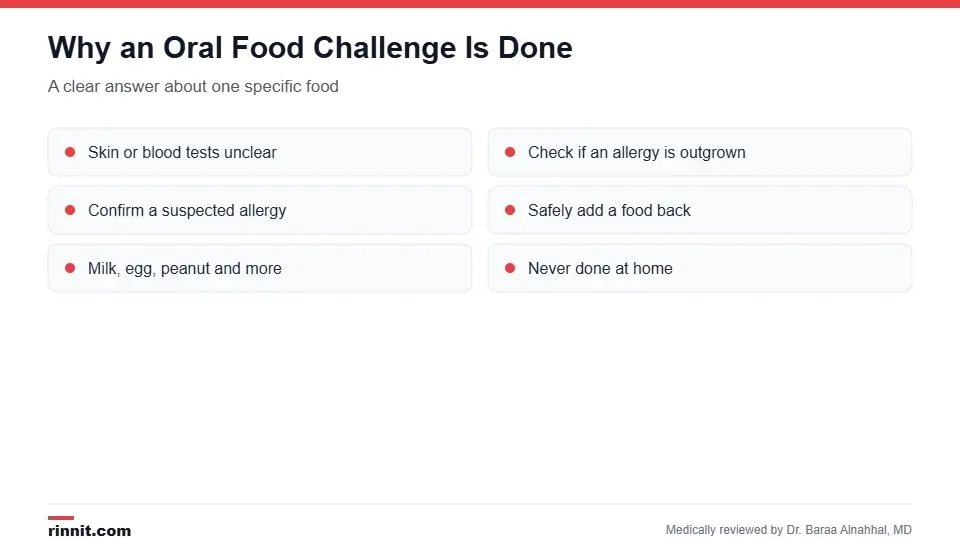
A food challenge gives a clear answer about a specific food.
People with a history of severe reactions usually don't have a challenge unless it's to check whether they've outgrown the allergy. Sources: [1]
How to prepare
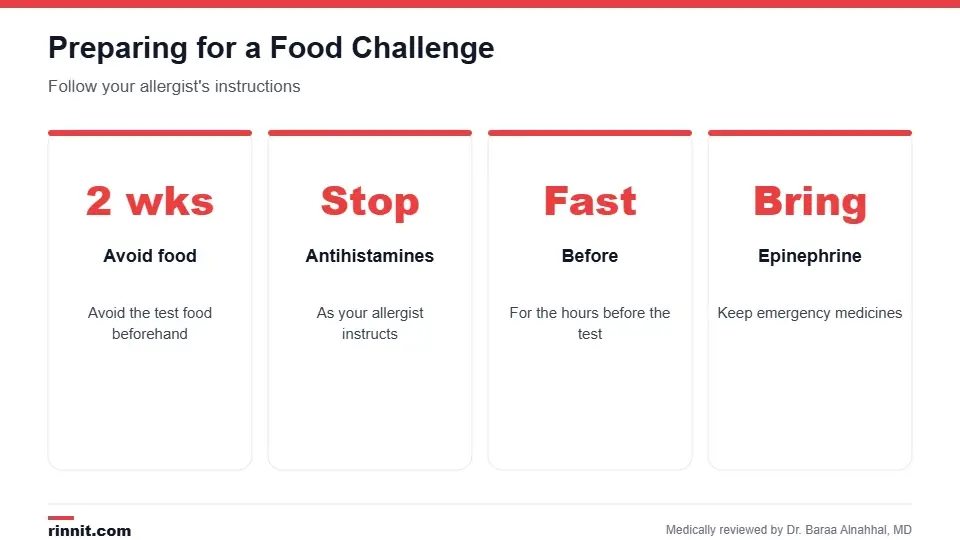
Follow your allergist's instructions closely.
Avoid the food being tested for up to 2 weeks.
Stop prescription and over-the-counter antihistamines for as long as your allergist tells you.
Don't eat or drink for the hours before the test, as instructed.
Reschedule if you have cold or flu symptoms that morning.
Keep taking emergency medicines such as inhalers, and bring your epinephrine. Sources: [1]
What happens during the test
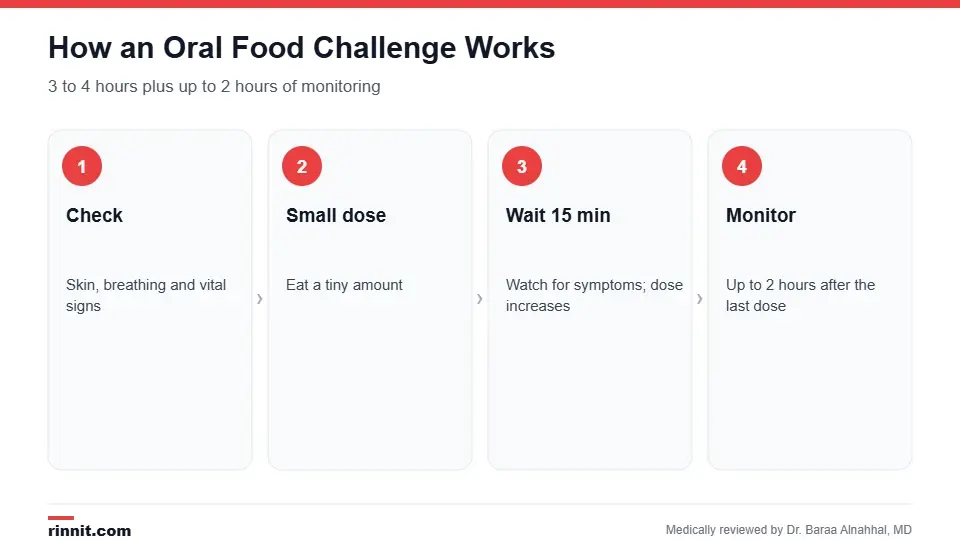
The test can take 3 to 4 hours plus observation.
Your care team checks your skin, breathing and vital signs.
You eat a very small amount of the food.
You wait about 15 minutes while staff watch for symptoms.
If there's no reaction, you eat a larger dose, usually 4 to 6 doses in total.
The test stops at the first sign of a reaction or after the full serving is eaten.
You're monitored for up to 2 hours afterward, or longer after a reaction. Sources: [1]
Reactions and safety
Reactions are usually mild, such as hives, itching or a rash, and are treated quickly with medicine. Serious reactions, such as trouble breathing or anaphylaxis, are uncommon, and the team is trained and equipped with epinephrine to treat them. This is why challenges are only done in a medical setting. Sources: [1, 2, 3]
Results
Result | What it means | Next step |
Passed (tolerated) | No allergy to that food at that amount | You can usually add the food to your diet |
Failed (reaction) | Food allergy confirmed | Avoidance plan and possibly an epinephrine prescription |
Inconclusive | Unclear result | Your allergist may advise avoidance or a repeat test |
Sources: [1]
Conclusion
An oral food challenge is the most reliable way to know whether a food is safe for you. Done carefully under medical supervision, it can confirm a real allergy or open the door to eating a food again.
Keep learning: read about food allergies and allergy testing.
Frequently asked questions
What is an oral food challenge?
A supervised test where you eat increasing amounts of a food to check for an allergy.
Why is it called the gold standard?
It directly shows whether eating the food causes a reaction.
How long does a food challenge take?
Up to 3 to 4 hours, plus up to 2 hours of monitoring.
Do I need to stop antihistamines?
Yes, for as long as your allergist instructs.
Can I do a food challenge at home?
No. It must be done under medical supervision.
What happens if I react?
The test stops and the care team treats the reaction right away.
Is a food challenge dangerous?
Serious reactions are uncommon, and staff are ready to treat them.
Can children have food challenges?
Yes. They're often used to see whether a child has outgrown an allergy.
What does passing mean?
You can usually eat the food again.
What if I feel sick that day?
Call to reschedule if you have cold or flu symptoms.
Related Reading
Food Allergy: Symptoms, Causes, Treatment & Complete Guide the condition a food challenge diagnoses.
Allergy Testing: Types, How to Prepare and What Results Mean skin and blood tests for allergies.
Anaphylaxis: Symptoms, Triggers, and Why Epinephrine Is the Only Emergency Treatment the most serious allergic reaction.
Peanut Allergy: The Complete Guide a common allergy tested by food challenge.
Oral Immunotherapy (OIT) for Food Allergies: How It Works, Risks, and Results a treatment that builds tolerance to foods.
References
Cleveland Clinic. Oral Food Challenge (OFC): Test, Risks & Results. Cleveland Clinic. Last updated November 16, 2023. https://my.clevelandclinic.org/health/diagnostics/9544-food-challenge-test
Perry TT, Matsui EC, Conover-Walker MK, et al. Risk of oral food challenges. Journal of Allergy and Clinical Immunology. 2004;114(5):1164-1168. PMID 15536426. https://doi.org/10.1016/j.jaci.2004.07.063
Akuete K, Guffey D, Israelsen RB, et al. Multicenter prevalence of anaphylaxis in clinic-based oral food challenges. Annals of Allergy, Asthma & Immunology. 2017;119(4):339-348.e1. PMID 28890356. https://doi.org/10.1016/j.anai.2017.07.028
Medical disclaimer
This article is for general education only and does not replace advice from a qualified healthcare professional. Talk to your doctor about your own diagnosis and treatment, and seek emergency care right away for severe or sudden symptoms.



Comments