Biologic Therapy for Severe Asthma: Types, Side Effects and Results

Updated: 2 days ago
Written and medically reviewed by Dr. Baraa Alnahhal, MD · Last reviewed: November 2026 · How we review
Quick Answer
Biologic therapy for severe asthma uses lab-made medicines that target the antibodies, cells or molecules driving airway inflammation. It's for people with moderate to severe asthma who still have frequent symptoms despite using inhalers correctly. It's given as a shot or IV infusion every 2 to 8 weeks alongside usual asthma medicines and can cut flare-ups and steroid use.
What the research says
Mepolizumab cut asthma attacks by about half: in the MENSA trial of 576 people with severe eosinophilic asthma, mepolizumab shots every 4 weeks cut asthma attacks by 53% and attacks needing an ER visit or hospital stay by 61% versus placebo (Ortega HG et al., New England Journal of Medicine, 2014) [2]
Tezepelumab helped even with low eosinophils: in the NAVIGATOR trial of 1,061 people aged 12 to 80 with severe asthma, tezepelumab every 4 weeks lowered the yearly attack rate to 0.93 versus 2.10 on placebo, including in people with low eosinophil counts (Menzies-Gow A et al., New England Journal of Medicine, 2021) [3]
Key takeaways
Biologics target the immune pathways behind severe asthma.
They're for asthma that stays uncontrolled despite proper inhaler use.
They're given as shots or IV infusions every few weeks.
They're used with, not instead of, other asthma medicines.
It may take four months or more to see if one works.
What is biologic therapy for asthma?
Biologics are medicines made from living cells. In asthma, they block specific parts of the immune response, such as IgE antibodies or eosinophils. Some also improve lung function. Sources: [1]
Who it's for
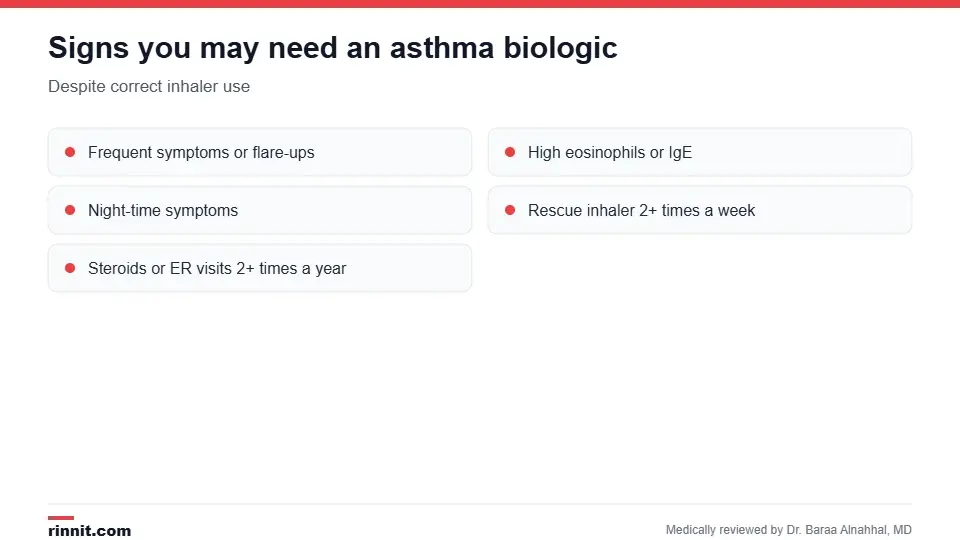
Your provider uses breathing tests and blood work to decide.
Symptoms despite using medicines correctly and managing triggers.
High eosinophil or IgE levels in blood tests.
Symptoms that wake you at night.
Using your rescue inhaler more than twice a week.
Needing steroids for flare-ups or ER care more than twice a year.
A hospital stay for asthma. Sources: [1]
Types of biologics
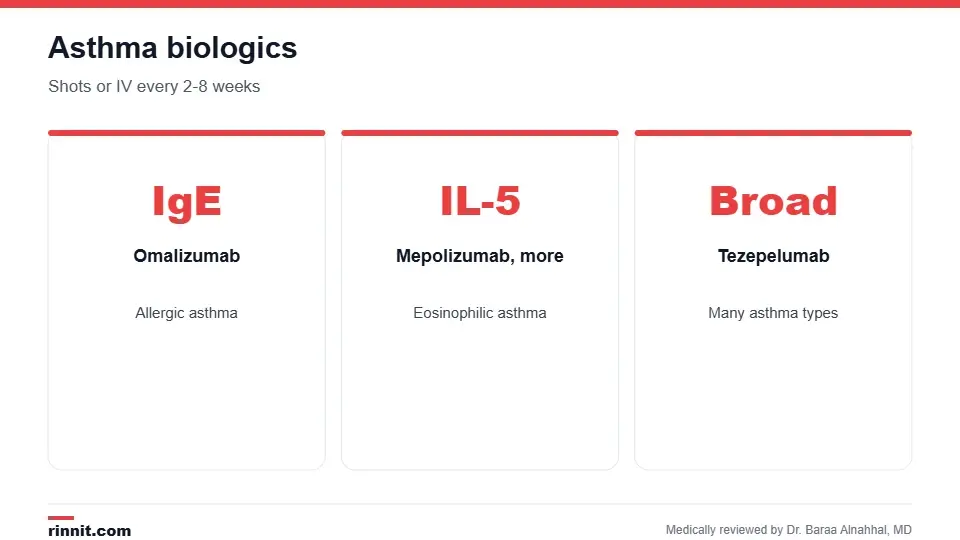
No studies directly compare them.
Medicine | How it works | How often |
Omalizumab (Xolair) | Blocks the allergy antibody IgE | Shot every 2 or 4 weeks |
Mepolizumab (Nucala) | Blocks IL-5, which drives eosinophils | Shot every 4 weeks |
Reslizumab (Cinqair) | Blocks IL-5 | IV every 4 weeks |
Benralizumab (Fasenra) | Lowers eosinophils | Every 4 weeks for 3 doses, then every 8 weeks |
Dupilumab (Dupixent) | Blocks other inflammation pathways | Shot every 2 weeks |
Tezepelumab (Tezspire) | Reduces inflammation | Shot every 4 weeks |
Your provider picks one based on breathing tests, blood work and your asthma type. Sources: [1, 2, 3]
How it's given
At an infusion center or specialist's office; some shots can later be done at home.
You may be watched for up to two hours after a dose.
Keep using your inhalers and other asthma medicines.
Other inhaler doses may be lowered once asthma is controlled. Sources: [1]
Side effects
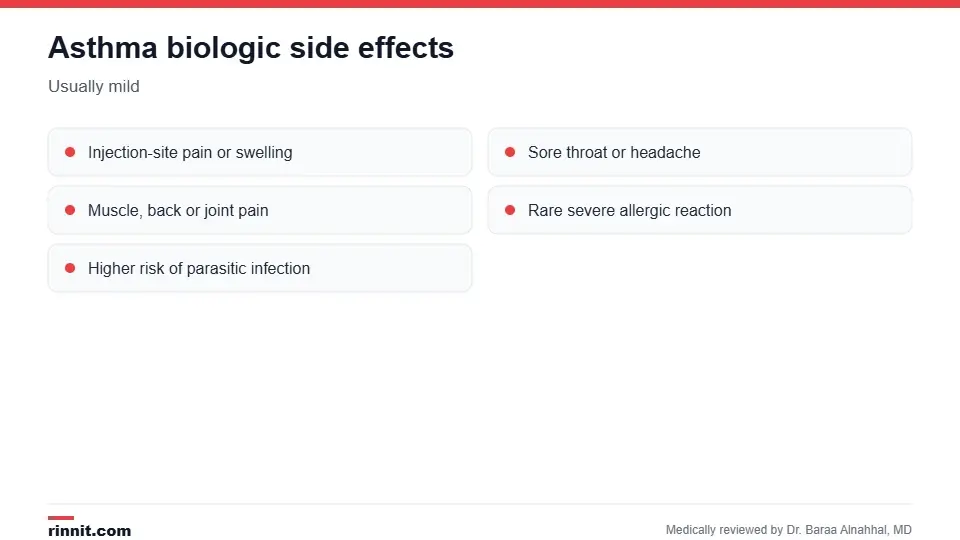
Symptoms may worsen if you stop therapy.
Pain or swelling at the injection site.
Sore throat or headache.
Back, muscle or joint pain.
Fatigue.
Rarely, severe allergic reactions such as hives or anaphylaxis.
A higher risk of parasitic infections. Sources: [1]
Symptoms may get worse if you stop therapy. Sources: [1]
Results
Less airway inflammation and fewer symptoms.
Fewer flare-ups and ER visits.
Easier physical activity.
Better sleep.
Less missed school or work. Sources: [1, 2, 3]
Some people improve within one or two weeks; others take four to six months. Sources: [1]
When to call your provider
Symptoms don't improve or get worse after several months.
You develop allergy symptoms. Call 911 for trouble breathing, throat or tongue swelling, or fainting after a dose.
You need to reschedule a dose. Sources: [1]
Conclusion
Biologic therapy can bring hard-to-control asthma under control by targeting its root causes. Working with an asthma specialist helps you find the biologic that fits your asthma type.
Keep learning: read about allergic asthma and asthma attacks.
Frequently asked questions
What is biologic therapy for asthma?
Medicines that target the immune pathways behind severe asthma.
Who needs a biologic?
People whose asthma stays uncontrolled despite correct treatment.
What biologics are available?
Omalizumab, mepolizumab, reslizumab, benralizumab, dupilumab and tezepelumab.
How are they given?
As shots or IV infusions every 2 to 8 weeks.
Can I stop my inhalers?
No. Biologics are used alongside them.
How long until it works?
From a couple of weeks to several months.
Can I give the shots at home?
Some can be given at home after the first doses.
What are common side effects?
Injection-site reactions, sore throat and headache.
What if I stop the biologic?
Your symptoms may get worse.
Which biologic is best?
It depends on your asthma type and test results.
Related Reading
Biologics: What They Are, Types, Uses and Side Effects how biologic medicines work.
Asthma: Symptoms, Causes, Triggers, Diagnosis & Treatment — Complete Guide an overview of asthma.
Allergic Asthma: The Breathing Condition Triggered by the Air Around You a type biologics treat.
Understanding Eosinophils: Your Body's Defense Against Invaders immune cells biologics target.
Inhalers: Types, Medicines and How to Use Them your everyday asthma medicines.
References
Cleveland Clinic. Biologic Therapy for Severe Asthma: Risks & Results. Cleveland Clinic. Last updated August 5, 2024. https://my.clevelandclinic.org/health/treatments/17711-biologic-therapy-for-severe-asthma
Ortega HG, Liu MC, Pavord ID, et al. Mepolizumab treatment in patients with severe eosinophilic asthma. New England Journal of Medicine. 2014;371(13):1198-1207. PMID 25199059. https://doi.org/10.1056/NEJMoa1403290
Menzies-Gow A, Corren J, Bourdin A, et al. Tezepelumab in adults and adolescents with severe, uncontrolled asthma. New England Journal of Medicine. 2021;384(19):1800-1809. PMID 33979488. https://doi.org/10.1056/NEJMoa2034975
Medical disclaimer
This article is for general education only and does not replace advice from a qualified healthcare professional. Talk to your doctor about your own diagnosis and treatment, and seek emergency care right away for severe or sudden symptoms.



Comments