Understanding Eosinophils: Your Body's Defense Against Invaders

Updated: 2 days ago
Medically reviewed by Dr. Baraa Alnahhal, MD · Last reviewed: October 2026
Quick Answer: What are eosinophils?
Eosinophils are white blood cells that serve as the body's main defense against parasites and certain bacteria and also take part in allergic responses [4]. Formed in the bone marrow, they make up less than 5% of all white blood cells [4]. Too many (eosinophilia) or too few (eosinopenia) often call for testing to look for an underlying disorder.
What the research says
Allergy is the most common cause of raised eosinophils in children. In a retrospective review of 771 children with raised blood eosinophils, allergy accounted for 46% of cases (atopy and drug reactions were the most common sub-causes), followed by unknown cause (36%), infection (9%), and eosinophilic disorders (6%); 74% of the children with an unknown cause had limited or no follow-up testing (PubMed: Ness et al., J Pediatr, 2022 [1]).
Higher eosinophil counts in the blood are linked to more asthma flare-ups. A meta-analysis of 23 observational studies with 155,772 participants found that a high blood eosinophil count was associated with higher odds of asthma exacerbation (OR 1.31, 95% CI 1.16–1.49), with the association appearing from a cutoff of 200 cells/μL (PubMed: Mallah et al., Pediatr Allergy Immunol, 2020 [2]).
A low eosinophil count can be a clue to sepsis, but it is not a stand-alone test. In a meta-analysis of 7 studies with 3,842 participants, eosinopenia identified sepsis with a pooled sensitivity of 0.66 and specificity of 0.68 (area under the curve 0.73). The authors found it no better than conventional biomarkers, though it is a simple, fast, and inexpensive measure that merits further large trials (PubMed: Lin et al., BMC Infect Dis, 2021 [3]).
The Function of Eosinophils
Eosinophils act as specialized "troops" within the immune system, specifically trained to target and eliminate unfamiliar organisms before they can cause widespread harm.
Defense Mechanisms
These cells are equipped with small, sand-like granules that store toxic proteins. When an invader is detected, the eosinophil releases these proteins to destroy and consume it [4]. Eosinophils help your body defend itself in three main ways:
Destroy parasites. They help fight parasitic infections such as strongyloidiasis and pinworms [4]. (Learn more about parasites.)
Neutralize allergens. They play a key role in immediate hypersensitivity reactions and allergic responses [4].
Combat bacteria. They target intracellular bacteria that grow within host cells [4].
Distribution in the Body
Unlike some white blood cells that primarily circulate in the bloodstream, eosinophils are predominantly found in the body's tissues. The most common places to find them are the blood, bone marrow, lungs, skin, and stomach, along with fat (adipose) tissue [4] and the gastrointestinal tract.
Location | Role of eosinophils |
Bone marrow | Production and maturation site [4] |
Lungs | Defense against inhaled allergens and pathogens |
Stomach | Monitoring for ingested parasites and bacteria |
Skin | Protecting the body's external barrier |
Anatomy and Appearance
Eosinophils are spherical, microscopic cells that are larger than most cells in the body [4]. Under a microscope, they are distinguished by their unique physical features:
Two-lobed nucleus [4]. The nucleus consists of two distinct sections connected by a thin thread, often resembling raindrops.
Granular texture. The protein-filled granules give the cell a sandy appearance [4].
Coloration. While clear in the body, an acidic dye used during testing turns the cells pink or purple [4] for easier examination.

Conditions Related to Eosinophil Counts
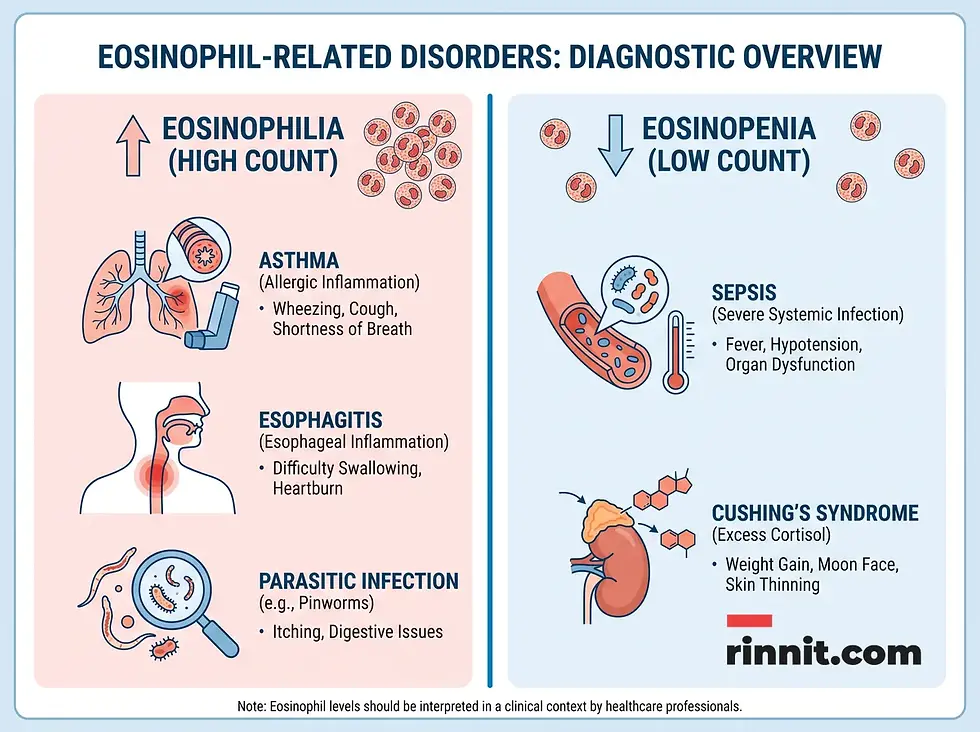
Deviations from the normal eosinophil count fall into two primary conditions: eosinophilia and eosinopenia.
Eosinophilia (High Count)
A high eosinophil count is often a response to an active threat or a chronic condition. (For the full picture, see our guide to eosinophilia.)
Gastrointestinal disorders. Clusters of eosinophils can cause inflammation in the esophagus (esophagitis), the stomach (eosinophilic gastritis), or the colon (colitis) [4].
Lung disorders. High counts are associated with severe forms of asthma and pneumonia [4] (see eosinophilic pneumonia).
Tissue disorders. Eosinophils can affect connective tissues and blood vessels, potentially impacting vital organs like the heart and kidneys. (See hypereosinophilic syndrome.)
Eosinopenia (Low Count)
A lower-than-normal amount of eosinophils is often associated with high stress or severe infection [4].
Count | What it is | Examples of related conditions |
High (eosinophilia) | More eosinophils than normal, often a response to an active threat or chronic condition | Gastrointestinal, lung, and tissue disorders; allergies; parasitic infections [4] |
Low (eosinopenia) | Fewer eosinophils than normal, often linked to high stress or severe infection | Cushing's syndrome; sepsis [4] |
Diagnostic Testing and Care
Healthcare providers use several methods to monitor eosinophil health, typically starting with a complete blood count (CBC) [4].
Specialized Tests
Absolute eosinophil count (AEC). A targeted blood test that calculates the exact number of eosinophils per microliter of blood [4].
Bone marrow biopsy. A procedure to examine the quality and quantity of cells where they are produced [4].
Localized biopsies. Skin or tissue samples may be taken to check for clustered eosinophils in specific organs [4].

Key Takeaways
Eosinophils are essential, high-impact members of the immune system that provide specialized protection against a variety of environmental and biological threats. While they make up only a small portion of our white blood cells, their ability to target parasites and manage allergic reactions is vital for overall health. Understanding the signs of eosinophil imbalance can help in the early detection of underlying conditions, ensuring that the body's internal "specialized troops" can continue their protective mission.
Take the Next Step
Concerned about persistent rashes or digestive issues? Consult with your healthcare provider to discuss whether a complete blood count or an absolute eosinophil count is appropriate for you.
Related reading: Eosinophilia · Eosinophilic Gastritis · Eosinophilic Colitis · Eosinophilic Pneumonia · Hypereosinophilic Syndrome
Frequently Asked Questions
1. What are eosinophils?
Eosinophils are a type of white blood cell that helps the immune system fight off parasites and manage allergic reactions.
2. Where are eosinophils produced?
Eosinophils are produced and matured in the bone marrow before traveling to various tissues in the body.
3. What is a normal eosinophil count?
In healthy adults, eosinophils typically make up less than 5% of all white blood cells.
4. What is eosinophilia?
Eosinophilia is a condition where the body has a higher-than-normal count of eosinophils, often due to an allergy or infection.
5. What is eosinopenia?
Eosinopenia is a lower-than-normal eosinophil count, which can be caused by severe stress, sepsis, or Cushing's syndrome.
6. How do eosinophils fight parasites?
Eosinophils release toxic proteins from small granules within the cell to destroy and consume invading organisms.
7. What are the symptoms of high eosinophils?
Common symptoms include fatigue, skin rashes, abdominal pain, and difficulty breathing.
8. Are high eosinophil counts contagious?
While the high count itself isn't contagious, it can be caused by contagious parasitic infections.
9. What is an absolute eosinophil count (AEC)?
An AEC is a blood test that determines the exact number of eosinophils present in a blood sample.
10. Can allergies affect my eosinophil count?
Yes, exposure to allergens is a common cause of increased eosinophil levels as the body attempts to defend itself.
Related Reading
Biologic Therapy for Severe Asthma: Types, Side Effects and Results explains biologic therapy for severe asthma.
References
Ness TE, Erickson TA, Diaz V, et al. Pediatric eosinophilia: a review and multiyear investigation into etiologies. J Pediatr. 2022;253:232-237.e1. doi:10.1016/j.jpeds.2022.09.048. PMID: 36195311.
Mallah N, Rodriguez-Segade S, Gonzalez-Barcala FJ, Takkouche B. Blood eosinophil count as predictor of asthma exacerbation. A meta-analysis. Pediatr Allergy Immunol. 2020;32(3):465-478. doi:10.1111/pai.13403. PMID: 33135257.
Lin Y, Rong J, Zhang Z. Silent existence of eosinopenia in sepsis: a systematic review and meta-analysis. BMC Infect Dis. 2021;21(1):471. doi:10.1186/s12879-021-06150-3. PMID: 34030641.
Cleveland Clinic. Eosinophils. Cleveland Clinic Health Library. Medically reviewed; last updated July 5, 2022. https://my.clevelandclinic.org/health/body/23402-eosinophils
Medical Disclaimer
This article is for informational purposes only and does not constitute medical advice. Always seek the advice of your physician or other qualified health provider with any questions you may have regarding a medical condition. Never disregard professional medical advice or delay in seeking it because of something you have read here.



Comments