Salivary Glands: Location, Function, Symptoms and Care

Updated: 2 days ago
Medically reviewed by Dr. Baraa Alnahhal, MD · Last reviewed: October 2026
Quick Answer: What are salivary glands?
Salivary glands are small organs in and around the mouth that make saliva, which keeps the mouth moist, eases swallowing, starts digesting starches and protects teeth. The three major pairs are the parotid, submandibular and sublingual glands, plus hundreds of minor glands. Problems include stones, inflammation, reduced saliva and growths, and persistent symptoms deserve professional assessment. [1]
What the research says
Endoscopic stone removal worked for most people with parotid stones. A systematic review of 13 studies covering 1,285 patients with parotid salivary stones reported successful treatment in 1,139 (mean success rate 88.7%) with no major complications, and suggested sialendoscopy as the first choice when conservative therapy fails (Galdermans & Gemels, Oral and Maxillofacial Surgery, 2020). Another review of laser-assisted lithotripsy with sialendoscopy (16 papers, mean stone size 7.11 mm) found a mean success rate of 87.3% and a 97% gland-preservation rate (Chiesa-Estomba et al., Ear, Nose & Throat Journal, 2021). [2] [3]
Sparing the salivary glands during head-and-neck radiation lowered dry mouth. A systematic review of 51 publications found that eight randomized trials of tissue-sparing radiation modalities showed a significantly lower prevalence of xerostomia, while evidence was insufficient for vitamin E, amifostine and photobiomodulation (Mercadante et al., Supportive Care in Cancer, 2025). [4]

What are salivary glands?
Salivary glands are small organs that make saliva, sometimes called spit. They are located in and around the mouth, where their secretions help keep the mouth and throat moist. [1]
Saliva is more than fluid. It changes the texture of food so it is easier to swallow, contributes to the early digestion of starches and helps keep the mouth clean. It also helps protect the teeth from cavities. [1]
Definition: Salivary glands are organs that produce saliva to support moisture, swallowing, digestion and oral health. [1]
What do salivary glands do?
The main job of the salivary glands is to produce saliva. In adulthood, the glands make about one to two liters of saliva each day. [1]
Saliva moistens food and helps it move through the mouth and throat. It contains amylase, an enzyme that helps the stomach break down starches in food. Saliva also helps clean the mouth and protects teeth from cavities. [1]
Saliva’s role | Why it matters |
Moistens food | Makes food easier to swallow. |
Supports digestion | Amylase helps begin the breakdown of starches. |
Keeps tissues moist | Helps maintain moisture in the mouth and throat. |
Cleans the mouth | Helps keep the oral environment clean. |
Protects teeth | Helps protect teeth from cavities. |
A change in saliva production can therefore affect several everyday functions at once. Dryness may be felt in the mouth and throat, while reduced moisture can also make swallowing less comfortable.
Where are the salivary glands located?
The major salivary glands are arranged around the mouth, jaw and cheeks. Each group has a characteristic location and contribution to saliva production. [1]
Gland group | Location | Notable detail |
Parotid glands | Just in front of the ears. | Largest of the three major gland groups; described as producing about 50% of saliva. |
Submandibular glands | Below the jaw. | One gland is located on each side; together they are about the size of a walnut. |
Sublingual glands | Beneath either side of the tongue, under the floor of the mouth. | Each is approximately the size of an almond. |
Minor salivary glands | Mostly in the lips, palate, tongue and inner lining of the cheeks. | There are hundreds, and each measures about 2 millimeters or less than 1/10 inch. |
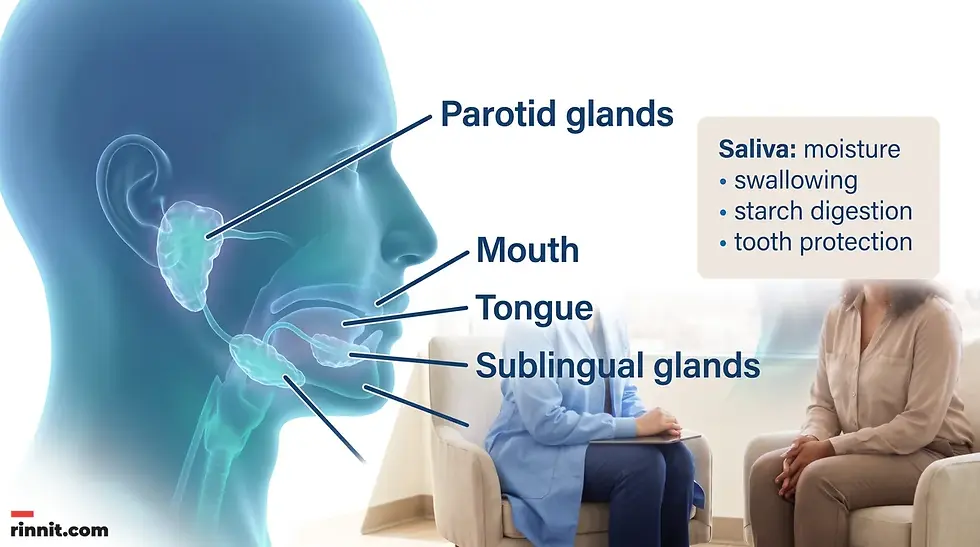
Parotid glands
The parotid glands sit on each side of the face, just in front of the ears. They are the largest of the three major gland groups and, according to Cleveland Clinic, make about half of the saliva in the mouth. Estimates of each gland’s share vary by source and with whether a person is resting or eating. [1]
Each parotid gland has a superficial section and a deep section in relation to the facial nerve. The gland is made of specialized cells that release enzymes and mucus that help the body digest food. [1]
Submandibular glands
The submandibular glands are located below the jaw. Together, the two glands are about the size of a walnut. [1]
Sublingual glands
The sublingual glands sit beneath either side of the tongue, under the floor of the mouth. Each is about the size of an almond. [1]
Minor salivary glands
Hundreds of minor salivary glands are distributed through the lips, palate, tongue and inner lining of the cheeks. These small glands contribute to the moisture of the mouth. [1]
What are salivary glands made of?
Salivary glands contain groups of specialized cells. These cells release enzymes and mucus that contribute to saliva and help the body digest food. [1]
The parotid gland has two sections described by their relationship to the facial nerve: a superficial section on top of the nerve and a deep section below it. This relationship is one reason the anatomy of the parotid region can be important during professional assessment. [1]
What conditions can affect salivary glands?
Several conditions can affect salivary glands. These include salivary stones, salivary-gland dysfunction, swelling from inflammation, growths and salivary-gland cancer.
Condition category | Plain-language description |
Salivary stones | Deposits that can clog or block a gland. |
Salivary-gland dysfunction | Glands do not work as expected, often producing too little saliva. |
Salivary-gland swelling | Inflammation can cause a gland to become swollen or painful. |
Salivary-gland growth | A growth or neoplasm can develop in gland tissue. |
Salivary-gland cancer | A malignant growth affecting salivary-gland tissue. |
The presence of a symptom does not identify which category is involved. A lump, dryness or swelling can have multiple possible explanations, so the overall pattern and a professional assessment matter.
What causes salivary-gland dysfunction and dry mouth?
Salivary-gland dysfunction often means that the glands do not make enough saliva, leading to chronic dry mouth. Several conditions and factors may reduce saliva production. [1]
The listed factors include autoimmune disorders such as Sjögren syndrome, lupus and rheumatoid arthritis. Cancer treatments involving the head and neck, including chemotherapy and radiation therapy, can also affect saliva production. Infections such as HIV and AIDS are additional listed factors. [1]
Some medications may contribute to dry mouth. Examples include certain antihistamines, antidepressants, sedatives and medications used for Parkinson’s disease. Do not stop a prescribed medication without speaking with the prescriber or another qualified healthcare professional. [1]
Possible contributor | How it is described |
Autoimmune disorders | Sjögren syndrome, lupus and rheumatoid arthritis may affect saliva production. |
Head-and-neck cancer treatment | Chemotherapy and radiation therapy may reduce saliva. |
Infection | HIV and AIDS are listed among possible contributors. |
Medication effects | Certain antihistamines, antidepressants, sedatives and Parkinson’s disease medications may contribute to dry mouth. |
Persistent dry mouth is worth discussing with a healthcare professional, particularly when it affects swallowing, speaking, eating or oral comfort.
What are common salivary-gland symptoms?
Dry mouth is a primary symptom of salivary-gland conditions. Other possible symptoms include difficulty swallowing, difficulty opening the mouth, fever and a lump or swelling under the jaw or ear.
These symptoms can occur in different combinations. A symptom list cannot determine whether the cause is a stone, inflammation, reduced saliva, a growth or another condition.
Symptom | Why professional context matters |
Dry mouth | May reflect reduced saliva or another contributor. |
Difficulty swallowing | Can affect eating and drinking and deserves attention if persistent. |
Difficulty opening the mouth | May occur with swelling or discomfort around the gland. |
Fever | Can be a sign of infection or another illness. |
Lump or swelling under the jaw or ear | Needs assessment rather than online diagnosis. |
What are salivary stones?
Salivary stones, also called sialolithiasis, can clog or block a salivary gland. A blocked gland may become painful or swollen, and the area over the gland may become red and inflamed if infection develops.
Cleveland Clinic lists drinking lots of water, sucking on a lemon or lemon drops and gently rubbing the area around the stone as measures that may help move it. These measures are not a guarantee that a stone will pass. Avoid forceful pressure or squeezing the area. [1]
A salivary stone may be associated with infection. Signs can include pain, very red and inflamed skin over the gland or pus from the ducts that drain the gland. Contact a healthcare professional if you think a stone has caused an infection. [1]

When should salivary-gland symptoms be evaluated?
Talk with a healthcare professional if dry mouth does not go away, or if you have swelling or pain in your face or jaw. Persistent symptoms can interfere with eating, swallowing and oral comfort. [1]
Contact a professional if a salivary stone is accompanied by signs of infection, such as increasing pain, red and inflamed skin or pus from a duct. Fever, worsening swelling or difficulty swallowing also deserves prompt attention.
How are salivary-gland problems cared for?
Care depends on the underlying problem. A professional may assess the symptoms, examine the mouth and jaw region and recommend a plan suited to the gland and condition involved.
For a suspected stone without clear infection, the listed self-care measures are hydration, lemon or lemon drops and gentle rubbing around the area. If infection is suspected, professional assessment is important rather than relying only on home measures.
Dry mouth may be connected with an autoimmune disorder, treatment history, infection or medication. A professional can help consider these possibilities and decide whether a medication review or further evaluation is appropriate. Do not change prescribed treatment on your own.
What questions should you ask about a salivary gland concern?
Useful questions about a salivary gland concern cover what may be causing dry mouth, swelling or pain, which gland is involved and which symptoms need prompt attention.
What might be contributing to my dry mouth, swelling or pain?
Which gland or area appears to be involved?
Could a medication or treatment history be affecting saliva production?
What should I watch for if a stone is suspected?
Which symptoms suggest that an infection needs prompt attention?
What can I safely do at home while waiting for an appointment?
Should I change any medication or treatment? If so, how should that be done safely?
When should I return for follow-up if symptoms continue?
When should you seek urgent help for a salivary gland problem?
Seek prompt professional care for fever with salivary-gland swelling, pus from a gland duct, rapidly worsening pain or swelling, or increasing difficulty swallowing or opening the mouth. Call emergency services (911 in the US) if swelling in the mouth, jaw or neck makes it hard to breathe or to swallow saliva. These symptoms can require assessment for infection or another condition.
Conclusion
Salivary glands are small but important organs that make the saliva needed to moisten the mouth and throat, support swallowing, begin starch digestion, keep the mouth clean and protect teeth from cavities. The three major gland groups are the parotid, submandibular and sublingual glands, supported by hundreds of minor glands throughout the mouth. [1]
Dry mouth, difficulty swallowing, fever and a lump or swelling under the jaw or ear can occur with salivary-gland problems. Because these symptoms can have different causes, persistent dryness, facial or jaw pain, swelling or signs of infection should be assessed by a healthcare professional. [1]
Continue learning about oral anatomy: continue with more health articles. [1]
Frequently Asked Questions
What do salivary glands do?
Salivary glands make saliva, which moistens the mouth and throat, makes food easier to swallow, supports the early digestion of starches, helps keep the mouth clean and protects teeth from cavities.
What are the three major salivary glands?
The three major pairs are the parotid glands in front of the ears, the submandibular glands below the jaw and the sublingual glands beneath the tongue.
How much saliva do adults make?
An adult’s salivary glands make about one to two liters of saliva each day.
What is the largest salivary gland?
The parotid glands are the largest of the three major gland groups. They sit in front of the ears and are described as making about half of the saliva in the mouth, although estimates vary with resting and eating.
What are common symptoms of a salivary-gland problem?
Dry mouth is a primary symptom. Difficulty swallowing, difficulty opening the mouth, fever and a lump or swelling under the jaw or ear can also occur.
Can salivary stones cause infection?
Yes. Salivary stones can block a gland, and infection may cause pain, red and inflamed skin over the gland or pus from a duct.
What can I do for a suspected salivary stone?
The listed measures include drinking lots of water, sucking on a lemon or lemon drops and gently rubbing around the stone. Do not use forceful pressure, and contact a healthcare professional if infection is suspected.
Can medications contribute to dry mouth?
Certain antihistamines, antidepressants, sedatives and Parkinson’s disease medications are listed as possible contributors. Speak with a healthcare professional before changing a prescribed medication.
When should I seek care for dry mouth?
Speak with a healthcare professional if dry mouth does not go away, or if it occurs with facial or jaw pain, swelling, difficulty swallowing, fever or other concerning changes.
What is Sjogren's syndrome?
Sjogren's syndrome is an autoimmune condition in which the immune system attacks moisture-making glands, including the salivary glands. It can cause ongoing dry mouth and dry eyes, so talk with a healthcare provider if these symptoms persist.
Related Reading
Amylase Test: Blood and Urine Amylase, Normal Range and Results explains the blood and urine test for the digestive enzyme amylase.
References
Cleveland Clinic. Salivary Glands: Location & Function. Cleveland Clinic. Last updated June 3, 2025. https://my.clevelandclinic.org/health/body/23462-salivary-glands
Galdermans M, Gemels B. Success rate and complications of sialendoscopy and sialolithotripsy in patients with parotid sialolithiasis: a systematic review. Oral Maxillofac Surg. 2020;24(2):145-150. PMID 32162129. https://doi.org/10.1007/s10006-020-00834-x
Chiesa-Estomba CM, Saga-Gutierrez C, Calvo-Henriquez C, et al. Laser-assisted lithotripsy with sialendoscopy: systematic review of YO-IFOS Head and Neck Study Group. Ear Nose Throat J. 2021;100(1_suppl):42S-50S. PMID 32442031. https://doi.org/10.1177/0145561320926281
Mercadante V, Smith DK, Abdalla-Aslan R, et al. A systematic review of salivary gland hypofunction and/or xerostomia induced by non-surgical cancer therapies: prevention strategies. Support Care Cancer. 2025;33(2):87. PMID 39792256. https://doi.org/10.1007/s00520-024-09113-x Erratum in: Support Care Cancer. 2025;33(4):305. PMID 40111560. https://doi.org/10.1007/s00520-025-09327-7.
National Institute of Dental and Craniofacial Research. Dry Mouth. NIDCR. Last reviewed October 2024. https://www.nidcr.nih.gov/health-info/dry-mouth
Disclaimer
This article is for general educational purposes and is not a substitute for professional medical advice, diagnosis or treatment. Always seek the advice of a qualified health provider with any questions you may have regarding a medical condition.
It explains salivary-gland anatomy, saliva, common symptoms and general care context without determining the cause of an individual’s dry mouth, swelling, pain or lump. It does not provide a personal treatment plan. Do not stop prescribed medication without professional guidance, and seek prompt care when symptoms suggest infection or swallowing becomes difficult.



Comments