Amylase Test: Blood and Urine Amylase, Normal Range and Results

Updated: 3 days ago
Written and medically reviewed by Dr. Baraa Alnahhal, MD · Last reviewed: November 2026 · How we review
Quick Answer
An amylase test is a blood or urine test that measures amylase, a digestive enzyme made by the pancreas and salivary glands that breaks down carbohydrates. It's mainly used to help diagnose and monitor pancreatitis and other pancreas problems. High amylase often points to a pancreas problem but can have other causes, so it's often checked with lipase.
What the research says
Amylase helps but can miss pancreatitis: a Cochrane review found serum amylase above three times normal had a sensitivity of about 72% and specificity of about 93% for acute pancreatitis, so about a quarter of cases may be missed and symptoms still matter (Rompianesi G et al., Cochrane Database Syst Rev, 2017) [2]
High amylase isn't always from the pancreas: in 88 people in a coma from head injury or stroke, raised amylase was more common than raised lipase and was usually not of pancreatic origin, which can help avoid unnecessary testing (Pezzilli R et al., Int J Clin Lab Res, 1997) [3]
Key takeaways
Measures a digestive enzyme from the pancreas and salivary glands.
Can be tested in blood or urine.
Mainly used for pancreatitis and other pancreas problems.
Normal blood range is about 30–110 U/L; labs vary.
Often checked with lipase, which is more specific to the pancreas.
What is amylase?
Amylase is an enzyme that helps your body digest carbohydrates. It's made mainly by the pancreas and the salivary glands. A small amount normally circulates in your blood and passes into your urine. Sources: [1]
Why is it done?
To diagnose or monitor pancreatitis, gallstone pancreatitis or pancreatic cancer.
In people with alcohol use disorder.
In cystic fibrosis.
In eating disorders.
In some infections. Sources: [1]
It's commonly ordered with a lipase blood test as part of a pancreas blood test. Sources: [1, 2]
How do I prepare?
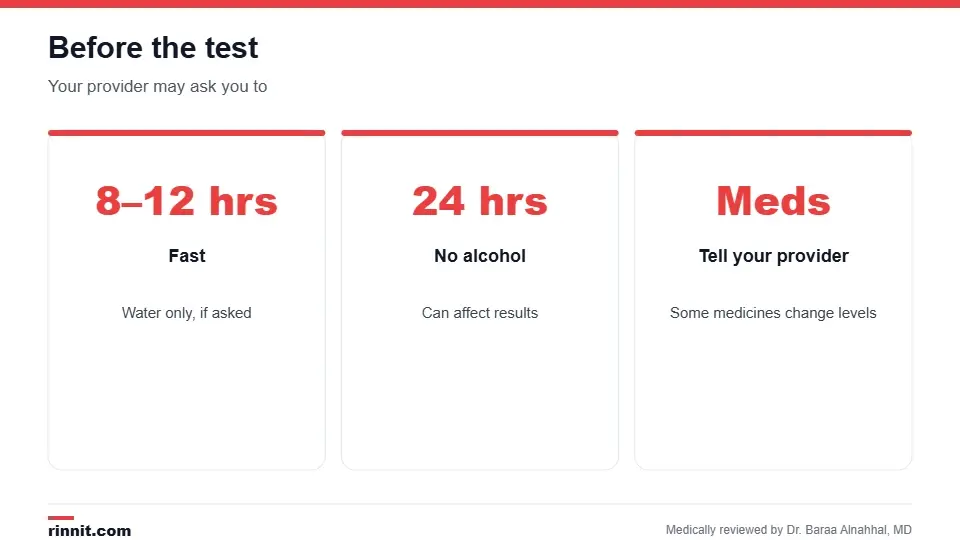
Some medicines can change amylase levels.
You may need to fast for 8–12 hours, drinking only water.
Avoid alcohol for 24 hours beforehand.
Tell your provider about all medicines; aspirin, corticosteroids, water pills, indomethacin, opioids and birth control pills can affect results. Sources: [1]
How is the test done?
Blood test: a band is tied around your arm and blood is drawn from a vein inside the elbow in a few minutes. Keep the bandage on and avoid exercise for a few hours.
Urine test: you give a single clean-catch sample, or collect urine at home over 24 hours as part of a urinalysis-style collection. Sources: [1]
The blood test is very safe, with a small chance of bruising. The urine test has no risks. Results usually come back in one to two days. Sources: [1]
Normal ranges
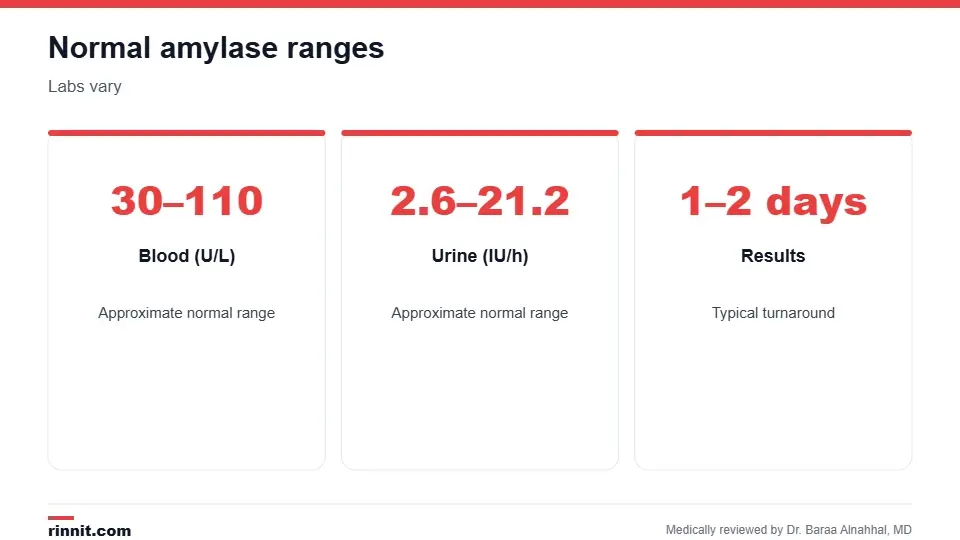
Ranges vary between labs.
Sample | Approximate normal range |
Blood | 30–110 U/L |
Urine | 2.6–21.2 IU per hour |
Sources: [1]
What do the results mean?
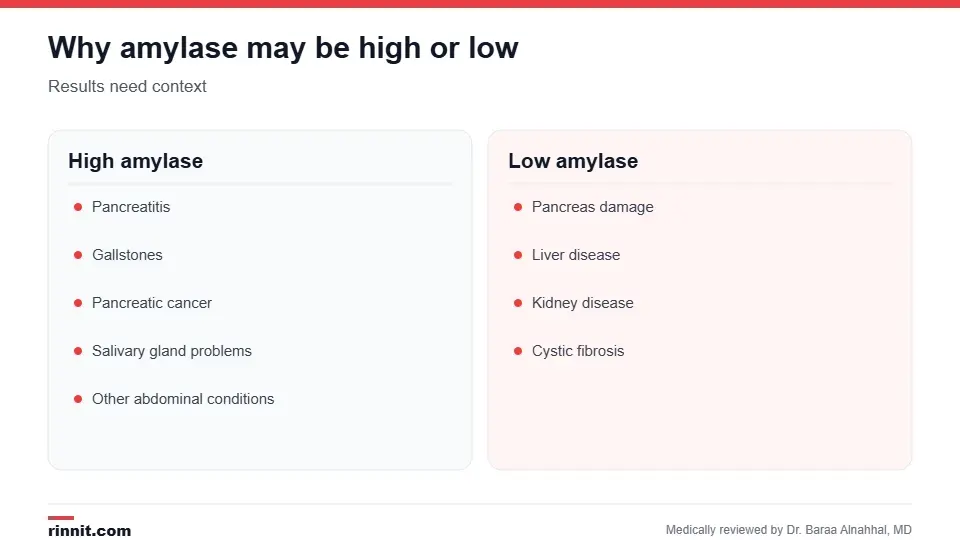
Amylase is interpreted with symptoms and other tests.
High amylase: may indicate a pancreas problem such as pancreatitis, gallstones or pancreatic cancer. Because salivary glands also make amylase, salivary gland problems and some other conditions can raise it too.
Low amylase: may point to damage to the pancreas, liver disease, kidney disease or cystic fibrosis. Sources: [1, 2, 3]
Your provider interprets results with your symptoms, history and other tests, often including lipase and imaging. Sources: [1, 2]
Conclusion
The amylase test is a simple blood or urine test that helps diagnose and monitor pancreas problems. Because amylase can come from other sources, it's usually read together with lipase and your symptoms.
Keep learning: read about pancreatitis and the pancreas blood test.
Frequently asked questions
What does an amylase test measure?
A digestive enzyme made by the pancreas and salivary glands.
Is it a blood or urine test?
It can be either.
What is a normal amylase level?
About 30–110 U/L in blood, though labs vary.
What does high amylase mean?
Often a pancreas problem, but other causes are possible.
What does low amylase mean?
It may suggest pancreas, liver or kidney problems or cystic fibrosis.
Do I need to fast?
You may need to fast for 8–12 hours.
Can medicines affect results?
Yes, including aspirin, steroids, opioids and birth control pills.
Is amylase or lipase better for pancreatitis?
Lipase is more specific; they're often checked together.
How long do results take?
Usually one to two days.
Are there risks?
Only minor bruising from the blood draw.
Related Reading
Pancreas Blood Test: Amylase and Lipase for Pancreatitis amylase and lipase testing together.
Lipase Blood Test: Normal Range, High and Low Levels and What They Mean the other key pancreas enzyme test.
Pancreatitis: Symptoms, Causes, and Treatment — A Clear Guide to Understanding and Managing the Condition the main condition amylase helps diagnose.
Salivary Glands: Location, Function, Symptoms and Care another source of amylase.
Pancreas: Function, Location, Anatomy and Common Conditions how the pancreas works.
References
Cleveland Clinic. Amylase Test: What It Is, Purpose, Procedure & Results. Cleveland Clinic. Last updated February 2, 2022. https://my.clevelandclinic.org/health/diagnostics/22386-amylase-test
Rompianesi G, Hann A, Komolafe O, et al. Serum amylase and lipase and urinary trypsinogen and amylase for diagnosis of acute pancreatitis. Cochrane Database Syst Rev. 2017;4(4):CD012010. PMID 28431198. https://doi.org/10.1002/14651858.CD012010.pub2
Pezzilli R, Billi P, Barakat B, et al. Serum pancreatic enzymes in patients with coma due to head injury or acute stroke. Int J Clin Lab Res. 1997;27(4):244-246. PMID 9506268. https://doi.org/10.1007/BF02912465
Medical disclaimer
This article is for general education only and does not replace advice from a qualified healthcare professional. Talk to your doctor about your own diagnosis and treatment, and seek emergency care right away for severe or sudden symptoms.



Comments