Urinalysis: What It Tests, How to Prepare, Normal Values and What Results Mean

Written and medically reviewed by Dr. Baraa Alnahhal, MD · Last reviewed: November 2026 · How we review
Quick Answer: What is a urinalysis?
A urinalysis is a set of tests on a sample of your urine. It looks at how your urine appears, checks it with a chemical dipstick and may examine it under a microscope for cells, crystals and germs. Providers use it for routine checkups and to look for infection, kidney or liver disease, diabetes and other conditions. [1]
What the research says
Two negative dipstick results make a urinary infection unlikely. A review of 70 studies found that when both the nitrite and leukocyte esterase tests were negative, the dipstick was useful in all patient groups to rule out infection. The combined test picked up 68% to 88% of infections, but positive results still needed to be confirmed. (Devillé et al., BMC Urology, 2004) [2]
Dipstick protein can miss early kidney damage. In data from 919,383 adults, a dipstick protein result of trace or more found only 62% of people with raised urine albumin (30 mg/g or higher), while 88% of people without raised albumin correctly tested negative. The authors note that the urine albumin-creatinine ratio remains the preferred test. (Sumida et al., Annals of Internal Medicine, 2020) [3]
Key takeaways
A urinalysis has three possible parts: a visual exam, a dipstick test and a microscopic exam, and the lab runs only the parts your provider orders. [1]
It is used in routine exams, during pregnancy, before surgery, on hospital admission and when you have signs of infection, kidney disease or diabetes. [1]
Most people need no special preparation, but tell your provider if you are on your period. [1]
The clean-catch midstream method is the most common way to collect the sample. [1]
Results usually come back in one to two business days. [1]
An abnormal result does not always mean you have a condition, and providers rarely diagnose from a urinalysis alone. [1]
What is a urinalysis?
A urinalysis is a group of tests that examines your urine. It checks how your urine looks and whether it contains blood cells, proteins and other substances. [1]
Providers use it for routine screening and to look for signs of infection, kidney disease, liver disease, diabetes and other conditions. [1]
What are the parts of a urinalysis?
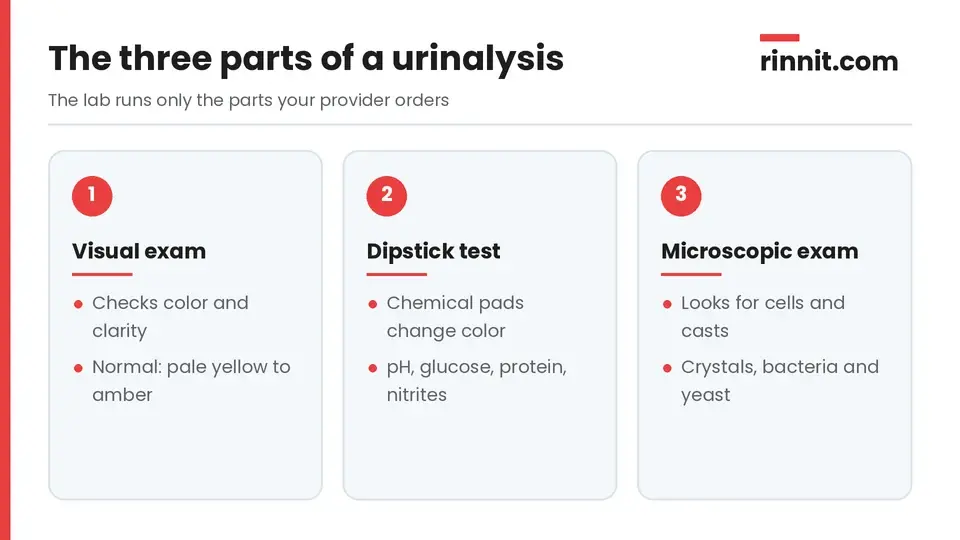
A urinalysis can include up to three different checks.
A urinalysis can include up to three parts. The lab only runs the tests your provider orders. [1]
Visual exam
The visual exam looks at color and clarity. Normal urine is a shade of yellow, from pale to deep amber, depending on how concentrated it is. Urine can be clear or cloudy, and "turbid" describes urine thick with suspended material. [1]
Dipstick test
A dipstick is a thin strip with chemical pads that change color when they touch certain substances in your urine. [1]
Dipstick check | What an abnormal result can point to |
pH | Kidney problems and UTIs can raise it; diabetic ketoacidosis and diarrhea can lower it |
Bilirubin | Liver or bile duct problems |
Blood (hemoglobin) | Infection, urinary tract damage, high blood pressure or cancer |
Glucose | Diabetes or gestational diabetes |
Ketones | Mainly used to check for diabetic ketoacidosis |
Leukocyte esterase | Inflammation in the urinary tract, most often from a UTI |
Nitrites | Bacteria in the urinary tract, which can suggest a UTI |
Protein (such as albumin) | Kidney damage (often from high blood pressure or diabetes), heart failure, overexertion or dehydration |
Specific gravity | How concentrated your urine is; many conditions can cause abnormal results |
Sources: [1]
Microscopic exam
A lab professional looks at a small amount of urine under a microscope to check for: [1]
Red blood cells: finds blood you cannot see; higher levels may point to bladder, kidney or urinary tract issues.
White blood cells: raised levels may mean infection or inflammation in the urinary tract.
Epithelial cells: some are normal; high numbers can suggest infection, inflammation or cancer, and squamous cells usually mean the sample was contaminated.
Casts: tube-shaped particles made from protein released by kidney cells; some types suggest kidney problems and others are normal.
Crystals: certain types can point to kidney stones.
Bacteria, yeast or parasites: can point to a UTI, a yeast infection or a sexually transmitted infection, although germs from outside the urinary tract can contaminate the sample.
Why would you need a urinalysis?
Your provider may order a urinalysis: [1]
As part of a routine medical exam
If you have symptoms of infection, kidney disease or diabetes
To monitor a condition you already have
During pregnancy
When you are admitted to the hospital
To prepare for surgery
How do you prepare for a urinalysis?
Usually you do not need to prepare. If you think you will have trouble passing urine when asked, an extra glass of water may help, but drinking too much can affect the results. [1]
Tell your provider if: [1]
You are menstruating, because menstrual blood and vaginal discharge can interfere with results.
You find it hard to pass urine away from home (shy bladder syndrome, or paruresis), so they can offer other options.
In some cases your provider may ask you to collect a first-morning sample, avoid certain foods or pause certain medications. Only stop a medication if your provider tells you to. [1]
How is a urine sample collected?
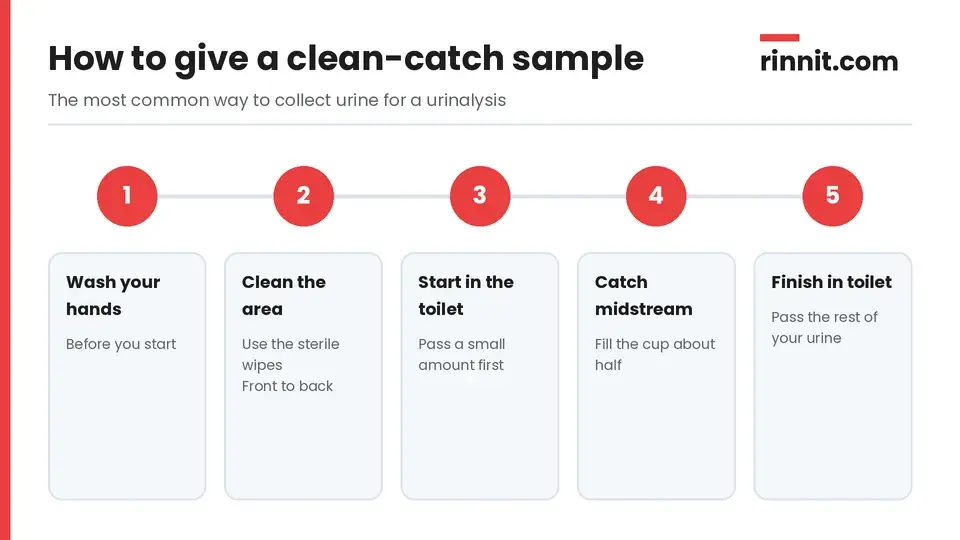
The clean-catch method helps keep germs from your skin out of the sample.
Clean-catch method
This is the most common method. [1]
Wash your hands.
Clean your genital area with the sterile wipes you are given. If you have labia, spread them and wipe the inner folds and the urethral opening from front to back. If you have a penis, clean the head, pulling back the foreskin first if you are uncircumcised.
Pass a small amount of urine into the toilet.
Collect the midstream urine in the cup until it is about half full, or the amount your provider asks for.
Finish urinating into the toilet.
Catheter method
Sometimes a provider collects the sample with a catheter. They clean the urethral opening with an antiseptic, insert a thin tube, drain urine into a sterile container and then remove the tube. [1]
Your provider may run a dipstick test right away in the office or send the sample to a lab. [1]
What are normal urinalysis results?
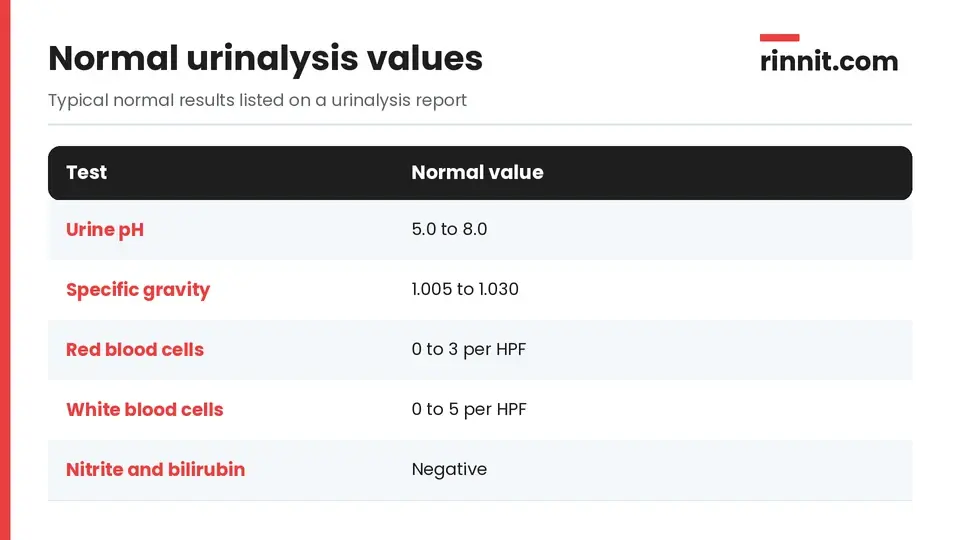
Normal values can vary slightly between labs.
Your report lists each test, your result (a number, positive or negative, or a word such as "yellow" or "clear"), the normal range and whether your result is within normal limits. Cell and bacteria counts may be described as "few," "moderate" or "many." Results usually come back in one to two business days. [1]
Test | Normal value |
Color | Yellow |
Clarity | Clear or cloudy |
Bilirubin | Negative |
Glucose | Negative or trace |
Hemoglobin (blood) | Negative or trace |
Ketones | Negative, none or trace |
Protein | Negative or trace |
Leukocyte esterase | Negative or trace |
Nitrite | Negative |
Urine pH | 5.0 to 8.0 |
Urine specific gravity | 1.005 to 1.030 |
Bacteria | None or negative |
Casts | 0 per low-powered field (LPF) |
Red blood cells | 0 to 3 per high-powered field (HPF) |
White blood cells | 0 to 5 per HPF |
Yeast | None or negative |
Sources: [1]
What does an abnormal urinalysis mean?
An abnormal result does not necessarily mean you have a medical condition. Providers rarely make a diagnosis from a urinalysis alone. They look at your medical history, symptoms and medications, and they may order more tests. [1]
Several things can affect your results: [1]
Certain medications and supplements, such as metronidazole and vitamin C supplements
Contamination during collection, such as vaginal discharge or menstrual blood
Contact your provider if you notice lasting changes in the color, smell or consistency of your urine, or if you have questions about your results. [1]
Conclusion
A urinalysis is a quick, noninvasive test that gives your provider a broad look at your urinary tract, kidneys and overall health from a single urine sample.
One abnormal value is a starting point, not a diagnosis. Ask your provider what your result means for you and whether you need further testing.
Keep learning: Read our guide to urinary tract infections or our explainer on the urine specific gravity test. For more trusted, doctor-reviewed health guides, visit Rinnit.com.
FAQ
What is a urinalysis?
It is a set of tests on your urine that checks its appearance, chemicals and cells.
What does a urinalysis check for?
Signs of infection, kidney or liver disease, diabetes and other conditions.
What are the three parts of a urinalysis?
A visual exam, a dipstick test and a microscopic exam.
Do I need to prepare for a urinalysis?
Usually not, but follow any instructions your provider gives you.
Can I have a urinalysis during my period?
Tell your provider first, because menstrual blood can affect the results.
What is a clean-catch urine sample?
A midstream sample collected after cleaning your genital area to reduce contamination.
What is a normal urine pH?
Between 5.0 and 8.0.
What is normal urine specific gravity?
Between 1.005 and 1.030.
How long do urinalysis results take?
Usually one to two business days.
Does an abnormal urinalysis mean I am sick?
Not necessarily; your provider may order more tests before making a diagnosis.
Related Reading
Urinary Tract Infection (UTI): Symptoms, Causes, Treatment, and Prevention explains the infection that nitrites, leukocyte esterase and white blood cells in urine often point to.
Blood in Urine (Hematuria): Symptoms, Causes, and Treatment covers what it means when a urinalysis finds red blood cells.
Chronic Kidney Disease: What It Is, Its 5 Stages, Causes, and How It's Treated describes long-term kidney damage that protein in urine can signal.
Kidney Stones: Symptoms, Causes, and Treatment Guide explains the stones that certain urine crystals can point to.
Asymptomatic Bacteriuria: A Plain-Language Guide to Bacteria in Urine Without Symptoms explains what bacteria in urine mean when you have no symptoms.
Orthostatic Proteinuria (Postural Proteinuria): Symptoms, Causes, Diagnosis, and Management — What You Need to Know covers a harmless cause of protein in urine that appears only when you are upright.
Diabetic Ketoacidosis (DKA): Signs, Triggers, and What To Do in an Emergency explains the emergency that ketones in urine are mainly used to check for.
24-Hour Urine Test: How to Collect It, Why It's Done and What Results Mean explains how to collect a full-day urine sample and what it measures.
Urine Cytology: Testing Urine for Bladder Cancer Cells explains the urine test that looks for bladder and urinary tract cancer cells.
References
Cleveland Clinic. Urinalysis: What It Is, Purpose, Procedure, Results & Types. Cleveland Clinic. Last updated July 3, 2024. https://my.clevelandclinic.org/health/diagnostics/17893-urinalysis
Devillé WL, Yzermans JC, van Duijn NP, et al. The urine dipstick test useful to rule out infections. A meta-analysis of the accuracy. BMC Urol. 2004;4:4. PMID 15175113. https://doi.org/10.1186/1471-2490-4-4
Sumida K, Nadkarni GN, Grams ME, et al. Conversion of Urine Protein-Creatinine Ratio or Urine Dipstick Protein to Urine Albumin-Creatinine Ratio for Use in Chronic Kidney Disease Screening and Prognosis : An Individual Participant-Based Meta-analysis. Ann Intern Med. 2020;173(6):426-435. PMID 32658569. https://doi.org/10.7326/M20-0529
Medical disclaimer
This article is for general education only and does not replace advice from a qualified healthcare professional. Talk to your doctor about your own diagnosis and treatment, and seek emergency care right away for severe or sudden symptoms.



Comments