24-Hour Urine Test: How to Collect It, Why It's Done and What Results Mean

Updated: 2 days ago
Written and medically reviewed by Dr. Baraa Alnahhal, MD · Last reviewed: November 2026 · How we review
Quick Answer
A 24-hour urine test measures the amount of protein, creatinine and other substances the kidneys pass into the urine over a full day. You collect every drop of urine for 24 hours and keep it cold. It's used to diagnose and monitor kidney problems. A normal adult protein level is less than 150 mg per day.
What the research says
Quick dipsticks can't replace a full collection: a meta-analysis of 17 studies in pregnancy found that urine dipsticks detected significant protein with only 65–69% sensitivity and 70–82% specificity compared with 24-hour urine collection, so they aren't reliable for ruling out proteinuria (Jones C et al., Pregnancy Hypertension, 2024) [2]
Repeating the test helps prevent kidney stones: in 200 people with kidney stones who had repeated 24-hour urine tests, those with the worst initial results had about 3 times more stone events per year (0.31 vs 0.09), and improving the results over time was linked to a lower risk of new stones (Sui W et al., Urolithiasis, 2025) [3]
Key takeaways
Measures protein, creatinine and other substances over 24 hours for an accurate daily total.
Discard the first morning urine, then collect everything for exactly 24 hours, ending with one last collection.
Keep the container in the fridge or on ice and return it to the lab promptly.
Missed collections, heavy exercise, stress, dehydration and some foods or medicines can affect results.
Normal adult protein is under 150 mg per day; results usually take a few days.
What is a 24-hour urine test?
Your kidneys filter waste from your blood into urine, and the amount of many substances changes throughout the day. A single urine sample gives a snapshot; a 24-hour collection gives the total amount for the whole day, which is more accurate for measuring protein, creatinine, calcium, oxalate, citrate, hormones and other substances. Providers usually order it after a urinalysis or blood test raises a question. Sources: [1]
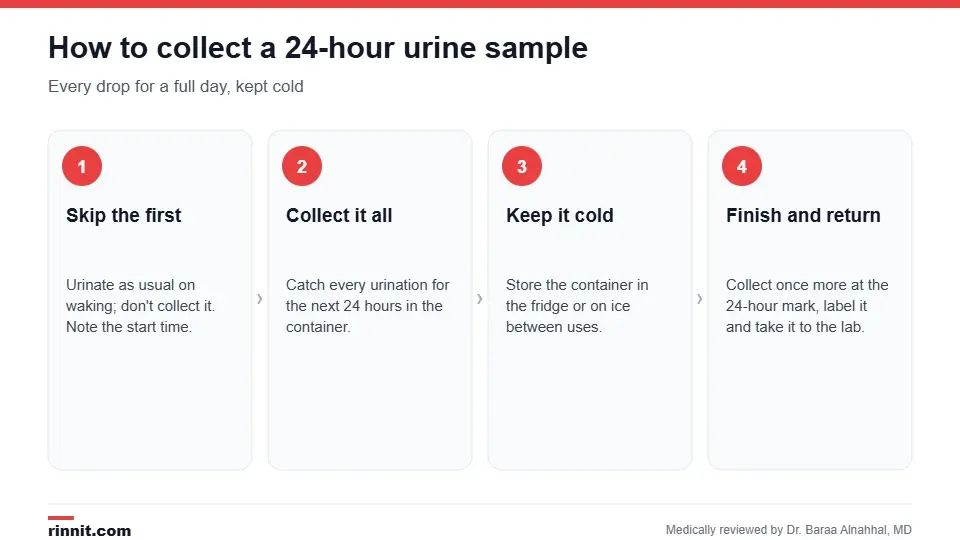
A 24-hour urine collection must include every urination.
Why is it done?

Conditions a 24-hour urine test helps diagnose or monitor.
Protein loss and nephrotic syndrome, which can be caused by diabetes-related kidney disease, lupus nephritis, amyloidosis and other conditions.
Kidney stones, to find out why they form.
Preeclampsia in pregnancy.
High blood pressure and heart failure.
Multiple myeloma, Alport syndrome and bladder cancer.
Rhabdomyolysis and urinary tract infections. Sources: [1]
How do I prepare?
Pick a day when you'll be home most of the day.
Make sure you have a fridge or another way to keep the container cold.
Avoid strenuous exercise the day before and on the collection day if your provider asks.
Follow any food or drink instructions; you may be asked to avoid caffeine, alcohol, nicotine or certain fruits and juices.
Tell your provider about all medicines, vitamins, herbs and supplements, but don't stop any unless told to. Sources: [1]
How to collect the sample
When you wake up, urinate in the toilet as usual. Don't collect this sample. Write down the time; this is your start time.
For the next 24 hours, collect all urine in the container. Keep toilet paper and stool out of it.
Keep the container in the fridge or on ice between uses.
Drink water through the day (about eight 6–8 oz glasses) and eat normally unless told otherwise.
Make your last collection as close as possible to 24 hours after the start time.
Label the container with your name and start and end times, and take it to the lab as soon as possible. Sources: [1]
If you miss a collection or spill some urine, tell the lab; you may need to start again on another day. Sources: [1]
Understanding your results
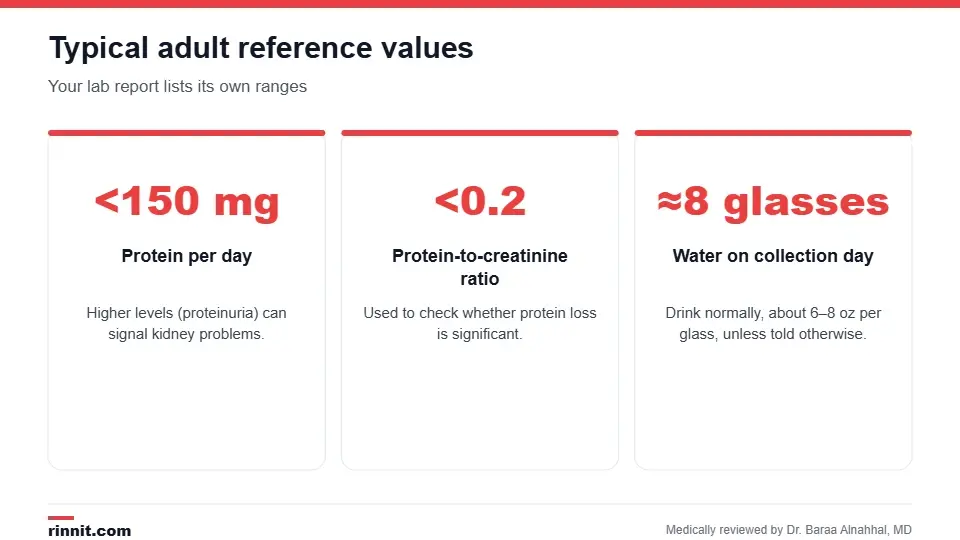
Typical adult reference values; labs may differ.
Measure | Typical adult value | Higher values may mean |
Total protein | Less than 150 mg/day | Proteinuria, a sign of kidney damage |
Protein-to-creatinine ratio | Less than 0.2 | Significant protein loss |
Stone-risk substances (calcium, oxalate, citrate, uric acid) | Lab-specific ranges | Higher risk of new kidney stones |
Results usually take a few days. Each lab provides its own reference ranges, and your provider interprets results alongside your symptoms and other tests, such as the urine protein-creatinine ratio or creatinine clearance. Sources: [1]
What can affect the results?
Collecting for more or less than 24 hours, or missing a sample.
Certain foods, medicines or supplements.
Strenuous exercise or extreme stress.
Dehydration. Sources: [1]
Risks
There are no physical risks. The main risk is an inaccurate result from an incomplete or poorly stored collection, which may mean repeating the test. Sources: [1]
Conclusion
A 24-hour urine test gives your provider an accurate picture of what your kidneys release over a whole day. It takes some planning, but following the steps carefully, especially skipping the first sample and keeping everything cold, makes sure the result is reliable.
Keep learning: read about kidney stones and nephrotic syndrome.
Frequently asked questions
Do I collect the first morning urine?
No. Urinate normally first thing, note the time, then collect everything after that.
Does the container need to be refrigerated?
Yes. Keep it in the fridge or on ice between uses.
What if I miss a sample?
Tell your provider or lab; you may need to repeat the collection.
Can I drink normally during the test?
Yes, unless told otherwise; about eight glasses of water is typical.
What is a normal 24-hour urine protein?
Less than 150 mg per day for adults.
Why not just use a single urine sample?
Levels change through the day, so a 24-hour total is more accurate for some measurements.
Can I exercise during the test?
Avoid strenuous exercise if your provider asks, because it can raise protein levels.
How long do results take?
Usually a few days.
Is the test used for kidney stones?
Yes. It shows substances such as calcium, oxalate and citrate that affect stone risk.
Are there any risks?
No physical risks; the main issue is an incomplete collection.
Related Reading
Kidney Stones: Symptoms, Causes, and Treatment Guide a common reason for a 24-hour urine test.
Nephrotic Syndrome: Symptoms, Causes, and Treatment Guide heavy protein loss measured by this test.
Urine Protein Creatinine Ratio (UPCR): Test, Normal Range and Results a single-sample alternative for measuring protein.
Urinalysis: What It Tests, How to Prepare, Normal Values and What Results Mean the routine urine test that often comes first.
Cushing Syndrome: What High Cortisol Does to Your Body and How It Is Treated a hormone condition sometimes checked with a 24-hour collection.
References
Cleveland Clinic. 24-Hour Urine Test: What It Is, Purpose, Procedure & Results. Cleveland Clinic. Last updated March 25, 2024. https://my.clevelandclinic.org/health/diagnostics/24-hour-urine-test
Jones C, Jakubowski BE, Stevens R, et al. The diagnostic accuracy of visual versus automated dipstick proteinuria testing in pregnancy: a systematic review and meta-analysis. Pregnancy Hypertension. 2024;35:73-81. PMID 38262144. https://doi.org/10.1016/j.preghy.2024.01.133
Sui W, Yang H, Escobar MC, et al. Improved 24-hour urine parameters associated with reduced symptomatic kidney stone recurrence. Urolithiasis. 2025;54(1):8. PMID 41428069. https://doi.org/10.1007/s00240-025-01910-1
Medical disclaimer
This article is for general education only and does not replace advice from a qualified healthcare professional. Talk to your doctor about your own diagnosis and treatment, and seek emergency care right away for severe or sudden symptoms.



Comments