Cushing Syndrome: What High Cortisol Does to Your Body and How It Is Treated

Updated: 2 days ago
Medically reviewed by Dr. Baraa Alnahhal, MD · Last reviewed: October 17, 2026
Quick Answer
Cushing syndrome is a rare hormonal condition caused by too much cortisol, most often from long-term corticosteroid use or a pituitary or adrenal tumor. Common symptoms include a round moon face, fat between the shoulders, easy bruising and purple stretch marks. Treatment targets the cause, through steroid adjustment, surgery, radiation or medication, and often cures the condition. [1]
What the research says
Surgery is the preferred treatment for tumor-related causes, but some problems linger. A Lancet seminar on endogenous Cushing's syndrome notes that excess cortisol causes many complications and increased mortality despite treatment, that surgery is the preferred treatment for all causes, that medical therapy has advanced markedly, and that several comorbidities can remain even after remission (Gadelha et al., The Lancet, 2023) [2].
The main dangers are heart, metabolic, bone, and infection problems. A review of complications describes high blood pressure, visceral obesity, impaired glucose metabolism, abnormal blood fats, osteoporosis and fractures, and infection susceptibility; heart attack, heart failure, and stroke are the most common causes of death, and prompt treatment of cortisol excess is crucial to reduce this risk (Pivonello et al., The Lancet Diabetes & Endocrinology, 2016) [3].
Treatment aims to normalize cortisol and treat related conditions. An Endocrine Society guideline states that treating Cushing's syndrome is essential to reduce mortality and associated conditions, that surgical removal of the causal lesion is generally first-line, and that second-line options (medication, bilateral adrenalectomy, and radiation for pituitary tumors) are individualized (Nieman et al., Journal of Clinical Endocrinology & Metabolism, 2015) [4].
What Is Cushing Syndrome?
Cushing syndrome is a rare hormonal condition that happens when your body has too much cortisol. You may also hear it called hypercortisolism or Cushing's syndrome. [1]
Cortisol is an important hormone that controls many bodily functions. But having too much of it can cause noticeable symptoms, like a round or full face, weight gain, and skin changes. [1]
The most common causes are taking corticosteroid medications or developing a tumor on your pituitary or adrenal glands. Treatment focuses on lowering cortisol levels. [1]

Cushing syndrome at a glance: what it is, common symptoms, main causes, and the treatment goal.
Cushing Syndrome at a Glance
Fact | Detail |
Other names | Hypercortisolism, Cushing's syndrome |
Type of condition | Rare hormonal condition |
Root cause | Too much cortisol in the body |
Most common causes | Long-term corticosteroid medication use; tumors on the pituitary or adrenal glands |
Common symptoms | Round "moon face," weight gain, skin changes (easy bruising, stretch marks) |
Who is at higher risk | Women and people between 25 and 50 years old |
Main treatment goal | Lowering cortisol levels |
Prognosis | In many cases, treatment cures the condition; life expectancy is typically unaffected |
What are the symptoms of Cushing syndrome?
Signs and symptoms of Cushing syndrome can vary widely. You may have one, many, or none of the listed signs. The most recognized symptoms involve appearance and the skin. [1]
Symptom | What You Might Notice |
Moon face | Weight gain in the face, giving it a round, full appearance |
Buffalo hump | Increased fat at the back of the neck or between the shoulders |
Skin changes | Easy bruising and wounds that heal poorly |
Stretch marks | Purple or pink stretch marks on the belly, breasts, and hips |
Blood pressure | High blood pressure |
Blood sugar | Diabetes or prediabetes |
Children | Stunted growth |
Other symptoms could include fatigue and general weakness, mood changes, weak muscles with thinner arms and legs, loss of libido or erectile dysfunction, period changes, and excess hair growth in females.

Common signs of Cushing syndrome; you may have one, many, or none.
What Causes Cushing Syndrome?
Too much cortisol causes Cushing syndrome. The causes come from two different sources. [1]
Endogenous (from within your body) means your body makes too much cortisol, usually due to a tumor on your pituitary or adrenal gland. Exogenous (from outside your body) means long-term use of steroid medications causes high cortisol levels; this is the more common route. [1]
Cause | How It Happens |
Glucocorticoid medications | Long-term use of medications like prednisone, dexamethasone, and hydrocortisone |
Pituitary tumors | Tumors that make too much ACTH, a hormone that tells your adrenal glands to make cortisol, cause 8 out of 10 cases; this form is called Cushing disease |
Adrenal cortical tumors | A tumor on the adrenal gland makes too much cortisol; usually not cancerous, but very rarely can be an adrenocortical carcinoma |
Ectopic ACTH-producing tumors | Tumors that develop outside the pituitary gland make ACTH; these are usually cancerous |
Who Is at Risk?
Anyone can develop Cushing syndrome. But it is more likely to affect women and people between 25 and 50 years old. [1]
What complications can untreated Cushing syndrome cause?
Without treatment, hypercortisolism can cause serious health problems. [1]
Complication | Effect on the Body |
Infections | Increased risk of infections |
Blood clots | Especially in the lungs and legs |
Bones | Broken bones or weak bones |
Cholesterol | High cholesterol |
Blood sugar | Prediabetes or Type 2 diabetes |
Blood pressure | High blood pressure |
Mental health | Mood swings |
Weight | Abnormal weight gain |
If left untreated, Cushing syndrome can result in death. This is mainly because of complications related to diabetes or cardiovascular diseases. [1]
How Is Cushing Syndrome Diagnosed?
Your healthcare provider will ask questions about your symptoms, review your medical history, and perform a physical exam, then order tests that check cortisol and other hormone levels. Cushing syndrome can be difficult to diagnose because some of its symptoms, like tiredness and weight gain, can have several other causes. [1]
Test | What It Measures |
24-hour urinary cortisol test | Measures the amount of cortisol in your urine collected over 24 hours |
Midnight salivary cortisol test | Checks cortisol levels between 11 p.m. and midnight, when they are typically at their lowest |
Dexamethasone suppression test | Measures how well your body can suppress cortisol production |
ACTH blood test | Low ACTH may indicate an adrenal tumor; normal or high levels may point to a pituitary or ectopic tumor |
Once diagnosed, your provider will work to find the underlying cause. If you do not take glucocorticoids, it usually points to a tumor. Imaging tests may follow to locate the tumor:
Imaging Test | Purpose |
CT scan or MRI of the abdomen | Looks for a tumor in the adrenal glands |
MRI of the pituitary gland | Looks for a pituitary tumor |
BIPSS (bilateral inferior petrosal sinus sampling) | Finds the source of ACTH secretion |
Chest CT scan | Looks for lung cancer and an ectopic tumor |
How Is Cushing Syndrome Treated?
Treatment depends on the underlying cause of the high cortisol levels. [1]
Treatment | How It Works |
Adjusting steroid medications | The provider lowers the dosage of glucocorticoids or prescribes a different medication, lowering the dose slowly without causing harm |
Surgery | Removes tumors that are causing excess cortisol |
Radiation | Treats tumors, depending on location and other factors |
Cortisol-slowing medication | A prescribed medication slows down cortisol production |
If you use glucocorticoids, your healthcare provider will lower the dosage or prescribe a different medication, carefully lowering the dose slowly without causing you harm. If a tumor is causing the syndrome, your provider may suggest surgery or radiation depending on the location and other factors. [1]
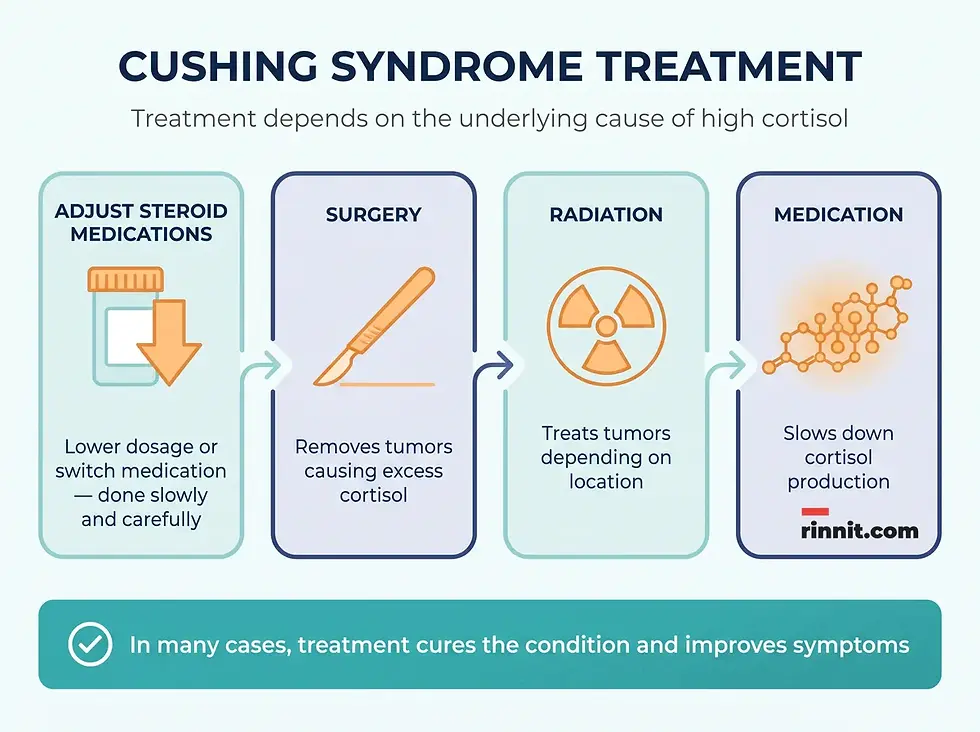
Treatment depends on the underlying cause of high cortisol.
Outlook: What Happens If Cushing Syndrome Goes Untreated?
Untreated Cushing syndrome is life-threatening, mostly because of the strain it can put on your heart and endocrine system. With the right treatment, your life expectancy should not be affected. Some related health problems, such as high blood pressure or bone loss, can linger after treatment, so ongoing follow-up matters. [1]
In many cases, treatment will cure Cushing syndrome and improve your symptoms. Regular checkups matter: Cushing syndrome can get worse without proper treatment, so let your provider know of any new or worsening symptoms. [1]
Some of the symptoms this condition causes can be embarrassing. If it is taking a toll on your mental health, reaching out to a therapist or joining a support group of others living with the condition may help. [1]
Conclusion
Cushing syndrome is a rare hormonal condition driven by too much cortisol, most often from long-term corticosteroid medication use or a pituitary or adrenal tumor. It reshapes the face, deposits fat between the shoulders, and changes the skin, and it can quietly raise blood pressure, blood sugar, and cholesterol along the way. The good news is that treatment focuses on the root cause, and in many cases it cures the condition and restores a normal life expectancy.
If you have noticed a round, fuller face, unexplained weight gain, easy bruising, or purple stretch marks, especially if you take steroid medications regularly, talk to a healthcare provider. Testing your cortisol is the first step, and early treatment can cure Cushing syndrome before complications take hold.
Related reading: adrenal glands, pituitary tumors, and adrenal cancer.
Frequently Asked Questions
What is Cushing syndrome?
Cushing syndrome, also called hypercortisolism, is a rare hormonal condition that happens when your body has too much cortisol. It can be caused by corticosteroid medications or by tumors on the pituitary or adrenal glands, and it commonly produces a round face, weight gain, and skin changes.
What are the symptoms of Cushing syndrome?
Common signs include a round, full "moon face," a "buffalo hump" of fat between the shoulders, easy bruising, purple or pink stretch marks on the belly, breasts, and hips, high blood pressure, and diabetes or prediabetes. Children may have stunted growth. You may have one, many, or none of these signs.
What causes Cushing syndrome?
There are two sources. Exogenous causes come from outside the body: long-term use of glucocorticoid medications like prednisone, dexamethasone, and hydrocortisone, which is more common. Endogenous causes come from within the body, usually a tumor on the pituitary or adrenal gland that makes too much cortisol or ACTH.
Is Cushing disease the same as Cushing syndrome?
Cushing disease is a specific form of Cushing syndrome caused by a pituitary tumor that makes too much ACTH, a hormone that tells the adrenal glands to make cortisol. Pituitary tumors cause 8 out of 10 cases of endogenous Cushing syndrome.
How is Cushing syndrome diagnosed?
Diagnosis involves a symptom review, medical history, and physical exam, followed by cortisol tests: a 24-hour urinary cortisol test, a midnight salivary cortisol test, a dexamethasone suppression test, and an ACTH blood test. Imaging (CT or MRI of the abdomen and pituitary, BIPSS, or a chest CT) is then used to find the tumor, if present.
How is Cushing syndrome treated?
Treatment targets the cause: lowering the dosage of steroid medications or switching drugs, surgery or radiation for tumors, or prescribing medication that slows down cortisol production.
Can Cushing syndrome be cured?
In many cases, treatment cures Cushing syndrome and improves symptoms. With the right treatment, life expectancy should not be affected, though some related health problems can linger and need ongoing care.
Is Cushing syndrome dangerous if untreated?
Yes. Without treatment, it can cause infections, blood clots, weak or broken bones, high cholesterol, diabetes, high blood pressure, and mood swings. If left untreated, it can result in death, mainly from diabetes or cardiovascular complications.
Who is most likely to develop Cushing syndrome?
Anyone can develop it, but it is more likely to affect women and people between 25 and 50 years old.
Should I stop my steroid medication if I'm worried about Cushing syndrome?
No. Never adjust or stop glucocorticoid medication on your own. Your healthcare provider will evaluate the situation and lower the dose slowly without causing you harm.
External Resources
Related Reading
CO2 Blood Test (Bicarbonate): Purpose, Procedure, Normal Levels and What Results Mean explains why Cushing's syndrome can cause a high result on a CO2 blood test.
Chloride Blood Test: Normal Range and What High or Low Levels Mean explains the electrolyte test behind high and low chloride results.
Cortisol Test: Blood, Saliva and Urine Tests, Normal Levels and What Results Mean explains how cortisol is measured in blood, saliva and urine and what the results mean.
Blood Glucose Test: Normal Blood Sugar Levels, Prediabetes and Diabetes Ranges explains normal, prediabetes and diabetes blood sugar ranges.
Dexamethasone Suppression Test (DST): Types, Preparation and Results explains the cortisol test used to diagnose Cushing syndrome.
24-Hour Urine Test: How to Collect It, Why It's Done and What Results Mean explains how to collect a full-day urine sample and what it measures.
References
Cleveland Clinic. Cushing Syndrome. Cleveland Clinic. Medically reviewed; last updated January 28, 2026. https://my.clevelandclinic.org/health/diseases/5497-cushing-syndrome
Gadelha M, Gatto F, Wildemberg LE, Fleseriu M. Cushing's syndrome. The Lancet. 2023;402(10418):2237-2252. PMID 37984386. https://doi.org/10.1016/S0140-6736(23)01961-X
Pivonello R, Isidori AM, De Martino MC, et al. Complications of Cushing's syndrome: state of the art. The Lancet Diabetes & Endocrinology. 2016;4(7):611-629. PMID 27177728. https://doi.org/10.1016/S2213-8587(16)00086-3
Nieman LK, Biller BMK, Findling JW, et al. Treatment of Cushing's syndrome: an Endocrine Society clinical practice guideline. Journal of Clinical Endocrinology & Metabolism. 2015;100(8):2807-2831. PMID 26222757. https://doi.org/10.1210/jc.2015-1818
Medical disclaimer
This article is for general educational purposes only and is not a substitute for professional medical advice, diagnosis or treatment. Never stop or change a steroid medication on your own; always talk to your healthcare provider first.



Comments