Adrenal Cancer: Complete Guide to Symptoms, Causes & Treatment

Updated: 2 days ago
Medically reviewed by Dr. Baraa Alnahhal, MD · Last reviewed: September 2026
Quick Answer
Adrenal cancer (also called adrenocortical carcinoma) is a rare growth of cells that starts in an adrenal gland — one of the small, triangular glands on top of the kidneys that control metabolism, blood pressure, and other vital functions. It most often affects children under 5 and adults in their 40s and 50s. Because the tumor cells often make extra hormones — most commonly cortisol — symptoms can include weight gain, muscle weakness, purple stretch marks, easy bruising, and high blood pressure, alongside back pain, belly pain, and unexplained weight loss. When found early, a cure may be possible; diagnosis uses hormone blood/urine tests, CT/MRI/PET imaging, and sometimes surgery, and treatment centers on removing the adrenal gland (adrenalectomy), often supported by radiation, chemotherapy, mitotane, and immunotherapy.
TL;DR
What it is: A rare cancer starting in the adrenal glands; also called adrenocortical carcinoma. Most adrenal growths are benign (not cancer).
Who it affects: Most likely children younger than 5 and adults in their 40s and 50s; can happen at any age.
Key symptoms: Back/belly pain, weight loss without trying, loss of appetite — plus hormone-driven changes (Cushing syndrome signs, sex hormone effects, or high blood pressure with low potassium).
Cause: DNA changes that make cells grow too fast and refuse to die; five inherited syndromes raise risk.
Prevention: Nothing found so far prevents adrenal cancer.
Treatment: Surgery (adrenalectomy) is the cornerstone, plus radiation, chemotherapy, mitotane, and immunotherapy depending on the situation.
Adrenal Cancer at a Glance
What it is: A growth of cells starting in an adrenal gland; also called adrenocortical carcinoma.
How common: Rare; most adrenal growths are benign (not cancer).
Who it affects: Most likely children under 5 and adults in their 40s and 50s; can occur at any age.
Outlook: A cure may be possible when found early; less likely once it has spread beyond the glands.
Common symptoms: Back pain, belly pain, weight loss without trying, loss of appetite.
Hormone symptoms: Extra cortisol (Cushing syndrome signs), sex hormone changes, or rarely high blood pressure with low potassium.
Cause: DNA changes in adrenal gland cells; five inherited syndromes raise risk.
Prevention: Nothing has been found that prevents adrenal cancer.
Diagnosis: Physical exam and history, blood/urine hormone tests, CT/MRI/PET imaging, sometimes surgery with lab testing.
Treatment: Adrenalectomy (surgery to remove the gland), radiation therapy, chemotherapy, mitotane, immunotherapy.
Note: This article is for general information only and is not a substitute for professional medical advice. Always consult a qualified healthcare professional for diagnosis and treatment.
What Is Adrenal Cancer?
Adrenal cancer is a growth of cells that starts in an adrenal gland. The adrenal glands are small, triangular glands located on top of the kidneys. Although small, these glands control much of what happens in the body — they make hormones that help control metabolism, blood pressure, and other important functions.
Two reassuring facts are worth knowing from the start. First, adrenal cancer is rare — it can happen at any age but is most likely to affect children younger than 5 and adults in their 40s and 50s. Second, most growths that form in the adrenal glands are not cancer — the medical term for that is benign. An example of a benign adrenal growth is an adrenal adenoma.
The timing matters enormously for the outcome: when adrenal cancer is found early, a cure may be possible. When the cancer has spread beyond the adrenal glands, a cure becomes less likely. In that situation, treatment may be used to keep the cancer from spreading more.

Healthy adrenal glands on top of the kidneys versus an adrenal gland affected by cancer: where the tumor forms, how it invades, and why early detection matters. Source: rinnit.com
Adrenal Cancer Symptoms: What to Watch For
General Symptoms
Signs and symptoms of adrenal cancer may include:
Back pain
Belly pain
Losing weight without trying
Loss of appetite
Hormone-Driven Symptoms: The Telling Clue
Many people who have adrenal cancer develop hormone changes in the body, because the cancer cells make extra hormones. The pattern of symptoms depends on which hormone the tumor overproduces:
Cortisol (most often): The cancer most often makes extra cortisol, causing Cushing syndrome. Symptoms include weight gain; muscle weakness; pink or purple stretch marks on the skin; bruises that happen even with a small injury; high blood pressure; high blood sugar or diabetes.
Sex hormones — estrogen and testosterone (less often): In females: extra facial hair, hair loss on the head, periods that aren't regular. In males: the testicles shrink and breast tissue gets bigger.
Aldosterone (rarely): High blood pressure and low levels of potassium in the blood.
This hormone connection is what makes adrenal cancer unusual: the symptoms can look like a hormonal disorder rather than a tumor, which is one reason awareness of the full symptom picture matters.
When to See a Doctor
Make an appointment with a healthcare professional if you have any symptoms that worry you. Unexplained pain, weight loss, or the hormone changes described above — especially in combination — deserve a proper medical evaluation.
What Causes Adrenal Cancer?
It's not clear exactly what causes adrenal cancer, but the mechanism is understood. Adrenal cancer happens when cells in the adrenal gland develop changes in their DNA. A cell's DNA holds the instructions that tell the cell what to do — in healthy cells, the DNA tells cells to grow and multiply at a set rate and to die at a set time.
In cancer cells, the DNA changes give different instructions: they tell the cancer cells to grow and multiply quickly and to keep living when healthy cells would die. This causes too many cells. The cancer cells might form a mass called a tumor, which can grow to invade and destroy healthy body tissue. In time, cancer cells can break away and spread to other parts of the body — when cancer spreads, it's called metastatic cancer.
Risk Factors: Inherited Conditions That Raise the Risk
Adrenal cancer happens more often in people who inherit certain health conditions that raise the risk of some cancers:
Beckwith-Wiedemann syndrome: Raises the risk of some cancers, including adrenal cancer.
Familial adenomatous polyposis: Raises the risk of some cancers.
Li-Fraumeni syndrome: Raises the risk of some cancers.
Lynch syndrome: Raises the risk of some cancers.
Multiple endocrine neoplasia, type 1 (MEN 1): Raises the risk of some cancers.
Importantly, healthcare professionals haven't found anything that can prevent adrenal cancer.
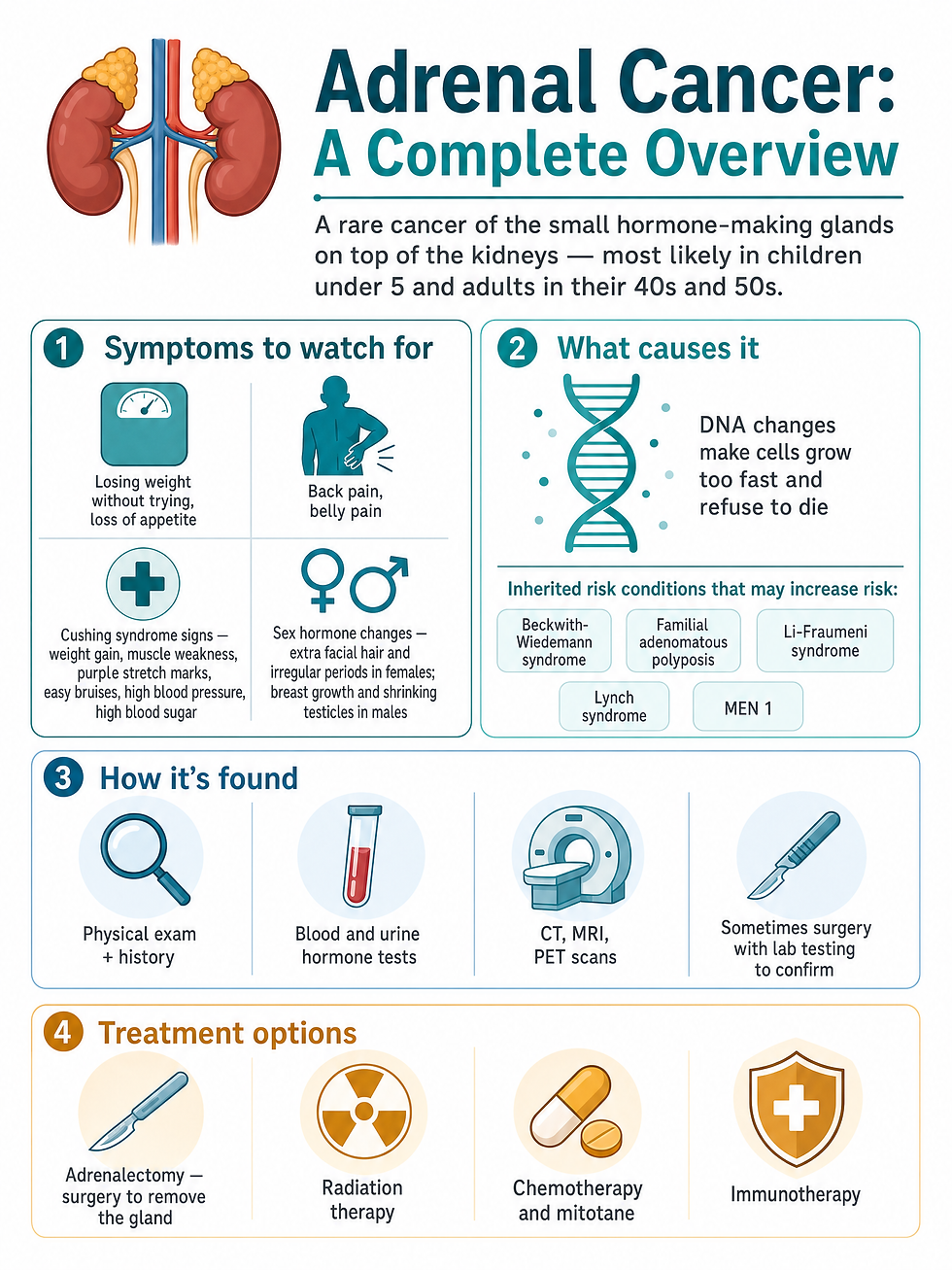
A quick reference: symptoms to watch for, what causes it, the inherited risk conditions, how it's found, and the four treatment options. Source: rinnit.com
How Adrenal Cancer Is Diagnosed
Diagnosis begins with a physical exam and a review of your health history and family medical history. Beyond that, the process involves blood and urine tests, imaging tests, and sometimes surgery:
Blood and urine tests: Lab tests may show levels of hormones made by the adrenal glands that are outside a healthy range — those hormones include cortisol, aldosterone, and androgens.
Imaging tests: CT, MRI, and PET scans (positron emission tomography) are used to examine growths on the adrenal glands and to look for signs that the cancer has spread to other areas of the body.
Surgery to remove the adrenal gland: In some situations, the adrenal gland that might have cancer is removed with surgery, then examined in a lab by a pathologist — a doctor who studies body tissues. Testing can show whether the gland has cancer.
Adrenal Cancer Treatment: What to Expect
Treatment for adrenal cancer often includes surgery to remove the adrenal gland, with other treatments used in some situations:
Surgery (adrenalectomy): Removes the entire adrenal gland; the cornerstone of treatment.
Radiation therapy: Powerful energy beams (X-rays, protons, or other sources) used after surgery to kill leftover cells, or to ease pain from cancer that has spread to bones.
Chemotherapy: Strong medicines for cancers that can't be entirely removed by surgery or that come back after surgery.
Mitotane (Lysodren): An older medicine for advanced adrenal cancer; may help prevent recurrence after surgery in high-risk patients; research is ongoing.
Immunotherapy: Medicine that helps the body's immune system find and kill cancer cells; used when cancer has spread or surgery isn't possible.
Surgery: The Cornerstone of Treatment
Surgery for adrenal cancer — called an adrenalectomy — typically involves removing the entire adrenal gland. It is done for several reasons at once: to confirm the diagnosis, to remove as much of the cancer as possible, to see whether the cancer has spread outside the adrenal gland, and to ease symptoms — including symptoms caused by too much cortisol and belly or back pain from a large tumor.
One complication makes surgery even more important: it's common for adrenal cancer to spread outside the adrenal gland. If the surgeon finds evidence that the cancer has spread to nearby organs such as the liver or kidney, parts or all of those organs may also need to be removed.
Radiation Therapy, Chemotherapy, and Mitotane
Radiation therapy treats cancer with powerful energy beams from X-rays, protons, or other sources. It is sometimes used after surgery to kill any cells that might be left behind, and it can help ease pain and other symptoms when cancer has spread to other parts of the body, such as the bones.
Chemotherapy treats cancer with strong medicines. For adrenal cancers that can't be entirely removed with surgery or that return after surgery, chemotherapy may help keep the cancer from growing and spreading.
Mitotane (Lysodren) is an older medicine used to treat advanced adrenal cancer. It has also shown promise in keeping adrenal cancer from coming back after surgery, and may be used after surgery for people at high risk of recurrence — though research into this use is ongoing.
Immunotherapy: Enlisting the Body's Own Defense
Immunotherapy treats cancer with medicine that helps the body's immune system kill cancer cells. The immune system fights disease by attacking germs and other cells that shouldn't be in the body — cancer cells survive by hiding from the immune system, and immunotherapy helps immune cells find and kill them. For adrenal cancer, it may be used when the cancer has spread to other parts of the body or when surgery isn't possible.
Coping and Support
With time, you'll find what helps you cope with an adrenal cancer diagnosis. Until then, two approaches stand out:
Learn more. Learn enough about adrenal cancer to help make decisions about your care. Ask your healthcare team about your cancer, understand your test results and treatment choices, and choose how much you want to know about your outlook — the choice that feels right to you. As you learn more, you may become more confident in making decisions.
Find a good listener. Talking with someone willing to hear your hopes and fears helps — a friend or family member, a counselor, a medical social worker, a clergy member, or a cancer support group. Ask your healthcare team about support groups and resources in your area; in the United States, examples include the National Cancer Institute and the American Cancer Society.
Preparing for Your Appointment
Start by making an appointment with a healthcare professional if you have any symptoms that worry you. Because appointments may be short, it's a good idea to be prepared.
What You Can Do
Be aware of anything you need to do before your appointment — when you make the appointment, ask if there's anything you need to do to get ready (for example, stopping eating or drinking for a certain amount of time)
Write down any symptoms you have, including any that seem unrelated
Write down key personal information, including major stresses, recent life changes, and family medical history
Make a list of all medicines, vitamins, or supplements you take
Consider taking a family member or friend along — someone with you may remember something you missed
Write down questions to ask
Questions to Ask
What's likely causing my symptoms? Other than the most likely cause, what are other possible causes?
What tests do I need?
What's the best course of action? What are the alternatives to the approach you're suggesting?
I have other health conditions — how can I best manage them together?
Are there restrictions I need to follow? Should I see a specialist?
Are there brochures or printed material I can have? What websites do you recommend?
What to Expect From the Doctor
Be ready to answer questions such as:
When did your symptoms begin? Do they come and go, or are they always present?
How serious are your symptoms?
What seems to make your symptoms better? What makes them worse?
Frequently Asked Questions (FAQ)
What is adrenal cancer?
Adrenal cancer is a growth of cells that starts in one of the adrenal glands — the small, triangular glands located on top of the kidneys that make hormones controlling metabolism, blood pressure, and other important functions. It is rare and is also called adrenocortical carcinoma.
Is an adrenal tumor always cancer?
No. Most growths that form in the adrenal glands are not cancer — the medical term for that is benign. An example of a benign adrenal growth is an adrenal adenoma. Only a proper medical evaluation can determine whether a growth is cancerous.
What are the first signs of adrenal cancer?
General signs can include back pain, belly pain, losing weight without trying, and loss of appetite. Because the tumor cells often make extra hormones — most commonly cortisol — hormone-driven symptoms such as weight gain, muscle weakness, purple stretch marks, easy bruising, high blood pressure, or high blood sugar may also appear.
Who is most at risk for adrenal cancer?
Adrenal cancer can happen at any age but is most likely to affect children younger than 5 and adults in their 40s and 50s. It also occurs more often in people who inherit certain conditions such as Beckwith-Wiedemann syndrome, familial adenomatous polyposis, Li-Fraumeni syndrome, Lynch syndrome, or MEN 1. Nothing has been found that prevents it.
How is adrenal cancer diagnosed?
Diagnosis starts with a physical exam and review of health and family history, followed by blood and urine tests to check hormone levels (cortisol, aldosterone, androgens), imaging tests such as CT, MRI, or PET scans to examine the growth and check for spread, and sometimes surgery to remove and test the adrenal gland in a lab.
How is adrenal cancer treated?
Treatment often begins with an adrenalectomy — surgery to remove the entire adrenal gland — which confirms the diagnosis, removes as much cancer as possible, checks for spread, and eases symptoms. Radiation therapy, chemotherapy, the medicine mitotane, and immunotherapy may also be used depending on the situation.
Conclusion
Three lessons anchor this guide: rare does not mean negligible — adrenal cancer is uncommon and most adrenal growths are benign, but its hormone-driven symptoms make early recognition possible, and early detection is what makes a cure achievable; hormones are the messenger — excess cortisol, sex hormones, or aldosterone produce a distinctive symptom picture that, when noticed, can point directly to the adrenal glands; and treatment is multi-layered — surgery anchors the plan, with radiation, chemotherapy, mitotane, and immunotherapy adding depth when needed.
This guide walked you through what the adrenal glands do, the general and hormone-specific symptoms, the DNA mechanism behind the disease, the five inherited conditions that raise risk, the full diagnostic pathway, every treatment option, and how to prepare for your appointment. If you're experiencing symptoms that worry you — especially the combination of pain, weight loss, and hormone changes described here — the most valuable next step is to make an appointment with a healthcare professional now, because when adrenal cancer is found early, a cure may be possible.
What to do next: If you found this guide useful, explore more in-depth health guides on rinnit.com — including our guide to Addison's disease, a condition of the same adrenal glands where too little hormone, rather than too much, drives the symptoms.
References
This content is provided for general informational purposes only and is not a substitute for professional medical advice, diagnosis, or treatment. Always seek the advice of a qualified healthcare provider with any questions about a medical condition.
Comments