Chloride Blood Test: Normal Range and What High or Low Levels Mean

Updated: 2 days ago
Written and medically reviewed by Dr. Baraa Alnahhal, MD · Last reviewed: November 2026 · How we review
Quick Answer: What is a chloride blood test?
A chloride blood test measures the amount of chloride, an electrolyte, in the blood. Chloride helps control nerve and muscle function, acid-base balance and the body's water. A normal adult level is about 96 to 106 mEq/L; high levels can point to dehydration or kidney disease, and low levels to heart failure or certain lung conditions. [1]
What the research says
Low chloride signals higher risk in heart failure. In 1,318 people hospitalized with acute heart failure, lower chloride on admission was linked to higher long-term death risk (7% lower risk for each 1 mEq/L higher chloride), an effect that held up in a separate group of 876 patients. (Grodin et al., Journal of the American College of Cardiology, 2015) [2]
Both high and low chloride are common in intensive care and tied to worse outcomes. A meta-analysis of 34 studies with 175,021 critically ill adults found high chloride in 34% and low chloride in 14%; both were linked to higher death rates, and high chloride also to acute kidney injury. (Wan et al., PLOS ONE, 2025) [3]
Key takeaways
Chloride is an electrolyte that helps control fluid balance, pH and nerve and muscle function. [1]
The test is rarely ordered alone; it is usually part of a BMP, CMP, electrolyte panel or renal function panel. [1]
A normal adult chloride level is about 96 to 106 mEq/L, but ranges vary by lab. [1]
High chloride may point to dehydration, kidney disease or acidosis; low chloride to heart failure, lung disease or alkalosis. [1]
An abnormal result does not always mean you have a medical condition. [1]
What is chloride?
Chloride is an electrolyte, a mineral that carries an electric charge when it dissolves in liquid. Along with sodium, potassium and bicarbonate, it helps: [1]
Control nerve and muscle function
Keep your blood's acid-base (pH) balance stable
Regulate the amount of water in your body
What is a chloride blood test?

Chloride is usually measured as part of a larger panel.
A chloride blood test, also called a serum chloride test, measures the chloride in your blood. It is often checked with other electrolytes to help diagnose or monitor kidney disease, heart failure, liver disease and high blood pressure. [1]
Chloride is rarely ordered by itself. It is usually part of one of these panels: [1]
Panel | What else it includes |
Basic metabolic panel (BMP) | Glucose, calcium, kidney tests and other electrolytes |
Comprehensive metabolic panel (CMP) | The BMP tests plus liver and protein tests |
Electrolyte panel | Sodium, potassium, chloride and bicarbonate |
Renal function panel | Tests that check how well your kidneys work |
Sources: [1]
Why would you need a chloride blood test?
It may be part of your routine blood work. Your provider may also order it if you have symptoms of a fluid or acid-base imbalance, such as: [1]
Repeated vomiting
Diarrhea
Fatigue or weakness
Dehydration
Difficulty breathing
Read together with your other electrolytes, the chloride result helps your provider find conditions caused by an imbalance of acids or fluids. [1]
How do you prepare for a chloride blood test?
A chloride test on its own or an electrolyte panel needs no special preparation. If it is part of a BMP or CMP, you may need to fast for several hours. Your provider will tell you what to do. [1]
What happens during the test?
A phlebotomist finds a vein, usually on the inside of your arm opposite your elbow, cleans the area and inserts a small needle, which may feel like a small pinch. Blood collects in a tube, the needle is removed, pressure is applied and a bandage goes on. Your sample goes to a lab, and your provider shares the results. [1]
What is a normal chloride level?

Check the normal range printed on your own lab report.
Results usually come back within two business days. Your report lists the test, your result, the normal range and whether your level is normal, high or low. [1]
A normal adult chloride level is generally 96 to 106 milliequivalents per liter (mEq/L), also written as 96 to 106 mmol/L. Ranges vary between labs, so check the range printed on your report. [1]
What do high and low chloride levels mean?
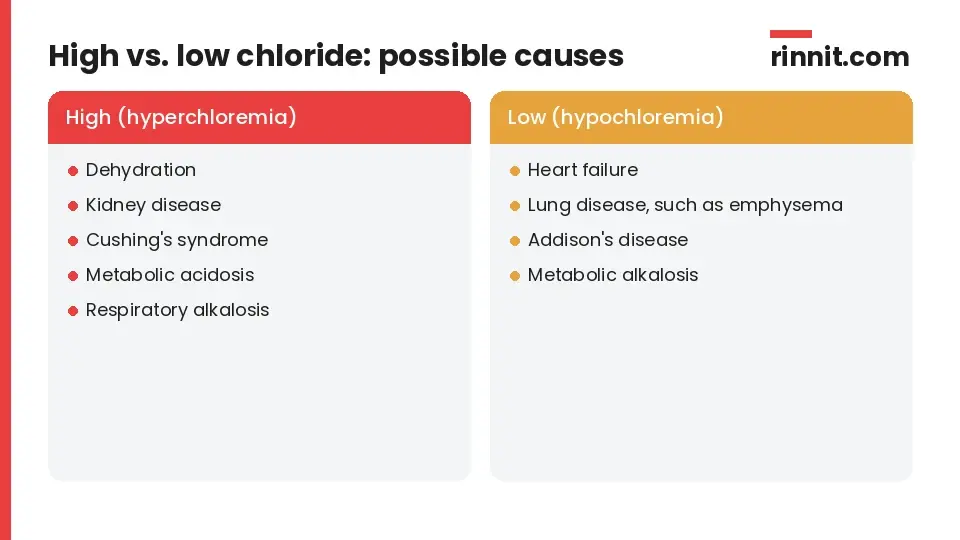
An abnormal level is a clue, read with your other results.
Result | Possible causes |
High chloride (hyperchloremia) | Dehydration, kidney disease, Cushing's syndrome, metabolic acidosis, respiratory alkalosis |
Low chloride (hypochloremia) | Heart failure, lung diseases such as emphysema, Addison's disease, metabolic alkalosis |
Sources: [1]
What else can affect chloride results?
Drinking large amounts of fluid
Losing fluid through vomiting or diarrhea
Certain medicines, such as antacids
An error during blood collection
Sources: [1]
What happens if your chloride level is abnormal?
An abnormal chloride level does not necessarily mean you have a medical condition or need treatment. Your provider will interpret it alongside your other test results and medical history and may order more tests to find the cause. Ask your provider any questions you have about your results. [1]
Conclusion
A chloride blood test is a routine part of most metabolic and electrolyte panels, and it helps your provider understand your fluid and acid-base balance. A high or low level is a clue that is read together with your other electrolytes, not a diagnosis on its own.
If your chloride is outside the normal range, ask your provider what is likely causing it and whether you need follow-up testing.
Keep learning: Read our guide to the basic metabolic panel (BMP) or our electrolytes guide. For more background, see the MedlinePlus page on the chloride blood test.
FAQ
What is a chloride blood test?
A blood test that measures chloride, an electrolyte that helps control fluid balance, pH and nerve and muscle function. [1]
What is a normal chloride level?
Generally 96 to 106 mEq/L (mmol/L) for adults, though ranges vary by lab. [1]
What does high chloride mean?
It may point to dehydration, kidney disease, Cushing's syndrome, metabolic acidosis or respiratory alkalosis. [1]
What does low chloride mean?
It may point to heart failure, lung diseases such as emphysema, Addison's disease or metabolic alkalosis. [1]
Why is a chloride test done?
As part of routine blood work or to check for fluid or acid-base problems with symptoms like vomiting, diarrhea, weakness or trouble breathing. [1]
Is chloride tested on its own?
Rarely; it is usually part of a BMP, CMP, electrolyte panel or renal function panel. [1]
Do I need to fast for a chloride blood test?
Not for chloride alone, but you may need to fast for several hours if it is part of a BMP or CMP. [1]
What can affect chloride results?
Drinking a lot of fluid, vomiting or diarrhea, medicines such as antacids, or a blood collection error. [1]
How long do chloride test results take?
Usually within two business days. [1]
Does an abnormal chloride level mean I need treatment?
Not necessarily; your provider reads it with your other results and may order more tests. [1]
Related Reading
Hypochloremia: Understanding Low Chloride Levels explains what a low chloride result means.
High Chloride Levels (Hyperchloremia): Causes and Management covers what a high chloride result means.
Understanding Metabolic Acidosis: Causes, Symptoms, and Treatment describes an acid-base problem linked to high chloride.
Understanding Metabolic Alkalosis: Causes, Symptoms, and Management describes an acid-base problem linked to low chloride.
Dehydration: Symptoms, Causes, Risk Groups & Treatment — Complete Guide covers a common cause of high chloride.
Addison's Disease: Complete Guide to Adrenal Insufficiency Symptoms, Causes & Treatment explains a hormone condition that can lower chloride.
Cushing Syndrome: What High Cortisol Does to Your Body and How It Is Treated explains a hormone condition that can raise chloride.
Sweat Test for Cystic Fibrosis: How It Works and What Results Mean explains the sweat chloride test used to diagnose cystic fibrosis.
References
Cleveland Clinic. Chloride Blood Test: What It Is, Purpose, Procedure & Results. Cleveland Clinic. Last updated October 28, 2024. https://my.clevelandclinic.org/health/diagnostics/22023-chloride-blood-test
Grodin JL, Simon J, Hachamovitch R, et al. Prognostic Role of Serum Chloride Levels in Acute Decompensated Heart Failure. J Am Coll Cardiol. 2015;66(6):659-666. PMID 26248993. https://doi.org/10.1016/j.jacc.2015.06.007
Wan X, Deng F, Bai X, et al. Dysregulated serum chloride and clinical outcomes in critically ill adults: A systematic review and meta-analysis. PLoS One. 2025;20(12):e0337560. PMID 41325394. https://doi.org/10.1371/journal.pone.0337560
Medical disclaimer
This article is for general education only and does not replace advice from a qualified healthcare professional. Talk to your doctor about your own diagnosis and treatment, and seek emergency care right away for severe or sudden symptoms.



Comments