Dehydration: Symptoms, Causes, Risk Groups & Treatment — Complete Guide

Updated: 2 days ago
Medically reviewed by Dr. Baraa Alnahhal, MD · Last reviewed: October 2026
Quick Answer: What Is Dehydration?
Dehydration is a condition in which the body loses or uses more fluid than it takes in. Mild to moderate cases are usually fixed by drinking more fluids, but severe dehydration needs immediate IV fluids. Infants, young children and older adults are at highest risk; call a doctor for fever of 102°F or higher or persistent vomiting of fluids.
What the research says
Oral rehydration works as well as an IV for most dehydrated children. In 17 randomized controlled trials of 1,811 children with mild or moderate dehydration, oral rehydration solution was as effective as intravenous rehydration for weight gain, duration of diarrhea and fluid administration, with shorter hospital stays (weighted mean difference −1.2 days; 95% CI −2.38 to −0.02); oral rehydration failed in 4% of patients. (Posovszky et al., Dtsch Arztebl Int, 2020) [3]
Dehydration from gastroenteritis is a major reason children are hospitalized. In the United States, acute gastroenteritis accounts for 1.5 million office visits, 200,000 hospitalizations and 300 deaths in children each year; oral rehydration therapy is the mainstay of treatment for mild dehydration, oral rehydration solutions are recommended for moderate dehydration, and hospitalization with IV fluids is reserved for severe dehydration (signs of shock or more than 10% dehydration) or children who do not respond to oral therapy. (Hartman et al., Am Fam Physician, 2019) [4]
People with dementia are more prone to dehydration. In a meta-analysis of 11 hospital database studies (1,044,131 patients with dementia versus 9,639,027 older patients without), dementia was associated with higher rates of dehydration and electrolyte imbalance (RR 1.87, 95% CI 1.55–2.25). (Rao et al., Arch Gerontol Geriatr, 2016) [5]
At a Glance
Aspect | Summary |
Definition | Body loses or uses more fluid than it takes in |
Most common cause in young children | Diarrhea and vomiting |
Most common cause in hot weather | Not drinking enough while active in the heat |
Highest-risk groups | Infants, young children, and older adults |
First signs in adults | Extreme thirst, less urination, dark urine, dizziness |
First signs in babies | Fewer wet diapers, no tears when crying, no wet diaper for 3 hours |
How mild cases are fixed | Drinking more fluids |
How severe cases are treated | IV fluids given immediately in a hospital |
Most serious complication | Hypovolemic (low blood volume) shock — can be deadly |
Prevention basics | Drink water, eat water-rich fruits and vegetables, avoid sodas and energy drinks |
What is dehydration, and why does it happen?
Dehydration occurs when the body uses or loses more fluid than it takes in. When that balance tips, the body no longer has enough water and other fluids to carry out its usual work — from regulating temperature to keeping blood pressure and blood volume stable.
Anyone can become dehydrated. The condition is simply more serious for infants, children, and older adults. In young children, the most common trigger is diarrhea and vomiting. In older adults, the body starts with a lower volume of water to begin with, and illnesses or medicines such as water pills (diuretics) push them over the edge more easily. Dehydration also strikes anyone who does not drink enough water during hot weather, especially people who are physically active in the heat.
The good news is that drinking more fluids usually fixes mild to moderate dehydration. Severe dehydration, however, needs medical treatment right away.

What are the symptoms of dehydration at every age?
Thirst is not always a reliable alarm. Many people — mainly older adults — do not feel thirsty until they are already dehydrated. That is why it matters to increase water intake during hot weather or illness, before symptoms appear. The signs also differ by age, so knowing both lists is important for families.
Dehydration Signs in Infants and Young Children
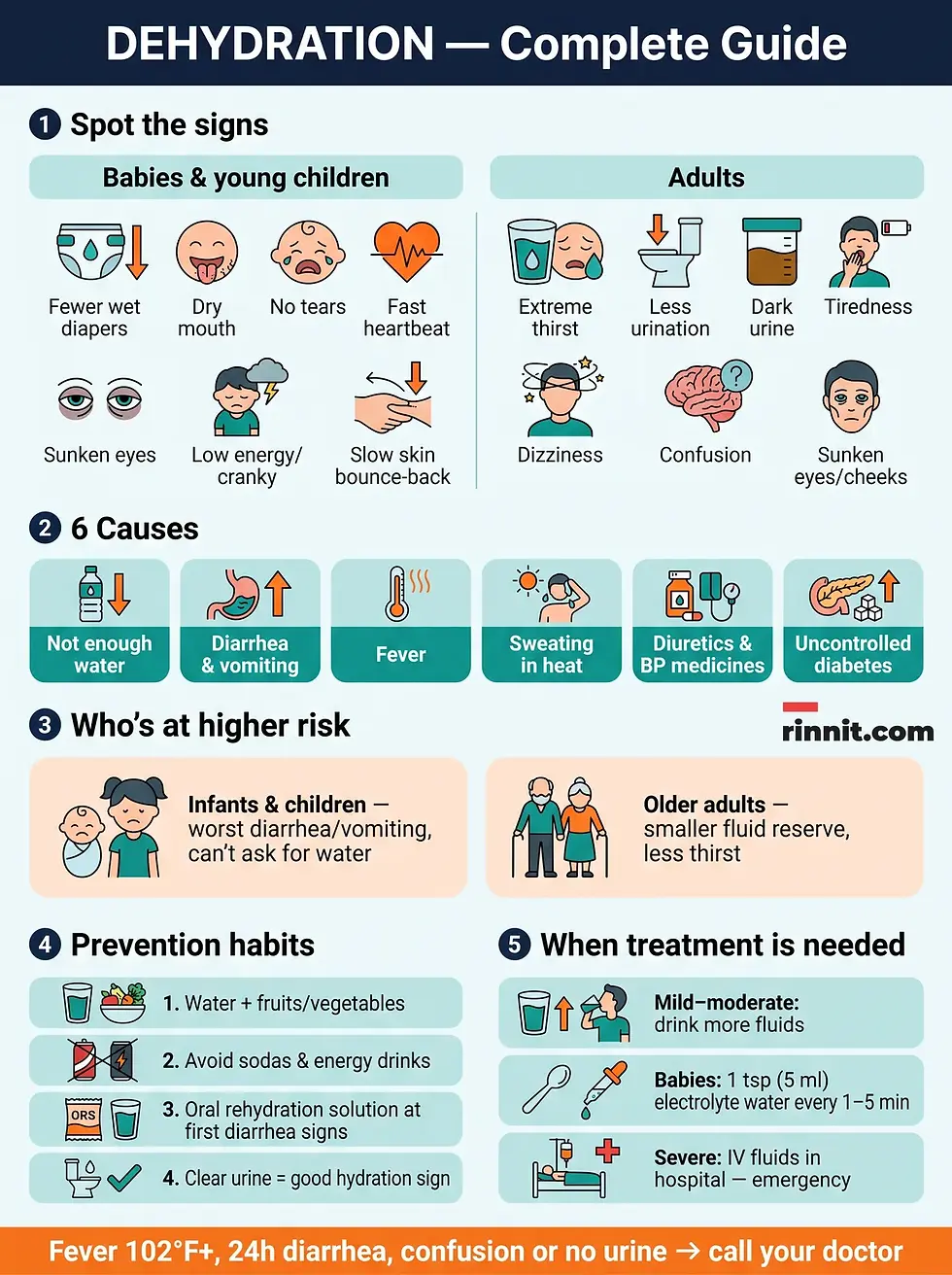
In babies and toddlers, the clues are mostly behavioral and visual, since they cannot tell you they are thirsty:
Urinating less than usual, or no wet diapers for three hours
Dry mouth
No tears when crying
Rapid heart rate
Sunken eyes, cheeks, or the soft spot on top of the skull
Lacking energy or being cranky
Skin that does not flatten back right away after being pinched
Dehydration Signs in Adults
Adults show a mix of thirst, urinary, and neurological signs:
Extreme thirst
Urinating less with dark-colored urine
Tiredness and dizziness
Confusion
Skin that does not flatten back right away after being pinched
Sunken eyes or cheeks
When to See a Doctor
Call your family healthcare professional if you or a loved one:
Has had diarrhea for 24 hours or more
Is cranky or confused
Is sleepier or less active than usual
Cannot keep down fluids
Has bloody or black stool
Has a fever of 102 degrees or higher
Emergency note: If a person shows signs of serious dehydration — no energy or not responding to others — seek immediate care at a hospital rather than waiting for an appointment.
What are the main causes of dehydration?
Sometimes dehydration happens for simple reasons: not drinking enough water because you are sick, too busy to remember, or without access to safe water while traveling, hiking, or camping. Beyond that, six specific causes account for most cases.
Cause | How it drains your fluids |
Diarrhea and vomiting | Sudden, hard diarrhea causes a huge loss of water and electrolytes (the minerals your body needs) in a short time; vomiting on top of diarrhea adds even more loss |
Fever illnesses | The higher the fever, the more severe the dehydration risk; the combination of fever plus diarrhea and vomiting is worse still. Even without fever, a cold or sore throat reduces eating and drinking |
Sweating in hot weather or activity | Sweating drains fluid; hot, humid weather increases sweat and fluid loss. Fluids must be replaced during hard activity |
Certain medicines | Diuretics ("water pills") and some blood pressure medicines cause more urination, which can lead to dehydration |
Diabetes | Diabetes that has not been diagnosed or is not controlled can lead to dehydration |
Not drinking enough water | Being sick, too busy, or without safe water when traveling, hiking, or camping |
Who is at highest risk of dehydration?
Anyone can get dehydrated, but two groups carry most of the danger because of biology, not behavior.
Infants and children are most likely to have bad diarrhea and vomiting, and they also lose a lot of fluids from high fevers or burns. Critically, young children often cannot say that they are thirsty — and cannot get a drink for themselves.
Older adults enter aging with a smaller fluid reserve. The body's ability to hold onto water is reduced, and older people are less likely to feel thirsty. Illnesses such as diabetes and dementia, plus certain medicines, pile on top of these problems — and some older adults cannot get water for themselves.
What complications can dehydration cause?
Left unchecked, dehydration can escalate into four serious complications.
Heat injury. Exercising hard and sweating a lot without drinking enough can lead to a heat injury. These range from mild heat cramps to heat exhaustion or heatstroke — which can be deadly.
Urinary and kidney problems. Long-lasting or repeated bouts of dehydration can cause urinary tract infections, kidney stones, and even kidney failure.
Seizures. Electrolytes such as potassium and sodium carry electrical signals from cell to cell. When they fall out of balance, the signals get mixed up — muscles can tighten or shorten, and a person can pass out.
Hypovolemic shock (low blood volume shock). This is the most serious complication of dehydration, and it can be deadly. Low blood volume causes a drop in blood pressure and a drop in the amount of oxygen in the body.
How can you prevent dehydration?
The simplest prevention is to drink fluids and eat foods that hold a lot of water, such as fruits and vegetables. Avoid fluids with caffeine or a lot of sugar — sodas and some energy drinks can actually be dehydrating.
Four situations create a need for more fluids than usual, and knowing them ahead of time is the whole strategy:
Situation | What to do |
Vomiting or diarrhea | Children need extra water at the first signs of illness, or a drink that replaces water, sugar, and electrolytes — an oral rehydration solution. Don't wait until dehydration occurs. |
Hard exercise | Start drinking more fluids the day before. Lots of clear urine is a good sign of being well hydrated. Drink regularly during the activity and continue afterward. |
Hot or cold weather | In heat, more water lowers body temperature and replaces sweat loss. In cold, dry air — especially at higher altitudes — extra water prevents moisture loss. |
Illness | Older adults can become dehydrated during even minor illnesses such as the flu, bronchitis, or bladder infections. Drink extra fluids whenever you don't feel well. |
How is dehydration diagnosed?
A healthcare professional often can diagnose dehydration from symptoms alone. For a child, a change in weight may be used in the diagnosis.
To confirm the diagnosis and measure exactly how dehydrated you are, two tests are commonly used:
Test | What it checks |
Blood tests | Levels of electrolytes — especially sodium and potassium — and how well the kidneys are working |
Urinalysis | Whether you are dehydrated and how much; it also checks for a bladder infection |
How is dehydration treated?
The only way to treat dehydration is to replace lost fluids and lost electrolytes. The best method depends on age, how bad the dehydration is, and its cause.
Treatment for Infants and Children
For babies and children dehydrated from diarrhea, vomiting, or fever, use water with electrolytes (such as oral rehydration solutions):
Start with about a teaspoon (5 milliliters) every 1 to 5 minutes
Increase the amount as the child is able to take it
For very young children, a syringe might be easier
Older children can drink watered-down sports drinks — 1 part sports drink to 1 part water
Treatment for Adults
Most adults with mild to moderate dehydration from diarrhea, vomiting, or fever can recover by simply drinking more water or other liquids. People who work or exercise outdoors in hot or humid weather should drink cool water, and sports drinks with electrolytes and a carbohydrate solution may also help.
Avoid this: For both children and adults, full-strength fruit juice and soft drinks might make diarrhea worse.
Treatment for Severe Dehydration
Severe dehydration should be treated right away — either by emergency workers in an ambulance or in a hospital emergency room. Salts and fluids given through a vein (intravenously, or IV) are absorbed quickly and speed recovery.
How should you prepare for a dehydration appointment?
You will likely start by seeing your or your child's family healthcare professional. If you or your child shows signs of serious dehydration — no energy or not responding to others — skip the appointment and seek immediate hospital care.
If you have time to prepare, make a list of:
Symptoms and when they began — if there has been vomiting or diarrhea, write down when it began and how long it lasted
Key personal information — recent travel or foods eaten that might have caused illness
Key medical information — other conditions, plus all medicines, vitamins, and supplements with doses
Questions to ask at your appointment
Questions to Ask Your Doctor
What's causing these symptoms?
What tests are needed?
What treatment do you recommend?
How long will it take to get better?
What can prevent dehydration from happening again?
Questions Your Doctor Will Likely Ask
What were you doing when the symptoms began?
Can you keep down food or drink?
When did you last urinate? Do you have pain with urination or feel like you have to urinate right away?
Are there other symptoms, such as belly cramping, fever, headache, or muscle aches? How bad are they?
Has there been blood in the stools?
Frequently Asked Questions
What is dehydration?
Dehydration occurs when your body uses or loses more fluid than it takes in, so it no longer has enough water and other fluids to do its usual work. Anyone can become dehydrated, but it is more serious for infants, children, and older adults.
What are the main causes of dehydration?
The most common causes are diarrhea and vomiting, fever, sweating in hot or humid weather, certain medicines such as diuretics ("water pills") and some blood pressure drugs, uncontrolled diabetes, and simply not drinking enough water.
How do you know if a baby or young child is dehydrated?
Watch for urinating less than usual or no wet diapers for three hours, a dry mouth, no tears when crying, a rapid heart rate, sunken eyes or soft spot, low energy or crankiness, and skin that does not flatten back quickly after being pinched.
How is dehydration diagnosed?
A healthcare professional can often diagnose it from symptoms, and in children a change in weight may help. Blood tests check electrolytes like sodium and potassium and kidney function, while a urinalysis shows whether — and how much — you are dehydrated.
What is the best treatment for dehydration?
Mild to moderate dehydration is usually fixed by drinking more fluids, while babies and children may need an oral electrolyte solution given as small frequent sips. Severe dehydration requires immediate medical care, with salts and fluids given intravenously in a hospital.
Can dehydration cause serious health problems?
Yes. It can lead to heat injury ranging up to deadly heatstroke, urinary tract infections, kidney stones, kidney failure, seizures from electrolyte imbalance, and hypovolemic shock — a dangerous drop in blood volume, blood pressure, and oxygen that can be deadly.
How can I prevent dehydration?
Drink plenty of fluids, eat water-rich fruits and vegetables, and avoid sodas and energy drinks. Add extra fluids at the first signs of vomiting or diarrhea, before and during hard exercise, in hot or cold weather, and whenever you feel ill.
Conclusion
This guide covered the full picture of dehydration: how it happens, how it looks different in babies versus adults, what pushes it toward danger, and how to stop it before it starts. Three lessons are worth keeping:
Thirst arrives late. Don't wait for it — increase fluids in hot weather and during illness, especially for older adults who may not feel thirsty at all.
Babies need extra vigilance. Fewer wet diapers, no tears, and a sunken soft spot mean act now — with small, frequent sips of electrolyte solution.
Severe means emergency. No energy, confusion, or unresponsiveness calls for immediate hospital care with IV fluids.
Understanding your body's fluid balance is one of the simplest and most powerful ways to protect your health. If you want to keep building that knowledge, explore more complete health guides written in plain language in the rinnit.com library.
Share your thoughts: comment below — did this guide answer your questions?
This content is for general informational purposes only and does not replace professional medical advice, diagnosis, or treatment. Always consult a qualified healthcare provider for medical decisions.
Related Reading
Electrolytes and Electrolyte Panel: Test, Normal Ranges and Imbalances: An electrolyte panel is a simple blood test that checks sodium, potassium, chloride and bicarbonate, which dehydration can push out of balance.
Learn more in our guide to BUN Test (Blood Urea Nitrogen): Normal Range, High and Low Levels.
Learn more in our guide to Urine Specific Gravity Test: Normal Range and What Results Mean.
Albumin Blood Test: What It Checks, How It's Done and What Results Mean explains why dehydration is the usual cause of a high albumin blood test result.
Basic Metabolic Panel (BMP): What It Tests, Normal Ranges and What Results Mean explains the blood test that checks kidney function, blood sugar and electrolytes.
Chloride Blood Test: Normal Range and What High or Low Levels Mean explains the electrolyte test behind high and low chloride results.
Capillary Refill Time: Normal Range and What a Slow Refill Means explains the quick fingertip test used to spot poor blood flow and shock.
References
Mayo Clinic Staff. Dehydration — Symptoms and causes. Mayo Clinic. May 2, 2025. https://www.mayoclinic.org/diseases-conditions/dehydration/symptoms-causes/syc-20354086
Mayo Clinic Staff. Dehydration — Diagnosis and treatment. Mayo Clinic. May 2, 2025. https://www.mayoclinic.org/diseases-conditions/dehydration/diagnosis-treatment/drc-20354092
Posovszky C, Buderus S, Classen M, et al. Acute infectious gastroenteritis in infancy and childhood. Dtsch Arztebl Int. 2020;117(37):615-624. PMID 33263539. https://doi.org/10.3238/arztebl.2020.0615
Hartman S, Brown E, Loomis E, Russell HA. Gastroenteritis in children. Am Fam Physician. 2019;99(3):159-165. PMID 30702253. https://pubmed.ncbi.nlm.nih.gov/30702253/
Rao A, Suliman A, Vuik S, Aylin P, Darzi A. Outcomes of dementia: systematic review and meta-analysis of hospital administrative database studies. Arch Gerontol Geriatr. 2016;66:198-204. PMID 27362971. https://doi.org/10.1016/j.archger.2016.06.008



Comments