Urine Specific Gravity Test: Normal Range and What Results Mean

Updated: 2 days ago
Written and medically reviewed by Dr. Baraa Alnahhal, MD · Last reviewed: November 2026 · How we review
Quick Answer: What is a urine specific gravity test?
A urine specific gravity test is a quick part of a urinalysis that compares the density of the urine with the density of water. It shows how well the kidneys balance water and remove waste. A typical range is 1.005 to 1.030. A low result means the urine is dilute, and a high result means it's concentrated. [1]
What the research says
Reading a dipstick by eye can underestimate specific gravity. In a study of 86 urine samples from 43 hospitalized children, bedside dipstick, automated dipstick reader and refractometer results were compared with laboratory analysis. Only the refractometer agreed well with the lab, while 31% of visually read dipstick values were falsely low. (Kalbfeld et al., Journal of Pediatric Oncology Nursing, 2021) [2]
Specific gravity is a standard yardstick for hydration. In 474 elite athletes who gave 803 urine samples, researchers used a specific gravity of 1.020 or higher to define low hydration and 1.010 or lower to define high hydration. A yellowness measure of urine color correlated strongly with specific gravity (r = 0.811). (Feng et al., Frontiers in Nutrition, 2022) [3]
Urine color tracks specific gravity, but less closely in older adults. A systematic review that screened 424 articles and included 10 studies found that urine color was linked with urine specific gravity or osmolality, with correlations from 0.40 to 0.93. Correlations were lower in adults older than 60. (Kostelnik et al., Journal of the American College of Nutrition, 2021) [4]
Key takeaways
Urine specific gravity compares the density of your urine with water to show how well your kidneys balance water and waste. [1]
A typical range is 1.005 to 1.030, and the expected normal range is also given as 1.0101 to 1.030. Labs' ranges vary. [1]
A low result points to dilute urine, such as from drinking a lot of fluid or diabetes insipidus; a high result points to concentrated urine, such as from dehydration. [1]
The test uses a urine sample in a cup and is read with a dipstick or a more accurate refractometer. [1] [2]
You may need to limit fluids for at least 12 hours beforehand, and some medicines and recent contrast dye can affect results. [1]
What is a urine specific gravity test?
Specific gravity of urine is a type of urine test that helps your provider understand the amount of water and waste products in your pee. It compares the density of your urine with the density of water, which has a specific gravity of 1. [1]
The test is also called a urine concentration test, urinary specific gravity, urine S.G., specific gravity urinalysis, urine density, water loading test or water deprivation test. Dehydration, overhydration or certain conditions can push your result outside the typical range. [1]
The waste products that make urine denser include: [1]
Urea, which comes from the breakdown of protein
Uric acid, which comes from purines in foods and drinks such as meats, beer and liquor
Sodium salts
Amino acids
Sources: [1]
Why is a urine specific gravity test done?
Your provider may order this test if they suspect a condition that affects how well your kidneys balance water or remove waste from your blood. A result outside the typical range can point to a cause of urine that is too dilute or too concentrated. [1]

Result | What it means | Possible causes |
Low (dilute urine) | More water than waste in your urine | Drinking a lot of fluid, diabetes insipidus, kidney infection (pyelonephritis), chronic kidney disease, kidney failure |
High (concentrated urine) | More waste than water in your urine | Dehydration, vomiting, diarrhea, SIADH, prerenal azotemia, Addison's disease |
Sources: [1]
Diabetes insipidus happens when your body makes too little vasopressin (antidiuretic hormone) or your kidneys do not respond to it. SIADH, the syndrome of inappropriate antidiuretic hormone secretion, is the opposite problem: too much of this hormone. Prerenal azotemia means reduced blood flow to the kidneys, and Addison's disease means your adrenal glands do not make enough hormones. [1]
How is urine specific gravity measured?
After you give a urine sample, it is checked with one of two methods. [1]
Feature | Dipstick | Refractometer |
What it is | A thin strip of plastic or paper with patches of chemicals | A medical device that measures how much light passes through urine |
How it works | The chemical patches change color according to the specific gravity | More water lets more light through; more waste lets less light through |
Sample used | The dipstick is placed in your sample | A few drops of your sample |
Speed | Result right away | May take longer |
Accuracy | Less accurate | More accurate than a dipstick |
Sources: [1]
Research supports this difference. In hospitalized children, visually read dipsticks gave falsely low values in 31% of samples, while the refractometer agreed well with laboratory results. [2]
How do you prepare for a urine specific gravity test?
Your provider will call you with exact instructions before the test. Common steps include: [1]
List all your medicines. Tell your provider about prescription, over-the-counter and herbal products. Stop a medicine only if your provider tells you to.
Mention recent imaging or procedures. Contrast dye from an MRI or CT scan, or a procedure that needed anesthesia, can affect results.
Follow fluid instructions. You may need to limit how much you drink for at least 12 hours before the test.
Sources: [1]
What happens during a urine specific gravity test?
You give a urine sample at your provider's office or a lab. The steps are simple: [1]

Wash your hands with soap and water.
Pee into the collection cup you are given.
If you have trouble peeing away from home (shy bladder syndrome), tell your provider. They may give you a cup to use at home or another option.
If you are menstruating, tell your provider, because menstrual blood can affect results.
Hand the sample to a staff member or leave it in the collection cupboard, as directed.
Sources: [1]
Urine specific gravity test at a glance
Item | Typical detail |
Sample | Urine collected in a cup |
Where | Provider's office or lab (a take-home cup may be an option) |
Preparation | Possible fluid limit for at least 12 hours |
Methods | Dipstick or refractometer |
Results | Dipstick right away; full urinalysis in one to two business days |
Sources: [1]
What happens after the test?
A urine specific gravity test is usually one part of several urine tests, so you will likely get all your results within one to two business days. Your provider may call you or send the results electronically. [1]
What do urine specific gravity results mean?
Water has a specific gravity of 1. A typical range is 1.005 to 1.030, and some labs use 1.010 to 1.030. Labs' ranges vary, so your provider will explain your result in light of your health and other test results. [1]
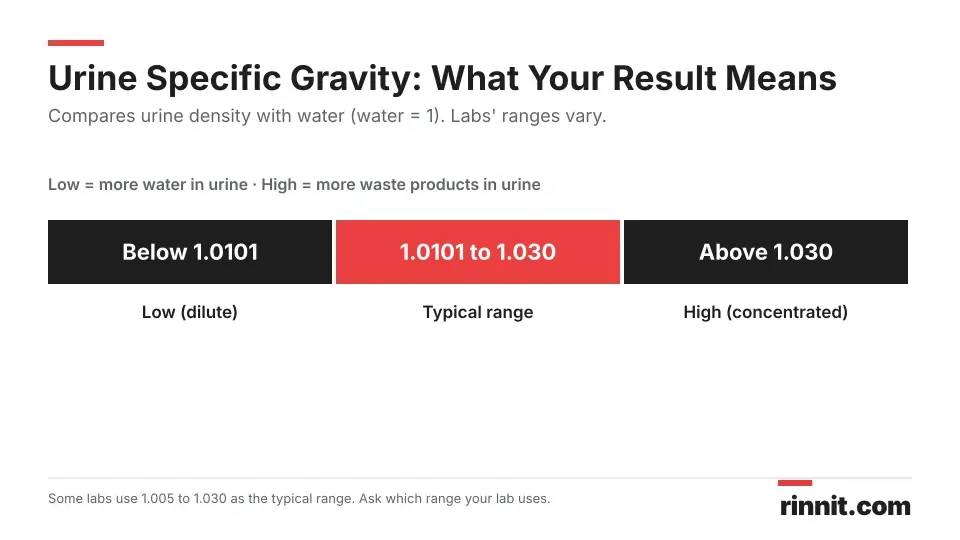
Result | Value | What it suggests |
Low | Below 1.005 | More water in your urine (dilute) |
Typical | About 1.005 to 1.030 | Typical range; labs' ranges vary |
High | Above 1.030 | More waste products in your urine (concentrated) |
Sources: [1]
What tests might follow an abnormal result?
If your result is abnormal, your provider may order more tests to find the cause: [1]
Type | Examples |
Blood tests | Osmolality, comprehensive metabolic panel, blood urea nitrogen (BUN) |
Imaging | Kidney (renal) ultrasound, CT scan, MRI |
Urine tests | Additional urine tests |
Sources: [1]
Are there risks?
A urine specific gravity test only needs a urine sample you give into a cup, and the sample is checked with a dipstick or a refractometer. Results can be affected by some medicines, recent contrast dye, anesthesia and menstrual blood, so share these details with your provider. [1]
When should you call your provider?
Contact your provider if: [1]
You have not received your results within a few days
You notice changes in your urine
You have questions about your results
Questions to ask your provider
Why do I need a urine specific gravity test?
Do I need to limit fluids or stop any medicines before the test?
Will my sample be tested with a dipstick or a refractometer?
What normal range does your lab use?
If my result is abnormal, what tests come next?
Conclusion
A urine specific gravity test is a simple urine test that compares the density of your urine with water. It helps your provider see whether your kidneys are balancing water and waste well, and whether your urine is too dilute or too concentrated. [1]
The test needs only a urine sample, though you may be asked to limit fluids beforehand. A refractometer gives a more accurate reading than a dipstick, and an abnormal result is usually followed by blood, imaging or more urine tests to find the cause. [1] [2]
Keep learning: Read our guides to dehydration, diabetes insipidus and chronic kidney disease. For more on this test, see the MedlinePlus guide to the urine specific gravity test.
FAQ
What is a urine specific gravity test?
It is a quick urine test that compares the density of your urine with the density of water to show how well your kidneys balance water and remove waste.
Why would a provider order a urine specific gravity test?
A provider may order it if they suspect a condition that affects how well your kidneys balance water or remove waste from your blood.
What is a normal urine specific gravity?
A typical range is 1.005 to 1.030, and the expected normal range is also given as 1.010 to 1.030. Labs' ranges vary, so ask your provider what your result means.
What does low urine specific gravity mean?
A low result means your urine has more water than usual. Causes include drinking a lot of fluid, diabetes insipidus, kidney infection, chronic kidney disease and kidney failure.
What does high urine specific gravity mean?
A high result means your urine has more waste than usual. Causes include dehydration, vomiting, diarrhea, SIADH, prerenal azotemia and Addison's disease.
How do I prepare for a urine specific gravity test?
Tell your provider about all your medicines and any recent contrast imaging or anesthesia. You may be asked to limit fluids for at least 12 hours before the test.
Does a urine specific gravity test hurt?
The test only requires you to pee into a cup. The sample is then tested with a dipstick or a refractometer.
How long does it take to get results?
A dipstick gives a result right away, while a refractometer may take longer. Results of all your urine tests usually arrive in one to two business days.
Is a dipstick or a refractometer more accurate?
A refractometer, which measures how much light passes through a few drops of urine, is more accurate than a dipstick.
What happens if my result is abnormal?
Your provider may order blood tests such as osmolality, a comprehensive metabolic panel and BUN, imaging such as a kidney ultrasound, CT or MRI, or more urine tests.
Related Reading
Learn more in our guide to Dehydration: Symptoms, Causes, Risk Groups & Treatment — Complete Guide.
Learn more in our guide to Diabetes Insipidus: Symptoms, Types, Causes & Treatment — Complete Guide.
Learn more in our guide to Central Diabetes Insipidus (CDI): The Rare Thirst Condition Caused by a Hormone Shortage.
Learn more in our guide to Nephrogenic Diabetes Insipidus: Causes, Symptoms, and Management.
Learn more in our guide to Acute Kidney Injury: What Causes Sudden Kidney Failure, and How It Is Treated.
Learn more in our guide to Addison's Disease: Complete Guide to Adrenal Insufficiency Symptoms, Causes & Treatment.
References
Cleveland Clinic. Urine-Specific Gravity: Purpose, Range & High Symptoms. Cleveland Clinic. Last updated January 9, 2025. https://my.clevelandclinic.org/health/diagnostics/specific-gravity-of-urine
Kalbfeld K, Parkosewich JA, Teng W, et al. Comparison of Point-of-Care Testing Methods and Laboratory Analysis for Assessing Urine Specific Gravity and pH of Children Undergoing Chemotherapy. J Pediatr Oncol Nurs. 2021;38(1):6-15. PMID 32951503. https://doi.org/10.1177/1043454220958652
Feng Y, Fang G, Qu C, et al. Validation of urine colour L*a*b* for assessing hydration amongst athletes. Front Nutr. 2022;9:997189. PMID 36034925. https://doi.org/10.3389/fnut.2022.997189
Kostelnik SB, Davy KP, Hedrick VE, et al. The Validity of Urine Color as a Hydration Biomarker within the General Adult Population and Athletes: A Systematic Review. J Am Coll Nutr. 2021;40(2):172-179. PMID 32330109. https://doi.org/10.1080/07315724.2020.1750073
Medical disclaimer
This article is for general education only and does not replace advice from a qualified healthcare professional. Talk to your doctor about your own diagnosis and treatment, and seek emergency care right away for severe or sudden symptoms.



Comments