Central Diabetes Insipidus (CDI): The Rare Thirst Condition Caused by a Hormone Shortage

Updated: 2 days ago
Medically reviewed by Dr. Baraa Alnahhal, MD · Last reviewed: October 17, 2026
Quick answer
Central diabetes insipidus (CDI) is a rare condition in which the body lacks enough antidiuretic hormone (ADH), causing extreme thirst and excessive urination [1]. It is usually caused by damage to the hypothalamus or pituitary gland [1] [2] [4]. It is treated with desmopressin, a medication that works like ADH, and the outlook is generally good with medication and regular water intake [1].
What the research says
According to PubMed:
Surgery on pituitary-area tumors can cause CDI, and the risk depends on the tumor type. In a meta-analysis of 51 studies, vasopressin deficiency (the newer name for CDI) after transsphenoidal surgery was transient in 17% and permanent in 3% of patients overall. Permanent rates were 2% for pituitary adenomas, 14% for Rathke's cleft cysts, and 30% for craniopharyngiomas (Fountas et al., European Journal of Endocrinology, 2024) [6].
A severe head injury with a basal skull fracture can cause lasting CDI. In a case report with literature review, a 16-year-old developed CDI within 3 days of severe traumatic brain injury (polyuria and sodium of 155 mmol/l) and still had CDI symptoms 2 years later; the authors named probable damage to the posterior pituitary and pituitary stalk as a cause (Astafyeva et al., Zhurnal Voprosy Neirokhirurgii, 2022) [7].
Inflammation of the pituitary stalk can trigger CDI that desmopressin controls. In a case report with review, a woman developed CDI three weeks after COVID-19: her urine stayed dilute during water deprivation, MRI showed pituitary stalk thickening, and oral desmopressin quickly improved her symptoms, though it was still needed after four months (Natsuki et al., Endocrine Journal, 2024) [8].
Study details are from PubMed abstracts.
What is central diabetes insipidus (CDI)?
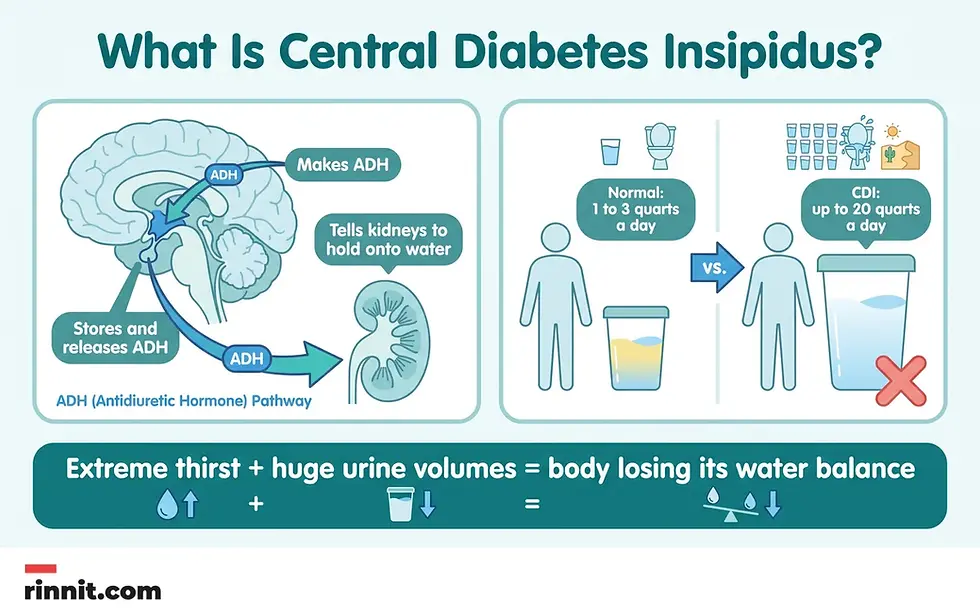
Central diabetes insipidus (CDI) is a rare condition in which your body doesn't have enough antidiuretic hormone (ADH, or vasopressin). This causes you to pee large volumes of urine and become very thirsty [1]. Your hypothalamus produces ADH, but your pituitary gland stores and releases it [1]. You can get CDI if your pituitary gland or hypothalamus is damaged [1] [3] [5].
Hormones are chemicals that coordinate different functions in your body by carrying messages through your blood to your organs, muscles, and other tissues. Your hypothalamus is the part of your brain that controls your autonomic nervous system and the activity of your pituitary gland. The posterior lobe of the pituitary stores and releases ADH.
ADH helps regulate the water balance in your body by controlling how much water your kidneys reabsorb while they filter wastes out of your blood. Normally, your body produces more ADH when you're dehydrated or losing blood pressure — telling your kidneys to hold onto water instead of releasing it in your pee [1]. In CDI, the hypothalamus isn't making enough ADH and/or the pituitary isn't releasing enough, causing frequent and excessive water loss through your urine [1].
People with CDI pee large volumes of urine several times a day and drink large amounts of water because they feel constantly thirsty. If you have CDI and don't drink enough fluid to replace water loss through urine, you can become dehydrated, which is dangerous to your health [1] [3].
How is CDI different from other types of diabetes insipidus?
Central diabetes insipidus is the most common type of diabetes insipidus [1]. Other types include nephrogenic diabetes insipidus (kidneys don't respond to ADH), dipsogenic diabetes insipidus (drinking problems), and gestational diabetes insipidus (occurring in pregnancy) [1] [3].
Is central diabetes insipidus the same as diabetes?
No. CDI is not the same as diabetes mellitus, the common "sugar diabetes" in which your pancreas doesn't make enough insulin or your body doesn't use it properly [1] [3]. They share the name "diabetes" because they both cause increased thirst and frequent urination. The word comes from the Greek "diabainein," meaning "go through" [1] — much like the liquids that quickly pass through your body in both conditions.
How is central diabetes insipidus different from nephrogenic diabetes insipidus?
Both central and nephrogenic diabetes insipidus cause the same signs and symptoms: peeing large amounts of urine and drinking a lot of fluids. The difference lies in what causes them and how they're treated.
Central DI (CDI) | Nephrogenic DI | |
What's broken | Hypothalamus and/or pituitary gland don't release enough ADH | Kidneys don't respond to ADH, even when there's plenty of it |
Usual causes | ||
Response to synthetic ADH | Responds | Doesn't respond |
Who does central diabetes insipidus affect?
Central diabetes insipidus can affect anyone at any age. The onset of CDI is more common between the ages of 10 and 20 years [1].
How common is central diabetes insipidus?
Central diabetes insipidus is a rare condition. It affects approximately 1 out of every 25,000 people [1] [4].
What are the symptoms of central diabetes insipidus?
The main symptoms of central diabetes insipidus (CDI) involve producing very large amounts of urine, which can quickly lead to dehydration if fluids are not replaced.
Symptom | What it looks like |
Frequent urination | Needing to pee often, including through the night |
Large urine volume | Passing large amounts of light-colored or clear urine each time |
Extreme thirst | Feeling very thirsty and drinking liquids very often [1] |
While most people produce one to three quarts of urine a day, people with CDI can produce up to 20 quarts of urine a day [1] [3] [5].
If CDI isn't treated, or if a person with CDI stops drinking fluids, it can quickly lead to dehydration. Symptoms of dehydration include feeling dizzy or lightheaded, feeling tired, having a dry mouth, lips, and eyes, difficulty performing simple mental tasks, nausea, and fainting [1].
If you're experiencing extreme thirst and frequent urination and/or dehydration, it's important to go to the hospital as soon as possible. While CDI is rare, it's not the only condition that causes these symptoms — and extreme thirst with frequent urination is a significant sign that something in your body isn't working properly and needs medical treatment.
What causes central diabetes insipidus?
Central diabetes insipidus (CDI) results from a partial or complete deficiency of antidiuretic hormone. This deficiency usually comes from damage to your hypothalamus, pituitary gland, or the pituitary stalk — the tissue that connects them [1]. Specific causes include:
Cause | How it damages ADH production or release |
Brain surgery | |
Head injury | Damage to the hypothalamus or pituitary gland, particularly basal skull fractures [1] |
Inflammation (granulomas) | |
Tumors | |
A rare disorder that can damage tissue or cause lesions in one or more places in your body | |
Inherited gene mutation | A change on chromosome 20 — an extremely rare cause, with fewer than 100 reported cases [1] |
In approximately one-third of CDI cases, healthcare providers can't determine the cause [1]. This is known as idiopathic central diabetes insipidus. Researchers believe some idiopathic cases may be caused by autoimmune factors — conditions in which your immune system attacks healthy tissue for unknown reasons. In this case, your immune system would produce antibodies or lymphocytes that attack the cells that release ADH [1].
CDI can also occur as part of a larger syndrome or condition, including Wolfram syndrome (an inherited condition) and septo-optic dysplasia (a rare disorder of early brain development) [1] [4].

How is central diabetes insipidus diagnosed?
Since other conditions, including diabetes mellitus, also cause frequent thirst and urination, part of diagnosing CDI involves ruling out other conditions. Because of this, your healthcare provider may order several tests if you're experiencing these symptoms. A diagnosis also involves determining the cause.
Test | What it checks |
Water deprivation test | The simplest and most reliable method [1] [2]. You stop drinking liquids for several hours under constant supervision (since it can cause dehydration). With CDI, you continue to pee large amounts of watery (dilute), light-colored urine — when normally you'd pee a small amount of concentrated, dark yellow urine [1]. |
Blood test (ADH) | Checks your antidiuretic hormone (vasopressin) levels. |
Blood test (glucose) | Checks glucose levels to rule out diabetes mellitus [1]. |
Urinalysis | Checks osmolality (the concentration of your urine) and/or ketones, which could indicate diabetes mellitus [1]. |
Synthetic ADH injection | A diagnostic injection of synthetic ADH to determine your kidneys' response. People with nephrogenic DI don't respond (their kidneys are resistant to ADH); people with CDI do respond [1]. |
MRI |
How is central diabetes insipidus treated?
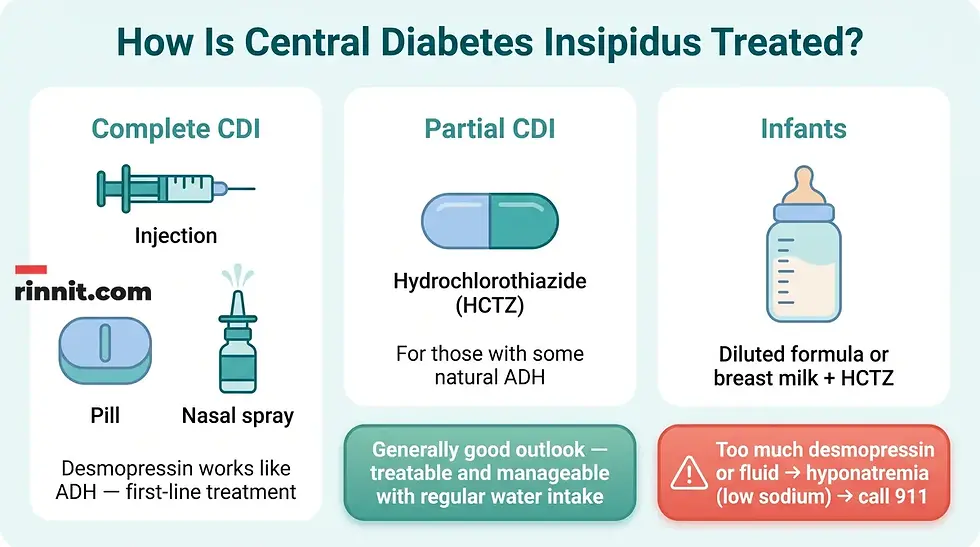
Treatment for CDI depends on the severity of the ADH deficiency [1].
What are the side effects of desmopressin?
Desmopressin is generally very safe to use and has few side effects. Possible side effects include headache, abdominal pain, nausea, a blocked or runny nose, and nosebleeds [1].
However, if you take too much desmopressin or drink too much fluid while taking it, your body can retain too much water, causing hyponatremia — a low level of salt (sodium) in your blood [1]. Symptoms of hyponatremia include a severe or prolonged headache, confusion, and nausea and vomiting [1].
Emergency: If you're experiencing symptoms of hyponatremia, call 911 or go to your nearest emergency room as soon as possible.
What can I do to manage CDI at home?
Aside from medical treatment, it's important to drink water regularly to make sure you don't get dehydrated. It's also important to see your provider regularly to make sure your treatment is working and that you have the right dosage of medication [1].
What's the outlook?
The outlook (prognosis) for CDI is generally good. It usually doesn't cause serious problems as long as it's treated properly and you drink enough water [1].
The risk of complications and death is higher for infants, seniors, and those with mental health conditions, because they may have trouble recognizing their thirst or can't do anything about it [1].
What are the complications?
The main complication of CDI is dehydration — when your body loses too much fluid and electrolytes to work properly. You can usually make up for the significant volume of fluids you pass in your urine by drinking more liquids. But if you don't, you could quickly become dehydrated, and dehydration is dangerous and can be life-threatening [1] [3].
Who | Complications of untreated CDI |
Infants | Seizures, brain damage, developmental delays, stunted growth [1] (from repeated dehydration episodes) |
Children and adults | Irregular heartbeats (arrhythmia), fever, dry skin and mucous membranes, seizures, coma [1] |
Adults | Orthostatic hypotension — a dramatic drop in blood pressure when standing or sitting, causing dizziness or momentary loss of consciousness [1] |
Can I prevent central diabetes insipidus?
Most cases of central diabetes insipidus (CDI) unfortunately can't be prevented [1], although several known risk factors have been identified. Known risk factors include:
When should I see my healthcare provider?
If you have CDI, it's important to see your healthcare provider regularly so they can run tests to monitor your condition and make sure your treatment is working. If you're experiencing any concerning symptoms, contact your provider.
Emergency: If you're experiencing symptoms of severe dehydration, such as altered consciousness and nausea, get to the nearest emergency room as soon as possible.
What questions should I ask my healthcare provider?
If you've been diagnosed with central diabetes insipidus (CDI), you may want to ask your provider about its cause, treatment options, daily water intake and family risk.
What caused my CDI?
Is my CDI chronic or temporary?
What are my treatment options?
What are the benefits and risks of different treatment options?
How much water should I be drinking in a day?
Is there anything else I can do to manage my condition?
Are my family members at risk for developing CDI?
Conclusion
Central diabetes insipidus is a rare but real condition — affecting about 1 in 25,000 people — in which the brain's ADH-producing system (the hypothalamus and pituitary gland) can't keep your body's water balance in check. The warning signs are unmistakable: extreme thirst, constant fluid intake, and urine volumes that can reach 20 quarts a day. Most cases trace back to damage from surgery, head injury, inflammation, tumors, or an inherited gene change, and about a third have no identifiable cause. The good news is that CDI is treatable and manageable: desmopressin replaces the missing hormone for complete CDI, and the prognosis is generally good with proper treatment and regular hydration. The caution to remember: dehydration is the main danger, and staying on top of your medication, your water intake, and your provider visits is what keeps it at bay.
A note of reassurance. CDI is rare, but it's also treatable and manageable. With the right medication, regular check-ins with your provider, and consistent water intake, most people with CDI live full lives. If you or a loved one has been diagnosed, questions are welcome — your care team is there to help you manage the condition.
Looking for clear answers on tough health questions? Browse hundreds of plain-language guides at Rinnit.com.
Frequently asked questions
What is central diabetes insipidus?
Central diabetes insipidus (CDI) is a rare condition in which your body doesn't have enough antidiuretic hormone (ADH, or vasopressin), causing you to pee large volumes of urine and become very thirsty.
How common is central diabetes insipidus?
It's rare — it affects approximately 1 out of every 25,000 people.
What does "insipidus" mean? Is it the same as diabetes?
No. CDI is not the same as diabetes mellitus (the sugar diabetes). Both conditions cause increased thirst and frequent urination, which is why they share the word "diabetes" — from the Greek "diabainein," meaning "go through."
What is ADH or vasopressin?
Antidiuretic hormone is a hormone made by the hypothalamus and stored and released by the pituitary gland. It regulates your body's water balance by telling your kidneys how much water to reabsorb while filtering wastes from your blood.
Why do I pee so much with CDI?
In CDI, your hypothalamus isn't making enough ADH and/or your pituitary isn't releasing enough. Without enough ADH, your kidneys can't hold onto water, so your body loses large amounts of it through urine.
How much urine do people with CDI produce?
Most people produce one to three quarts of urine a day. People with CDI can produce up to 20 quarts a day.
What are the main symptoms of CDI?
Needing to pee often (including through the night), passing large amounts of light-colored or clear urine each time, and feeling very thirsty and drinking liquids very often.
Can CDI affect infants?
Yes. Infants with CDI may also have irritability, lethargy, vomiting, constipation, and fever.
What happens if I don't drink enough water with CDI?
You can quickly become dehydrated, which is dangerous. Dehydration symptoms include dizziness, tiredness, dry mouth and lips, difficulty with simple mental tasks, nausea, and fainting.
Who gets central diabetes insipidus?
Anyone at any age — though onset is more common between ages 10 and 20.
What causes CDI?
Usually damage to the hypothalamus, pituitary gland, or pituitary stalk, from causes including brain surgery, head injury (especially basal skull fractures), inflammation (granulomas from sarcoidosis or tuberculosis), tumors (craniopharyngioma, germinoma), Langerhans cell histiocytosis, or an inherited gene mutation on chromosome 20.
What is idiopathic central diabetes insipidus?
In about one-third of CDI cases, providers can't determine the cause — that's called idiopathic CDI. Researchers believe some idiopathic cases may be autoimmune, meaning the immune system produces antibodies or lymphocytes that attack the cells releasing ADH.
How is CDI different from nephrogenic diabetes insipidus?
Both cause the same symptoms, but CDI stems from too little ADH (brain problem), while nephrogenic DI stems from kidneys that don't respond to ADH (kidney problem). Nephrogenic DI can be caused by medications like lithium and tetracycline, low potassium, high calcium, or a blocked urinary tract.
How is CDI diagnosed?
The simplest and most reliable method is a water deprivation test — supervised not drinking for several hours to see how your body responds. Providers may also order blood tests (ADH and glucose levels), urinalysis, a diagnostic injection of synthetic ADH, and imaging such as an MRI.
What happens during a water deprivation test?
You stop drinking liquids for several hours under constant supervision (since it can cause dehydration). If you have CDI, you'll continue to pee large amounts of watery, light-colored urine — when normally you'd produce only a small amount of concentrated, dark yellow urine.
How is CDI treated?
For complete CDI, the first-line treatment is desmopressin, a medication that works like ADH, available as an injection, pill, or nasal spray. For partial CDI, providers may prescribe hydrochlorothiazide (HCTZ). Infants may be treated by diluting formula or breast milk with water plus hydrochlorothiazide.
What are the side effects of desmopressin?
Desmopressin is generally very safe. Possible side effects include headache, abdominal pain, nausea, a blocked or runny nose, and nosebleeds.
What is hyponatremia, and why does it matter?
Hyponatremia is a low level of salt (sodium) in your blood. It can occur if you take too much desmopressin or drink too much fluid while taking it, causing your body to retain too much water. Symptoms include a severe or prolonged headache, confusion, and nausea/vomiting — and require calling 911 or going to the emergency room right away.
What's the outlook for CDI?
Generally good. CDI usually doesn't cause serious problems as long as it's treated properly and you drink enough water.
What are the complications of untreated CDI?
The main complication is dehydration. Untreated CDI in infants can lead to seizures, brain damage, developmental delays, and stunted growth. In children and adults it can cause irregular heartbeats, fever, dry skin and mucous membranes, seizures, and coma. Adults may also develop orthostatic hypotension (dizziness or brief loss of consciousness when standing or sitting).
Can I prevent CDI?
Unfortunately, most cases can't be prevented. Risk factors include brain surgery, family history of diabetes insipidus or Wolfram syndrome, head injury, and brain infections.
When should I go to the emergency room?
If you have symptoms of severe dehydration such as altered consciousness and nausea, or symptoms of hyponatremia (severe/prolonged headache, confusion, nausea and vomiting), get to the nearest emergency room as soon as possible.
Related reading
This article is for general informational purposes only and is not a substitute for professional medical advice, diagnosis, or treatment. Always seek the advice of your physician or other qualified health provider with any questions about a medical condition. Never disregard professional medical advice or delay seeking care because of something you have read here. If you or someone else experiences symptoms of severe dehydration (such as altered consciousness or nausea) or hyponatremia (severe headache, confusion, vomiting), call 911 or go to the nearest emergency room immediately.
Learn more in our guide to Urine Specific Gravity Test: Normal Range and What Results Mean.
References
Cleveland Clinic. Central Diabetes Insipidus (CDI). Cleveland Clinic. Last updated July 13, 2022. https://my.clevelandclinic.org/health/diseases/23515-central-diabetes-insipidus-cdi
Carmichael JD. Arginine Vasopressin Deficiency (Central Diabetes Insipidus). Merck Manual Professional Version. Last updated May 2026. https://www.merckmanuals.com/professional/endocrine-and-metabolic-disorders/pituitary-disorders/central-diabetes-insipidus
National Institute of Diabetes and Digestive and Kidney Diseases. Diabetes Insipidus. NIDDK. Last reviewed September 2021. https://www.niddk.nih.gov/health-information/kidney-disease/diabetes-insipidus
National Organization for Rare Disorders. Arginine Vasopressin Deficiency. NORD Rare Disease Database. Last updated April 15, 2024. https://rarediseases.org/rare-diseases/central-diabetes-insipidus/
Mayo Clinic Staff. Diabetes insipidus: Symptoms and causes. Mayo Clinic. August 14, 2026. https://www.mayoclinic.org/diseases-conditions/diabetes-insipidus/symptoms-causes/syc-20351269
Fountas A, Coulden A, Fernández-García S, et al. Central diabetes insipidus (vasopressin deficiency) after surgery for pituitary tumours: a systematic review and meta-analysis. Eur J Endocrinol. 2024;191(1):S1-S13. PMID 38996052. https://doi.org/10.1093/ejendo/lvae084
Astafyeva LI, Sidneva YG, Badmaeva IN, et al. Permanent central diabetes insipidus after traumatic brain injury. Case report and literature review. Zh Vopr Neirokhir Im N N Burdenko. 2022;86(5):112-118. PMID 36252201. https://doi.org/10.17116/neiro202286051112
Natsuki Y, Nagata Y, Nagasaki T, et al. A case of central diabetes insipidus after COVID-19 as a probable diagnosis of lymphocytic infundibulo-neurohypophysitis with positive anti-rabphilin-3A antibodies with review of literature. Endocr J. 2024;71(12):1165-1173. PMID 39198191. https://doi.org/10.1507/endocrj.EJ24-0093



Comments