Electrolytes and Electrolyte Panel: Test, Normal Ranges and Imbalances

Written and medically reviewed by Dr. Baraa Alnahhal, MD · Last reviewed: November 2026 · How we review
Quick Answer: What is an electrolyte panel?
An electrolyte panel is a routine blood test that measures the charged minerals that keep your body's fluids, pH, nerves and muscles working. The core panel checks sodium, potassium, chloride and bicarbonate. It is often part of a basic or comprehensive metabolic panel and helps find fluid and acid-base imbalances. [1, 2]
What the research says
Even a moderately low sodium level is linked to a higher risk of death. A meta-analysis of 81 studies with 850,222 patients, 17.4% of whom had hyponatremia, found low sodium was tied to a 2.6-fold higher risk of overall mortality (RR 2.60); people who died had a mean sodium 4.8 mmol/L lower than survivors. (Corona et al., PLoS One, 2013) [4]
Correcting low sodium is associated with better survival. Across 15 studies with 13,816 patients, any improvement in hyponatremia was linked to lower overall mortality (OR 0.57), and the benefit held at 12 months (OR 0.55). (Corona et al., PLoS One, 2015) [5]
Potassium outside a narrow band raises risk after a heart attack. A systematic review of 23 articles, with 12 studies pooled, found higher short- and long-term mortality in people whose potassium was below 3.5 mEq/L or 4.5 mEq/L and above after acute myocardial infarction; potassium below 3.5 mEq/L was also linked to ventricular arrhythmias. (Colombo et al., European Journal of Preventive Cardiology, 2018) [6]
Key takeaways
Electrolytes are minerals that carry a positive or negative electrical charge when dissolved in body water. [1]
A standard electrolyte panel measures sodium, chloride, potassium and bicarbonate from a simple blood draw. [1]
Typical adult ranges include sodium 136 to 144 mEq/L and potassium 3.7 to 5.2 mEq/L, but each lab sets its own reference range. [3]
Dehydration, kidney disease, heart disease, diabetes, vomiting, diarrhea and some medicines can push levels out of range. [2]
An abnormal value does not always mean disease, and a normal one does not always rule it out, so follow-up tests are common. [1, 2]
What are electrolytes?
Electrolytes are substances that take on a natural positive or negative electrical charge when they dissolve in water. Because about 60% of an adult's body is water, electrolytes are found in nearly every fluid and cell. [1]
You take in electrolytes through food and drink. Your kidneys filter out what you do not need and pass it in urine, and you also lose electrolytes when you sweat. [1]
What do electrolytes do?
Your cells use the charges that electrolytes carry to send signals, including the signals that make muscles contract. Electrolytes also drive chemical reactions, keep you hydrated and balance fluid inside and outside your cells. [1]
They also help move nutrients into cells and waste out, keep heart rhythm and blood pressure steady and support healthy bones and teeth. [2]
Which electrolytes matter most?
Positively charged electrolytes (cations) include sodium, potassium, calcium and magnesium. Negatively charged ones (anions) include chloride, phosphate and bicarbonate. [1]
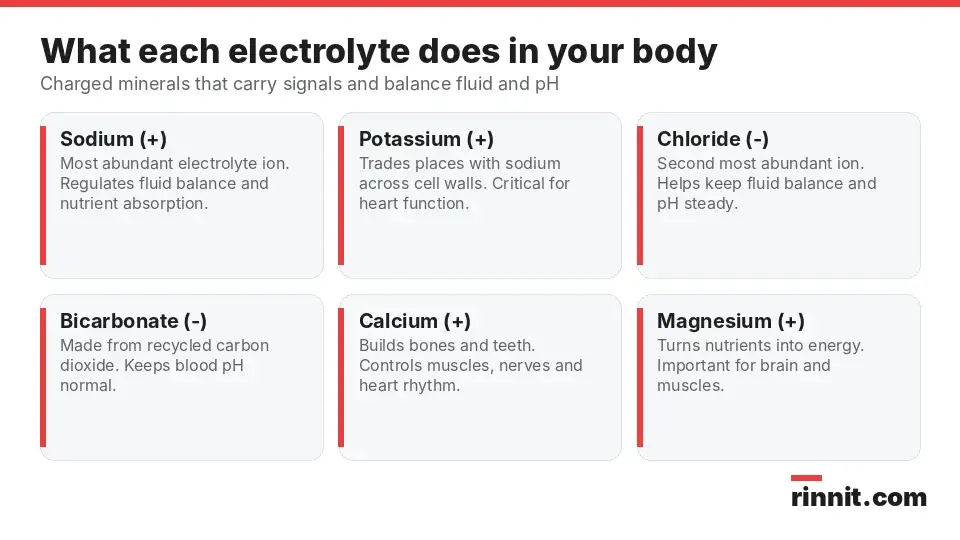
Each electrolyte has its own job, so a problem with one can cause very different symptoms from a problem with another.
Electrolyte | Charge | Main role |
Sodium | Positive | Most abundant electrolyte ion; regulates fluid balance and nutrient absorption |
Potassium | Positive | Exchanges with sodium across cell membranes; critical for heart function |
Calcium | Positive | Builds bones and teeth; controls muscles, nerve signals and heart rhythm |
Magnesium | Positive | Converts nutrients into energy; important for the brain and muscles |
Chloride | Negative | Second most abundant ion; helps keep fluid balance and pH |
Phosphate | Negative | Helps move compounds out of cells, process nutrients and build parts of DNA |
Bicarbonate | Negative | Made from recycled carbon dioxide; keeps blood pH normal |
Sources: [1]
What is an electrolyte panel used for?
Providers use an electrolyte panel to look for fluid imbalances and acid-base problems. It is often part of routine blood work. [2]
Electrolyte problems are found with lab tests. A broad metabolic panel is usually the first screen, and an abnormal result often leads to more specific tests to find the cause, because treatment depends on that cause. [1]
What symptoms may lead to an electrolyte test?
Your provider may order the test if you have symptoms such as: [2]
Nausea and vomiting
Confusion or irritability
Weakness or fatigue
An irregular or fast heartbeat
Diarrhea or constipation
Headaches
Muscle weakness, cramps or spasms
Numbness or tingling in your arms, legs, fingers or toes
What is the difference between an electrolyte panel and a metabolic panel?
All three tests are blood tests, but they measure different amounts of information. [1]
Test | What it measures |
Electrolyte panel | Sodium, chloride, potassium and bicarbonate only |
Basic metabolic panel (BMP) | Electrolytes plus blood urea nitrogen (BUN) for kidney function and possible dehydration, and blood sugar |
Comprehensive metabolic panel (CMP) | Everything in a BMP plus calcium, albumin, total protein, bilirubin, AST and ALT |
Sources: [1]
Some labs use a broader electrolyte panel that also includes calcium, magnesium and phosphate. Your provider may also check a single electrolyte if one specific imbalance is suspected. [2]
What other electrolyte tests might you need?
When a panel is abnormal, your provider may order more targeted blood or urine tests. These include: [1]
Aldosterone (blood and 24-hour urine)
Anion gap (blood)
Antidiuretic hormone (blood)
Carbon dioxide, chloride, magnesium, phosphorus and sodium (blood)
Chloride, phosphorus and sodium (urine, sometimes collected over 24 hours)
Blood and urine osmolality, with urine collected by the clean-catch method
Urine concentration
The anion gap is often ordered with the panel. It compares positively and negatively charged electrolytes, and a gap that is too high or too low can point to a serious problem. [2]
How do you prepare for an electrolyte panel?
No special preparation is usually needed for an electrolyte panel. [2]
If the test is part of a basic metabolic panel, your provider may ask you not to eat or drink for 8 hours, because fasting makes the blood sugar result more useful. [1, 3]
Tell your provider about your medicines. Diuretics ("water pills"), steroids, antibiotics, chemotherapy drugs and large amounts of antacids can all affect electrolyte levels. [2]
What happens during the test?
A healthcare professional draws blood from a vein, usually in your arm, using a small needle. The blood is collected in a tube and sent to a lab. [2]

The blood draw is a short, routine step, and the lab does the rest of the work.
Does an electrolyte blood test hurt?
You may feel a brief sting or slight pain when the needle goes in, and some throbbing afterward. [2, 3]
How long does it take?
The blood draw usually takes less than five minutes. [2] Ask your provider or their staff when to expect your results. [1]
What are normal electrolyte levels?
Your report lists each value next to a reference range. Results may be shown in millimoles (mmol/L), milliequivalents (mEq/L) or milligrams per deciliter (mg/dL); milliequivalents take each ion's electrical charge into account. [1]
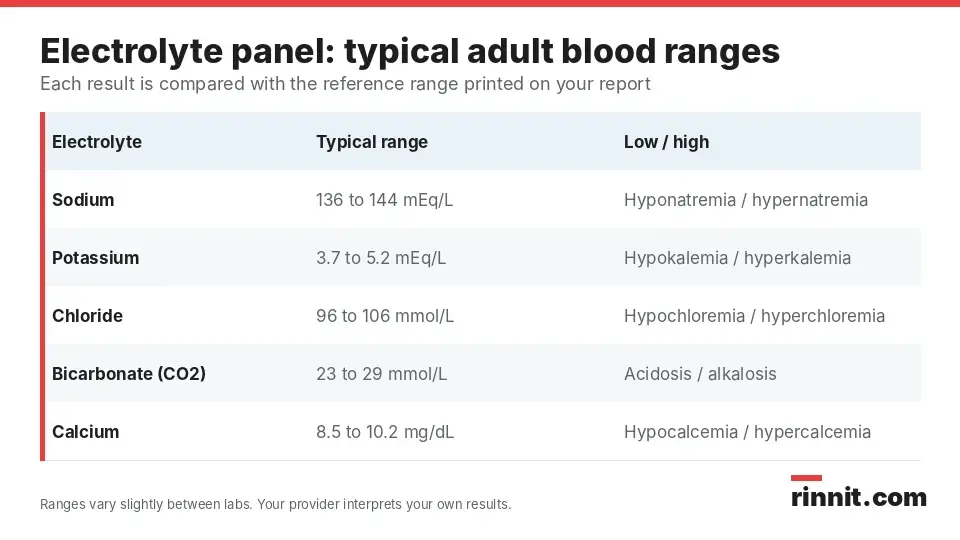
Your own lab's range is the one that applies to you, since ranges vary slightly between labs.
Electrolyte | Typical adult blood range | Low level | High level |
Sodium | 136 to 144 mEq/L (136 to 144 mmol/L) | Hyponatremia | Hypernatremia |
Potassium | 3.7 to 5.2 mEq/L (3.7 to 5.2 mmol/L) | Hypokalemia | Hyperkalemia |
Chloride | 96 to 106 mmol/L | Hypochloremia | Hyperchloremia |
Bicarbonate (CO2) | 23 to 29 mmol/L | Acidosis | Alkalosis |
Calcium | 8.5 to 10.2 mg/dL (2.13 to 2.55 mmol/L) | Hypocalcemia | Hypercalcemia |
Sources: [2, 3]
Normal blood pH sits between 7.36 and 7.44. A pH below 7 is acidic, 7 is neutral and above 7 is basic (alkaline). [1]
What does an abnormal result mean?
A value outside the range does not always mean something is wrong, and a value inside it does not always rule out a problem. Your body can compensate for imbalances, so your provider may order more than one test. [1]
Results can also shift with how much you drink, fluid lost through vomiting or diarrhea, and medicines such as antacids and blood pressure drugs. [2]
What causes an electrolyte imbalance?
Abnormal electrolyte levels can be caused by: [2]
Dehydration
Kidney disease
Heart disease
Diabetes
Lung infections, such as tuberculosis
Malabsorption
Liver disease
Acidosis (too much acid) or alkalosis (too much base)
Some medicines can also cause imbalances, including antibiotics, chemotherapy drugs, diuretics, steroids and large amounts of antacids. [2]
What are the symptoms of an electrolyte imbalance?
Symptoms depend on which electrolyte is off and in which direction. The prefix hyper- means too much and hypo- means too little. [1]
Sodium
High sodium can cause confusion, behavior changes, overly strong reflexes, loss of muscle control, seizures and coma. Low sodium can cause confusion, irritability, weak reflexes, nausea, vomiting, seizures and coma. [1]
Potassium
High potassium can cause weakness, inability to move muscles, confusion and an irregular heartbeat. Low potassium can cause muscle weakness and cramps, thirst, frequent urination and dizziness or fainting when standing; severe cases can lead to muscle breakdown (rhabdomyolysis) and serious heart rhythm problems. [1]
Calcium
High calcium can cause headache, fatigue, confusion, constipation, belly pain, vomiting, frequent urination, kidney stones, kidney failure, irregular heartbeat and bone or joint pain. Low calcium can cause confusion, strong reflexes, muscle twitching and spasms, including throat spasms that affect speaking or breathing. [1]
Magnesium
High magnesium can cause heart rhythm changes, weak reflexes, trouble breathing and cardiac arrest. Low magnesium can cause muscle weakness, twitching and arrhythmias, and it often occurs with low calcium and low potassium. [1]
Chloride, bicarbonate and phosphate
High chloride or low bicarbonate can lead to acidosis, with nausea, vomiting, fatigue, fast deep breathing and confusion. Low chloride or high bicarbonate can lead to alkalosis, with apathy, confusion, arrhythmias and muscle twitching; low chloride is usually linked to low sodium or vomiting. [1]
High phosphate usually lowers calcium and may cause intense itching, though it often has no symptoms until it becomes severe. Low phosphate starts with muscle weakness and can progress to rhabdomyolysis, seizures, weaker heart function and breathing trouble. [1]
Are there risks to an electrolyte blood test?
The risk is very low. You may have slight pain or a bruise where the needle went in, and this usually fades quickly. [2]
When should you call your doctor?
Contact your healthcare provider if: [1]
You do not understand your results
A result is outside the reference range and you are worried about it
Your symptoms change suddenly
Conclusion
An electrolyte panel is a quick, low-risk blood test that shows how well your body is balancing fluid, acid and the charged minerals your nerves, muscles and heart depend on. It is often part of routine blood work and is a common first step when symptoms such as weakness, confusion or an irregular heartbeat appear. [1, 2]
Results are always read against your lab's reference range and your overall health. An out-of-range value is a starting point, not a diagnosis, and your provider may repeat the test or order targeted blood or urine tests to find the cause before deciding on treatment. [1]
Keep learning: Read about Dehydration: Symptoms, Causes, Risk Groups & Treatment — Complete Guide and Chronic Kidney Disease: What It Is, Its 5 Stages, Causes, and How It's Treated.
FAQ
What is an electrolyte panel?
An electrolyte panel is a blood test that measures sodium, chloride, potassium and bicarbonate. Some labs also include calcium, magnesium and phosphate. [1, 2]
Why would a doctor order an electrolyte test?
It checks for fluid and acid-base imbalances. It is often part of routine blood work or ordered for symptoms such as weakness, confusion, vomiting, cramps or an irregular heartbeat. [2]
Do I need to fast for an electrolyte panel?
Usually not. If it is drawn as part of a basic metabolic panel, your provider may ask you to fast for 8 hours. [2, 3]
Does the electrolyte blood test hurt?
You may feel a brief sting when the needle goes in and some soreness afterward. [2]
How long does an electrolyte test take?
The blood draw usually takes less than five minutes. Your provider can tell you when results will be ready. [1, 2]
What are normal electrolyte levels?
Typical adult ranges are about 136 to 144 mEq/L for sodium, 3.7 to 5.2 mEq/L for potassium, 96 to 106 mmol/L for chloride and 23 to 29 mmol/L for bicarbonate. Your lab's own range applies to you. [3]
What causes an electrolyte imbalance?
Common causes include dehydration, vomiting or diarrhea, kidney, heart or liver disease, diabetes and medicines such as diuretics and steroids. [2]
Does an abnormal result mean I am sick?
Not always. Fluid intake, recent vomiting or diarrhea and medicines can shift levels, so your provider may repeat the test or order follow-up tests. [1, 2]
Are there risks to the test?
The risk is very low. Slight pain or bruising at the needle site usually goes away quickly. [2]
When should I call my doctor about my results?
Call if you do not understand your results, a value is out of range and you are concerned, or your symptoms change suddenly. [1]
Related Reading
Electrolyte Panel: What It Tests, Normal Ranges and What Results Mean explains the blood test that measures sodium, potassium, chloride and bicarbonate.
Hyponatremia: Complete Guide to Low Blood Sodium, Symptoms, Causes, and Treatment explains why sodium drops, how low sodium shows up on an electrolyte panel and how it is treated.
Hyperkalemia (High Blood Potassium): A Complete Guide to Causes, Symptoms, and Treatment covers what a high potassium result means and why it matters for your heart.
Hypokalemia: A Comprehensive Guide to Managing Low Potassium Levels explains the causes, symptoms and management of low potassium.
Understanding Metabolic Acidosis: Causes, Symptoms, and Treatment covers the acid-base problem that a low bicarbonate result can point to.
Dehydration: Symptoms, Causes, Risk Groups & Treatment — Complete Guide explains one of the most common reasons electrolyte levels fall out of balance.
References
Cleveland Clinic. Electrolytes: Types, Purpose & Normal Levels. Cleveland Clinic. Last updated September 24, 2021. https://my.clevelandclinic.org/health/diagnostics/21790-electrolytes
MedlinePlus. Electrolyte Panel. MedlinePlus Medical Test. Last updated March 12, 2024. https://medlineplus.gov/lab-tests/electrolyte-panel/
MedlinePlus. Basic metabolic panel. MedlinePlus Medical Encyclopedia. Last updated May 19, 2025. https://medlineplus.gov/ency/article/003462.htm
Corona G, Giuliani C, Parenti G, et al. Moderate hyponatremia is associated with increased risk of mortality: evidence from a meta-analysis. PLoS One. 2013;8(12):e80451. PMID 24367479. https://doi.org/10.1371/journal.pone.0080451
Corona G, Giuliani C, Verbalis JG, et al. Hyponatremia improvement is associated with a reduced risk of mortality: evidence from a meta-analysis. PLoS One. 2015;10(4):e0124105. PMID 25905459. https://doi.org/10.1371/journal.pone.0124105
Colombo MG, Kirchberger I, Amann U, et al. Association of serum potassium concentration with mortality and ventricular arrhythmias in patients with acute myocardial infarction: A systematic review and meta-analysis. Eur J Prev Cardiol. 2018;25(6):576-595. PMID 29473462. https://doi.org/10.1177/2047487318759694
Medical disclaimer
This article is for general education only and does not replace advice from a qualified healthcare professional. Talk to your doctor about your own diagnosis and treatment, and seek emergency care right away for severe or sudden symptoms.



Comments