Hyperkalemia (High Blood Potassium): A Complete Guide to Causes, Symptoms, and Treatment

Updated: 2 days ago
Medically reviewed by Dr. Baraa Alnahhal, MD · Last reviewed: October 2026
Quick Answer
Hyperkalemia is a condition in which blood potassium is too high, above 5.5 mmol/L, compared with a normal range of 3.5 to 5.0 mmol/L. Kidney disease is the major cause. Levels above 6.5 mmol/L can cause dangerous heart rhythm changes. Treatments include a low-potassium diet, medication changes, diuretics, potassium binders and emergency IV therapy or dialysis. [1]
What the research says
Hyperkalemia often returns in people taking heart- and kidney-protective drugs. A 2024 review reports that about half of patients taking renin-angiotensin-aldosterone system inhibitors or mineralocorticoid receptor antagonists who are prone to hyperkalemia have two or more recurrences each year. Cutting back or stopping these drugs can leave patients under-treated, so newer strategies such as potassium binders aim to let them stay on treatment. (Masi et al., European Journal of Internal Medicine, 2024)
IV calcium gluconate helped severe rhythm problems, but only to a limited degree. In a prospective study of 111 patients with hyperkalemia (mean potassium 7.1 ± 0.6 mmol/L) and ECG changes, calcium gluconate improved 9 of 79 major rhythm disturbances, a statistically significant change, but did not significantly change other ECG abnormalities. The authors note that the evidence supporting calcium is of low quality. (Celebi Yamanoglu & Yamanoglu, Turkish Journal of Emergency Medicine, 2022)
What is hyperkalemia?
Hyperkalemia is a state in which the concentration of potassium in the blood reaches unsafe levels. Potassium is a positively charged electrolyte that carries electric charges throughout the body. It helps muscles contract, helps nerves send signals, moves nutrients into cells and waste out of them, and helps offset the effects of sodium on blood pressure. [1]
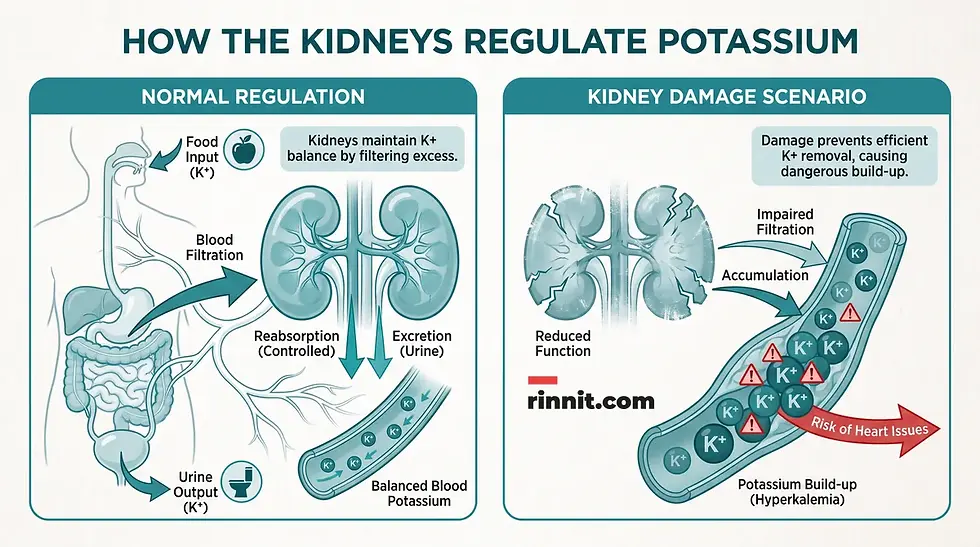
Normally the body keeps potassium in balance. Potassium comes in through food and drink, and the kidneys filter out the excess, which leaves the body in urine. If the kidneys are damaged, or potassium intake is very high, the mineral can build up in the blood. Mild hyperkalemia may go unnoticed, but severe cases can damage the heart, cause palpitations, and lead to a heart attack. [1] Hyperkalemia raises the risk of arrhythmia and sudden death, especially in people with chronic kidney disease. [5]
Causes and risk factors
The most common cause of hyperkalemia is kidney disease. When the kidneys are damaged, they cannot filter waste, including excess potassium, as well as they should. [1]
Common triggers and risk groups
Category | Examples |
Primary cause | Chronic kidney disease (CKD) and abnormal kidney structure. |
Dietary factors | A high-potassium diet and potassium supplements. |
Medications | Certain drugs for high blood pressure that block the kidneys' ability to release potassium. |
Health conditions | Diabetes, congestive heart failure, Addison's disease, and HIV. |
Beyond kidney problems, certain medicines and health conditions raise the risk. People with diabetes or heart failure are more prone to hormonal imbalances that affect potassium control. In rare cases, genetic disorders such as pseudohypoaldosteronism type 2 (Gordon's syndrome) can cause high potassium. Other risk factors include burns over a large part of the body and alcohol use disorder. [1]
Symptoms and diagnosis

One of the most dangerous things about hyperkalemia is that it often has no obvious signs. Mild cases may cause subtle symptoms such as abdominal pain, diarrhea, nausea, or vomiting, which are easy to dismiss and may develop slowly over weeks or months. When potassium becomes dangerously high, it can cause sudden, life-threatening problems. [1]
Warning signs of severe hyperkalemia
Chest pain: A possible sign of heart distress.
Heart palpitations: A fluttering, fast, or irregular heartbeat.
Arrhythmia: Life-threatening changes in heart rhythm.
Muscle weakness: Weakness or numbness in the limbs.
Diagnosis usually relies on a serum potassium test, which is a standard blood test. Because symptoms are often absent, many people only find out they have high potassium during routine checkups. Doctors may also order an electrocardiogram (EKG) to look for heart rhythm changes. Tall, "peaked" T waves are the earliest EKG sign of hyperkalemia. [1]
Management and treatment options

Treatment depends on how high the potassium is and on your overall health history. In an emergency, care follows a set order: protect the heart first, then move potassium into cells, then remove potassium from the body. [4] For long-term (chronic) hyperkalemia, doctors begin by reviewing the medicines that may be responsible and making sure diuretic treatment is effective. [4]
Treatment strategies
Low-potassium diet: Commonly advised for people at risk. Experts note that evidence for broad food restriction is limited, so advice should be personalized with a doctor or renal dietitian. [1][4]
Medication review: Blood pressure medicines and some other drugs can raise potassium. Your provider may stop or change them, but you should not stop them on your own. [1][4]
Diuretics: Also called "water pills," these help the kidneys flush out extra potassium through urine. [1]
Potassium binders: These medicines attach to potassium in the digestive tract so it leaves the body in stool. They may be recommended if other treatments do not lower levels. [1]
Emergency IV therapy: In critical cases, doctors give IV calcium gluconate to protect the heart, followed by insulin to move potassium into cells. Albuterol may also be used to lower potassium. [1][2]
Dialysis: If the kidneys have failed or other treatments are not working, dialysis filters excess potassium from the blood. [1]
Conclusion
Hyperkalemia is a serious condition that needs careful monitoring, especially for people with kidney or heart problems. Mild cases can often be managed with diet changes and medicine adjustments, but because the condition is often silent, regular blood tests are essential for anyone at risk. By protecting kidney health and following your doctor's guidance, most people can keep potassium in a safe range and avoid life-threatening complications. [1]
Stay informed. For more information on kidney health and electrolyte balance, visit our comprehensive health library at Rinnit.com.
Frequently Asked Questions
What are the symptoms of high potassium?
Mild cases often have no symptoms, but you may notice abdominal pain, diarrhea, nausea, or vomiting. Severe symptoms include chest pain, heart palpitations, an irregular heartbeat, and muscle weakness or numbness. [1]
Is hyperkalemia a medical emergency?
Severe hyperkalemia (above 6.5 mmol/L) can cause heart problems that need immediate medical attention. Go to the emergency room if you have chest pain, a weak pulse, trouble breathing, or extreme muscle weakness. [1]
How do the kidneys control potassium?
The kidneys filter excess potassium from the blood and remove it in urine. If the kidneys are damaged, this process works less well and potassium builds up. [1]
Can a high-potassium diet cause hyperkalemia?
It can, especially in people with kidney disease who cannot clear the extra potassium from foods such as bananas, oranges, and potatoes. [1]
What medications can raise potassium levels?
Certain blood pressure medicines can interfere with the kidneys' ability to release potassium. Common examples include ACE inhibitors, angiotensin receptor blockers, and potassium-sparing diuretics. Never stop a prescribed medicine on your own; your doctor will decide whether to adjust it. [1][3]
What is a "peaked T wave" on an EKG?
It is a tall, narrow T wave on the heart tracing and is often the earliest sign a doctor sees when potassium is dangerously high. [1]
How do potassium binders work?
They are medicines that attach to potassium in the intestines so it leaves the body in stool instead of being absorbed. [1]
Can diabetes lead to high potassium?
Yes. Diabetes can damage the kidneys over time and affect the hormones that help regulate potassium in the blood. [1]
Is hyperkalemia the same as high blood pressure?
No, but they are related. Potassium helps regulate blood pressure, and some blood pressure medicines can raise potassium as a side effect. [1]
Can children get hyperkalemia?
Yes. People of any age can be affected, including children, particularly those with kidney problems or certain genetic disorders. [1]
What is Gordon's syndrome?
Gordon's syndrome (pseudohypoaldosteronism type 2) is a rare genetic disorder caused by a mutation that affects how the body regulates blood pressure and salt, leading to high blood pressure and high potassium. [1]
How fast does emergency treatment work?
Emergency IV treatments begin working within minutes: calcium gluconate protects the heart, and insulin moves potassium into cells. Other measures, such as potassium binders or dialysis, are then used to actually remove potassium from the body. [1][4]
Is hyperkalemia contagious?
No. It is a metabolic condition, not an infectious disease. [1]
Should I avoid all potassium if I have kidney disease?
No. Potassium is essential. Follow the potassium plan set by your doctor or a renal dietitian. [1]
Can alcohol use disorder cause high potassium?
Alcohol use disorder is listed as a risk factor for hyperkalemia. Heavy, long-term drinking can harm the kidneys and disturb electrolyte balance. [1]
Related Reading
Potassium Binders: Types, How They Work and Side Effects explains potassium binder medicines.
Electrolytes and Electrolyte Panel: Test, Normal Ranges and Imbalances: An electrolyte panel is a routine blood test that measures potassium alongside sodium, chloride and bicarbonate, with a typical adult potassium range of 3.7 to 5.2 mEq/L.
Learn more in our guide to Comprehensive Metabolic Panel (CMP): What It Tests, How to Prepare and What Results Mean.
Basic Metabolic Panel (BMP): What It Tests, Normal Ranges and What Results Mean explains the blood test that checks kidney function, blood sugar and electrolytes.
References
Cleveland Clinic. Hyperkalemia (High Potassium). Cleveland Clinic. Last updated May 11, 2023. https://my.clevelandclinic.org/health/diseases/15184-hyperkalemia-high-blood-potassium
Celebi Yamanoglu NG, Yamanoglu A. The effect of calcium gluconate in the treatment of hyperkalemia. Turk J Emerg Med. 2022;22(2):75-82. PMID 35529029. https://doi.org/10.4103/2452-2473.342812
Masi S, Dalpiaz H, Piludu S, et al. New strategies for the treatment of hyperkalemia. Eur J Intern Med. 2024;132:18-26. PMID 39489630. https://doi.org/10.1016/j.ejim.2024.10.016
Palmer BF, Clegg DJ. Hyperkalemia treatment standard. Nephrol Dial Transplant. 2024;39(7):1097-1104. PMID 38425037. https://doi.org/10.1093/ndt/gfae056
Watanabe R. Hyperkalemia in chronic kidney disease. Rev Assoc Med Bras (1992). 2020;66(Suppl 1):s31-s36. PMID 31939533. https://doi.org/10.1590/1806-9282.66.S1.31
Medical disclaimer
This article is for general educational purposes only and is not a substitute for professional medical advice, diagnosis, or treatment. Always seek the advice of your physician or other qualified healthcare provider with any questions you may have about a medical condition. Never disregard professional medical advice or delay seeking care because of something you have read here. If you think you may have a medical emergency, call your doctor or emergency services immediately.



Comments