Potassium Binders: Types, How They Work and Side Effects

Updated: 2 days ago
Written and medically reviewed by Dr. Baraa Alnahhal, MD · Last reviewed: November 2026 · How we review
Quick Answer
Potassium binders are medicines that lower high potassium by binding extra potassium in your intestines so it leaves your body in stool. They treat hyperkalemia when diet changes and other medicines aren't enough. A level of 6.5 mmol/L or higher can cause dangerous heart rhythms. Common side effects are constipation, diarrhea, bloating and nausea.
What the research says
Patiromer lowered potassium and kept it down: in the OPAL-HK trial of people with chronic kidney disease, patiromer lowered potassium by 1.01 mmol/L in 4 weeks, with 76% reaching target; high potassium returned in 15% kept on patiromer versus 60% switched to placebo, and 11% had mild to moderate constipation (Weir MR et al., New England Journal of Medicine, 2015) [2]
Sodium zirconium cyclosilicate worked within a day: in the HARMONIZE trial of 258 people, sodium zirconium cyclosilicate brought potassium to normal in 84% by 24 hours and 98% by 48 hours; over 28 days, 80% to 94% stayed normal versus 46% on placebo, though swelling occurred in 14% at the highest dose (Kosiborod M et al., JAMA, 2014) [3]
Key takeaways
Potassium binders trap potassium in the gut so it leaves in stool.
They treat high potassium (hyperkalemia).
The main types are sodium zirconium cyclosilicate, patiromer and sodium polystyrene sulfonate.
Levels start falling within 24 hours.
Digestive side effects are most common.
What are potassium binders?
Your kidneys normally remove extra potassium. When they can't keep up, potassium builds up in your blood, a condition called hyperkalemia. Binders give your body another way to get rid of it. Sources: [1]
Who needs them
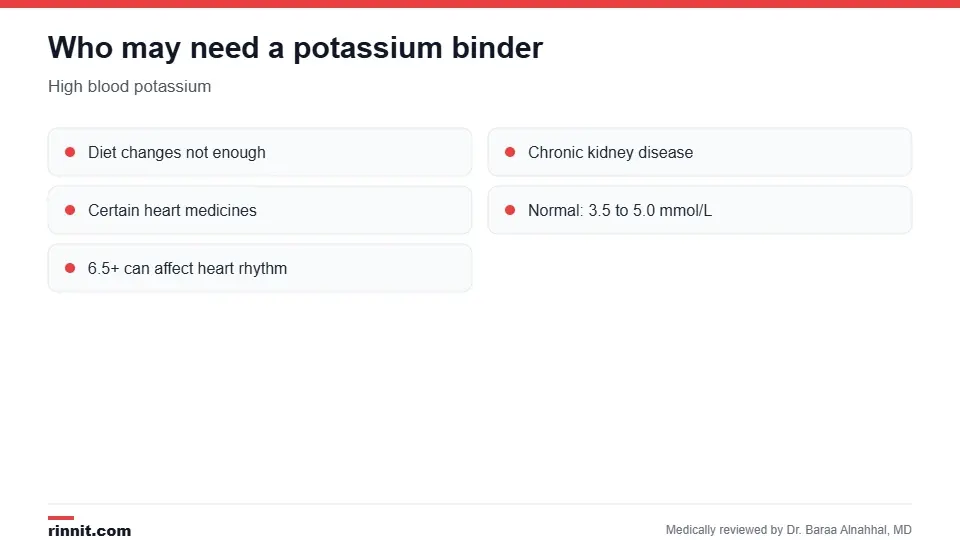
Levels of 6.5 mmol/L or higher can cause dangerous heart rhythms.
People with high potassium that diet and other medicines don't fix.
People with chronic kidney disease.
People taking certain heart disease medicines that raise potassium. Sources: [1, 2]
Potassium level | What it means |
3.5 to 5.0 mmol/L | Typical adult range |
Above 5.0 mmol/L | High (hyperkalemia) |
6.5 mmol/L or higher | Can cause dangerous heart rhythms |
Sources: [1]
Types of potassium binders
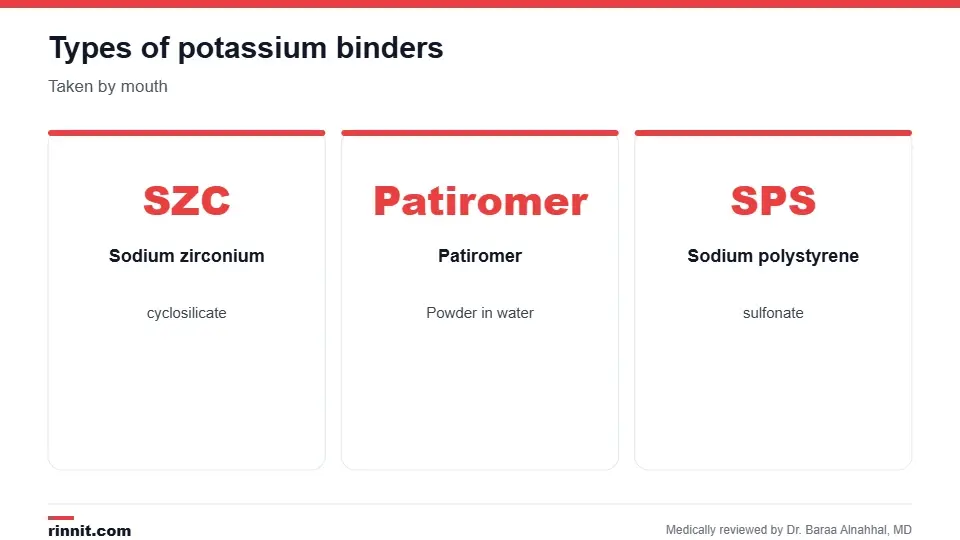
Your provider chooses the best one for you.
Sodium zirconium cyclosilicate.
Patiromer.
Sodium polystyrene sulfonate. Sources: [1]
Some are used for a few days or weeks; people with kidney disease or on certain heart medicines may need them long term. Sources: [1]
How to take them

Potassium levels start to drop within 24 hours.
Mix the powder with water and drink it.
Follow your provider's directions on how often and when to take it.
Ask which medicines to separate from your binder.
Tell your provider about all medicines, vitamins and supplements. Sources: [1]
Side effects
Belly pain, bloating or gas.
Constipation or diarrhea.
Heartburn or indigestion.
Nausea or vomiting.
Swelling with some binders. Rarely, sodium polystyrene sulfonate can cause serious bowel injury, so report severe belly pain or bloody stools.
Low magnesium with some newer binders, which can lead to low potassium. Sources: [1, 2, 3]
Results
Potassium levels start to drop within 24 hours. Following your provider's directions carefully gives the best results. Sources: [1, 3]
When to call your provider
Side effects that bother you.
Chest pain or heart palpitations; call 911 if they are severe or come with fainting or sudden muscle weakness.
Nausea and vomiting. Sources: [1]
Conclusion
Potassium binders offer a simple way to bring high potassium down and keep it in a safe range. Regular blood tests help your provider adjust your treatment.
Keep learning: read about hyperkalemia and chronic kidney disease.
Frequently asked questions
What are potassium binders?
Medicines that trap potassium in the gut so it leaves in stool.
What do they treat?
High blood potassium (hyperkalemia).
What is a normal potassium level?
About 3.5 to 5.0 mmol/L for adults.
What are the types?
Sodium zirconium cyclosilicate, patiromer and sodium polystyrene sulfonate.
How do I take them?
Usually as a powder mixed with water.
How fast do they work?
Levels start dropping within 24 hours.
What are common side effects?
Constipation, diarrhea, bloating and nausea.
Can they lower magnesium?
Some newer binders can.
How long will I take one?
From a few days to long term, depending on the cause.
Can they interact with other medicines?
Yes, so tell your provider everything you take.
Related Reading
Hyperkalemia (High Blood Potassium): A Complete Guide to Causes, Symptoms, and Treatment high blood potassium.
Hypokalemia: A Comprehensive Guide to Managing Low Potassium Levels low blood potassium.
Chronic Kidney Disease: What It Is, Its 5 Stages, Causes, and How It's Treated a common cause of high potassium.
Aldosterone Antagonists: Uses, Types and Side Effects medicines that can raise potassium.
End-Stage Renal Disease: Symptoms, Causes, and Treatment advanced kidney disease.
References
Cleveland Clinic. Potassium Binders: Uses, How They Work, Risks & Results. Cleveland Clinic. Last updated August 6, 2026. https://my.clevelandclinic.org/health/treatments/24744-potassium-binder
Weir MR, Bakris GL, Bushinsky DA, et al. Patiromer in patients with kidney disease and hyperkalemia receiving RAAS inhibitors. New England Journal of Medicine. 2015;372(3):211-221. PMID 25415805. https://doi.org/10.1056/NEJMoa1410853
Kosiborod M, Rasmussen HS, Lavin P, et al. Effect of sodium zirconium cyclosilicate on potassium lowering for 28 days among outpatients with hyperkalemia: the HARMONIZE randomized clinical trial. JAMA. 2014;312(21):2223-2233. PMID 25402495. https://doi.org/10.1001/jama.2014.15688
Medical disclaimer
This article is for general education only and does not replace advice from a qualified healthcare professional. Talk to your doctor about your own diagnosis and treatment, and seek emergency care right away for severe or sudden symptoms.



Comments