Aldosterone Antagonists: Uses, Types and Side Effects

Updated: 2 days ago
Written and medically reviewed by Dr. Baraa Alnahhal, MD · Last reviewed: November 2026 · How we review
Quick Answer
Aldosterone antagonists are prescription medicines that block aldosterone, a hormone that makes the kidneys hold on to salt and water, so the body releases extra fluid while keeping potassium. They treat heart failure, hard-to-control high blood pressure and hyperaldosteronism. Common ones are spironolactone, eplerenone and finerenone. The main risk is high potassium.
What the research says
Spironolactone lowered deaths in severe heart failure: in the RALES trial of 1,663 people with severe heart failure, spironolactone cut deaths from 46% to 35% and heart failure hospital stays by 35%, though 10% of men had breast enlargement or pain (Pitt B et al., New England Journal of Medicine, 1999) [2]
Finerenone slowed kidney disease in diabetes: in a trial of 5,734 people with chronic kidney disease and type 2 diabetes, finerenone lowered serious kidney outcomes to 17.8% versus 21.1% with placebo over about 2.6 years (Bakris GL et al., New England Journal of Medicine, 2020) [3]
Key takeaways
Aldosterone antagonists block a hormone that holds salt and water.
They help the body release fluid while keeping potassium.
They treat heart failure, high blood pressure and kidney disease.
Common ones are spironolactone, eplerenone and finerenone.
High potassium is the main risk.
What are aldosterone antagonists?
Aldosterone, made by the adrenal glands, makes your kidneys keep salt and water, which raises blood pressure. Aldosterone antagonists block its receptor. In heart failure, removing extra fluid eases the heart's workload. Spironolactone is one of the top 100 prescribed medicines in the U.S. Sources: [1]
What they treat

Spironolactone is also prescribed by dermatologists for acne.
High blood pressure not controlled by other medicines.
Hyperaldosteronism.
Swelling from liver or kidney disease.
Chronic kidney disease.
Heart weakness after a heart attack.
Acne. Sources: [1]
Types of aldosterone antagonists
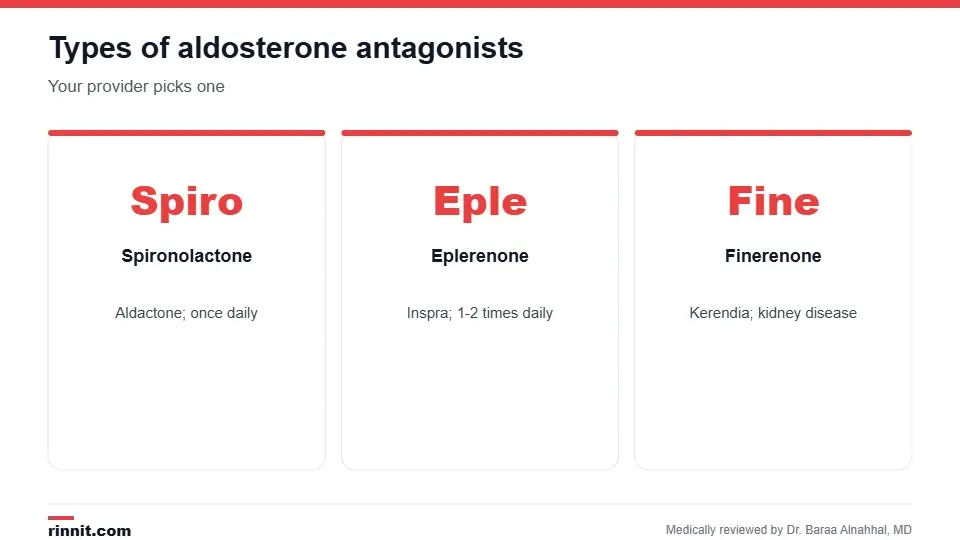
Your provider chooses the best one for you.
Medicine | Brand names | How it's taken |
Spironolactone | Aldactone, CaroSpir | Tablet or liquid, once a day |
Eplerenone | Inspra | Tablet, once or twice a day |
Finerenone | Kerendia | Tablet, once a day; for kidney disease with type 2 diabetes and some types of heart failure |
Sources: [1]
How to take them
Take with or without food at the same time each day.
Don't take two doses to make up for a missed one.
Tell your provider about other medicines and supplements.
Ask before drinking grapefruit juice or using salt substitutes that contain potassium. Sources: [1]
Full benefits may take several weeks. Sources: [1]
Side effects

Eplerenone is an alternative if hormone side effects are a concern.
Medicine | Possible side effects |
All types | Frequent urination, cough, dizziness, headache, diarrhea, high potassium |
Spironolactone only | Breast enlargement, erection problems, vaginal bleeding after menopause |
High potassium is more likely with kidney disease, so providers often start with lower doses. Eplerenone is an option if hormone-related side effects are a concern. Sources: [1, 2, 3]
Benefits
In heart failure, aldosterone antagonists can help people live longer, exercise more, feel better and spend less time in the hospital. They can lower the risk of sudden cardiac death by about 20% in people with heart failure or heart pumping problems. Sources: [1, 2]
When to call your provider
Contact your provider if side effects are hard to tolerate or your symptoms haven't improved after a few weeks. Your dose or medicine may be changed. Sources: [1]
Conclusion
Aldosterone antagonists help your body shed extra fluid and protect your heart and kidneys. Regular blood tests to check potassium help keep treatment safe.
Keep learning: read about heart failure medicines and heart failure.
Frequently asked questions
What are aldosterone antagonists?
Medicines that block the hormone aldosterone.
What do they treat?
Heart failure, high blood pressure, kidney disease, swelling and acne.
What are some examples?
Spironolactone, eplerenone and finerenone.
Are they diuretics?
Yes, they're potassium-sparing diuretics.
What is the main risk?
High potassium levels.
Can spironolactone cause breast growth?
Yes, in any sex, because it affects other hormone receptors.
How long until they work?
Full benefits may take several weeks.
Can I eat grapefruit?
Ask your provider first.
Do they help people with heart failure live longer?
Yes. Studies show they lower the risk of death.
Is spironolactone used for acne?
Yes, often by dermatologists.
Related Reading
Potassium Binders: Types, How They Work and Side Effects explains potassium binder medicines.
Heart Failure Medications: Types, Benefits, Side Effects, and How to Take Them Safely other heart failure medicines.
Heart Failure: Symptoms, Causes & Treatment Guide an overview of heart failure.
Congestive Heart Failure: Symptoms, Stages, and How It's Treated fluid buildup from heart failure.
Left-Sided Heart Failure: Types, Causes, and Management a common type of heart failure.
References
Cleveland Clinic. How Do Aldosterone Antagonists Work? Cleveland Clinic. Last updated April 29, 2022. https://my.clevelandclinic.org/health/treatments/22917-aldosterone-antagonists
Pitt B, Zannad F, Remme WJ, et al. The effect of spironolactone on morbidity and mortality in patients with severe heart failure. New England Journal of Medicine. 1999;341(10):709-717. PMID 10471456. https://doi.org/10.1056/NEJM199909023411001
Bakris GL, Agarwal R, Anker SD, et al. Effect of finerenone on chronic kidney disease outcomes in type 2 diabetes. New England Journal of Medicine. 2020;383(23):2219-2229. PMID 33264825. https://doi.org/10.1056/NEJMoa2025845
Medical disclaimer
This article is for general education only and does not replace advice from a qualified healthcare professional. Talk to your doctor about your own diagnosis and treatment, and seek emergency care right away for severe or sudden symptoms.



Comments