Heart Tumor Removal Surgery: Approaches, Risks and Recovery

Updated: 2 days ago
Written and medically reviewed by Dr. Baraa Alnahhal, MD · Last reviewed: November 2026 · How we review
Quick Answer
Heart tumor removal surgery treats tumors in the heart, most of which are benign, such as myxomas and papillary fibroelastomas. Surgery is advised when a tumor causes symptoms, affects heart function, grows quickly or raises complication risk. Approaches include open-heart, minimally invasive and robotically assisted surgery. Benign tumors are usually removed completely with excellent results.
What the research says
Robotic myxoma removal meant a faster recovery: in 94 people having a left atrial myxoma removed, robotic surgery had no deaths and led to less drainage, shorter time on a ventilator, a shorter hospital stay and faster return to exercise than sternotomy, though bypass time was longer and cost higher (Liu Y et al., Asian Journal of Surgery, 2024) [2]
Small-port robotic tumor removal was safe: in 18 robotic heart tumor removals through five 8-mm ports, there were no deaths during surgery or reoperations for bleeding, and the median hospital stay was 4.5 days (Rosen JL et al., Journal of Cardiac Surgery, 2022) [3]
Key takeaways
Most heart tumors are benign, mainly myxomas and papillary fibroelastomas.
Surgery removes tumors that cause symptoms or raise stroke risk.
Options are open, minimally invasive and robotic surgery.
Robotic surgery offers a shorter stay and faster recovery.
Benign tumors are usually removed completely.
What is heart tumor removal surgery?
Cardiac tumors that start in the heart are rare, and most are benign. Cancerous ones, such as cardiac angiosarcoma, are extremely rare and often aren't treated with surgery. The surgery may include valve repair or replacement. Sources: [1]
Why it's done

Myxomas and papillary fibroelastomas are the most common.
Benign tumors that cause symptoms.
Tumors that affect heart or valve function.
Tumors that raise the risk of blood clots or stroke.
Tumors that grow quickly.
Cancerous tumors, to ease symptoms. Sources: [1]
Learn about papillary fibroelastoma. Sources: [1]
Surgical approaches

Robotic surgery offers the fastest recovery.
Approach | How it's done | Notes |
Incision through the breastbone | Used for complex tumors | |
Minimally invasive | Small incisions | Lower complication risk |
Several tiny cuts between the ribs | Shortest stay and fastest recovery |
Sources: [1, 2, 3]
How to prepare
Tests may include CT, an echocardiogram, MRI and a coronary angiogram.
Follow instructions about medicines and fasting.
Quit smoking and tobacco in the weeks before. Sources: [1]
What happens during surgery
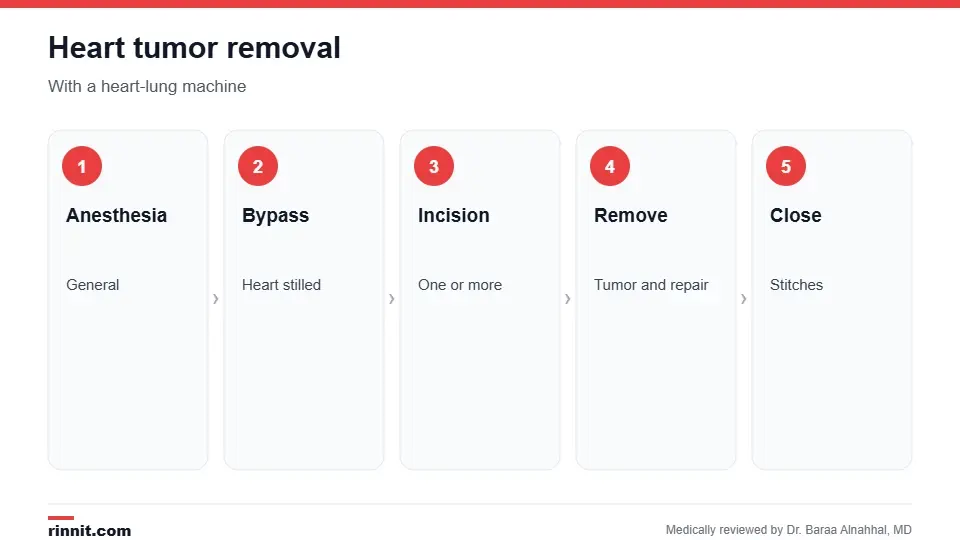
Valve repair or replacement may be done at the same time.
You get general anesthesia.
A heart-lung machine takes over so the heart can be stilled.
The surgeon makes one or more chest incisions.
The tumor is removed, and any repair is done.
The incisions are closed. Sources: [1]
Risks
Allergic reaction to anesthesia.
Abnormal heart rhythms.
Bleeding.
Temporary confusion.
Damage to blood vessels or organs.
Infection.
Stroke. Sources: [1]
Minimally invasive and robotic methods lower complication risk. Sources: [1, 2]
Recovery
You'll spend one or more days in the ICU.
A robotic surgery hospital stay is typically three to four days.
Robotic surgery has less pain and bleeding and a faster recovery.
Return to activities and work when you're ready. Sources: [1, 2, 3]
Outlook
Surgery eases symptoms, lowers complication risk and improves quality of life. Benign myxomas and papillary fibroelastomas are usually removed completely with very successful results. Complex or cancerous tumors may be only partly removable. Sources: [1, 2]
When to call your provider
Chest pain that doesn't improve.
Fever.
Nausea and vomiting.
Shortness of breath.
Redness or oozing at the incision.
Slurred speech or other stroke signs. Sources: [1]
Conclusion
Heart tumor removal surgery can cure most benign heart tumors and prevent strokes and valve damage. Robotic options let many people recover faster with smaller scars.
Keep learning: read about cardiac tumors and robotic heart surgery.
Frequently asked questions
Are most heart tumors cancerous?
No. Most are benign.
What are the most common heart tumors?
Myxomas and papillary fibroelastomas.
Why remove a benign tumor?
It can cause clots, stroke or valve problems.
What surgical approaches are used?
Open-heart, minimally invasive and robotic surgery.
Is a heart-lung machine used?
Yes, in all approaches.
How long is the hospital stay?
Typically three to four days after robotic surgery.
Can valves be repaired too?
Yes, if needed.
Is robotic surgery better?
It offers smaller cuts, less pain and faster recovery.
Will the tumor come back?
Benign tumors are usually removed completely.
What are the risks?
Bleeding, rhythm problems, infection and stroke.
Related Reading
Papillary Fibroelastoma: Symptoms, Causes, and Surgical Treatment a common benign tumor.
Robotically Assisted Heart Surgery robotic heart surgery.
Open-Heart Surgery: Procedure, Preparation, and Recovery open-heart surgery.
Cardiac Angiosarcoma: Symptoms, Causes, and Treatment of This Rare Heart Cancer a rare heart cancer.
References
Cleveland Clinic. Heart Tumor Removal Surgery. Cleveland Clinic. Last updated September 23, 2022. https://my.clevelandclinic.org/health/treatments/17441-robotically-assisted-removal-of-cardiac-tumors
Liu Y, Ge S, Li X, et al. Comparative analysis of robotically-assisted versus conventional sternotomy approach in left atrial-myxoma resection: a single-center retrospective observational study. Asian Journal of Surgery. 2024;47(9):3877-3882. PMID 38443251. https://doi.org/10.1016/j.asjsur.2024.02.112
Rosen JL, Yost CC, Wong DH, et al. Routine endoscopic robotic cardiac tumor resection using an 8-mm working port and percutaneous cannulation. Journal of Cardiac Surgery. 2022;37(12):4803-4807. PMID 36423256. https://doi.org/10.1111/jocs.17166
Medical disclaimer
This article is for general education only and does not replace advice from a qualified healthcare professional. Talk to your doctor about your own diagnosis and treatment, and seek emergency care right away for severe or sudden symptoms.



Comments