What Is a Cardiac Tumor? A Complete Guide to Heart Tumors, Types, and Treatments

Updated: 3 days ago
Medically reviewed by Dr. Baraa Alnahhal, MD · Last reviewed: October 2026
Quick Answer: Is a cardiac tumor cancer?
A cardiac tumor is a growth in the heart that is not always cancer: about 85% of primary heart tumors are noncancerous [1] [3], while metastatic tumors spreading from elsewhere are always cancerous. [8] They range from less than half an inch to about 6 inches. [8] Impact depends on type, size and location; some are easily treatable, others fatal. [8]
What the research says
Most primary heart tumors are benign, and spread from other cancers is far more common. A 2025 review of cardiac tumors reported that benign lesions account for 85% of primary cardiac tumors and malignant neoplasms for 15%, that secondary (metastatic) cardiac tumors are 20–30 times more common than primary ones, and that most primary tumors require surgery to prevent life-threatening complications. For malignant tumors and metastases, the treatment of choice is a combination of surgery, radiotherapy and/or chemotherapy, which may prolong survival in a small subset of patients (Corradi et al., Trends Cardiovasc Med, 2025) [1].
Even a benign myxoma can cause a stroke before it is removed. In a single-center series of 74 patients who had surgery for a cardiac myxoma (median follow-up 60 months), thromboembolic events occurred in 14 patients (18.9%), including stroke in 13.5%. Tumor recurrence occurred in 2.7%, and only one death was recorded. The authors concluded that early surgical resection gives excellent long-term outcomes and should be considered even in people without symptoms (Madogolele et al., Arq Bras Cardiol, 2026) [6].
Outcomes depend heavily on the tumor type. Among 41 patients who had surgery for a primary cardiac tumor, myxomas (73% of the group) showed no recurrence and no tumor-related deaths over a median follow-up of 12.8 years, while all 3 patients with diffuse large B-cell lymphoma died within 2 years despite surgery and chemotherapy. This was a small single-center study (Shiba et al., Circ Rep, 2026) [7].
Key takeaways
A cardiac tumor is a growth in the heart that can be cancerous or noncancerous, and can form in the lining, muscle, protective sac, or valves. [8]
Papillary fibroelastoma is the most common heart tumor in adults; cardiac rhabdomyoma is the most common in babies and children. [1] [3] [8]
Heart tumors are rare, affecting an estimated 1 to 30 people per 100,000. [1] [8]
About 85% of primary heart tumors are noncancerous [1] [3] [8], but even benign tumors can be dangerous if they interfere with heart function or cause stroke. [8]
Metastatic heart tumors, which spread from another cancer, are 20 to 30 times more common than primary heart tumors. [1] [8]
Earlier diagnosis generally means a better outcome, and noncancerous tumors can often be removed successfully with surgery. [1] [8]
What Is a Cardiac Tumor?
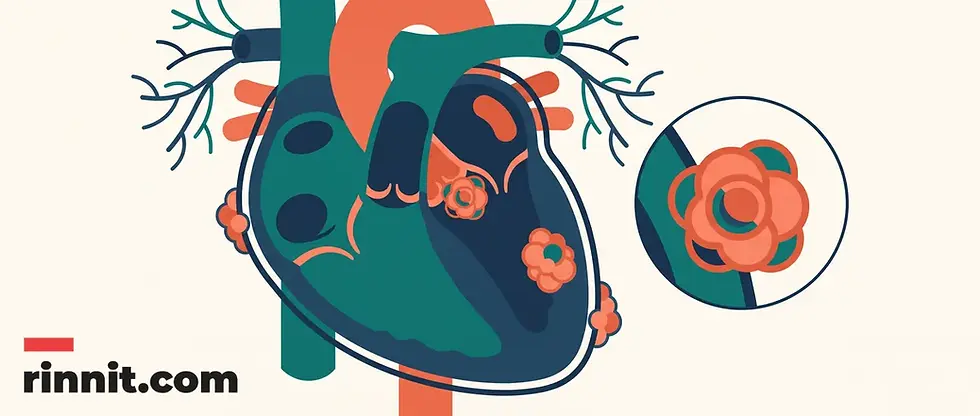
Cardiac tumors, also called heart tumors, are growths that form in the heart. They can be either cancerous (malignant) or noncancerous (benign). Heart tumors vary in size from less than half an inch to about 6 inches. [8] How a tumor affects you depends on its type, size, and location within the heart. [8] Some heart tumors are easily treatable and have an excellent prognosis, while others can be fatal. [8]
Heart tumors can affect anyone at any age. [3] [8] Some types are present at birth, and others develop during childhood or adulthood. [8] They can form in many different areas of the heart, including the inner lining (endocardium), the muscle (myocardium), the protective sac (pericardium), or the valves. [8]
Overall, cardiac tumors are rare. Experts estimate they affect between 1 and 30 in every 100,000 people. [1] [8]
Types of Heart Tumors
Heart tumors fall into two main groups. Primary heart tumors start in the heart itself. Most, about 85%, are noncancerous, but about 15% are cancerous. [1] [8] Even noncancerous tumors can be dangerous if they interfere with heart function, and they can pose a risk of stroke if left untreated. [8] Metastatic heart tumors start somewhere else in the body and spread to the heart. They are always cancerous, and up to 1 in 10 people with a cancer diagnosis have tumors that spread to the heart. [3] [8]
Noncancerous (Benign) Primary Heart Tumors
The most common benign tumor in adults is the papillary fibroelastoma, while the most common type in babies and children is the cardiac rhabdomyoma. [1] [3] [8]
Tumor type | Who it affects | Where it forms | Key notes |
|---|---|---|---|
Papillary fibroelastoma (PFE) | Most common benign primary tumor in adults | Usually the aortic or mitral valve | — |
Cardiac myxoma | Next most common among adults | Most often the left atrium | — |
Cardiac rhabdomyoma | Most common in infants and children | Heart muscle | Grows in clusters; usually goes away on its own |
Cardiac fibroma | Next most common among children | Wall separating the lower two chambers | Linked to gene changes, including Gorlin syndrome |
Adult cellular rhabdomyoma | Rare; only adults | Many different heart areas | Surgery can usually remove it successfully |
Lipomatous hypertrophy of the atrial septum | Adults | Wall between the top two chambers | Collection of fat and heart muscle cells that thickens the septum; often found by accident on imaging |
Cardiac lipoma | Any age | Epicardium (outermost layer) | Usually no symptoms, but can cause chest pain, fainting, or life-threatening abnormal heartbeats |
Cardiac hemangioma | Rare; any age; most diagnosed in their 40s | Various | May have no symptoms or cause shortness of breath, fainting, or chest pain; surgery is usually possible and successful |
Cystic tumor of the AV node | Present at birth | Near the AV node, which controls heartbeat | Often very small (one-tenth of an inch) but serious; can lead to sudden death |
Cancerous (Malignant) Primary Heart Tumors
Tumor type | Details |
|---|---|
Sarcomas | Several types can develop in the heart. The most common are cardiac angiosarcoma, cardiac undifferentiated pleomorphic sarcoma, and cardiac leiomyosarcoma. They usually affect people between ages 30 and 50. |
Lymphomas | It is rare for lymphoma to first form in the heart. When it does, diffuse large B-cell lymphoma is the most common type. It most often affects males in their 50s and 60s. |
Metastatic Heart Tumors
Metastatic heart tumors are 20 to 30 times more common than primary heart tumors [1] [8], though they are still rare overall. Many different types of cancer can spread to the heart, including breast cancer, kidney cancer, lung cancer, lymphoma, melanoma, pleural mesothelioma, and stomach cancer. [3] [8]
Symptoms of Cardiac Tumor
Cardiac tumor symptoms vary based on the tumor type and its exact location in the heart. [8] Some people have no symptoms or only very mild ones, while others experience symptoms that signal life-threatening heart problems. [8] In general, people with cancerous heart tumors have symptoms that begin suddenly and worsen quickly, while symptoms of noncancerous heart tumors may develop more gradually. [8]
Possible symptoms include chest pain or discomfort, fainting or feeling like you might faint, fatigue or a general sense of not feeling well, fever, heart palpitations, low blood pressure, joint pain or stiffness, muscle aches, shortness of breath, swelling in the legs or feet, and weight loss without a known cause. [3] [8]

Symptom | Description |
|---|---|
Chest pain or discomfort | Pain or pressure in the chest |
Fainting | Fainting or feeling like you might faint |
Fatigue | Fatigue or a general sense of not feeling well |
Fever | Elevated body temperature |
Heart palpitations | Noticeable irregular or fast heartbeat |
Low blood pressure | Below-normal blood pressure readings |
Joint pain or stiffness | Pain or stiffness in the joints |
Muscle aches | Aching muscles |
Shortness of breath | Difficulty breathing |
Leg or foot swelling | Swelling in the legs or feet |
Unexplained weight loss | Weight loss without a known cause |
Many of these symptoms are non-specific, meaning many different medical conditions could cause them besides heart tumors. It is important to tell your healthcare provider what you are feeling so they can look for the cause. [8]
Causes of Cardiac Tumor
It is not always clear what causes primary heart tumors. Genetic syndromes, such as Carney complex, may play a role in causing some noncancerous tumors. [3] [5] [8] Metastatic heart tumors are linked to more advanced cancers, developing when cancer spreads from another part of the body to the heart. [8]
Complications
Heart tumors of any type can keep the heart from working the way it should. [8] Tumors that grow on the heart valves can disrupt normal blood flow, and tumors in the heart muscle may keep electrical signals from traveling normally through the heart. [8]
Possible complication | Description |
|---|---|
Embolism | A blockage caused by a clot or tumor fragment traveling through the bloodstream |
Heart attack | Damage to the heart muscle from blocked blood flow |
[Heart failure](https://www.rinnit.com/post/heart-failure-symptoms-causes-treatment-guide) | The heart cannot pump effectively |
Stroke or TIA | Stroke or transient ischemic attack from blocked blood flow to the brain |
Sudden cardiac death | Unexpected death from a heart rhythm problem |
Arrhythmias | Abnormal heart rhythms |
How Is a Cardiac Tumor Diagnosed?
Your healthcare provider will perform a physical exam and talk with you about any symptoms you have. [8] Based on those findings, they may run tests that can show a tumor's size, location, and whether it might be cancerous. [5] [8]
Test | What it shows |
|---|---|
Transthoracic echocardiogram | Can show tumors in the lower heart chambers |
Transesophageal echocardiogram | Can show tumors in the upper heart chambers |
Cardiac MRI | Helps identify details about the tumor, such as whether it is cancerous |
Cardiac CT scan | Evaluates the entire chest area, including the lungs, blood vessels, and coronary arteries |
PET scan | Can show whether cancer in another part of the body has spread to the heart |
Heart biopsy | Removes a tiny tissue sample from the heart to check for cancer |
If you have cancer somewhere else in your body along with sudden heart problems, your provider may suspect a heart tumor, and testing can confirm whether the cancer has spread to the heart. [8]
Primary heart tumors are often hard to diagnose because they share symptoms with many other health conditions. [8] A provider may suspect a primary tumor if you have symptoms of heart failure without a clear cause. In many cases, providers diagnose these tumors when they are not looking for them, as an imaging test done for another reason reveals a tumor and leads to further testing. [8]
Treatment for Cardiac Tumor
Treatment depends on the type of tumor and how it affects your body. [8] Your healthcare provider will explain what is best for your specific case. Possible treatments include:

Treatment | How it works |
|---|---|
Heart tumor removal surgery | A first-line treatment for many noncancerous primary heart tumors. Removing the tumor lets the heart function normally and protects against complications. Surgery may also be an option for some cancerous heart tumors. |
Chemotherapy | A common treatment for cancerous heart tumors. Medicine destroys cancer cells, which can shrink the tumors and relieve symptoms. |
Radiation therapy | Uses high-powered X-rays to destroy cancer cells. Because radiation may harm the heart, providers use it only in certain situations, such as relieving symptoms when surgery is not an option. |
Expectant management | When the risk of treating the tumor is higher than the benefit of removing it, the provider may monitor the tumor with serial images rather than immediately treating it. |
Palliative care | Provides symptom relief and support. It may help when other treatments are not possible or have not worked. |
Follow-Up Care
If you have been diagnosed with a cardiac tumor, it is important to follow your provider's guidance on appointment frequency and treatment plan. They may also recommend genetic testing for you and your family members. [8]
If you have had surgery to remove a tumor, you will need regular follow-ups and imaging tests. These allow your provider to check whether any tumors have returned, assess your heart function, and treat any issues that come up. [8] If your child is diagnosed with a cardiac tumor, their provider will explain the next steps, and the child may need treatment right away. [8]
Outlook and Prognosis
The outlook depends on the type of tumor and how early it is diagnosed. Overall, an earlier diagnosis leads to a better outcome, but some cancerous tumors spread aggressively and are difficult or impossible to cure. [8]
Tumor category | General outlook |
|---|---|
Noncancerous primary heart tumors | Can often be removed successfully through surgery |
Cancerous primary heart tumors | Are often fatal; they spread quickly or return after treatment. Outlook depends on tumor size, how much it has spread, and how early the cancer was diagnosed |
Metastatic heart tumors | Are usually fatal, with poor long-term outcomes due to the cancer's aggressive spread |
You may find survival statistics online for various types of cardiac tumors, but it is important not to focus too much on these numbers. [8] It is hard to know whether the numbers apply to you or what other factors affected them. Your provider is the best source of information about what to expect in your unique situation.
Questions to Ask Your Healthcare Provider
Question | Why it matters |
|---|---|
What type of heart tumor do I have? | Determines the treatment path and outlook |
Is the tumor cancerous or noncancerous? | Affects urgency and treatment approach |
What tests do I need? | Establishes the diagnostic plan |
Is surgery an option for my tumor? | Clarifies whether removal is possible |
Do I need genetic testing? | Relevant if a genetic syndrome may be involved |
How often will I need follow-up imaging? | Sets the monitoring schedule |
What symptoms should prompt an emergency visit? | Identifies warning signs |
Hearing that you have a heart tumor, especially a rare one, is not easy. You may wonder why this happened to you or what comes next. Take the time you need to learn about your condition, ask your healthcare provider as many questions as you need, and consider local or online support groups, which can help you learn more while connecting with others in the same situation.
Conclusion
A cardiac tumor is a growth that forms in the heart, and it may be cancerous or noncancerous. These tumors are rare, affecting an estimated 1 to 30 people per 100,000, and they can develop in the heart's lining, muscle, protective sac, or valves at any age. The most common benign tumor in adults is the papillary fibroelastoma, while cardiac rhabdomyoma is most common in babies and children. Metastatic tumors that spread to the heart from another cancer are always cancerous and are 20 to 30 times more common than primary heart tumors. Symptoms range from chest pain, fainting, fatigue, fever, and palpitations to shortness of breath, swelling, and unexplained weight loss, and many are non-specific enough to require careful medical evaluation. Diagnosis relies on echocardiograms, cardiac MRI, CT scans, PET scans, and sometimes a heart biopsy, while treatment options include surgery, chemotherapy, radiation, watchful monitoring, and palliative care. Because earlier diagnosis generally means a better outcome, paying attention to persistent or unusual symptoms and following through with recommended follow-up imaging is essential.
If you or a loved one has been diagnosed with a cardiac tumor, work closely with a cardiology team to understand the tumor type, the treatment plan, and the monitoring schedule. Knowledge and early action are your best tools.
If you would like to turn your own health content into clear, shareable visuals like the ones in this guide, explore Rinnit's infographic templates to build patient-friendly graphics in minutes.
Frequently Asked Questions
What is a cardiac tumor?
A cardiac tumor, also called a heart tumor, is a growth that forms in the heart. It can be cancerous (malignant) or noncancerous (benign). [8]
Are heart tumors cancerous?
Not always. About 85% of primary heart tumors are noncancerous, while about 15% are cancerous. [1] [8] Metastatic heart tumors, which spread from another cancer, are always cancerous. [8]
Can a benign heart tumor be dangerous?
Yes. Even noncancerous tumors can be dangerous if they interfere with heart function, and they can pose a risk of stroke if left untreated. [8]
How common are cardiac tumors?
Cardiac tumors are rare. Experts estimate they affect between 1 and 30 in every 100,000 people. [1] [8]
How big can a heart tumor get?
Heart tumors vary in size from less than half an inch to about 6 inches. [8]
Where do heart tumors form?
Heart tumors can form in the heart's inner lining (endocardium), muscle (myocardium), protective sac (pericardium), or valves. [8]
Who gets heart tumors?
Heart tumors can affect anyone at any age. [3] [8] Some types are present at birth, while others develop during childhood or adulthood. [8]
What determines how a heart tumor affects me?
How a tumor affects you depends on its type, size, and location in the heart. [8]
What is a primary heart tumor?
A primary heart tumor starts in the heart itself. Most are noncancerous, but some are cancerous. [1] [8]
What is a metastatic heart tumor?
A metastatic heart tumor starts somewhere else in the body and spreads to the heart. It is always cancerous. [8]
How common are metastatic heart tumors?
Up to 1 in 10 people with a cancer diagnosis have tumors that spread to the heart. [3] [8] Metastatic heart tumors are 20 to 30 times more common than primary heart tumors. [1] [8]
What is the most common heart tumor in adults?
What is the most common heart tumor in children?
What is a papillary fibroelastoma?
A papillary fibroelastoma is the most common benign primary heart tumor in adults, and it usually develops on the aortic valve or mitral valve. [8]
What is a cardiac myxoma?
A cardiac myxoma is the next most common benign tumor among adults. It most often forms in the left atrium. [3] [8]
What is a cardiac rhabdomyoma?
Cardiac rhabdomyoma is the most common heart tumor in infants and children. These tumors grow in clusters and usually go away on their own. [3] [8]
What is a cardiac fibroma?
Cardiac fibroma is the next most common benign tumor among children. It usually forms in the wall separating the lower two heart chambers and has been linked to gene changes, including those that occur in Gorlin syndrome. [8]
What is adult cellular rhabdomyoma?
Adult cellular rhabdomyoma is a rare tumor that only affects adults. It can form in many different areas of the heart, and surgery can usually remove it successfully. [8]
What is lipomatous hypertrophy of the atrial septum?
Lipomatous hypertrophy of the atrial septum is a collection of fat and heart muscle cells on the wall between the top two chambers, making the septum thicker than normal. It is often discovered by accident on imaging tests. [8]
What is a cardiac lipoma?
A cardiac lipoma tends to form on the heart's outermost layer (epicardium). It usually causes no symptoms but can sometimes cause chest pain, fainting, or life-threatening abnormal heartbeats. [8] Surgery can remove the tumor. [2] [8]
What is a cardiac hemangioma?
Cardiac hemangioma is a rare tumor that can affect people at any age, most often people in their 40s. It may have no symptoms or cause shortness of breath, fainting, or chest pain. Surgery is usually possible and successful. [8]
What is a cystic tumor of the AV node?
A cystic tumor of the AV node is a tumor present at birth that forms near the AV node, the cluster of cells that helps control your heartbeat. It is often very small, about one-tenth of an inch, but it is serious because it can lead to sudden death. [8]
What are cancerous primary heart tumors?
Cancerous tumors that start in the heart include sarcomas and lymphomas. [3] [8] The most common sarcomas are cardiac angiosarcoma, cardiac undifferentiated pleomorphic sarcoma, and cardiac leiomyosarcoma. When lymphoma first forms in the heart, diffuse large B-cell lymphoma is the most common type. [8]
Who gets cardiac sarcomas?
Cardiac sarcomas usually affect people between ages 30 and 50. [8]
Who gets heart lymphomas?
Diffuse large B-cell lymphoma of the heart most often affects males in their 50s and 60s. [8]
Which cancers can spread to the heart?
Breast cancer, kidney cancer, lung cancer, lymphoma, melanoma, pleural mesothelioma, and stomach cancer can all spread to the heart. [3] [8]
What are cardiac tumor symptoms?
Symptoms may include chest pain or discomfort, fainting, fatigue, fever, heart palpitations, low blood pressure, joint pain or stiffness, muscle aches, shortness of breath, swelling in the legs or feet, and unexplained weight loss. [3] [8]
Do cancerous heart tumors cause symptoms differently than benign ones?
Yes. In general, cancerous heart tumors cause symptoms that begin suddenly and worsen quickly, while noncancerous tumor symptoms may develop more gradually. [8]
Why are some cardiac tumor symptoms called non-specific?
Non-specific means many different medical conditions could cause the same symptoms besides heart tumors, so telling your provider what you feel helps them look for the cause. [8]
What causes heart tumors?
The cause of primary heart tumors is not always clear, though genetic syndromes like Carney complex may play a role in some noncancerous ones. [3] [5] [8] Metastatic heart tumors develop when cancer from another part of the body spreads to the heart. [8]
What complications can heart tumors cause?
Complications include embolism, heart attack, heart failure, stroke or transient ischemic attack (TIA), sudden cardiac death, and arrhythmias. [8]
How can a tumor on a heart valve cause problems?
Tumors that grow on the heart valves can disrupt normal blood flow in the heart. [8]
How can a tumor in the heart muscle cause problems?
Tumors in the heart muscle may keep electrical signals from traveling normally through the heart, which can trigger arrhythmias. [8]
How is a cardiac tumor diagnosed?
Providers may use a physical exam, transthoracic or transesophageal echocardiograms [4], cardiac MRI, cardiac CT scans, PET scans, and heart biopsy. [8]
What does a heart biopsy do?
A heart biopsy removes a tiny tissue sample from the heart to check for cancer. [8]
What does a PET scan show for heart tumors?
A PET scan can show whether cancer in another part of the body has spread to the heart. [8]
Why are primary heart tumors hard to diagnose?
Primary heart tumors share symptoms with many other health conditions, and they are often found by accident when an imaging test done for another reason reveals a tumor. [8]
How are cardiac tumors treated?
Treatments include heart tumor removal surgery, chemotherapy, radiation therapy, expectant management with serial imaging, and palliative care. The best option depends on the tumor type and how it affects your body. [8]
What is the first-line treatment for noncancerous primary heart tumors?
Heart tumor removal surgery is a first-line treatment for many noncancerous primary heart tumors, as it lets the heart function normally and protects against complications. [8]
When is radiation therapy used for heart tumors?
Because radiation may harm the heart, providers use it only in certain situations, such as relieving symptoms when surgery is not an option. [8]
What is expectant management of a heart tumor?
When the risk of treating the tumor is higher than the benefit of removing it, the provider may monitor the tumor with serial images rather than immediately treating it. [8]
What is palliative care for a heart tumor?
Palliative care provides symptom relief and support. It may help when other treatments are not possible or have not worked. [8]
What happens after heart tumor surgery?
You will need regular follow-ups and imaging tests so your provider can check whether tumors have returned, assess heart function, and treat any issues that come up. [8]
Should I consider genetic testing for a heart tumor?
Your provider may recommend genetic testing for you and your family members [8], particularly if a genetic syndrome such as Carney complex or Gorlin syndrome could be involved.
What is the outlook for a noncancerous heart tumor?
Noncancerous primary heart tumors can often be removed successfully through surgery. [8]
What is the outlook for a cancerous heart tumor?
Cancerous primary heart tumors are often fatal because they spread quickly or return after treatment. The outlook depends on tumor size, how much it has spread, and how early the cancer was diagnosed. [8]
What is the outlook for a metastatic heart tumor?
Metastatic heart tumors are usually fatal, with poor long-term outcomes due to the cancer's aggressive spread. [8]
Should I trust survival statistics I find online?
It is hard to know whether online statistics apply to you or what factors affected them. Your provider is the best source of information about your unique situation.
Is a heart tumor diagnosis an emergency for children?
If a child is diagnosed with a cardiac tumor, the provider will explain the next steps, and the child may need treatment right away. [8]
Related Reading
Heart Tumor Removal Surgery: Approaches, Risks and Recovery explains heart tumor removal surgery.
Echocardiogram: Types, What to Expect, Results and Risks: An echocardiogram uses sound waves to picture the heart's chambers and can help find tumors in or on the heart.
Learn more in our guide to Transesophageal Echocardiogram (TEE): Why It's Done, What to Expect and Risks.
References
Corradi D, Moreno PR, Rahouma M, et al. Cardiac tumors: updated classifications and main clinico-pathologic findings. Trends Cardiovasc Med. 2025;35(5):297-308. PMID 39978423. https://doi.org/10.1016/j.tcm.2025.01.005
Shu S, Wang J, Zheng C. From pathogenesis to treatment, a systemic review of cardiac lipoma. J Cardiothorac Surg. 2021;16:1. PMID 33407682. https://doi.org/10.1186/s13019-020-01379-6
Maleszewski JJ, Basso C, Bois MC, et al. The 2021 WHO classification of tumors of the heart. J Thorac Oncol. 2022;17(4):510-518. PMID 34774791. https://doi.org/10.1016/j.jtho.2021.10.021
L'Angiocola PD, Donati R. Cardiac masses in echocardiography: a pragmatic review. J Cardiovasc Echogr. 2020;30(1):5-14. PMID 32766100. https://doi.org/10.4103/jcecho.jcecho_2_20
Baldassarre LA, Akintoye E. Cardiac Tumors. Merck Manual Professional Edition. Last updated June 2026. https://www.merckmanuals.com/professional/cardiovascular-disorders/cardiac-tumors/cardiac-tumors
Madogolele HDCN, Barroso MCRD, Mejía HPG, et al. Operative experience and clinical outcomes in cardiac myxoma patients: a retrospective single-center study. Arq Bras Cardiol. 2026;123(2):e20250596. PMID 41880435. https://doi.org/10.36660/abc.20250596
Shiba M, Nishiyama M, Sotomi Y, et al. Long-term outcomes of primary cardiac tumors by histological subtype. Circ Rep. 2026;8(3):472-478. PMID 41808950. https://doi.org/10.1253/circrep.CR-25-0234
Cleveland Clinic. Cardiac Tumor. Cleveland Clinic Health Library. Last updated April 22, 2026. https://my.clevelandclinic.org/health/diseases/22914-cardiac-tumor
Medical disclaimer
This article is for general informational purposes only and is not a substitute for professional medical advice, diagnosis, or treatment. Always seek the advice of a qualified healthcare provider with any questions about a medical condition. Never disregard professional medical advice or delay seeking it because of something you have read here.



Comments