Basic Metabolic Panel (BMP): What It Tests, Normal Ranges and What Results Mean

Updated: 2 days ago
Written and medically reviewed by Dr. Baraa Alnahhal, MD · Last reviewed: November 2026 · How we review
Quick Answer: What is a basic metabolic panel (BMP)?
A basic metabolic panel (BMP) is a common blood test that measures eight substances in the blood: glucose, calcium, blood urea nitrogen (BUN), creatinine and four electrolytes. It gives a broad picture of kidney function, blood sugar, fluid and electrolyte balance and acid-base balance. You usually fast for at least eight hours. [1]
What the research says
Even moderately low sodium on a blood test is linked to higher risk of death. A meta-analysis of 81 studies with 850,222 patients found that hyponatremia (low sodium) was linked to a 2.6-fold higher risk of death from any cause. (Corona et al., PLOS ONE, 2013) [2]
Routine lab tests before low-risk surgery rarely change outcomes. Among 73,596 people having elective hernia repair, 63.8% had preoperative lab testing and 61.6% of those tested had at least one abnormal result, yet neither testing nor abnormal results predicted complications after surgery. (Benarroch-Gampel et al., Annals of Surgery, 2012) [3]
Key takeaways
A BMP measures eight substances from one blood sample. [1]
It checks kidney function, blood sugar, fluid and electrolyte balance and blood pH. [1]
You will likely need to fast for at least eight hours beforehand. [1]
Normal ranges vary between labs, so compare your result to the range on your report. [1]
One abnormal value does not necessarily mean you have a medical condition. [1]
What is a basic metabolic panel?
A basic metabolic panel is a blood test that measures eight different substances in your blood. Together, they give your healthcare provider useful information about your body's chemical balance and your metabolism, which is how your body turns the food you eat into energy. [1]
Providers often use a BMP as a go-to blood test to assess your general physical health and to help diagnose, screen for or monitor certain health conditions. [1]
What does a BMP measure?
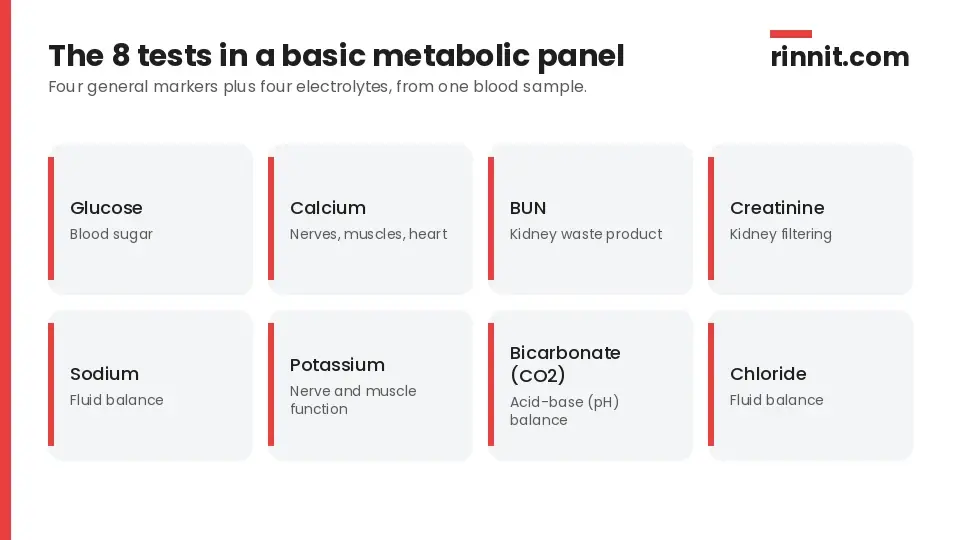
A BMP measures eight substances from one blood sample.
The panel measures four general markers and four electrolytes. [1]
Measurement | What it tells your provider |
Glucose | Blood sugar, your body's main energy source; high levels are often a sign of diabetes |
Calcium | A key mineral, mostly stored in bones, that keeps your nerves, muscles and heart healthy |
BUN (blood urea nitrogen) | Urea, a waste product your kidneys help remove from your blood |
Creatinine | A waste product from digesting protein and normal muscle breakdown, filtered out by your kidneys |
Sodium | Helps your cells keep the right fluid balance; your kidneys regulate it |
Potassium | Helps your nerves and muscles work |
Bicarbonate (CO2) | Reflects the carbon dioxide in your blood and helps keep a healthy acid-base (pH) balance |
Chloride | Helps your cells keep the right fluid balance |
Sources: [1]
Why would you need a BMP?
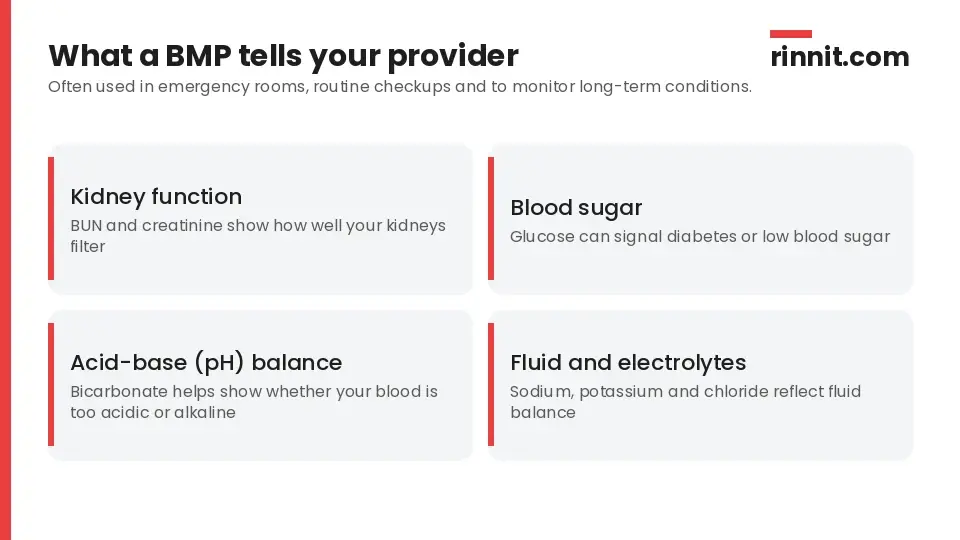
One test, four body functions.
With eight measurements, a BMP can check several body functions at once: [1]
Your kidney function and health
Your blood sugar level
The acid-base (pH) balance of your blood
Your fluid and electrolyte balance
Your provider may order a BMP: [1]
When you are receiving care in an emergency room
If you have symptoms related to kidney or metabolism problems
If you have a general symptom, such as fatigue or vomiting
To monitor a long-term condition, such as high blood pressure or kidney disease
To recheck a previous abnormal result
When you are starting a new medicine that can affect your kidney function
How do you prepare for a BMP?
You will likely need to fast for at least eight hours before the test. Fasting means not eating or drinking anything except water. Your provider will give you specific instructions when they order the test. [1]
What happens during a BMP blood test?
A healthcare provider, usually a phlebotomist, checks your arm for a vein, typically on the inner side of your elbow. They clean the area, insert a small needle and collect a small amount of blood in a test tube, which may feel like a small pinch. They then remove the needle, press a cotton ball or gauze on the site and place a bandage. The whole process usually takes less than five minutes. [1]
After the draw, your sample goes to a laboratory, and your provider shares the results with you. [1]
Are there risks?
Blood tests carry very little risk. You may have slight tenderness or a bruise where the needle went in, and this usually clears up quickly. [1]
When will you get your BMP results?
In most cases, results come back within one to two business days, though it can take longer. If you have the test in an emergency room, your care team should have results within hours. [1]
What are normal BMP results?

General normal ranges; always check the range on your lab report.
Your report lists each test, your number, the lab's normal range and whether your result is normal, high or low. Labs may use slightly different reference ranges, so always check the range printed on your report. In general, normal ranges are: [1]
Measurement | General normal range |
Glucose | 74 to 99 mg/dL |
Calcium | 8.5 to 10.2 mg/dL |
BUN | 7 to 21 mg/dL |
Creatinine | About 0.6 to 1.3 mg/dL (lower in women) |
Sodium | 136 to 144 mmol/L |
Potassium | 3.7 to 5.1 mmol/L |
Bicarbonate (CO2) | 22 to 30 mmol/L |
Chloride | 98 to 107 mmol/L |
Sources: [1]
What do abnormal BMP results mean?
If you have an abnormal result, your provider will likely recommend more tests to confirm or rule out a diagnosis. Providers rarely make a diagnosis from a BMP alone. [1]
One or more results outside the normal range may point to, but do not prove, long-term conditions such as: [1]
Diabetes
Bone disease
High blood pressure (hypertension)
Kidney disease
Liver disease
A BMP can also help diagnose sudden, severe conditions, such as: [1]
Dehydration
Diabetes-related ketoacidosis
Heart failure
Hypoglycemia (low blood sugar)
Kidney (renal) failure
Should you worry about one abnormal value?
Not necessarily. The foods you eat, certain medicines and other health conditions can affect results, and errors can happen during processing. About 1 in 20 healthy people will have a result outside the normal range. Your provider will consider your medical history and current medicines and let you know if you need further testing. [1]
Conclusion
A basic metabolic panel is a quick, low-risk blood test that gives your provider a broad view of your kidneys, blood sugar, electrolytes and acid-base balance. Fast as instructed, and remember that a single result outside the range is a starting point for a conversation, not a diagnosis.
Ask your provider what each of your numbers means for you and whether you need follow-up testing.
Keep learning: Read our guide to the comprehensive metabolic panel (CMP), which adds liver tests to the BMP, or our electrolytes guide. For more background, see the MedlinePlus page on the basic metabolic panel.
FAQ
What is a basic metabolic panel (BMP)?
It is a blood test that measures glucose, calcium, BUN, creatinine, sodium, potassium, bicarbonate and chloride to check your general health. [1]
What does a BMP test for?
It checks your kidney function, blood sugar, fluid and electrolyte balance and the acid-base balance of your blood. [1]
Do I need to fast before a BMP?
Usually yes, for at least eight hours with nothing but water; follow your provider's instructions. [1]
How long does a BMP take?
The blood draw usually takes less than five minutes. [1]
When will I get my BMP results?
Usually within one to two business days, or within hours in an emergency room. [1]
What are normal BMP values?
In general: glucose 74 to 99 mg/dL, calcium 8.5 to 10.2 mg/dL, BUN 7 to 21 mg/dL, creatinine about 0.6 to 1.3 mg/dL (lower in women), sodium 136 to 144 mmol/L, potassium 3.7 to 5.1 mmol/L, bicarbonate 22 to 30 mmol/L and chloride 98 to 107 mmol/L. [1]
What conditions can a BMP help find?
Diabetes, kidney disease, high blood pressure, bone or liver disease, and sudden problems such as dehydration, diabetic ketoacidosis, low blood sugar or kidney failure. [1]
Does an abnormal BMP mean I am sick?
Not necessarily; diet, medicines and lab errors can affect results, and about 1 in 20 healthy people have a value outside the range. [1]
What is the difference between a BMP and a CMP?
A comprehensive metabolic panel includes the eight BMP tests plus liver function and protein tests.
Are there risks to a BMP?
Very few; you may have slight tenderness or a bruise where the blood was drawn. [1]
Related Reading
Electrolyte Panel: What It Tests, Normal Ranges and What Results Mean explains the blood test that measures sodium, potassium, chloride and bicarbonate.
Chronic Kidney Disease: What It Is, Its 5 Stages, Causes, and How It's Treated explains a long-term condition a BMP helps monitor.
Acute Kidney Injury: What Causes Sudden Kidney Failure, and How It Is Treated covers the sudden kidney problem rising BUN and creatinine can signal.
Dehydration: Symptoms, Causes, Risk Groups & Treatment — Complete Guide describes a common cause of abnormal BMP results.
Diabetic Ketoacidosis (DKA): Signs, Triggers, and What To Do in an Emergency explains an emergency a BMP helps diagnose.
Hyponatremia: Complete Guide to Low Blood Sodium, Symptoms, Causes, and Treatment covers what a low sodium result means.
Hyperkalemia (High Blood Potassium): A Complete Guide to Causes, Symptoms, and Treatment explains a high potassium result.
References
Cleveland Clinic. Basic Metabolic Panel (BMP): What It Is, Procedure & Results. Cleveland Clinic. Last updated October 21, 2024. https://my.clevelandclinic.org/health/diagnostics/22020-basic-metabolic-panel-bmp
Corona G, Giuliani C, Parenti G, et al. Moderate hyponatremia is associated with increased risk of mortality: evidence from a meta-analysis. PLoS One. 2013;8(12):e80451. PMID 24367479. https://doi.org/10.1371/journal.pone.0080451
Benarroch-Gampel J, Sheffield KM, Duncan CB, et al. Preoperative laboratory testing in patients undergoing elective, low-risk ambulatory surgery. Ann Surg. 2012;256(3):518-528. PMID 22868362. https://doi.org/10.1097/SLA.0b013e318265bcdb
Medical disclaimer
This article is for general education only and does not replace advice from a qualified healthcare professional. Talk to your doctor about your own diagnosis and treatment, and seek emergency care right away for severe or sudden symptoms.



Comments