Diabetic Ketoacidosis (DKA): Signs, Triggers, and What To Do in an Emergency

Updated: 3 days ago
Medically reviewed by Dr. Baraa Alnahhal, MD · Last reviewed: November 2026
Quick Answer
Diabetic ketoacidosis (DKA) is a life-threatening emergency in which lack of insulin makes the body burn fat, releasing ketones that acidify the blood and cause dehydration [1] [2]. It can develop within 24 hours, mainly in type 1 diabetes [1]. Vomiting, fruity breath and rapid, deep breathing mean go to the emergency room [1] [2]. Hospital treatment uses IV fluids and insulin [1].
What the research says
Awareness campaigns can reduce DKA at the time type 1 diabetes is diagnosed in children. A systematic review of 14 studies found that DKA at diagnosis fell after community awareness campaigns, with a pooled reduction of 7.20% (95% CI 0.99–13.41) in 12 before-and-after studies (PubMed: Cherubini et al., Diabetes Res Clin Pract, 2021 [4]).
SGLT2 inhibitors are linked to a higher risk of DKA, including DKA with near-normal blood sugar. A systematic review of 47 published case reports (77 patients) plus a meta-analysis of clinical trials found that the risk of DKA was 3.7 times higher with SGLT2 inhibitors than with other medicines (risk ratio 3.70; 95% CI 2.58–5.29), and that this euglycemic DKA is rare and was most often reported in middle-aged women with type 2 diabetes (PubMed: Dutta et al., J Family Med Prim Care, 2022 [5]).
DKA is still a cause of death, which is why speed matters. US national data recorded 71,575 DKA-related deaths between 2006 and 2021; DKA-related mortality rose steadily before the COVID-19 pandemic and ran 36.91% above forecast in 2020 and 46.58% above forecast in 2021, with the highest excess in children (PubMed: He et al., J Diabetes, 2024 [6]).
What Is Diabetic Ketoacidosis (DKA)?
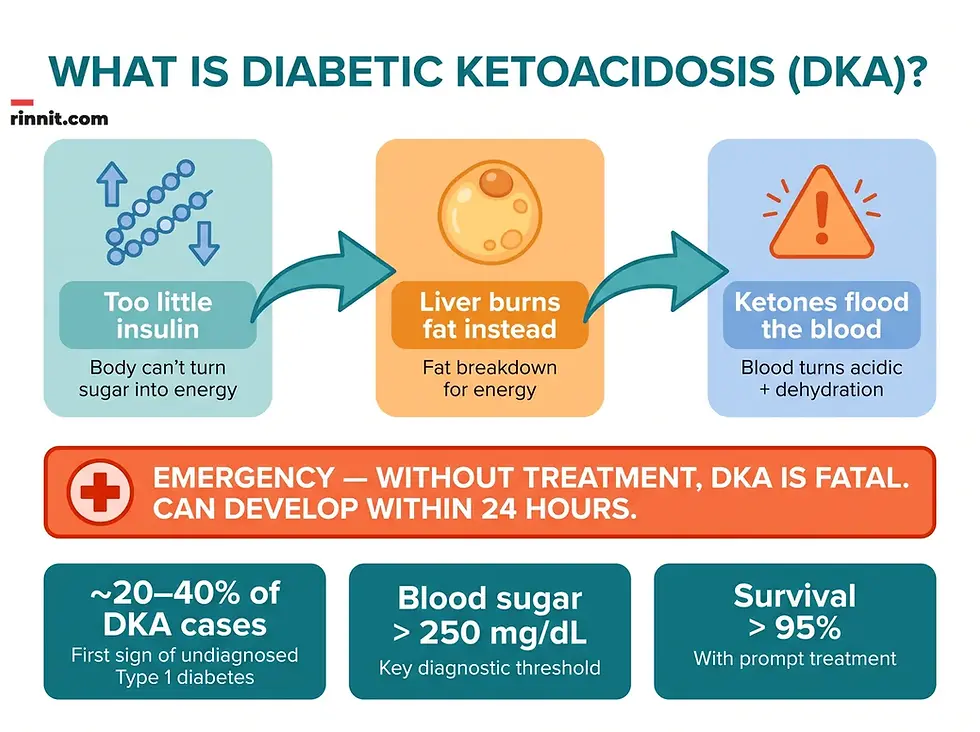
Diabetic ketoacidosis (DKA) is a life-threatening complication of diabetes, including diabetes you don't know you have yet [1]. Without treatment, DKA is fatal [1].
It all starts with insulin, the hormone your body needs to turn glucose (sugar) into energy. When insulin is too low, your liver switches to breaking down body fat for energy, which releases ketones into your bloodstream [1] [2]. When ketones build up, two dangerous things happen at once: your blood turns acidic, and you become dehydrated [1]. That combination is an emergency.
Who Gets DKA?
Situation | What happens |
Undiagnosed type 1 diabetes | For some people, DKA is how they find out they have type 1 diabetes. This accounts for about 20% to 40% of DKA cases |
Existing type 1 diabetes | People with type 1 diabetes can develop DKA at any point if they don't get enough injected or inhaled insulin |
Type 2 diabetes | Less common, but people with ketosis-prone type 2 diabetes can develop DKA. Type 2 diabetes more often leads to hyperosmolar hyperglycemic state (HHS) instead |
How Fast Does DKA Develop?
DKA has a severe and sudden onset. It can develop within 24 hours, and if you are vomiting it can move much faster [1]. That speed is why knowing the early signs matters.
Symptoms of DKA
DKA warning signs arrive in stages. Early signs are easy to miss; severe signs are an emergency.
Early Signs and Symptoms
Early sign | Why it happens |
Peeing more often than usual | Your body tries to flush out excess sugar |
Extreme thirst | Fluid loss from frequent urination |
Intense hunger | Your cells can't get the energy they need |
Signs of dehydration: dry mouth, headache, flushed skin | Your body is losing water |
High ketones in urine or blood | Fat breakdown detected on at-home tests |
Blood sugar over 250 mg/dL | The hallmark glucose threshold |
Severe Symptoms: Go to the ER
Severe symptom | What to do |
Nausea and vomiting | Call your provider immediately or go to the nearest emergency room |
Abdominal pain | Seek emergency care |
Rapid, deep breathing | Seek emergency care |
Fruity-smelling breath | Seek emergency care |
Feeling very tired or weak | Seek emergency care |
Disorientation or confusion | Seek emergency care |
Decreased alertness | Seek emergency care |
Loss of consciousness | Call your local emergency number |
If you have any severe symptoms, call your healthcare provider immediately or go to the nearest emergency room [1]. Don't wait to see if symptoms improve.

What Causes DKA?
The root cause of DKA is always the same: a lack of insulin in your body [1] [2]. Several situations can cause that shortage.
Trigger | How it causes low insulin |
New type 1 diabetes diagnosis | Your immune system attacks the insulin-producing cells in your pancreas, eventually causing a total lack of insulin |
Missing one or more insulin doses | Forgetting or skipping insulin directly drops your insulin level |
Insulin pump problems | A kinked cannula, a disconnected site or tubing, or an empty reservoir stops insulin from reaching your body |
Expired or spoiled insulin | Extreme heat or cold, or using expired insulin, makes it stop working |
Risk Factors That Push You Toward DKA
Certain conditions raise your DKA risk because they make your body release stress hormones that cause insulin resistance [1], so your usual insulin doses suddenly work less well.
Risk factor | Category |
Illness, especially with vomiting | Physical stress |
Infections (pneumonia, urinary tract infections, skin infections) | Physical stress |
Severe physical injury or emotional trauma | Physical stress |
Surgery | Physical stress |
Heart attack or stroke | Physical stress |
Pregnancy | Hormonal stress |
Alcohol use disorder or substance use disorder | Behavioral factor |
Certain medications: antipsychotics, diuretics (water pills), SGLT2 inhibitors, corticosteroids | Medication factor |
Complications of Untreated DKA
DKA moves quickly, and every hour without treatment raises the risk of serious damage. Left untreated, DKA can lead to:
Complication | Description |
Very low potassium (hypokalemia) | A dangerous electrolyte imbalance |
Brain swelling (cerebral edema) | Especially dangerous in younger people |
Fluid inside the lungs | Impairs breathing |
Cardiac arrest | The heart stops |
Kidney and organ damage | Lasting harm to vital organs |
Coma | Loss of consciousness |
Death | DKA is fatal without treatment |
This is why "wait and see" is never the right plan when DKA signs appear.
How Is DKA Diagnosed?
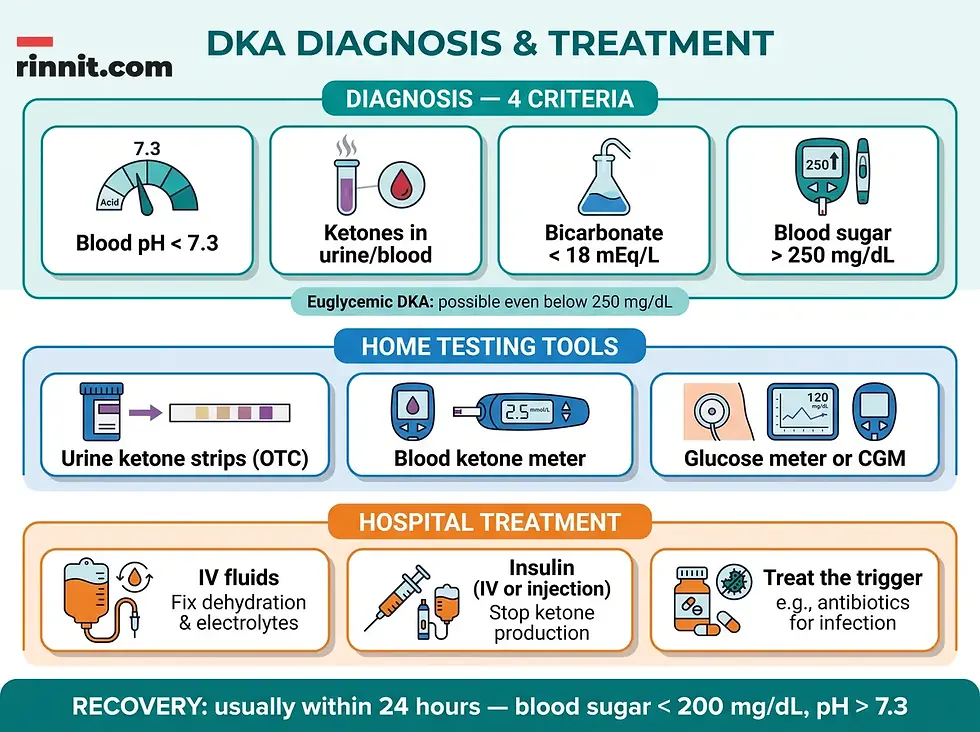
Healthcare providers diagnose DKA when these findings line up at the same time [1]:
Diagnostic criterion | Threshold |
Blood pH (acidity) | Less than 7.3 (acidosis) |
Ketones in urine and/or blood | Present |
Blood bicarbonate | Less than 18 mEq/L |
Blood sugar | 200 mg/dL or higher, or any level in someone known to have diabetes |
Important exception: you can have DKA even if your blood sugar is lower than 250 mg/dL. This is called euglycemic DKA [1]. It is less common, but it does happen, especially in people taking SGLT2 inhibitors [5].
Testing at Home
If you have diabetes and call your provider with symptoms, they can usually tell whether you have DKA from readings you collect at home with three tools [1]:
Home test | How it works |
Urine ketone test | A test strip changes color based on the ketone level in your urine. Strips are available at pharmacies without a prescription; follow the package instructions exactly |
Blood ketone test | Some blood glucose meters also measure blood ketones, and other meters measure ketones only |
Blood sugar check | Use a blood glucose meter or a continuous glucose monitor (CGM) |
How Is DKA Treated?
Treatment depends on your situation. If you have diabetes and catch DKA early, your provider may guide you through treatment at home [1]. Otherwise, you'll need the hospital. If you have DKA symptoms but no diabetes diagnosis, go straight to the hospital.
Hospital Treatment
Treatment | What it does |
IV fluids | Treat dehydration, clear ketones through your urine, and fix electrolyte imbalances |
Insulin (IV or injection) | Restores the hormone your body is missing and stops ketone production |
Other treatments | Added based on how severe the DKA is, plus treatment for the underlying trigger (for example, antibiotics for a bacterial infection) |
At-Home Treatment (Provider-Guided Only)
If your provider decides you can treat DKA at home, follow their instructions precisely, including how much insulin or medication to take. In general, you should:
Home step | Why it matters |
Check blood sugar often | Check about every hour to confirm your glucose is falling safely and treatment is working |
Check ketones | Use urine strips or a blood ketone meter; ketones should go down, not up |
Drink fluids | Water, broth, or sugar-free drinks prevent dehydration, especially if you are sick or vomiting |
Try to eat normally | Keep eating even when sick, and take the right amount of insulin with meals as directed |
Don't exercise | Physical activity raises blood sugar and increases ketones; wait for your provider's clearance |
Outlook: What Recovery Looks Like
With prompt treatment, DKA recovery typically happens within 24 hours [1]. Full recovery means your blood sugar is below 200 mg/dL and your blood pH is above 7.3 [1]. Depending on severity, treatment can take multiple days [1].
The survival rate of DKA continues to improve. With appropriate treatment, survival is over 95% [1]. Certain factors lead to worse outcomes:
Risk factor | Why it's dangerous |
Treatment started after coma, hypothermia, or low urine output (oliguria) | Signals very advanced DKA |
Age over 65 with acute conditions (heart attack, pneumonia, sepsis) | Adds strain on already-stressed body systems |
Brain swelling | Especially dangerous in younger people |
Can DKA Be Prevented?
You can't eliminate the risk entirely, because sometimes a perfect storm of factors triggers DKA outside your control. But daily habits meaningfully reduce your odds:
Prevention habit | How it helps |
Check glucose often | At least before and after meals and before bed; treat high blood sugar as soon as possible |
Take insulin and medication regularly | Follow your provider's instructions without skipping doses |
Check for ketones when blood sugar stays high | Use a urine or blood ketone test |
Check your insulin pump when blood sugar is high | Look for a kinked cannula or a disconnected site or tubing |
Have a sick day plan | Discuss with your provider how to manage diabetes when you're sick |
Stay educated about DKA | The more you know, the more likely you are to prevent it or catch it early |
If DKA develops despite your best efforts, try not to be hard on yourself [1]. Diabetes is a tough condition to manage, and DKA triggers are often beyond your control. The best move is always to get help as quickly as possible.
Key Takeaways
DKA is a life-threatening diabetes emergency caused by too little insulin. When your body can't use sugar, it burns fat instead, flooding your blood with acidic ketones and dehydrating you. It strikes fast, often within 24 hours, and can be the first sign of undiagnosed type 1 diabetes. The early signs are extreme thirst, frequent urination, intense hunger, and blood sugar over 250 mg/dL. The severe signs (vomiting, fruity-smelling breath, rapid deep breathing, confusion) mean go to the emergency room now. Diagnosis rests on low blood pH, ketones, low bicarbonate, and high blood sugar, and treatment combines IV fluids and insulin, with survival over 95% when care is prompt.
Take the Next Step
If you have diabetes and notice early DKA signs, test your ketones and call your provider immediately. If symptoms are severe, go to the nearest emergency room. Quick action saves lives.
Frequently Asked Questions
1. What is diabetic ketoacidosis (DKA)?
Diabetic ketoacidosis is a life-threatening diabetes complication that happens when your body lacks enough insulin to turn sugar into energy. Your liver burns fat instead, releasing ketones that make your blood acidic and dehydrate you. Without treatment, DKA is fatal.
2. How common is DKA?
DKA affects people with type 1 diabetes most often, and about 20% to 40% of DKA cases happen in people with undiagnosed type 1 diabetes, meaning DKA is how they first discover they have diabetes. It can also occur in people with ketosis-prone type 2 diabetes, though that is less common.
3. How fast does DKA develop?
DKA has a severe and sudden onset. It can develop within 24 hours. If you're vomiting, it can progress much more quickly, so don't wait to seek help.
4. What are the first signs of DKA?
Early signs include peeing more often than usual, extreme thirst, intense hunger, dehydration (dry mouth, headache, flushed skin), high ketones on at-home tests, and blood sugar above 250 mg/dL.
5. What blood sugar level indicates DKA?
Blood sugar of 200 mg/dL or higher (or known diabetes) is a key diagnostic criterion under current guidelines. However, you can still have DKA with blood sugar below 250 mg/dL. This is called euglycemic DKA and is less common.
6. Why does my breath smell fruity with DKA?
Ketones build up in your blood, and the fruity odor is a recognized sign of DKA. Combined with rapid, deep breathing, vomiting, or confusion, fruity-smelling breath means go to the emergency room.
7. Can DKA be treated at home?
If you have diabetes and catch DKA early, your provider may guide you through home treatment: checking blood sugar about every hour, monitoring ketones, drinking fluids, eating normally, and avoiding exercise. If you have symptoms but no diabetes diagnosis, go to the hospital.
8. How is DKA treated in the hospital?
Hospital treatment includes IV fluids to fix dehydration and electrolyte imbalances, insulin through an IV or injection to stop ketone production, and additional treatment for the underlying trigger, such as antibiotics for an infection.
9. What is the survival rate for DKA?
With appropriate treatment, the survival rate is over 95% and continues to improve. Recovery typically happens within 24 hours and is defined by blood sugar below 200 mg/dL and blood pH above 7.3.
10. What causes DKA in someone already diagnosed with diabetes?
The most common triggers are missing insulin doses, insulin pump problems (a kinked cannula, disconnected tubing, or an empty reservoir), spoiled or expired insulin, and illness that causes insulin resistance.
11. How can I prevent DKA?
Check glucose before and after meals and at bedtime, take insulin regularly, test ketones when blood sugar stays high, check your pump when readings run high, create a sick day plan with your provider, and learn the early warning signs.
Related Reading
Arterial Blood Gas (ABG) Test: Purpose, Procedure, Normal Values and Results explains the blood test that measures oxygen, carbon dioxide and pH in this condition.
CO2 Blood Test (Bicarbonate): Purpose, Procedure, Normal Levels and What Results Mean explains how a CO2 blood test can show the low bicarbonate seen in ketoacidosis.
Urinalysis: What It Tests, How to Prepare, Normal Values and What Results Mean explains how a urinalysis checks for ketones, mainly used to look for diabetic ketoacidosis.
Basic Metabolic Panel (BMP): What It Tests, Normal Ranges and What Results Mean explains the blood test that checks kidney function, blood sugar and electrolytes.
Learn more in our guide to Lipase Blood Test: Normal Range, High and Low Levels and What They Mean.
Anion Gap Blood Test: What It Measures and What High or Low Results Mean explains what this electrolyte calculation shows about your blood's acid balance.
References
Cleveland Clinic. Diabetes-Related Ketoacidosis (DKA). Cleveland Clinic. Nov. 21, 2025. https://my.clevelandclinic.org/health/diseases/21945-diabetic-ketoacidosis-dka
Centers for Disease Control and Prevention. Diabetic Ketoacidosis. CDC. Last reviewed May 15, 2024. https://www.cdc.gov/diabetes/about/diabetic-ketoacidosis.html
Lizzo JM, Goyal A, Kaur J. Adult Diabetic Ketoacidosis. In: StatPearls [Internet]. Treasure Island (FL): StatPearls Publishing; updated Nov. 30, 2025. PMID: 32809558. https://www.ncbi.nlm.nih.gov/books/NBK560723/
Cherubini V, Marino M, Carle F, Zagaroli L, Bowers R, Gesuita R. Effectiveness of ketoacidosis prevention campaigns at diagnosis of type 1 diabetes in children: a systematic review and meta-analysis. Diabetes Res Clin Pract. 2021;175:108838. doi:10.1016/j.diabres.2021.108838. PMID: 33901625.
Dutta S, Kumar T, Singh S, Ambwani S, Charan J, Varthya SB. Euglycemic diabetic ketoacidosis associated with SGLT2 inhibitors: a systematic review and quantitative analysis. J Family Med Prim Care. 2022;11(3):927-940. doi:10.4103/jfmpc.jfmpc_644_21. PMID: 35495849.
He X, Huang AH, Lv F, et al. Trends in diabetic ketoacidosis- and hyperosmolar hyperglycemic state-related mortality during the COVID-19 pandemic in the United States: a population-based study. J Diabetes. 2024;16(8):e13591. doi:10.1111/1753-0407.13591. PMID: 39136498.
Medical Disclaimer
This article is for informational purposes only and does not constitute medical advice. Always seek the advice of your physician or other qualified health provider with any questions you may have regarding a medical condition. Never disregard professional medical advice or delay in seeking it because of something you have read here.



Comments