Lipase Blood Test: Normal Range, High and Low Levels and What They Mean

Updated: 2 days ago
Written and medically reviewed by Dr. Baraa Alnahhal, MD · Last reviewed: November 2026 · How we review
Quick Answer: What is a lipase blood test?
A lipase blood test measures how much lipase, a digestive enzyme made mostly by the pancreas, is in the blood. A normal level is generally 0 to 160 U/L, though labs vary. A level 3 or more times the top of the normal range may signal acute pancreatitis. You usually need to fast for 8 to 12 hours. [1]
What the research says
Lipase misses about 1 in 5 cases on its own. A Cochrane review of 10 studies (5,056 people with acute belly pain) found that lipase above 3 times normal had a sensitivity of 79% and specificity of 89% for acute pancreatitis. The authors advise treating suspected pancreatitis even if the tests are normal. (Rompianesi et al., Cochrane Database of Systematic Reviews, 2017) [2]
Many very high lipase results are not pancreatitis. In 808 people with lipase at least 3 times normal, 401 had no pancreatitis, most often because of acute kidney injury (33.2%) or sepsis (27.7%). This group had higher in-hospital death rates than people with pancreatitis (22.4% vs 5.1%). (Feher et al., World Journal of Gastroenterology, 2024) [3]
Key takeaways
Lipase is a digestive enzyme made mostly by your pancreas.
The test is mainly used to check for acute pancreatitis.
Normal is generally 0 to 160 U/L; ranges vary by lab, age, sex and health.
3 or more times the upper limit may signal acute pancreatitis.
High or low lipase alone can't make a diagnosis; symptoms and other tests matter.
What is lipase?
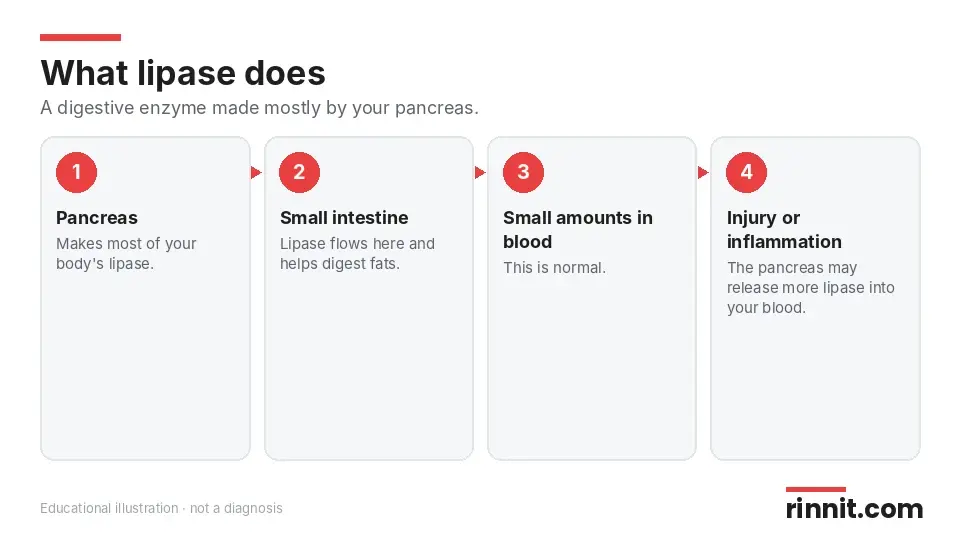
Lipase is an enzyme that helps you digest fats. Your pancreas makes most of it, and your stomach and salivary glands make smaller amounts. During digestion, lipase flows from your pancreas to your small intestine. [1]
It's normal to have small amounts of lipase in your blood. High levels may mean your pancreas is releasing lipase because of injury or inflammation (pancreatitis) or another condition. [1]
Why would a doctor order a lipase test?
Providers usually order it if you have symptoms of acute pancreatitis: [1]
Moderate to severe belly pain that may spread to your lower back
Nausea and vomiting
A fast heart rate
Fast, shallow breathing
Fever
These symptoms, together with very high lipase, are the main criteria for diagnosing acute pancreatitis. With other pancreatic tests such as an amylase test, lipase can also help find other pancreatic problems like a cyst or a blocked pancreatic duct, and can show how well treatment is working. [1]
How do you prepare for a lipase test?
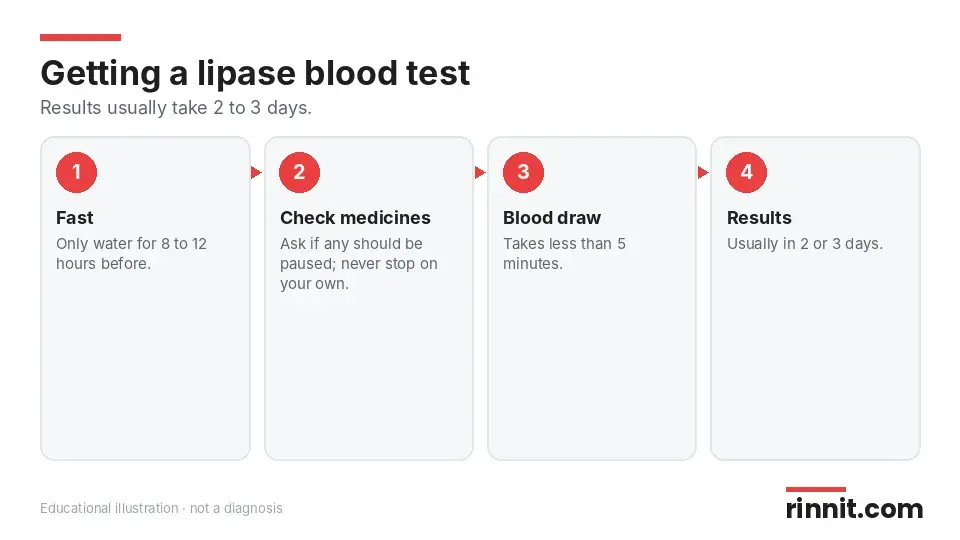
You'll need to fast and drink nothing but water for 8 to 12 hours before the test. [1]
Ask your provider whether to stop any medicines, supplements or herbs first. Some medicines can raise lipase, making it harder to tell if a condition is the cause. These include some: [1]
Birth control pills
Pain medicines, like codeine
Diuretics (water pills)
Cholesterol medicines
Never stop a medicine unless your provider tells you to. [1]
What happens during the test?
The test takes less than 5 minutes. A provider cleans your arm, inserts a needle into a vein and collects blood in a vial. You may feel a slight sting. Then they remove the needle and bandage the site. [1]
Are there risks?
A lipase test is safe, with minimal risk. You may have slight bruising, and some people feel faint after blood draws. If you feel dizzy, you may need to rest before leaving. [1]
What do lipase results mean?
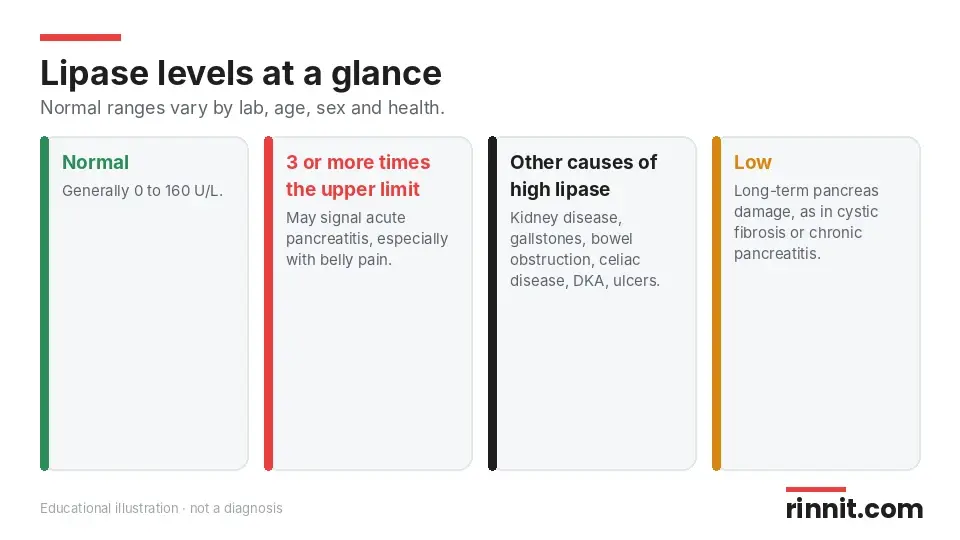
Labs vary in what they consider normal, and your age, sex and health status matter too. Generally, a lipase level of 0 to 160 U/L is considered normal. [1]
Lipase level | What it may mean |
Within the lab's normal range (generally 0 to 160 U/L) | Normal |
3 or more times the upper limit | May signal acute pancreatitis |
Below normal | Pancreas cells may not be making enough lipase |
Sources: [1]
Causes of high lipase
Besides acute pancreatitis, high lipase can be linked to: [1]
A blocked pancreatic duct
Bowel obstruction
Celiac disease
Diabetes-related ketoacidosis
Chronic kidney disease or kidney failure
Gallbladder disease or gallstones
Salivary gland inflammation (sialadenitis)
Stomach (peptic) ulcer or peptic ulcer disease
Alcohol use disorder
Causes of low lipase
Low lipase may mean the lipase-making cells in your pancreas have long-term damage, as can happen with: [1]
Cystic fibrosis
Chronic pancreatitis
When will you get your results?
Results usually take 2 or 3 days, depending on the lab. Ask when to expect them and how you'll receive them. [1]
What happens if your results are abnormal?
If your lipase is very high and you have symptoms of acute pancreatitis, your provider may recommend treatment, though acute pancreatitis sometimes heals on its own. If your symptoms don't point to pancreatitis, you may need more blood tests or imaging before a diagnosis. [1]
When should you call your provider?
Contact a provider if you have unexplained belly pain. Get emergency care for sudden, severe belly pain, especially if it spreads to your back or comes with vomiting or fever. Very high lipase with pancreatitis symptoms needs prompt medical care. [1]
Questions to ask your provider
Do I need to stop any of my medicines before the test?
How high is my lipase compared with the normal range?
Could something other than pancreatitis explain my result?
Do I need imaging or more blood tests?
Conclusion
A lipase blood test is a quick way to check for pancreatitis when you have belly pain. Very high levels, 3 or more times the upper limit, are a strong clue, but many conditions and even some medicines can raise lipase.
Try not to jump to conclusions from the number alone. Your provider will read it alongside your symptoms and other tests to find the cause.
Keep learning: Read our guides to the comprehensive metabolic panel (CMP), liver function tests, the CT scan and ERCP. For more on this enzyme, see StatPearls: Biochemistry, Lipase.
FAQ
What does a lipase blood test check for?
It measures the enzyme lipase in your blood, mainly to check for acute pancreatitis. [1]
What is a normal lipase level?
Generally 0 to 160 U/L, though labs vary. [1]
What level of lipase is concerning?
A level 3 or more times the top of the normal range may signal acute pancreatitis. [1]
Do I need to fast for a lipase test?
Yes. Fast and drink only water for 8 to 12 hours before. [1]
What can cause high lipase besides pancreatitis?
Kidney disease, gallstones, bowel obstruction, celiac disease, diabetic ketoacidosis, ulcers and alcohol use disorder. [1]
What does low lipase mean?
Your pancreas may have long-term damage, as in cystic fibrosis or chronic pancreatitis. [1]
Can medicines affect lipase levels?
Yes. Some birth control pills, pain medicines, diuretics and cholesterol medicines can raise lipase. [1]
How long do lipase results take?
Usually 2 or 3 days. [1]
What are the symptoms of high lipase?
They depend on the cause; with acute pancreatitis the main symptom is belly pain spreading to your lower back. [1]
Is a lipase test risky?
No. It is a safe blood draw with minimal risk of bruising or feeling faint. [1]
Related Reading
Learn more in our guide to Pancreatitis: Symptoms, Causes, and Treatment — A Clear Guide to Understanding and Managing the Condition.
Learn more in our guide to Gallstone Pancreatitis: Causes, Symptoms, and Treatment.
Learn more in our guide to Cystic Fibrosis: Symptoms, Causes, Diagnosis, and Treatment (2026 Guide).
Learn more in our guide to Celiac Disease: How Gluten Damages Your Gut, and How a Gluten-Free Diet Can Heal It.
Learn more in our guide to Diabetic Ketoacidosis (DKA): Signs, Triggers, and What To Do in an Emergency.
Learn more in our guide to Chronic Kidney Disease: What It Is, Its 5 Stages, Causes, and How It's Treated.
Pancreas Blood Test: Amylase and Lipase for Pancreatitis explains the amylase and lipase blood tests used to diagnose pancreatitis.
Amylase Test: Blood and Urine Amylase, Normal Range and Results explains the blood and urine test for the digestive enzyme amylase.
References
Cleveland Clinic. Lipase Blood Test: What It Is & Understanding the Results. Cleveland Clinic. Last updated July 16, 2024. https://my.clevelandclinic.org/health/diagnostics/lipase-blood-test
Rompianesi G, Hann A, Komolafe O, et al. Serum amylase and lipase and urinary trypsinogen and amylase for diagnosis of acute pancreatitis. Cochrane Database Syst Rev. 2017;4(4):CD012010. PMID 28431198. https://doi.org/10.1002/14651858.CD012010.pub2
Feher KE, Tornai D, Vitalis Z, et al. Non-pancreatic hyperlipasemia: A puzzling clinical entity. World J Gastroenterol. 2024;30(19):2538-2552. PMID 38817657. https://doi.org/10.3748/wjg.v30.i19.2538
Medical disclaimer
This article is for general education only and does not replace advice from a qualified healthcare professional. Talk to your doctor about your own diagnosis and treatment, and seek emergency care right away for severe or sudden symptoms.



Comments