CT Scan: What It Shows, How It Works, Risks and Results

Updated: 2 days ago
Written and medically reviewed by Dr. Baraa Alnahhal, MD · Last reviewed: November 2026 · How we review
Quick Answer: What is a CT scan?
A CT (computed tomography) scan, also called a CAT scan, is a painless imaging test that takes many X-ray pictures from different angles and uses a computer to combine them into detailed images of the bones, organs and soft tissues. It helps diagnose cancer, injuries, infections and blood clots. The scan itself usually lasts less than 5 minutes. [1]
What the research says
CT radiation in childhood carries a small added cancer risk. A study of 10.9 million Australians found that the 680,211 people who had a CT scan before age 20 had a 24% higher overall cancer incidence, rising by 0.16 for each extra scan. In absolute terms the excess was 9.38 cancers per 100,000 person-years. (Mathews et al., BMJ, 2013) [2]
The absolute risk is small, so scans should be justified and low-dose. In a UK cohort of about 178,000 young people, cumulative doses near 50 to 60 mGy roughly tripled the risk of leukemia and brain tumors, but this equals about one extra case of each per 10,000 head CT scans in the 10 years after a first scan before age 10. (Pearce et al., The Lancet, 2012) [3]
Key takeaways
CT combines many X-rays into cross-sectional and 3D images. [1]
Some scans use contrast dye through an IV or as a drink to make tissues clearer. [1]
You lie still on a table that slides into a doughnut-shaped scanner and may hold your breath briefly. [1]
CT uses a small amount of ionizing radiation and is considered safe, including for children. [1]
A radiologist reviews the images and sends a report to your provider, usually within 24 to 48 hours. [1]
What is a CT scan?
A CT or CAT (computed axial tomography) scan is an imaging test that uses X-rays and a special computer to create detailed pictures of your bones, organs and soft tissues. By taking X-ray pictures at many angles and combining them, it builds a 3D image that shows your body much more clearly than a standard X-ray. It can also show whether a condition is getting better or worse with treatment. [1]
What does a CT scan show?
CT scans show tumors, injuries and diseases in more detail than an X-ray. Examples include: [1]
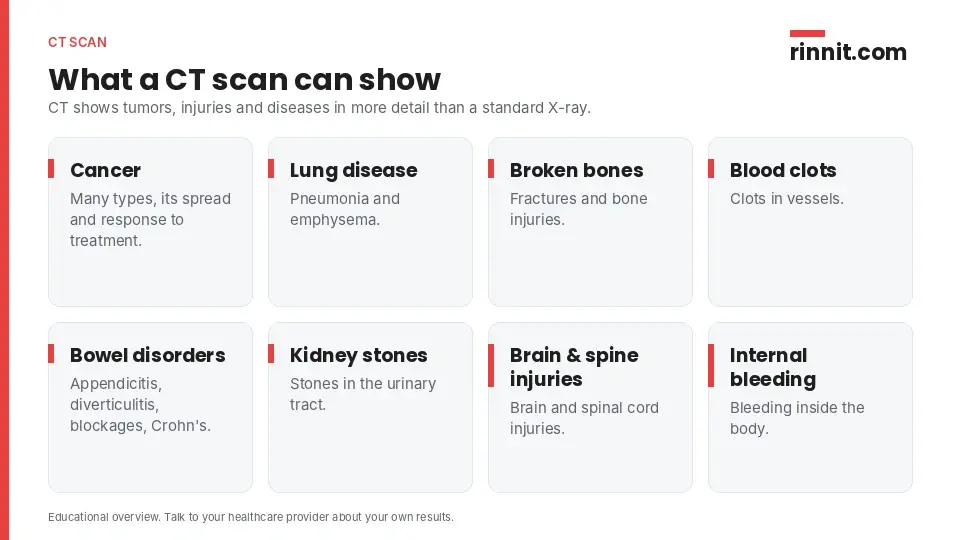
Many types of cancer
Pneumonia and emphysema
Broken bones
Heart disease and blood clots
Bowel disorders such as appendicitis, diverticulitis, blockages and Crohn's disease
Kidney stones
Brain and spinal cord injuries
Internal bleeding
Sources: [1]
How does a CT scan work?
A standard X-ray takes flat, 2D images. A CT machine moves around you, taking X-ray pictures from many angles to create cross-sectional images. Like the layers you see when you slice a cake, a CT shows the layers of your body, and together they form a 3D image. Some CT scans also use contrast material (dye) to make the pictures even clearer. [1]
How do you prepare for a CT scan?
Your provider will tell you what to do. In general, arrive early, wear comfortable clothes and remove metal jewelry or clothing; you may be given a hospital gown. [1]
CT scan with contrast
Contrast makes certain tissues, organs or blood vessels easier to see. It is usually injected into a vein through an IV, which can make you feel flushed or leave a metallic taste in your mouth. IV contrast usually leaves your body in your urine within 24 hours. Sometimes you drink a contrast liquid instead, which is especially helpful for scans of the intestines. [1]
Blood test: you may need one to make sure the contrast is safe for you.
Allergy medicine: if you are allergic to contrast, you may need steroid and antihistamine medicines the night before and the morning of the scan, ordered by your provider.
Sources: [1]
What happens during a CT scan?

You usually lie on your back on a bed-like table.
The table moves into the doughnut-shaped scanner. Stay as still as possible, because movement blurs the images.
You may be asked to hold your breath briefly, usually for less than 15 to 20 seconds.
The scanner, which is relatively quiet, takes pictures of the area your provider needs to see.
When the exam is over, the table moves back out of the scanner.
A technologist trained in CT guides you through the entire process. [1]

Step | Typical time |
Whole visit | About 1 hour, mostly preparation |
The scan itself | Less than 5 minutes |
Breath hold | Usually under 15 to 20 seconds |
IV contrast leaving the body | Within about 24 hours |
Results | 24 to 48 hours (often within an hour in an emergency) |
Sources: [1]
Are there risks or side effects?
Healthcare providers consider CT scans safe, including for children. Like X-rays, they use a small amount of ionizing radiation. If you are worried about radiation, talk to your provider, who can help you make an informed decision. [1]
The scan itself usually causes no side effects, but some people react to the contrast material with nausea and vomiting, headaches or dizziness. [1]
CT scans during pregnancy
Tell your provider if you are or might be pregnant. Scans of the pelvis and abdomen expose the fetus to radiation, but not enough to cause harm, and scans of other parts of the body give the fetus almost no radiation. [1]
What happens after a CT scan?
You can go home and return to your normal activities. If contrast was used, you may be asked to drink plenty of water. A radiologist reviews the images and writes a report for the provider who ordered the scan, and your provider then discusses the results with you at a visit or by phone. [1]
What do CT scan results mean?
Your radiologist's report usually includes: [1]
How the CT was done, such as whether contrast was used, your positioning and which body parts were scanned
Findings, describing what looked normal or abnormal
An Impression, a summary with the main finding, a possible diagnosis and any recommended further tests
Sometimes more testing is suggested, such as an MRI to look at a suspicious area in a different way. If your report has unfamiliar words, ask your provider to explain what they mean for your care. [1]
Conclusion
A CT scan is a fast, painless test that gives your care team a detailed look inside your body and helps diagnose a wide range of conditions, including cancer. The radiation dose is small, and research supports using CT when there is a clear medical reason and keeping doses as low as possible. Talk to your provider about any concerns, including other testing options. [1]
Keep learning: Read our guides to appendicitis, diverticulitis and the ultrasound test. For more on CT radiation, see the U.S. FDA's overview of computed tomography.
FAQ
What is a CT scan?
A CT (computed tomography) or CAT scan is an imaging test that uses a series of X-rays and a computer to create detailed pictures of bones, organs and soft tissues [1].
What can a CT scan detect?
It can show many cancers, pneumonia and emphysema, broken bones, heart disease, blood clots, bowel disorders, kidney stones, brain and spinal cord injuries, and internal bleeding [1].
How long does a CT scan take?
The visit usually takes about an hour, mostly for preparation. The scan itself usually takes less than 5 minutes [1].
Is a CT scan painful?
No. A CT scan is painless and noninvasive [1].
What does CT contrast feel like?
IV contrast can make you feel flushed or leave a metallic taste in your mouth. It usually leaves your body in your urine within 24 hours [1].
Is the radiation from a CT scan dangerous?
CT uses a small amount of ionizing radiation, and providers consider it safe, including for children. Talk to your provider if you have concerns [1].
How long do CT scan results take?
Usually about 24 to 48 hours. In an emergency setting, results often come within an hour [1].
Can a CT scan detect cancer?
Yes. It shows tumors and organ changes that could be cancer, and it helps check whether cancer has spread or treatment is working [1].
Can I have a CT scan if I am pregnant?
Tell your provider first. Pelvic and abdominal scans expose the fetus to radiation, but not enough to cause harm, and scans of other areas give almost none [1].
What happens after a CT scan?
You can go home and resume normal activities. If contrast was used, you may be told to drink plenty of water [1].
Related Reading
Learn more in our guide to Appendicitis: Symptoms, Causes, Diagnosis, Treatment & Complete Guide.
Learn more in our guide to Diverticulitis: Symptoms, Causes, Treatment & Diet — Complete Guide.
Learn more in our guide to Pneumonia: Complete Guide to Symptoms, Causes, and Treatment.
Learn more in our guide to Traumatic Brain Injury: Symptoms, Emergency Signs, Diagnosis and Recovery.
Incidental Finding: What It Means When a Scan Shows Something Unexpected explains what it means when a scan shows something unexpected.
References
Cleveland Clinic. CT Scan (Computed Tomography Scan). Cleveland Clinic. Last updated July 22, 2025. https://my.clevelandclinic.org/health/diagnostics/4808-ct-computed-tomography-scan
Mathews JD, Forsythe AV, Brady Z, et al. Cancer risk in 680,000 people exposed to computed tomography scans in childhood or adolescence: data linkage study of 11 million Australians. BMJ. 2013;346:f2360. PMID 23694687. https://doi.org/10.1136/bmj.f2360
Pearce MS, Salotti JA, Little MP, et al. Radiation exposure from CT scans in childhood and subsequent risk of leukaemia and brain tumours: a retrospective cohort study. Lancet. 2012;380(9840):499-505. PMID 22681860. https://doi.org/10.1016/S0140-6736(12)60815-0
Medical disclaimer
This article is for general education only and does not replace advice from a qualified healthcare professional. Talk to your doctor about your own diagnosis and treatment, and seek emergency care right away for severe or sudden symptoms.



Comments