Incidental Finding: What It Means When a Scan Shows Something Unexpected

Updated: 3 days ago
Written and medically reviewed by Dr. Baraa Alnahhal, MD · Last reviewed: November 2026 · How we review
Quick Answer
An incidental finding is something unexpected a provider sees on a test that was done for another reason, on imaging such as a CT scan, MRI or ultrasound. Common examples include lung nodules, thyroid nodules and kidney cysts. These findings are common and usually harmless. Your provider will decide whether one needs no action, follow-up or prompt treatment.
What the research says
How often incidentalomas are cancer varies widely: an umbrella review of 20 systematic reviews found the rate and seriousness of incidental imaging findings varied greatly by organ and scan type; breast incidentalomas were malignant about 42% of the time, while many other types were rarely cancer (O'Sullivan JW et al., BMJ, 2018) [2]
Guidelines help avoid unnecessary follow-up: the Fleischner Society guidelines give radiologists a simplified system for deciding which incidental lung nodules on CT need follow-up scans and when, based on nodule size, type and patient risk (MacMahon H et al., Radiology, 2017) [3]
Key takeaways
An unexpected finding on a test done for another reason.
Very common on modern scans and usually harmless.
Common examples are lung, thyroid and adrenal nodules and kidney cysts.
Next steps range from no action to follow-up or treatment.
Ask your provider what the finding means and whether follow-up is needed.
Why are incidental findings so common?
Modern imaging is so detailed that it can show tiny differences that wouldn't have been seen before. Many are harmless, such as small areas of old tissue damage or normal age-related changes. Incidental findings can also come from genetic testing. Sources: [1]
Common incidental findings
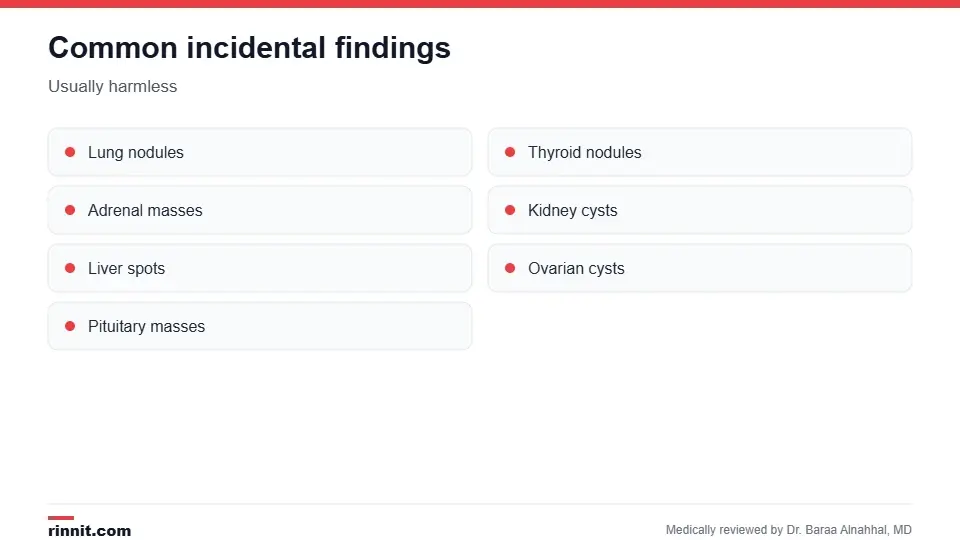
Most incidental findings are benign.
Finding | How common | Usual outcome |
About 1 in 3 chest CT scans | Small ones are usually benign | |
Up to 68% of imaging studies | Most are benign | |
Very common | Almost always benign, often adenomas | |
Kidney masses | Up to 40% of kidney imaging | Mostly benign kidney cysts |
Liver nodules | About 15% of CT scans | Often benign liver lesions |
Pituitary masses | Up to about 1 in 5 people | Often cysts or adenomas |
Other findings include gallstones, kidney stones, hernias, ovarian cysts, coronary artery calcium and, rarely, serious findings such as a brain aneurysm. Sources: [1]

Incidental findings are very common.
What happens next?
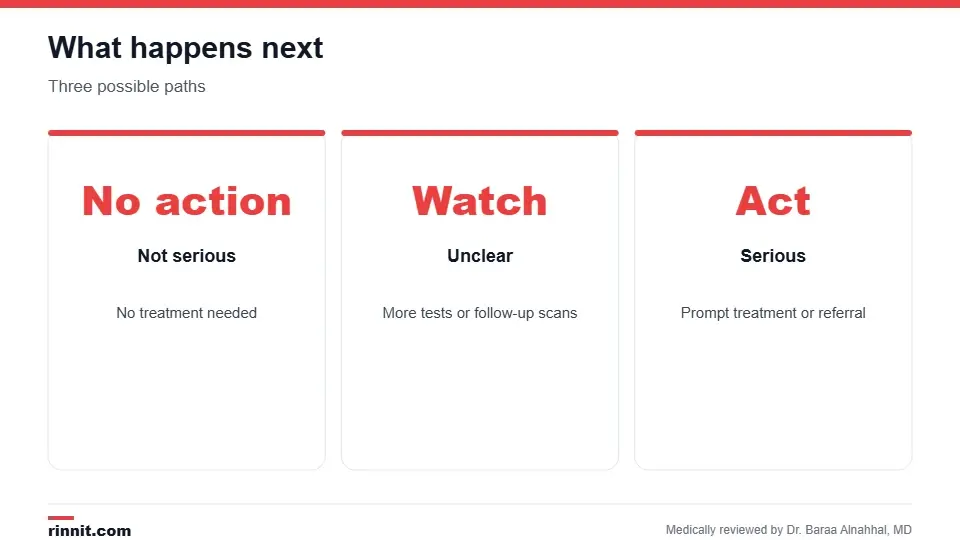
Your provider decides the next step.
Not serious: no treatment or follow-up is needed.
Unclear: your provider may order more imaging, a biopsy or other tests, or recheck it with follow-up scans over weeks or months.
Serious: it needs prompt treatment or referral. Sources: [1, 3]
Radiologists follow guidelines to decide which findings need follow-up, which helps limit unnecessary testing. Sources: [1, 3]
Benefits and downsides
Finding something early, such as a small cancer, can prevent it from becoming serious. But incidental findings can also lead to tests you may not need, added costs and anxiety about something harmless. Talking openly with your provider helps you weigh these trade-offs. Sources: [1, 2]
Questions to ask your provider
Is this finding likely to be serious?
Do I need more tests or treatment?
If it needs follow-up, when and how?
Are there symptoms I should watch for? Sources: [1]
Conclusion
Incidental findings are a normal part of modern imaging, and most are harmless. Your provider will help you understand whether yours needs any action, and following their plan keeps you safe without unnecessary worry.
Keep learning: read about pulmonary nodules and thyroid nodules.
Frequently asked questions
What is an incidental finding?
Something unexpected seen on a test done for another reason.
What is an incidentaloma?
An incidental growth or mass found on imaging.
Are incidental findings common?
Yes. They're very common on modern scans.
Are they usually serious?
No. Most are harmless.
What are common examples?
Lung nodules, thyroid nodules, adrenal masses and kidney cysts.
What happens after one is found?
No action, follow-up tests or treatment, depending on the finding.
Can they be found on genetic tests?
Yes.
Why might I need follow-up scans?
To make sure an unclear finding doesn't change over time.
Can incidental findings cause anxiety?
Yes. Ask your provider to explain what yours means.
Who decides if follow-up is needed?
Your provider and radiologist, using guidelines.
Related Reading
Pulmonary Nodules: Symptoms, Causes, and Management the most common incidental lung finding.
Thyroid Nodules: Symptoms, Causes, Diagnosis and Treatment — What You Need to Know a common incidental neck finding.
Adrenal Adenoma: The Most Common Adrenal Gland Tumor — What It Is, What It Does, and When It Needs Treatment a frequent incidental adrenal finding.
Kidney Cysts: Symptoms, Causes, Diagnosis, and Treatment Options a common incidental kidney finding.
CT Scan: What It Shows, How It Works, Risks and Results an imaging test that often reveals incidental findings.
References
Cleveland Clinic. Incidental Finding: What It Is & What To Do About It. Cleveland Clinic. Last updated January 15, 2026. https://my.clevelandclinic.org/health/diagnostics/incidental-finding
O'Sullivan JW, Muntinga T, Grigg S, et al. Prevalence and outcomes of incidental imaging findings: umbrella review. BMJ. 2018;361:k2387. PMID 29914908. https://doi.org/10.1136/bmj.k2387
MacMahon H, Naidich DP, Goo JM, et al. Guidelines for management of incidental pulmonary nodules detected on CT images: from the Fleischner Society 2017. Radiology. 2017;284(1):228-243. PMID 28240562. https://doi.org/10.1148/radiol.2017161659
Medical disclaimer
This article is for general education only and does not replace advice from a qualified healthcare professional. Talk to your doctor about your own diagnosis and treatment, and seek emergency care right away for severe or sudden symptoms.



Comments