Adrenal Adenoma: The Most Common Adrenal Gland Tumor — What It Is, What It Does, and When It Needs Treatment

Updated: 2 days ago
Medically reviewed by Dr. Baraa Alnahhal, MD · Last reviewed: September 2026
TL;DR
An adrenal adenoma is a benign (noncancerous) tumor that forms in the adrenal glands — the small, triangular glands sitting atop both kidneys. It is the most common type of adrenal gland tumor, found in roughly 3% to 9% of people, and most are discovered by accident during imaging for an unrelated condition (these are called incidentalomas). Most adrenal adenomas are nonfunctioning — they produce no excess hormones, cause no symptoms, and require no treatment, only periodic CT scans to watch them. A smaller share are functioning, secreting excess cortisol, aldosterone, or sex hormones and causing problems like Cushing’s syndrome, high blood pressure, and low potassium. Neither type is likely to become cancer — malignant adrenal tumors affect only about 1 in 1 million people — and when a functioning adenoma is surgically removed, treatment outcomes are excellent.
Quick Answer
What it is: An adrenal adenoma is a benign (noncancerous) tumor that forms in the adrenal cortex — the hormone-producing outer layer of the small, triangular glands atop both kidneys. It is the most common type of adrenal gland tumor, found in roughly 3% to 9% of people, with likelihood increasing with age.
How it is found: Most people never know they have one. Adrenal adenomas are usually discovered incidentally during imaging scans performed for an unrelated condition — which is why they are often called "incidentalomas."
Whether it matters: Most are nonfunctioning — producing no excess hormones and requiring no treatment, just periodic CT scans. Functioning adenomas secrete excess cortisol (Cushing’s syndrome), aldosterone (Conn’s syndrome), or rarely sex hormones, and may require surgery. Either way, becoming cancerous is rare; the most common adrenal cancer affects only about 1 in 1 million people.
Outlook: Treatment outcomes after surgery (adrenalectomy) are excellent — removing the affected gland often relieves the symptoms caused by a functioning adenoma. Adrenal adenomas cannot be prevented, but they are highly manageable with monitoring or a short course of hormone-stabilizing medication after surgery.
What Is an Adrenal Adenoma?
An adrenal adenoma is a benign (noncancerous) tumor that forms in your adrenal glands. Your adrenal glands are small, triangular glands located atop both of your kidneys. They secrete hormones that help your body respond to stress, and they also release hormones that regulate your blood sugar, blood pressure, and immune system, among other essential functions.
Your adrenal glands have two parts. The adrenal cortex secretes hormones, including cortisol and aldosterone. The adrenal medulla produces dopamine, epinephrine, and norepinephrine. Adrenal adenomas form in your adrenal cortex.

Adrenal adenomas don’t usually cause symptoms or require treatment. Some may lead to the overproduction of one or more normal adrenal hormones.
Functioning vs. Nonfunctioning Adrenal Adenomas
Adrenal adenomas are either functioning or nonfunctioning:
Type | What It Does | What It Means for You |
Functioning (active) | Secretes excess adrenal gland hormones | May cause symptoms that require treatment |
Nonfunctioning (inactive) | Does not produce excess adrenal hormones | Most adrenal adenomas are this type; they don’t cause symptoms or require treatment |
Neither type of tumor is likely to become cancer — but a nonfunctioning adrenal adenoma can become functional over time, which is why even quiet adenomas get periodic CT scans.
Can an Adrenal Adenoma Become Cancerous?
Adrenal adenomas can become cancerous, but this is rare. The most common cancerous tumor that forms in the adrenal glands is adrenocortical carcinoma. Like adrenal adenomas, functioning adrenocortical carcinoma tumors secrete excess hormones and may cause symptoms similar to functioning adrenal adenomas.
Only about 1 in 1 million people develop adrenocortical carcinoma. The majority of adrenal tumors are benign.
How Common Are Adrenal Adenomas, and Who Gets Them?
Anyone can get an adrenal adenoma, although the likelihood increases with age. Approximately 3% to 9% of people have adrenal adenomas — making them the most common type of adrenal gland tumor.
Fact | Detail |
Prevalence | Approximately 3% to 9% of people have adrenal adenomas |
Rank among adrenal tumors | Most common type of adrenal gland tumor |
Who is affected | Anyone; likelihood increases with age |
Cancer risk | Becoming cancerous is rare |
What Happens in the Body When an Adenoma Produces Excess Hormones?
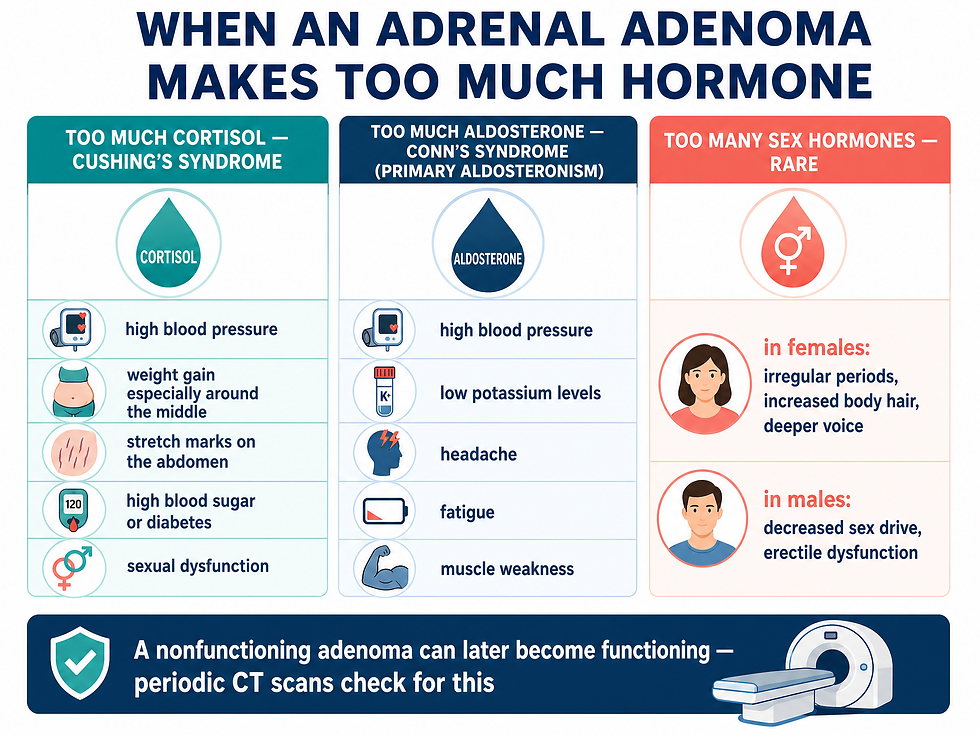
Functioning adrenal adenomas can cause your adrenal glands to secrete excess amounts of one or more types of hormone. As a result, you may experience symptoms of certain adrenal disorders:
Hormone Excess | Condition | Key Effects |
Too much cortisol | Cushing’s syndrome (hypercortisolism) | High blood pressure, weight gain especially around the middle, sexual dysfunction; increases likelihood of diabetes. Note: pituitary tumors most often cause Cushing’s syndrome, but adrenal tumors can also cause it |
Too much aldosterone | Primary aldosteronism (Conn’s syndrome) | Low potassium levels, high blood pressure, headache, fatigue, muscle weakness |
Too many androgens (e.g., testosterone) in females | Rare | Irregular periods, increased body hair (hirsutism), a deeper voice |
Too much estrogen in males | Rare | Decreased sex drive, erectile dysfunction |
What Are the Symptoms of an Adrenal Adenoma?
Functioning adrenal adenomas may produce symptoms related to having excess hormones in your body, especially excess cortisol (Cushing’s syndrome) or excess aldosterone (Conn’s syndrome):
Symptom | Notes |
Fatigue and achiness | Like backaches |
Headache | Common with aldosterone excess |
High blood pressure (hypertension) | Shared by cortisol and aldosterone excess |
High blood sugar or diabetes | Tied to cortisol excess |
Low potassium levels | A hallmark of aldosterone excess |
Mood changes | Feeling anxious, panicked, or depressed |
Muscle weakness or occasional numbness | Seen in aldosterone excess |
Stretch marks on your abdomen | Tied to cortisol excess |
Weight gain, especially in your upper body | Tied to cortisol excess |
In females, excess hormones may cause irregular menstrual cycles and increased masculine characteristics (virilization). In males, excess hormones may cause sexual dysfunction.
Nonfunctioning adenomas, by contrast, typically produce no symptoms at all — which is why most are found by accident rather than by symptom.
What Causes Adrenal Adenomas?
Researchers don’t know what causes an adrenal adenoma — or any benign adrenal gland tumor — to form. Certain genetic conditions may increase your risk, including:
Genetic Risk Factor | Abbreviation |
Multiple endocrine neoplasia, type 1 | MEN1 |
Familial adenomatous polyposis | FAP |
Carney complex | — |
Li-Fraumeni syndrome | — |
Multiple endocrine neoplasia, type 2 | MEN2 |
Neurofibromatosis type 1 | NF1 |
Obesity and tobacco use may also increase your chances of having an adrenal adenoma.
How Are Adrenal Adenomas Diagnosed?
Many people don’t realize they have an adrenal adenoma until a healthcare provider discovers an adrenal gland tumor during an imaging procedure for an unrelated medical condition. These tumors are sometimes called "incidentalomas" because they are found incidentally, or by chance.
Your healthcare provider will first determine whether a tumor is cancerous (for example, adrenocortical carcinoma) or benign (for example, adrenal adenoma). If it is an adrenal adenoma, they’ll perform tests to determine whether it is secreting excess hormones.
Diagnostic Tests
Your provider will perform a physical exam and ask about your symptoms and medical history, then may perform any of the following tests:
Test | What It Reveals |
Blood or urine test | Elevated hormone levels that may signal a functioning tumor; you may collect urine for 24 hours to test for elevated cortisol |
CT scan | The most commonly used imaging procedure for adrenal adenoma; helps determine whether a tumor is malignant or benign |
MRI | Sometimes ordered instead of a CT scan |
Biopsy (fine-needle aspiration) | If other tests don’t provide enough information; a thin hollow needle removes tissue and a pathologist examines it under a microscope for signs of cancer |
Adrenal vein sampling | Additional specialized testing |
MIBG scan | Metaiodobenzylguanidine scan — additional specialized testing |
A key size rule: larger tumors — more than 4 centimeters — are more likely to be cancerous than smaller tumors.
How Are Adrenal Adenomas Treated?
Treatment depends on whether the tumor is nonfunctioning or functioning (secreting excess hormones).
Scenario | Treatment |
Nonfunctioning, small | Periodic CT scans to ensure the tumor doesn’t increase in size or become functional |
Growing rapidly or getting bigger (usually nearing 5 centimeters) | Surgery may be recommended; large tumors and rapid growth increase the likelihood of a tumor becoming cancerous |
Functioning | Surgery almost always; plus medications |
Surgical Treatment
Adrenalectomy (adrenal gland removal) is the main surgical treatment:
If the tumor is benign and small, the adrenal gland may be removed via laparoscopy — the surgeon makes tiny cuts into your abdomen and performs the surgery through the incisions.
For a larger tumor or one that may be cancerous, the surgeon may make a larger incision in your back.
In some instances, your remaining adrenal gland may make enough hormones to keep you healthy. In others, you may need hormone therapy to supplement the lack of hormones.
Medication
If you’re not a candidate for surgery, your provider may prescribe medicines that prevent the adenoma from making excessive amounts of hormones. You may also receive medications for several weeks to help stabilize your hormone levels following an adrenalectomy.

What Is the Long-Term Prognosis?
Treatment outcomes associated with adrenalectomy are excellent. Removing the affected adrenal gland often relieves the symptoms related to functional adrenal adenomas.
Can Adrenal Adenomas Be Prevented?
Adrenal gland tumors, including adrenal adenoma, can’t be prevented. The risk factors for adrenal adenoma often depend on your genes. Still, you can develop an adrenal adenoma even if no one in your family has a history of adrenal gland tumors.
Living With an Adrenal Adenoma
Follow your healthcare provider’s guidance about how often you should be tested if you’ve been diagnosed with a nonfunctioning adrenal adenoma. Depending on your tumor, your provider may recommend periodic CT scans or hormone testing.
If a tumor is found on your imaging scan, it is natural to worry — but most of these tumors are harmless. If yours turns out to be an adrenal adenoma, your provider can run tests to see if it is causing hormone overproduction. If it is, surgery can help. If it is nonfunctioning, your provider can monitor it to ensure it doesn’t disrupt your hormones. If there is a concern that it could become malignant, your provider can remove it.
Conclusion
An adrenal adenoma sounds alarming, especially when it surfaces unexpectedly on a scan ordered for something else entirely — but for the vast majority of people it describes something quietly benign. These small tumors grow in the hormone-producing outer layer of the triangular glands sitting atop both kidneys, and roughly 3% to 9% of people have one. Most are nonfunctioning: they make no excess hormones, cause no symptoms, and need nothing more than periodic CT scans to confirm they stay small and stay quiet. The minority that are functioning matter clinically — extra cortisol brings Cushing’s syndrome with its weight gain and blood-pressure problems, extra aldosterone brings Conn’s syndrome with its low potassium and hypertension, and rarely excess sex hormones shift menstrual cycles or sexual function. What calms the worry is the cancer math: adrenocortical carcinoma strikes only about 1 in 1 million people, and tumors larger than 4 centimeters or nearing 5 centimeters are the ones that warrant closer attention. When a functioning adenoma is removed, outcomes are excellent, and any hormone gap is typically bridged with a short course of medication. Prevention isn’t possible because these tumors are largely a matter of genetics — but with monitoring and, when needed, a routine adrenalectomy, the condition is highly manageable.
CTA: If your imaging report mentions an "adrenal incidentaloma," don’t panic — but do act. Call your healthcare provider to confirm the plan: ask for the hormone blood and urine tests (including 24-hour urine cortisol), ask how large the tumor measures relative to the 4-centimeter threshold, and ask when your next monitoring CT scan is scheduled. If you have a genetic syndrome such as MEN1, MEN2, FAP, Carney complex, Li-Fraumeni, or NF1, mention it — it changes how aggressively the tumor should be watched.
Questions to Ask Your Provider
What type of adrenal gland tumor do I have?
Is it benign or cancerous?
What is the likelihood that my tumor could become cancerous?
Is it a functioning or nonfunctioning tumor?
Do I need treatment?
What treatments would you recommend?
Will I need hormone therapy as part of my treatment or recovery?
Frequently Asked Questions
What is an adrenal adenoma?
An adrenal adenoma is a benign (noncancerous) tumor that forms in the adrenal glands — the small, triangular glands located atop both kidneys that help the body respond to stress and regulate blood sugar, blood pressure, and the immune system. Adenomas form specifically in the adrenal cortex, the outer layer that secretes cortisol and aldosterone. They are the most common type of adrenal gland tumor.
Are adrenal adenomas cancer?
No, by definition adrenal adenomas are noncancerous, and becoming cancerous is rare. The most common cancerous adrenal tumor — adrenocortical carcinoma — affects only about 1 in 1 million people. Larger tumors (more than 4 centimeters) and rapidly growing tumors carry a higher concern, which is why size is monitored over time.
How common are adrenal adenomas?
Approximately 3% to 9% of people have adrenal adenomas, and anyone can get one, although the likelihood increases with age.
What is an adrenal "incidentaloma"?
Many people never know they have an adrenal adenoma until a healthcare provider discovers it during an imaging procedure for an unrelated medical condition. These tumors are sometimes called "incidentalomas" because they are found incidentally, or by chance.
What is the difference between a functioning and a nonfunctioning adrenal adenoma?
A functioning (active) adrenal adenoma secretes excess adrenal gland hormones and may cause symptoms that require treatment. A nonfunctioning (inactive) adenoma does not produce excess hormones — most adrenal adenomas are nonfunctioning, and they don’t cause symptoms or require treatment. However, a nonfunctioning adenoma can later become functional, so it is monitored with periodic CT scans.
What symptoms does a functioning adrenal adenoma cause?
Depending on the hormone involved, symptoms may include headache, muscle weakness or occasional numbness, fatigue and achiness, high blood pressure, high blood sugar or diabetes, low potassium levels, abdominal stretch marks, upper-body weight gain, and mood changes such as anxiety or depression. Excess cortisol causes Cushing’s syndrome; excess aldosterone causes Conn’s syndrome (primary aldosteronism); and, rarely, excess sex hormones can cause irregular periods, increased body hair, and a deeper voice in females, or decreased sex drive and erectile dysfunction in males.
What causes adrenal adenomas?
Researchers don’t know exactly what causes adrenal adenomas to form. Certain genetic conditions may increase risk — including MEN1, familial adenomatous polyposis (FAP), Carney complex, Li-Fraumeni syndrome, MEN2, and neurofibromatosis type 1 — and obesity and tobacco use may also raise your chances. You can develop an adrenal adenoma even with no family history.
How are adrenal adenomas treated, and what is the outlook?
Small, nonfunctioning adenomas are watched with periodic CT scans. Tumors that grow rapidly or near 5 centimeters may be surgically removed because size and growth speed raise cancer odds. Functioning adenomas almost always involve surgery — an adrenalectomy, performed laparoscopically for small benign tumors or through a larger back incision for larger or suspicious ones — and medications may be used to block hormone overproduction or stabilize hormone levels afterward. Outcomes after adrenalectomy are excellent, and removing the affected gland often relieves the symptoms of a functioning adenoma.
Related Reading
Sources
Medical Disclaimer
This article is for general informational purposes only and is not a substitute for professional medical advice, diagnosis, or treatment. Adrenal adenomas are benign tumors that are rarely malignant, but only a licensed healthcare provider can determine whether an adrenal tumor is benign or cancerous and whether it is functioning or nonfunctioning through blood tests, urine tests (including 24-hour cortisol collections), imaging, and biopsy. An incidental finding of an adrenal mass on any imaging study should be evaluated by a provider rather than ignored. Excess cortisol, aldosterone, or sex hormone production can raise blood pressure, lower potassium, and increase diabetes risk — conditions that warrant prompt medical attention. Never delay seeking medical care because of something you have read here.
Comments