Biopsy: What It Is, Types, Preparation, Risks and Results

Updated: 2 days ago
Written and medically reviewed by Dr. Baraa Alnahhal, MD · Last reviewed: November 2026 · How we review
Quick Answer: What is a biopsy?
A biopsy is a procedure that removes a sample of tissue, cells or fluid so a pathologist can examine it for disease. Providers use biopsies to diagnose and monitor conditions and to plan treatment. Biopsies aren't only for cancer: they can diagnose inflammation, infections and immune conditions. Results can take a few hours to more than a week. [1]
What the research says
Imaging before a biopsy can spare some people the procedure. In 576 men with raised PSA, MRI found 93% of clinically significant prostate cancers compared with 48% for standard ultrasound-guided biopsy. Using MRI first could let about 27% of men avoid an initial biopsy. Of all 740 men enrolled, 5.9% had serious side effects, including 8 cases of sepsis. (Ahmed et al., The Lancet, 2017) [2]
Targeting the biopsy improves what it finds. In a randomized trial of 500 men, MRI with targeted biopsy detected clinically significant prostate cancer in 38%, versus 26% with standard biopsy, and 28% of men in the MRI group avoided biopsy because their scan wasn't suspicious. (Kasivisvanathan et al., The New England Journal of Medicine, 2018) [3]
Key takeaways
A biopsy takes a sample of tissue, cells or fluid for a pathologist to study under a microscope. [1]
There are many types, including needle, excisional, incisional, punch, shave, bone marrow and liquid biopsies. [1]
Preparation may include fasting, pausing blood thinners and arranging a ride home. [1]
Complications are rare but include bleeding, infection and scarring. [1]
Having a biopsy doesn't by itself mean you have cancer or another serious illness. [1]
What is a biopsy?
A biopsy is a procedure to remove tissue, cells or fluid from your body so a pathologist, a doctor who studies samples, can check them for disease. Providers use biopsies to diagnose or monitor conditions and to help decide on treatment. [1]
Biopsies are often linked with cancer, but they help diagnose many other conditions, including kidney or liver inflammation, infections such as tuberculosis, chronic pancreatitis, peptic ulcer disease and endometriosis. [1]
What are the types of biopsy?
The type depends on where the tissue, cells or fluid are and what your provider is looking for. A biopsy can be done in a medical office or in an operating room. [1]
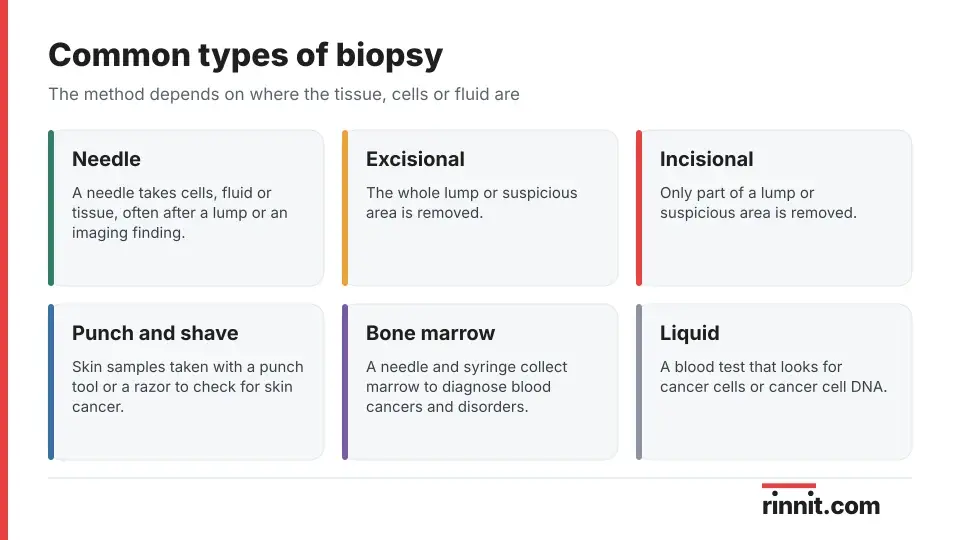
Type | What it involves |
Needle | A needle removes cells, fluid or tissue, often after a lump or an imaging finding |
Excisional | The entire lump or suspicious area is removed |
Incisional | A sample of a lump or suspicious area is removed |
Punch | A device removes a small round piece of skin that may be cancerous |
Shave | A razor scrapes a small skin sample to detect skin cancer |
Bone marrow | A needle and syringe take marrow to diagnose blood cancers and blood disorders |
Cone (conization) | Removes abnormal cervical tissue that may signal cancer or precancer |
Sentinel node | Checks whether cancer has spread from the original tumor |
Liquid | A blood test that looks for cancer cells or cancer cell DNA |
Sources: [1]
Common places sampled include the breast, prostate (sometimes MRI-guided), endometrium, liver, heart after a transplant, kidney and skin. Read our guides to the kidney biopsy, liver biopsy and cone biopsy for more detail. [1]
How do you prepare for a biopsy?
Your provider explains the procedure and whether you'll be awake or asleep. Tell them about: [1]
All medicines and supplements you take
Allergies, including to latex
Any current health problems
Whether you might be pregnant
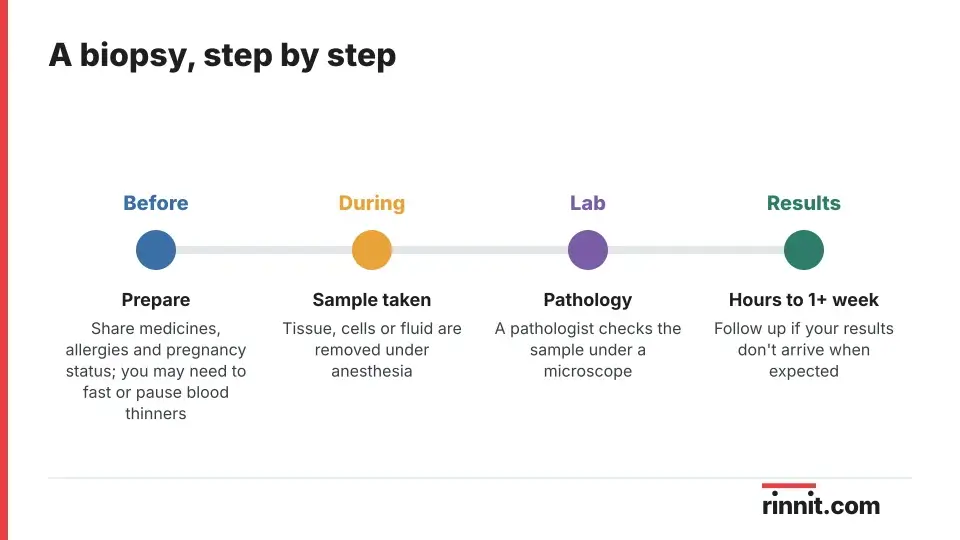
You may need to fast, stop certain medicines such as aspirin or blood thinners for a short time, arrange a ride home or have someone stay with you for a few hours afterward. [1]
What anesthesia is used?

Anesthesia | What it does |
Local | Numbs a small area; you stay awake |
Regional | Blocks pain over a larger area of the body |
General | Makes you unconscious during the procedure |
Sources: [1]
What happens during a biopsy?
How the sample is taken depends on its location, for example with a fine or hollow needle guided by imaging, through a scope, or by removing a small piece of tissue through a cut. The sample is then sent to a lab, where a pathologist examines it under a microscope. [1]
What happens after a biopsy?
Recovery depends on the anesthesia used and whether there were any complications. If you had local anesthesia, you usually go home soon afterward; after general anesthesia, you'll typically stay overnight. With anesthesia, a biopsy shouldn't be painful, though you may be sore afterward, and your provider can suggest pain medicine. [1]
What are the risks of a biopsy?
Complications are rare but can include: [1]
Heavy bleeding
Infection
Scarring
Risks vary by type. For example, in a large prostate study where men had two types of biopsy, about 6% reported a serious side effect, including some cases of sepsis. [2]
When will you get biopsy results?
Results may take a few hours, a few days or more than a week. Follow up with your provider if you haven't heard back when expected. If your results show abnormal cells, your provider will explain what they mean and plan the next steps, such as more tests or treatment. [1]
How accurate is a biopsy?
Biopsies are generally accurate, but false-negative results, where disease is present but missed, can happen. How likely that is depends on the condition, so ask your provider about the rate for your specific biopsy. Guiding the needle with imaging, such as MRI for the prostate, can improve accuracy. [1] [3]
When should you call your doctor?
Contact your provider after a biopsy if: [1]
Bleeding doesn't stop
The site becomes red, tender, swollen or starts to ooze
You develop a fever
Questions to ask your provider
Why do I need a biopsy, and what type will I have?
Will I be awake, and what anesthesia will you use?
Do I need to stop any medicines or fast beforehand?
When and how will I get my results?
How often does this biopsy miss a diagnosis?
Conclusion
A biopsy takes a small sample of tissue, cells or fluid so a pathologist can find out whether disease is present and what kind it is. There are many types, from needle and skin biopsies to bone marrow and liquid biopsies, and most are done with anesthesia so they aren't painful. [1]
Complications are rare, and having a biopsy doesn't by itself mean you have cancer. Waiting for results can be hard, so ask your provider when to expect them and what happens next. [1]
Keep learning: Read our guides to cancer, lymphoma and the kidney biopsy. For more, see the National Cancer Institute guide to how cancer is diagnosed.
FAQ
What is a biopsy?
A biopsy is a procedure that removes tissue, cells or fluid so a pathologist can check them for signs of disease. [1]
Does a biopsy mean I have cancer?
No. Biopsies also diagnose inflammation, infections and other conditions, and having one doesn't by itself mean you have cancer. [1]
What are the types of biopsy?
Common types include needle, excisional, incisional, punch, shave, bone marrow, cone, sentinel node and liquid biopsies. [1]
Is a biopsy painful?
A biopsy shouldn't be painful when anesthesia is used, though you may be sore afterward. [1]
Will I be awake during a biopsy?
It depends. Local and regional anesthesia keep you awake, while general anesthesia makes you unconscious. [1]
How do I prepare for a biopsy?
Tell your provider about your medicines, allergies, health problems and possible pregnancy. You may need to fast, pause blood thinners and arrange a ride home. [1]
How long do biopsy results take?
Results can take a few hours, a few days or more than a week. [1]
What are the risks of a biopsy?
Complications are rare but can include heavy bleeding, infection and scarring. [1]
Can a biopsy be wrong?
Biopsies are generally accurate, but false-negative results can happen. Ask about the rate for your specific biopsy. [1]
When should I call my doctor after a biopsy?
Call if bleeding won't stop, the site is red, swollen, tender or oozing, or you develop a fever. [1]
Related Reading
Immunostaining: How Labeled Antibodies Help Diagnose Cancer and Other Diseases explains the antibody staining methods pathologists use to pinpoint a diagnosis.
Learn more in our guide to Cancer: Symptoms, Causes, Diagnosis, Treatment and Prevention.
Learn more in our guide to Lymphoma: Symptoms, Types, Causes, Diagnosis and Treatment.
Learn more in our guide to Kidney Biopsy: Purpose, Types, Procedure, Risks and Recovery.
Learn more in our guide to Liver Biopsy: Procedure, Types, Risks, and Benefits.
Learn more in our guide to Cone Biopsy: A Comprehensive Guide to Cervical Conization.
Cancer Staging and Grading: What They Are, Why They Matter, Tests and Results explains how doctors stage and grade cancer and why the results guide treatment.
Immunohistochemistry (IHC): What It Is, How It Works and What Results Mean explains the antibody staining test that identifies cancer type and treatment targets.
ANCA Test: c-ANCA vs p-ANCA, What It Checks and What Results Mean explains the blood test for antibodies linked to small-vessel vasculitis.
Lymph Node Biopsy: Types, What to Expect, Recovery and Results explains the biopsy used to find out why a lymph node is enlarged.
Liquid Biopsy: Blood Testing for Tumor Cells and Tumor DNA explains the blood test that looks for tumor cells and tumor DNA.
Pathology Report: How to Read Margins, Grade, Stage and More explains how to read the sections and key terms of a pathology report.
References
Cleveland Clinic. What Is a Biopsy? Purpose & Results. Cleveland Clinic. Last updated May 26, 2023. https://my.clevelandclinic.org/health/diagnostics/15458-biopsy-overview
Ahmed HU, El-Shater Bosaily A, Brown LC, et al. Diagnostic accuracy of multi-parametric MRI and TRUS biopsy in prostate cancer (PROMIS): a paired validating confirmatory study. Lancet. 2017;389(10071):815-822. PMID 28110982. https://doi.org/10.1016/S0140-6736(16)32401-1
Kasivisvanathan V, Rannikko AS, Borghi M, et al. MRI-Targeted or Standard Biopsy for Prostate-Cancer Diagnosis. N Engl J Med. 2018;378(19):1767-1777. PMID 29552975. https://doi.org/10.1056/NEJMoa1801993
Medical disclaimer
This article is for general education only and does not replace advice from a qualified healthcare professional. Talk to your doctor about your own diagnosis and treatment, and seek emergency care right away for severe or sudden symptoms.



Comments