Kidney Biopsy: Purpose, Types, Procedure, Risks and Recovery

Updated: 3 days ago
Written and medically reviewed by Dr. Baraa Alnahhal, MD · Last reviewed: November 2026 · How we review
Quick Answer: What is a kidney biopsy?
A kidney biopsy is a procedure that removes a sample of kidney tissue so a pathologist can look for disease. It can find scarring, inflammation, protein deposits and inherited disorders that other tests may miss. Most biopsies are done with a needle through the skin and take an hour. Most people return to work in a day or two. [1]
What the research says
Serious bleeding after a native kidney biopsy is uncommon. A pooled analysis of 87 studies covering 118,064 biopsies found a hematoma (collection of blood) in about 11% of people, visible blood in the urine in 3.5% and bleeding that needed a blood transfusion in 1.6%. Only 0.3% needed a procedure to stop bleeding, and complications were more common in hospitalized people with acute kidney disease. (Poggio et al., Clinical Journal of the American Society of Nephrology, 2020) [2]
Biopsies of a transplanted kidney carry a low risk too. Across 72 studies and 40,082 transplant kidney biopsies, visible blood in the urine occurred in 3.18%, transfusion in 0.31% and major complications in 0.89%. Losing the transplanted kidney or dying from the biopsy was extremely rare. (Ho et al., Transplantation, 2022) [3]
Smaller needles may lower the risk of bleeding. In 34 studies with 9,474 ultrasound-guided biopsies, transfusion was needed in 0.9% overall, but in 2.1% with thicker 14-gauge needles compared with 0.5% with smaller needles. Higher creatinine levels and acute kidney injury were also linked to more transfusions. (Corapi et al., American Journal of Kidney Diseases, 2012) [4]
Key takeaways
A kidney biopsy takes a small piece of kidney tissue to diagnose kidney disease, guide treatment or check a transplanted kidney. [1]
The most common type is a percutaneous (needle) biopsy; an open (surgical) biopsy is used less often. [1]
The procedure usually takes about an hour, and the skin is numbed so you should not feel pain. [1]
Most people go home the same day or the next morning and are back to work or school in a day or two. [1]
Serious complications are rare; the main risk is bleeding, including blood in the urine. [1] [2]
What is a kidney biopsy?
A kidney biopsy is a procedure to remove a small sample of tissue from your kidney so it can be examined for signs of disease. It is also called a renal biopsy. A biopsy needle is usually used, and in some cases the sample is taken during surgery. [1]
The tissue can reveal problems that imaging, blood and urine tests may not show, such as scarring, inflammation, protein deposits and genetic disorders. A biopsy can also show how well a transplanted kidney is working and help track chronic kidney disease. It is generally a safe and minimally invasive procedure. [1]
Why is a kidney biopsy done?
Your provider may recommend a kidney biopsy if tests suggest a kidney problem that needs a clear diagnosis. Common reasons include: [1]
Abnormal blood test results that point to a kidney problem
Glomerulonephritis (inflammation of the kidney's tiny filters)
Blood in the urine (hematuria)
Protein in the urine (proteinuria)
Checking how a transplanted kidney is working
Monitoring the progress of chronic kidney disease
The results help your care team decide on the right treatment and understand how much the kidney has been affected. [1]
What are the types of kidney biopsy?
There are two main types of kidney biopsy. The right one for you depends on your health and why the biopsy is needed. [1]
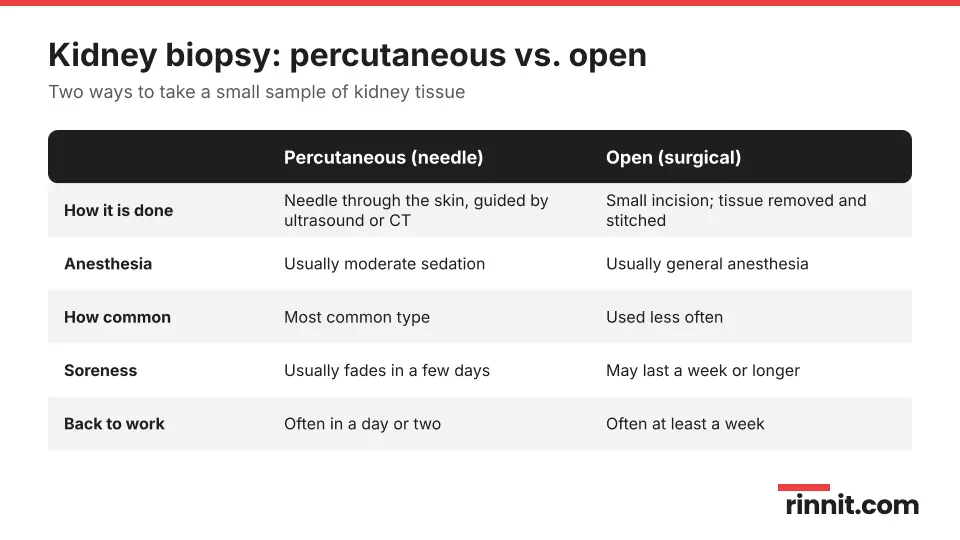
Feature | Percutaneous biopsy | Open biopsy |
How it is done | A needle is passed through the skin into the kidney, often guided by ultrasound or CT | A surgeon makes a small incision, removes tissue and closes the wound with stitches |
Anesthesia | Usually moderate sedation | Usually general anesthesia |
How common | The most common type | Used less often |
Soreness | Usually fades within a few days | May last a week or longer |
Return to work or school | Usually in a day or two | Usually after at least a week at home |
Sources: [1]
How do you prepare for a kidney biopsy?
Before the biopsy, your provider will review your medical history, examine you and may order blood and urine tests. If you have an infection, it may need to be treated first. [1]
List every medicine and supplement. Aspirin, NSAIDs such as ibuprofen and some herbal products raise the risk of bleeding.
Adjust medicines as told. You may need to stop certain medicines up to one week before the biopsy.
Follow eating and drinking instructions. Your team will tell you when to stop eating and drinking before the procedure.
Arrange a ride home. Sedation can make you drowsy for up to a day, so you will need someone to drive you.
Sources: [1]
What happens during a kidney biopsy?
A kidney biopsy is done in a hospital by a team that usually includes a radiologist or a nephrologist (kidney specialist) and nurses. [1]

You receive sedation, either moderate sedation or general anesthesia.
For a percutaneous biopsy, you usually lie on your stomach. If a transplanted kidney is being sampled through the lower belly, you lie on your back.
Ultrasound or CT imaging guides the needle to the right spot in the kidney.
The area is numbed, so you should not feel pain.
A biopsy needle removes small samples of kidney tissue. For an open biopsy, the surgeon removes the tissue through a small incision and closes it with stitches.
The tissue is sent to a pathologist, a doctor who examines it under a microscope.
Sources: [1]
Kidney biopsy at a glance
Item | Typical detail |
Usual setting | Hospital |
Who performs it | A radiologist or nephrologist, with nurses |
Anesthesia | Moderate sedation or general anesthesia, plus numbing at the site |
How long it takes | About an hour |
Monitoring afterward | A few hours to overnight |
Results | Usually within a few days; within a day if urgent |
Sources: [1]
What happens after a kidney biopsy?
After the procedure, you are watched in a recovery room for a few hours, and sometimes overnight. Your care team will: [1]
Check your vital signs, such as blood pressure and heart rate
Run blood tests
Track how much urine you pass
Make sure you can drink fluids and urinate normally
You may need up to a day of bed rest. Because sedation can cause drowsiness for up to a day, someone will need to drive you home. [1]
How long does recovery from a kidney biopsy take?
Recovery is usually quick after a needle biopsy and longer after an open biopsy. [1]

Pain: Soreness after a percutaneous biopsy usually fades within a few days. After an open biopsy it may last a week or longer. Pain relievers, including over-the-counter NSAIDs if your provider approves them, may help.
Activity: Avoid heavy lifting and strenuous activity, including sports, for one to two weeks.
Work and school: Most people go back a day or two after a percutaneous biopsy. An open biopsy may need at least a week at home.
Sources: [1]
What are the risks of a kidney biopsy?
The risks of a kidney biopsy are small. The main risk is bleeding, which can include blood in the urine. Other possible problems include: [1]
Complication | What it means |
Bleeding | Bleeding around the kidney or blood in the urine |
Dizziness | Feeling lightheaded after the procedure |
Fever | A raised temperature, which can be a sign of infection |
Urinary retention | Trouble emptying the bladder |
Pain | Soreness where the needle or incision was placed |
Urinary tract infection | An infection in the bladder or urinary tract |
Nondiagnostic sample | The sample is too small to make a diagnosis, so the biopsy may need to be repeated |
Sources: [1]
When will you get kidney biopsy results?
Results usually arrive within a few days. In urgent cases, they may be ready within a day. Your provider will explain what the tissue shows and what it means for your treatment. [1]
When should you call your provider after a kidney biopsy?
Call your provider or go to the emergency room if you have any of these signs: [1]
A fever of 100.4°F (38°C) or higher, or signs of infection such as discoloration or swelling at the site, or a headache
Blood in your urine more than 24 hours after the procedure
Trouble urinating, sudden strong urges to urinate, or burning when you urinate
Weakness or dizziness
Questions to ask your provider
Why do I need a kidney biopsy?
Will I have a percutaneous or an open biopsy?
What type of anesthesia do you recommend?
Which medicines should I stop or change, and when?
When should I expect my results?
Conclusion
A kidney biopsy takes a small sample of kidney tissue to find the cause of kidney problems, guide treatment or check a transplanted kidney. Most biopsies use a needle guided by imaging, take about an hour and let you return to normal activities within a day or two, with heavy lifting avoided for one to two weeks. [1]
Serious complications are uncommon, and the main risk is bleeding. Preparing well, especially by reviewing your medicines, and knowing the warning signs to watch for afterward help keep the procedure as safe as possible. [1] [2]
Keep learning: Read our guides to chronic kidney disease, glomerulonephritis and liver biopsy. For more on kidney tests, see the National Institute of Diabetes and Digestive and Kidney Diseases guide to kidney biopsy.
FAQ
What is a kidney biopsy?
A kidney biopsy is a procedure that removes a small sample of kidney tissue so it can be examined under a microscope for signs of disease.
Why would a doctor order a kidney biopsy?
Common reasons are abnormal kidney blood tests, glomerulonephritis, blood or protein in the urine, checking a transplanted kidney and tracking chronic kidney disease.
Is a kidney biopsy painful?
The area is numbed and you receive sedation, so you should not feel pain during the procedure. Soreness afterward usually fades within a few days.
How long does a kidney biopsy take?
A kidney biopsy usually takes about an hour.
Will I be awake during a kidney biopsy?
Most kidney biopsies use moderate sedation, which makes you relaxed and drowsy. An open biopsy is usually done under general anesthesia, so you are asleep.
Do I need to stop any medicines before a kidney biopsy?
You may need to stop medicines that raise bleeding risk, such as aspirin and NSAIDs, up to one week before. Always follow your provider's instructions.
How long will I stay in the hospital after a kidney biopsy?
You are usually monitored for a few hours up to overnight, and you may need up to a day of bed rest.
When can I go back to work after a kidney biopsy?
Most people return to work or school a day or two after a needle biopsy. An open biopsy may need at least a week at home.
What are the risks of a kidney biopsy?
The main risk is bleeding, including blood in the urine. Others include dizziness, fever, trouble urinating, pain, urinary tract infection and a sample too small for a diagnosis.
When should I call my doctor after a kidney biopsy?
Call for a fever of 100.4°F (38°C) or higher, blood in the urine after 24 hours, trouble or burning when urinating, or weakness or dizziness.
How do I prepare for a kidney biopsy?
Your provider reviews your medical history, examines you and may order blood and urine tests, and an infection may need treatment first. List every medicine and supplement, follow instructions about stopping medicines and when to stop eating and drinking, and arrange a ride home because sedation can make you drowsy for up to a day [1].
Related Reading
Learn more in our guide to Chronic Kidney Disease: What It Is, Its 5 Stages, Causes, and How It's Treated.
Learn more in our guide to Glomerulonephritis: Why Your Kidney Filters Inflame, the 6 Warning Signs, and How Treatment Protects Your Kidneys.
Learn more in our guide to Blood in Urine (Hematuria): Symptoms, Causes, and Treatment.
Learn more in our guide to Nephrotic Syndrome: Symptoms, Causes, and Treatment Guide.
Learn more in our guide to Lupus Nephritis: Complete Guide to Symptoms, Causes, Diagnosis, and Treatment.
Learn more in our guide to Kidney Transplant Rejection: Understanding the Signs and Prevention.
Learn more in our guide to Biopsy: What It Is, Types, Preparation, Risks and Results.
References
Cleveland Clinic. Kidney Biopsy: Purpose, Procedure, Risks & Results. Cleveland Clinic. Last updated June 6, 2024. https://my.clevelandclinic.org/health/procedures/21160-kidney-biopsy
Poggio ED, McClelland RL, Blank KN, et al. Systematic Review and Meta-Analysis of Native Kidney Biopsy Complications. Clin J Am Soc Nephrol. 2020;15(11):1595-1602. PMID: 33060160. https://doi.org/10.2215/CJN.04710420
Ho QY, Lim CC, Tan HZ, et al. Complications of Percutaneous Kidney Allograft Biopsy: Systematic Review and Meta-analysis. Transplantation. 2022;106(7):1497-1506. PMID: 35019898. https://doi.org/10.1097/TP.0000000000004033
Corapi KM, Chen JLT, Balk EM, et al. Bleeding complications of native kidney biopsy: a systematic review and meta-analysis. Am J Kidney Dis. 2012;60(1):62-73. PMID: 22537423. https://doi.org/10.1053/j.ajkd.2012.02.330
Medical disclaimer
This article is for general education only and does not replace advice from a qualified healthcare professional. Talk to your doctor about your own diagnosis and treatment, and seek emergency care right away for severe or sudden symptoms.



Comments