Kidney Transplant Rejection: Understanding the Signs and Prevention

Updated: 2 days ago
Medically reviewed by Dr. Baraa Alnahhal, MD · Last reviewed: October 2026
Quick Answer: Key Facts About Kidney Rejection
Kidney transplant rejection is when the immune system attacks a donor kidney, most often triggered by not taking immunosuppressant medicine as prescribed. About 15% to 20% of kidney recipients experience some rejection. Acute rejection happens within the first 12 months, while chronic rejection develops over years. Warning signs include fever, transplant-site pain and peeing less. Treatment usually increases immunosuppressant doses.
Feature | Details |
Primary cause | The immune system attacking the donor kidney. [1] |
Most common trigger | Not taking immunosuppressant medicine regularly or as prescribed. [1] |
Prevalence | About 15% to 20% of people who receive a new kidney experience some type of rejection. [1] |
Acute rejection | Happens quickly, within the first 12 months and most likely in the first several weeks. [1] |
Chronic rejection | Happens slowly over several years, and signs can be subtle. [1] |
Early warning signs | Fever, pain or tenderness at the transplant site, sudden weight gain, peeing less often and fatigue. [1] |
Main treatment | Adjusting immunosuppressant medicines, usually by increasing the dose. [1] |
What the research says
Missed medicine is a major theme in graft failure. In a prospective study of 315 kidney transplant recipients who had biopsies for clinical reasons, 60 kidneys went on to fail. Rejection explained 36 of the 56 failures that could be assigned a cause (64%), and every rejection loss had evidence of antibody-mediated rejection. Clinicians had independently identified 47% of those with rejection losses as nonadherent, and nonadherence was more frequent in patients whose kidneys failed (32%) than in those whose kidneys survived (3%). (Sellarés et al., Am J Transplant, 2012) [2]
Nonadherence shows up early, but its effect is delayed. A review of medication nonadherence after kidney transplant reports that electronic monitoring shows nonadherence appears early after transplant even though the effect on the graft is delayed. The strongest risk factors are past nonadherence and being an adolescent or young adult, and the authors recommend tailoring support to each recipient's needs and barriers. (Nevins et al., J Am Soc Nephrol, 2017) [3]
Antibody-mediated rejection is common but varies widely across studies. A systematic review of 28 large cohorts found that acute antibody-mediated rejection occurred in 1.1% to 21.5% of recipients (most studies reported 3% to 12%), usually within the first year, and chronic antibody-mediated rejection in 7.5% to 20.1% up to 10 years. Most studies identified it as an independent risk factor for graft failure. (Hart et al., Clin Transplant, 2021) [4]
What Is Kidney Transplant Rejection?
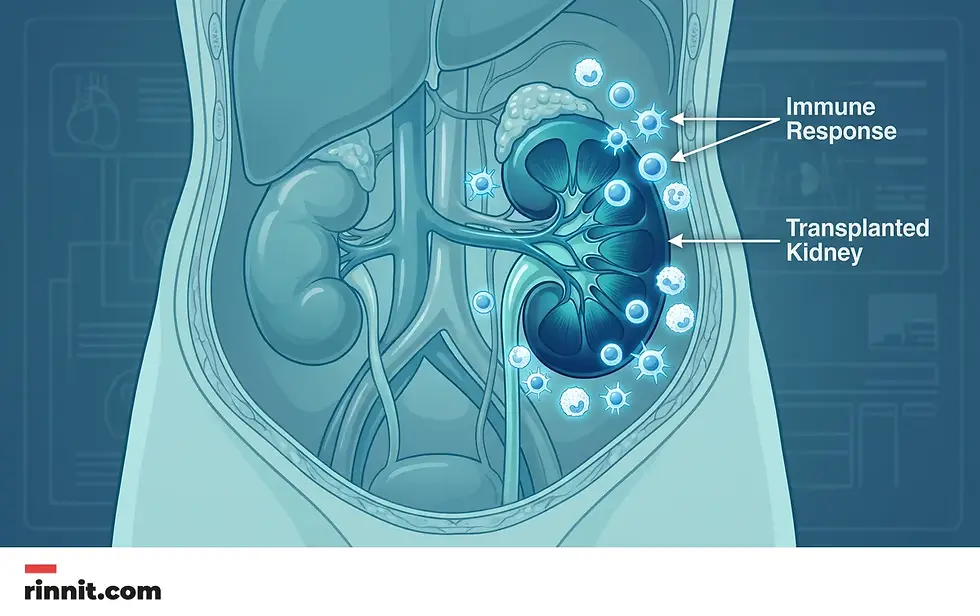
Rejection is your immune system's way of protecting your body from the new kidney, which it sees as a threat because it is not your own. Even when your kidney donor is a good match, your body recognizes the kidney as "new" and reacts by trying to destroy it. [1]
Rejection is most common in the first six months after transplant surgery, but it can occur years later. Your risk goes down over time, but it never goes away completely. Medicines called immunosuppressants help prevent and treat rejection by blocking your immune system from damaging your kidney. If rejection occurs, your healthcare provider prescribes a higher dose or a different combination of immunosuppressant drugs. [1]
Your healthcare provider can usually recognize and treat a kidney rejection before it causes major or irreversible damage. It is very important to take your medicines exactly as prescribed, get your laboratory tests and attend all follow-up appointments after a kidney transplant. [1]
What are the types of kidney transplant rejection?
Kidney transplant rejection comes in two main types, acute and chronic, which differ mainly in when the rejection occurs. The main difference is when the rejection occurs. Experiencing a rejection episode does not automatically mean the kidney will fail. [1]
Type | Timing and characteristics |
Acute rejection | Happens quickly, within the first 12 months, and is more likely in the first several weeks. If you do not have an acute rejection episode after 12 months, you may be less likely to have one as long as you take your medicine as prescribed. [1] |
Chronic rejection | A slow process over several years in which the immune system constantly fights the new kidney. It happens to kidney recipients more often than acute rejection, and signs are often subtle because it is gradual. [1] |
Cellular rejection | Caused by T lymphocytes, a specific type of white blood cell. [1] |
Antibody-mediated rejection | Occurs when the immune system rejects the new kidney through antibodies. [1] |
What are the warning signs and symptoms of kidney transplant rejection?
If you receive a kidney transplant, you should know the signs of organ rejection and tell your healthcare provider if you have any of them. Many of these signs are nonspecific and can be caused by problems other than rejection. If you think you have any of these symptoms, contact your transplant team immediately: [1]
Fever: higher than 101 degrees Fahrenheit (38 degrees Celsius).
Flu-like symptoms: chills, body aches, headache or nausea.
Localized pain: new pain or tenderness around the kidney area (the transplant site).
Fluid retention: sudden weight gain of more than 2 to 4 pounds within 24 hours, or swelling in your ankles.
Urinary changes: peeing less often.
Fatigue: feeling tired or having no energy.
Some people have no noticeable symptoms. This is why it is critical to attend follow-up appointments and get your scheduled blood tests. Your provider checks your kidney function with periodic blood tests, and it is often in these tests that rejection is detected. [1]

What causes kidney transplant rejection and who is at risk?
The most common cause of kidney transplant rejection is not taking your immunosuppressant (anti-rejection) medicine. Not taking it regularly or as prescribed can leave too little medicine in your blood, so your immune system is no longer held back and attacks and damages the new kidney. [1]
A rejection can also be triggered by certain infections or other health events that set off your immune system. [1]
How is kidney transplant rejection diagnosed and treated?
Your provider performs periodic follow-up appointments to help detect rejection. At these appointments, your provider may do one or all of the following: [1]
Blood tests: a complete blood count (CBC) to evaluate white blood cell, red blood cell and platelet counts, and tests such as creatinine and blood urea nitrogen (BUN) that look specifically at kidney function. Special donor-specific antibody tests show whether your immune system has made antibodies to the kidney.
Kidney biopsy: your provider takes a sample of kidney tissue and examines it under a microscope.
If a rejection is occurring, your provider adjusts your immunosuppressant prescription to prevent further complications, which typically means increasing the dose. You may need additional medicines or treatments for a short time. Some people receive treatment for rejection in the hospital for as long as five days, while others can be treated as outpatients. Because these medicines weaken your immune system, you may be more susceptible to infection, so your provider will monitor you carefully. [1]
How can kidney transplant rejection be prevented for long-term success?
Your healthcare team does all it can to prevent rejection, but sometimes it happens despite everyone's best efforts. Experiencing rejection does not mean your kidney will fail, and most of the time your provider can treat it and the kidney continues to function. To reduce your risk of kidney rejection: [1]
Attend all your follow-up appointments.
Take your immunosuppressant medicines exactly as your provider prescribes.
Alert your provider if you notice any signs of kidney transplant rejection.
Eat a healthy diet. Talk to your provider about which foods to eat more of and which to limit.
Manage other health conditions such as diabetes or high blood pressure.
Wash your hands often and limit interactions with people who have been sick.

Conclusion
The word "rejection" is not what anyone wants to hear after a kidney transplant, but rejection is usually treatable with the right medicine and does not mean your kidney will fail. Because rejection can happen years after a transplant, it helps to recognize the warning signs so you can tell your healthcare provider, keep up with regular checkups and take your medicine as prescribed. [1]
Learn more. For more evidence-based health guides, visit Rinnit.com.
Frequently Asked Questions
Does rejection mean I will need a new transplant?
Not necessarily. Having a rejection does not mean your kidney will fail. Most of the time your provider can treat a rejection and the kidney continues to function.
What happens if I miss a dose of my medicine?
Contact your transplant team right away for instructions. Do not double up on doses unless a professional tells you to.
Can I stop taking anti-rejection drugs after a few years?
No. Your risk of rejection never goes away completely, so do not stop or change your medicines unless your transplant team tells you to.
Are there side effects to anti-rejection drugs?
Yes. Because they lower your immune system, you may be more susceptible to infection, and they are powerful drugs with their own risks. Your provider monitors and manages your medicines carefully.
Can I travel after a kidney transplant?
Many people do, but plan ahead and ask your transplant team, so you have enough medicine and know how to get medical care if you need it.
How does a kidney biopsy feel?
A biopsy takes a small sample of kidney tissue to examine under a microscope. Your team will explain how it is done and what to expect, including pain control.
Can stress cause kidney rejection?
Stress is not named as a direct cause. Certain infections and other health events can trigger rejection, and stress can make it harder to keep up with your medicines, which is the most common cause. Tell your team if you are struggling.
Why do I need to weigh myself every day?
Sudden weight gain of more than 2 to 4 pounds in 24 hours can be a sign of fluid retention, which is one of the warning signs of rejection. Ask your team how and when to weigh yourself.
Is it safe to be around pets?
Many people with a transplant keep pets, but because your immune system is lowered, ask your team about hygiene and tasks to avoid, such as cleaning litter boxes or bird cages.
Can I drink alcohol after a transplant?
Ask your doctor, because alcohol can interact with certain transplant medicines.
What is a "good match"?
It describes how well the donor's tissue and blood type fit yours. Even with a good match, the body recognizes the kidney as new and can react to it.
Why is my new kidney in my lower abdomen instead of my back?
A transplanted kidney is usually placed in the lower abdomen. Your surgeon can explain why this location is used and how it affects monitoring.
Can I get a flu shot or other vaccines?
Vaccines are important, but always check with your transplant team first. Live vaccines are generally avoided after a transplant, and your team will advise which vaccines are safe.
How long do anti-rejection drugs take to work?
Your transplant team adjusts the type and dose of your medicines over time, guided by your blood tests, to find what works best for you.
Will I always have to be this careful?
You will always need to take your medicines and attend checkups, because rejection risk never disappears completely. Many people return to a very good quality of life with regular activities.
Related Reading
Learn more in our guide to Kidney Biopsy: Purpose, Types, Procedure, Risks and Recovery.
Renal Scan (Kidney Scan): Types, Preparation, Risks and Results explains the nuclear medicine scan used to measure kidney function, blood flow and blockages.
References
Cleveland Clinic. Kidney Transplant Rejection. Cleveland Clinic. Last updated August 21, 2023. https://my.clevelandclinic.org/health/diseases/21134-kidney-transplant-rejection
Sellarés J, et al. Understanding the causes of kidney transplant failure: the dominant role of antibody-mediated rejection and nonadherence. Am J Transplant. 2012;12(2):388-399. PMID 22081892. https://doi.org/10.1111/j.1600-6143.2011.03840.x
Nevins TE, et al. Understanding medication nonadherence after kidney transplant. J Am Soc Nephrol. 2017;28(8):2290-2301. PMID 28630231. https://doi.org/10.1681/ASN.2017020216
Hart A, et al. Incidence, risk factors, treatment, and consequences of antibody-mediated kidney transplant rejection: a systematic review. Clin Transplant. 2021;35(7):e14320. PMID 33864724. https://doi.org/10.1111/ctr.14320
Medical disclaimer
This article is for general educational purposes only and is not a substitute for professional medical advice. Always seek the advice of your transplant team or other qualified health provider with any questions about your medicines or symptoms. If you think your transplanted kidney may be rejecting, contact your transplant team right away.



Comments