ANCA Test: c-ANCA vs p-ANCA, What It Checks and What Results Mean

Updated: 2 days ago
Written and medically reviewed by Dr. Baraa Alnahhal, MD · Last reviewed: November 2026 · How we review
Quick Answer
An ANCA test (antineutrophil cytoplasmic antibody test) is a blood test that looks for autoantibodies aimed at proteins inside neutrophils, a type of white blood cell. These antibodies are strongly linked to ANCA-associated vasculitis, which inflames small blood vessels and can damage the kidneys, lungs and nerves. A positive result supports, but does not by itself prove, vasculitis.
What the research says
Immunoassays now lead the work-up: a meta-analysis found c-ANCA by immunofluorescence had 75.2% sensitivity and 98.4% specificity, PR3 immunoassays reached 79.8–86.6% sensitivity with 96.8–98.3% specificity, while p-ANCA and MPO tests were less sensitive (46.3% and 58.1%); the authors support screening with PR3 and MPO immunoassays first (Guchelaar NAD et al., Autoimmunity Reviews, 2021) [2]
ANCA testing works alongside biopsy: the 2022 EULAR recommendations, built on a systematic literature review and 20 experts from 16 countries, advise using biopsies and ANCA testing together to establish a diagnosis of ANCA-associated vasculitis (Hellmich B et al., Annals of the Rheumatic Diseases, 2024) [3]
Key takeaways
ANCA are autoantibodies against neutrophil proteins; their main targets are proteinase 3 (PR3) and myeloperoxidase (MPO).
The test helps diagnose and monitor granulomatosis with polyangiitis, microscopic polyangiitis and eosinophilic granulomatosis with polyangiitis.
Usually no preparation; fast 8–12 hours only if other fasting tests are drawn at the same time.
A negative result makes ANCA-associated vasculitis less likely; a positive result is interpreted with symptoms, urine and kidney tests, and often a biopsy.
Results come from a specialty lab and take several days to a week.
What is an ANCA test?
Neutrophils are white blood cells that fight infection. In some autoimmune diseases, the immune system makes antibodies against proteins inside them. These antineutrophil cytoplasmic antibodies can activate neutrophils against the walls of small blood vessels, causing inflammation called vasculitis. The ANCA test detects these antibodies and can measure how much is present. Sources: [1]

The ANCA test is a routine blood draw analysed in a specialty laboratory.
Why is the test done?
Your provider may order an ANCA test when symptoms suggest small-vessel vasculitis, such as long-lasting sinus problems, coughing blood, blood or protein in the urine, unexplained kidney decline, skin rash, nerve numbness, or fever and weight loss without an infection. It is also used to monitor people already diagnosed. ANCA-associated conditions include: Sources: [1]
Granulomatosis with polyangiitis (GPA), formerly called Wegener granulomatosis.
Eosinophilic granulomatosis with polyangiitis (EGPA), formerly called Churg-Strauss syndrome.
Without treatment, vessel inflammation can damage organs and lead to aneurysms, which is why prompt testing matters. Sources: [1]
Types of ANCA
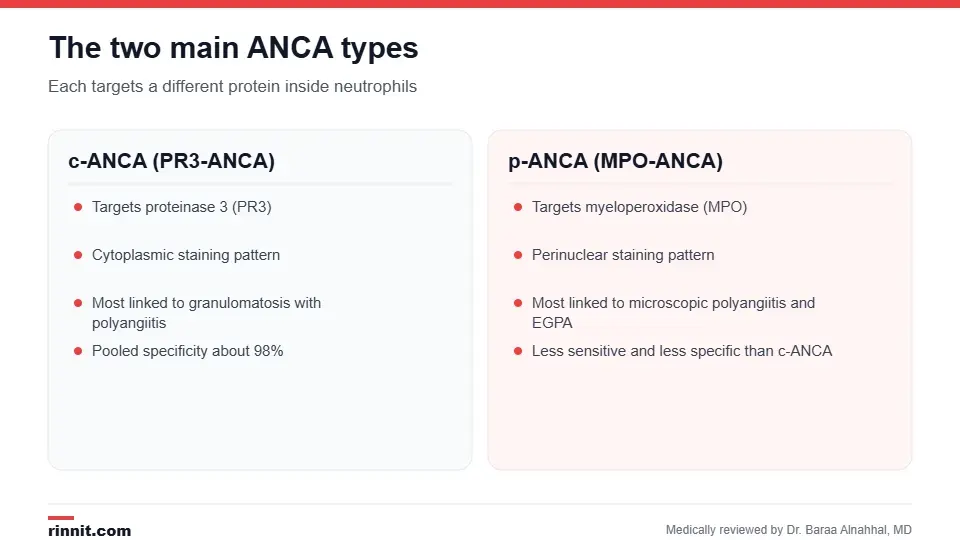
The two main ANCA types target different neutrophil proteins.
Type | Target protein | Staining pattern | Most linked with |
c-ANCA | Proteinase 3 (PR3) | Cytoplasmic | Granulomatosis with polyangiitis |
p-ANCA | Myeloperoxidase (MPO) | Perinuclear (around the nucleus) | Microscopic polyangiitis, EGPA |
Sources: [1]
How is ANCA measured?
Indirect immunofluorescence (IIF): your serum is applied to neutrophils on a slide and stained; the lab reads whether it is positive and which pattern appears.
Immunoassay (ELISA and similar): identifies the exact target, PR3 or MPO, and measures the antibody level. Sources: [1]
Current practice favors starting with PR3 and MPO immunoassays. A meta-analysis found PR3 immunoassays more sensitive (79.8–86.6%) than c-ANCA by immunofluorescence (75.2%), with similar specificity. Sources: [2]
How do I prepare?
Usually no preparation is needed. If other tests that require fasting are drawn at the same time, you may be asked to fast for 8–12 hours. Tell your provider about your medicines, because some drugs can trigger ANCA. Sources: [1]
What happens during the test?
A clinician cleans the inside of your elbow and inserts a small needle into a vein.
A tube of blood is collected in a few minutes; you may feel a brief sting.
A bandage is applied; keep it on for a few hours and avoid strenuous exercise for a few hours. Sources: [1]
Understanding your results
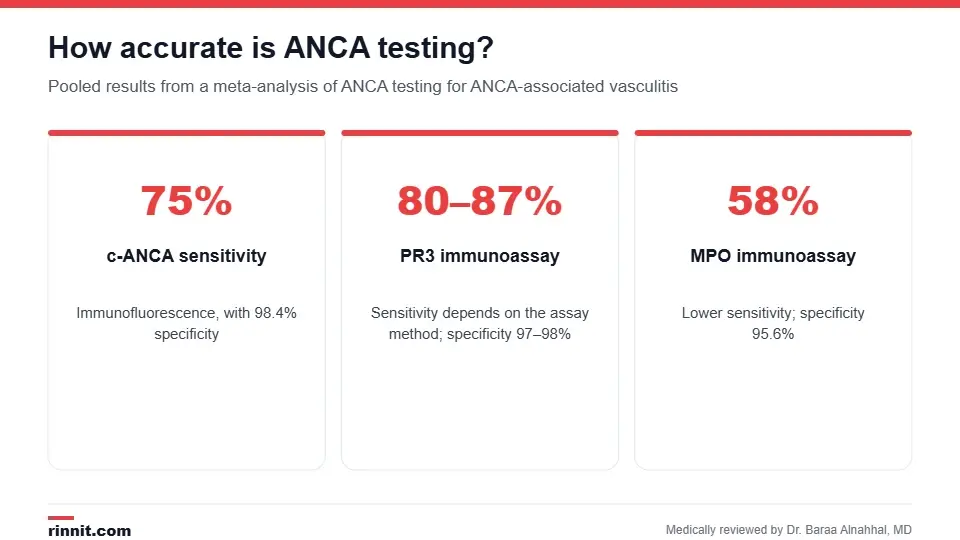
How well each ANCA method detects ANCA-associated vasculitis.
Result | What it may mean | Usual next step |
Negative | ANCA-associated vasculitis is unlikely | Look for other causes of symptoms |
Positive PR3 / c-ANCA | Supports granulomatosis with polyangiitis | Urine tests, kidney function, imaging, often a biopsy |
Positive MPO / p-ANCA | Supports microscopic polyangiitis or EGPA; can also occur in other conditions | Same work-up, plus eosinophil count for EGPA |
Weak or low positive | Can occur with infections, other autoimmune diseases or some medicines | Repeat testing and clinical review |
Results usually take several days to a week. Positive results are interpreted with your symptoms and other findings; guidelines recommend combining ANCA testing with a biopsy to confirm the diagnosis. Sources: [1, 3]
Risks
The risks are those of any blood draw: a small bruise or brief soreness, and rarely a swollen vein, which warm compresses can ease. Sources: [1]
Conclusion
The ANCA test is a key early step when symptoms point to small-vessel vasculitis. A positive PR3 or MPO result, together with a biopsy and kidney tests, allows treatment to start before permanent organ damage occurs. If your result is positive, ask which antibody was found and what further tests are planned.
Keep learning: read our guide to ANCA-associated vasculitis and how a biopsy confirms the diagnosis.
Frequently asked questions
What does ANCA stand for?
Antineutrophil cytoplasmic antibodies: autoantibodies against proteins inside neutrophils, a type of white blood cell.
What is the difference between c-ANCA and p-ANCA?
c-ANCA targets proteinase 3 and is most linked to granulomatosis with polyangiitis. p-ANCA targets myeloperoxidase and is most linked to microscopic polyangiitis and EGPA.
Do I need to fast for an ANCA test?
Usually not. You may be asked to fast 8–12 hours only if other fasting tests are drawn at the same time.
How long do ANCA results take?
Several days to a week, because the test is done at a specialized laboratory.
Does a positive ANCA mean I have vasculitis?
Not on its own. Positive results can occur with infections, other autoimmune diseases and some medicines, so they are interpreted with symptoms, urine tests and often a biopsy.
Can I have vasculitis with a negative ANCA test?
Yes. Some people with vasculitis, particularly EGPA or disease limited to one organ, test negative.
How accurate is the ANCA test?
PR3 testing is highly specific (about 97–98%) with sensitivity around 80–87%; MPO and p-ANCA testing are less sensitive.
Is the ANCA test used to monitor treatment?
Yes. Providers track ANCA levels alongside symptoms and kidney tests, although a rising level alone does not always mean a relapse.
What happens after a positive result?
Usually urine and kidney blood tests, chest imaging, and a biopsy of an affected organ such as the kidney, skin or sinus.
Is the test risky?
No. It is a routine blood draw with only minor bruising or soreness.
Related Reading
ANCA-Associated Vasculitis (AAV): What It Is, Why Blood Vessels Become Inflamed, and How Treatment Prevents Organ Damage the condition this test is designed to detect.
Granulomatosis with Polyangiitis (GPA): Symptoms, Causes, Diagnosis, and Treatment Explained the vasculitis most linked to PR3 (c-ANCA).
Microscopic Polyangiitis (MPA): Understanding Rare Blood Vessel Inflammation the vasculitis most linked to MPO (p-ANCA).
Vasculitis: Symptoms, Causes, Treatment & Complete Guide an overview of all types of blood vessel inflammation.
Biopsy: What It Is, Types, Preparation, Risks and Results how tissue samples confirm a positive ANCA result.
References
Cleveland Clinic. Antineutrophil Cytoplasmic Antibodies (ANCA) Test: What It Is. Cleveland Clinic. Last updated March 11, 2022. https://my.clevelandclinic.org/health/diagnostics/22512-anca-test
Guchelaar NAD, Waling MM, Adhin AA, et al. The value of anti-neutrophil cytoplasmic antibodies (ANCA) testing for the diagnosis of ANCA-associated vasculitis, a systematic review and meta-analysis. Autoimmunity Reviews. 2021;20(1):102716. PMID 33197574. https://doi.org/10.1016/j.autrev.2020.102716
Hellmich B, Sanchez-Alamo B, Schirmer JH, et al. EULAR recommendations for the management of ANCA-associated vasculitis: 2022 update. Annals of the Rheumatic Diseases. 2024;83(1):30-47. PMID 36927642. https://doi.org/10.1136/ard-2022-223764
Medical disclaimer
This article is for general education only and does not replace advice from a qualified healthcare professional. Talk to your doctor about your own diagnosis and treatment, and seek emergency care right away for severe or sudden symptoms.



Comments