Cancer Staging and Grading: What They Are, Why They Matter, Tests and Results

Updated: 2 days ago
Written and medically reviewed by Dr. Baraa Alnahhal, MD · Last reviewed: November 2026 · How we review
Quick Answer: What is cancer staging and grading?
Cancer staging is a way for a care team to describe how big a cancer is and how far it has spread, while grading describes how abnormal the cancer cells look under a microscope. Staging is based on a physical exam and tests such as imaging, a biopsy and blood tests. It helps plan treatment and estimate outlook [1] [5].
What the research says
Tumor grade strongly predicts outcome in breast cancer. In 2,219 people with operable breast cancer followed for a median of 111 months, grade was an independent predictor of both breast cancer survival and disease-free survival, and outcomes differed between each of the three grades. (Rakha et al., Journal of Clinical Oncology, 2008) [2]
Better staging scans can spare people surgery that would not help. In a randomized trial of 189 people with lung cancer, adding PET-CT to standard staging led to fewer chest operations (60 vs 73) and fewer futile ones (21 vs 38), though overall survival was similar. (Fischer et al., The New England Journal of Medicine, 2009) [3]
Staging systems keep evolving with the science. The Eighth Edition of the main TNM staging manual added nonanatomic factors, including molecular ones, only when strong evidence supported them, moving staging toward a more personalized approach. (Amin et al., CA: A Cancer Journal for Clinicians, 2017) [4]
Key takeaways
Staging measures how far a cancer has spread, and it guides diagnosis and treatment [1].
Grade describes how abnormal cancer cells look, and it is a different measure from stage [5].
The TNM system looks at the main tumor (T), nearby lymph nodes (N) and spread to distant areas (M) [1].
Some cancers, such as lymphomas and some cancers of the female reproductive organs, use their own staging systems [1].
Exams, imaging scans, endoscopy, biopsy and blood tests all help determine the stage [1].
The stage given at diagnosis stays the same, even if the cancer later spreads or goes into remission [1].
What is cancer staging?
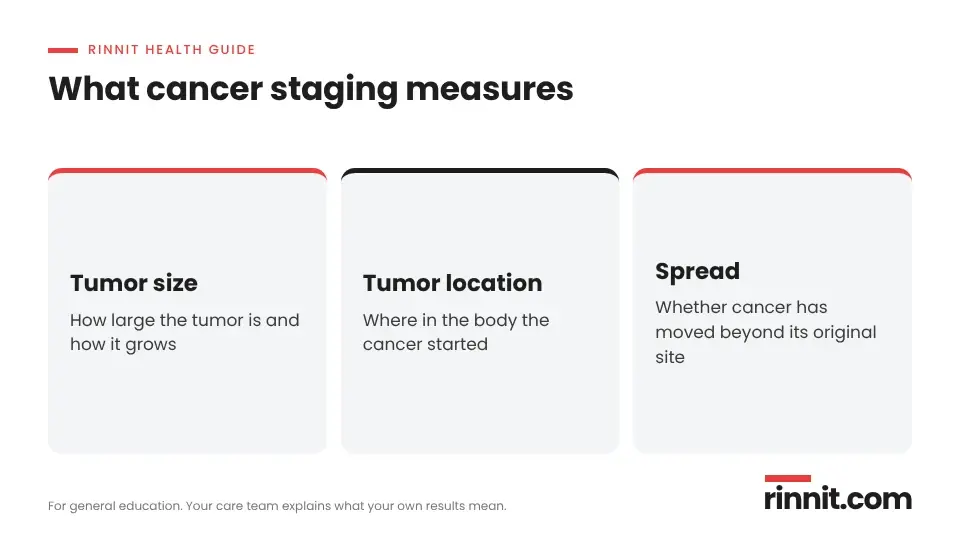
Staging looks at a tumor's size, location and how far it has spread.
Cancer staging is a method of measuring how much cancer is in your body and how far it has spread [1]. Oncologists, the doctors who treat cancer, use it to make a diagnosis and plan treatment [1].
Researchers also use staging information to follow treatment patterns and outcomes across large groups of people [1]. This helps improve care for future patients [1].
Providers look at three main factors when they stage cancer: the size and growth of the tumor, where it is located, and whether it has spread beyond the place where it started [1]. They may use one or more staging systems to do this [1].
Why staging matters
Cancer is complex, and staging gives your whole care team a common set of guidelines and a shared language [1]. This helps everyone involved in your care stay on the same page [1].
Staging serves several practical purposes:
Treatment planning: It gives providers a consistent starting point for choosing treatment, even as treatment options change over time [1].
Outlook: It helps providers estimate your prognosis, or likely outcome, based on experience with similar cancers [1].
Clinical trials: It supports cancer research and helps identify trials you may be able to join [1].
Coordinated care: It helps providers coordinate your care across different specialists [1].
How staging systems work
The TNM system
The most widely used approach is the TNM system, which describes a cancer using three letters [1]. Each letter is followed by more detail that your care team uses to work out your overall stage [1].
TNM is used for solid tumors, such as breast and colon cancers, but not for blood cancers like leukemia or lymphoma [1].
Other staging systems
Some cancers have their own staging systems [1]. For example, one system is used for Hodgkin and non-Hodgkin lymphoma, and another is used for some cancers of the female reproductive system [1].
Asking your oncologist which staging system applies to your cancer can help you better understand your diagnosis [1].
What is cancer grading?

Grade describes how normal or abnormal cancer cells look under a microscope.
Grading describes how normal or abnormal cancer cells look when viewed under a microscope [5]. A pathologist, a doctor who specializes in studying tissue, assigns the grade, usually from a biopsy sample [5].
The pathologist records the grade in a pathology report [5]. The features used to set the grade differ from one type of cancer to another [5].
Low grade vs high grade
In general, low-grade cancer cells look closer to normal cells and tend to grow and spread more slowly [5]. High-grade cancer cells look more abnormal and tend to grow and spread more quickly [5].
Because high-grade cancers may spread faster, they may need more prompt or intensive treatment [5]. Sometimes the grade cannot be determined, and the report will say so [5].
How grade is used
Your care team uses grade along with other information, such as your stage, the tumor's genetic features, your age and your overall health, to plan treatment [5]. In some cancers, grade also helps estimate your outlook [5].
Stage vs grade
Stage and grade are two different measures, and you will often see both in your reports [5]. Stage is about how large the cancer is and where it has spread, while grade is about how the cells look [5].
Feature | Stage | Grade |
What it describes | How big the cancer is and how far it has spread | How abnormal the cancer cells look under a microscope |
How it is found | Physical exam, imaging, endoscopy, biopsy and blood tests | Examining tissue, usually from a biopsy, under a microscope |
Who assigns it | Your oncologist and care team | A pathologist |
Main use | Treatment planning, outlook, clinical trials and research | Treatment planning and, in some cancers, outlook |
Changes over time | The stage at diagnosis stays the same | Reported from the tissue that was examined |
Tests used for staging
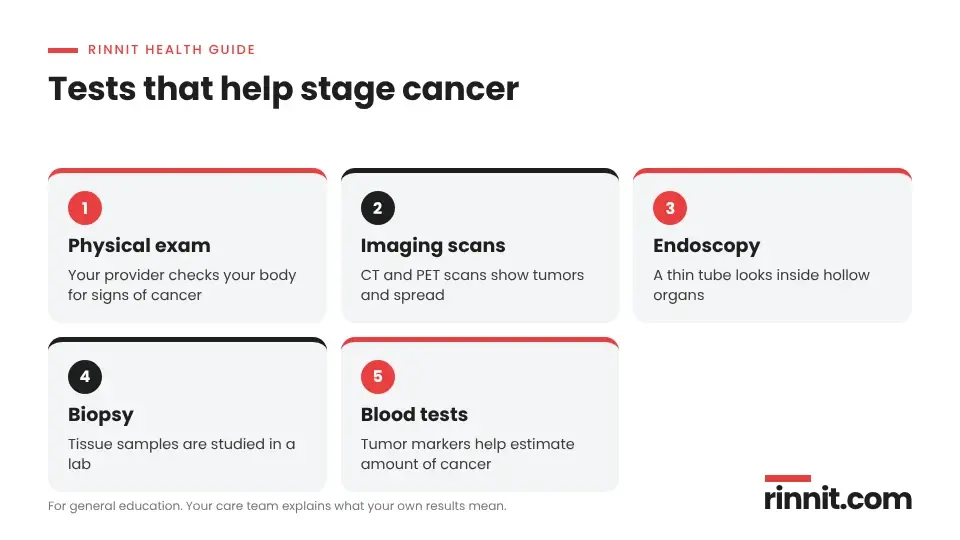
Several tests work together to give your care team a full picture.
Providers stage cancer using a physical exam and a combination of tests [1]. You may not need every test, since the choice depends on the type and location of your cancer.
Test | What it shows |
Physical exam | Signs of cancer your provider can see or feel |
CT scan | Where a tumor is located and helps find early cancers |
PET scan | Whether cancer has spread to distant parts of the body |
Endoscopy | Signs of cancer inside hollow organs, using a thin tube with a camera |
Biopsy | More detail about the cancer from tissue samples studied in a lab |
Blood tests | Tumor markers that help estimate tumor size or the amount of cancer |
Sources: [1]
Your care team will explain which of these tests you need and what to expect from each one [1].
Does your stage change over time?
The stage assigned when your cancer is first diagnosed does not change, even if the cancer later spreads or goes into remission [1]. If the cancer spreads, providers describe this by adding terms to the original stage rather than giving it a new stage [1].
If treatment removes all signs of cancer, your provider may describe this as complete remission or no evidence of disease (NED) [1].
Understanding your own stage and grade
Hearing staging and grading terms can feel stressful, and it is normal to have questions [1]. Your stage and grade help guide your treatment, how your care is coordinated and your outlook [1].
Your care team will explain your own stage and grade and what they mean for you [1]. It can help to write down your questions and bring them to your next visit [1].
Conclusion
Cancer staging describes how big a cancer is and how far it has spread, and grading describes how abnormal the cancer cells look. Together, they help your care team choose the right treatment and estimate your outlook.
Staging relies on exams, imaging, biopsy and blood tests, while grade comes from studying tissue under a microscope. Your care team is the best source for what your own results mean.
Keep learning: Read our guide to biopsy types, preparation and results or our guide to cancer treatment types and what to expect. For more background, see the National Cancer Institute page on tumor grade.
FAQ
What is cancer staging?
Cancer staging is a way to describe how large a cancer is and how far it has spread in the body. It helps your care team plan treatment.
What is the difference between stage and grade?
Stage describes the size and spread of a cancer. Grade describes how abnormal the cancer cells look under a microscope.
Why is cancer staged?
Staging gives providers a shared language to plan treatment, estimate outlook and find clinical trials that may fit you.
What do the letters T, N and M mean?
T describes the main tumor, N describes spread to nearby lymph nodes, and M describes spread to distant parts of the body.
What tests are used to stage cancer?
Common tests include a physical exam, CT and PET scans, endoscopy, a biopsy and blood tests for tumor markers.
Does cancer staging hurt?
Most staging tests, like scans and blood draws, cause little or no pain. A biopsy may cause brief discomfort, and your provider will explain how it is managed.
What does a high-grade cancer mean?
High-grade cancer cells look more abnormal and tend to grow and spread faster. They may need more prompt treatment.
What does a low-grade cancer mean?
Low-grade cancer cells look closer to normal cells and usually grow and spread more slowly.
Can my cancer stage change?
The stage given at diagnosis stays the same. If the cancer spreads later, providers add terms to describe it instead of changing the stage.
Who explains my stage and grade?
Your oncologist and care team will explain your stage and grade, what they mean for you and how they shape your treatment plan.
Related Reading
What Is Carcinoma? Types, Stages, Treatments, and What Your Diagnosis Means explains the most common type of cancer, which is often described using stage and grade.
Cancer Treatment: Types, How Doctors Choose, and What to Expect covers how doctors use information like stage and grade to choose treatment.
Carcinoma of Unknown Primary: Symptoms, Diagnosis, Treatment and Support explains what happens when tests find cancer spread but cannot find where it started.
Oligometastatic Disease (OMD) Comprehensive Guide: Limited Metastasis and Recovery covers cancer that has spread to only a few areas, which staging tests help identify.
High-Grade Glioma: Understanding Aggressive Brain and Spinal Tumors explains what a high tumor grade means for brain and spinal tumors.
Biopsy: What It Is, Types, Preparation, Risks and Results explains the tissue test that provides the sample used to grade cancer and help stage it.
Pathology Report: How to Read Margins, Grade, Stage and More explains how to read the sections and key terms of a pathology report.
References
Cleveland Clinic. Stages of Cancer: What They Mean & How Staging Works. Cleveland Clinic. Last updated August 5, 2024. https://my.clevelandclinic.org/health/diagnostics/22607-cancer-stages-grades-system
Rakha EA, El-Sayed ME, Lee AH, et al. Prognostic significance of Nottingham histologic grade in invasive breast carcinoma. J Clin Oncol. 2008;26(19):3153-8. PMID 18490649. https://doi.org/10.1200/JCO.2007.15.5986
Fischer B, Lassen U, Mortensen J, et al. Preoperative staging of lung cancer with combined PET-CT. N Engl J Med. 2009;361(1):32-9. PMID 19571281. https://doi.org/10.1056/NEJMoa0900043
Amin MB, Greene FL, Edge SB, et al. The Eighth Edition AJCC Cancer Staging Manual: Continuing to build a bridge from a population-based to a more "personalized" approach to cancer staging. CA Cancer J Clin. 2017;67(2):93-99. PMID 28094848. https://doi.org/10.3322/caac.21388
National Cancer Institute. Tumor Grade. National Cancer Institute. Last updated August 1, 2022. https://www.cancer.gov/about-cancer/diagnosis-staging/diagnosis/tumor-grade
Medical disclaimer
This article is for general education only and does not replace advice from a qualified healthcare professional. Talk to your doctor about your own diagnosis and treatment, and seek emergency care right away for severe or sudden symptoms.



Comments