Cancer Treatment: Types, How Doctors Choose, and What to Expect

Updated: 6 days ago
Written and medically reviewed by Dr. Baraa Alnahhal, MD · Last reviewed: October 31, 2026 · How we review
Quick Answer: What is cancer treatment?
Cancer treatment is any therapy used to cure cancer or to stop or slow its growth, including surgery, radiation, chemotherapy, hormone therapy, immunotherapy, targeted therapy, ablation, stem cell transplant and clinical trials. Doctors choose treatments based on cancer type, stage, growth speed, overall health and goals, and most people receive a combination. Report new or worsening symptoms during treatment promptly. [1]
What the research says
Exercise and talking therapies ease treatment-related tiredness better than medicines. A meta-analysis of 113 randomized trials with 11,525 adults found that exercise (effect size 0.30), psychological therapy (0.27) and the two combined (0.26) reduced cancer-related fatigue during and after treatment, while medicines showed no clear benefit (0.09). (Mustian et al., JAMA Oncology, 2017) [2]
Matching drugs to a tumor's biomarkers is linked to better results. Across 570 early-phase studies with 32,149 patients, personalized treatment arms had a higher median response rate (31% vs 10.5%), longer median survival (13.7 vs 8.9 months) and fewer treatment-related deaths (1.5% vs 2.3%). (Schwaederle et al., Journal of Clinical Oncology, 2015) [3]
Starting palliative care early improves quality of life in advanced cancer. A review of 7 trials with 1,614 participants found early palliative care raised quality-of-life scores by about 4.6 points on a standard scale and lowered symptom intensity, although its effect on survival remained uncertain. (Haun et al., Cochrane Database of Systematic Reviews, 2017) [4]
Key takeaways
Cancer treatment aims to cure cancer when possible, or to slow it, ease symptoms and help you live longer.
There are more than 100 types of cancer, and each one needs its own treatment approach.
Most people get a combination of treatments rather than just one.
Your plan depends on the cancer type, its stage, how fast it grows, your general health and your goals.
Side effects are common because treatments can harm healthy cells too, but they vary from person to person.
Tell your care team about any new or worsening symptoms; they may adjust your dose or switch treatments.
What is the goal of cancer treatment?
The goal of cancer treatment is to stop or slow the cancer, and in some cases to remove it completely (a cure). [1]
When a cure is not possible, treatment can still help. It can relieve symptoms, keep the cancer under control and help you live longer and more comfortably. Care focused on comfort and quality of life is called palliative care. [7]
There are more than 100 types of cancer, not counting subtypes. Each one needs a different treatment approach, so two people with "cancer" may have very different plans. For a broader overview of the disease itself, see our guide to cancer symptoms, causes, diagnosis and prevention.
How do doctors choose a cancer treatment?
Doctors choose a cancer treatment by weighing five main factors: the type of cancer, its stage, how aggressive it is, your overall health and your treatment goals. [1]
Cancer specialists (oncologists) look at the whole picture before recommending a plan:
Factor | What it means | Why it matters |
Cancer type | Where the cancer started and what cells it involves | Different cancers respond to different treatments |
How far the cancer has grown or spread | Early cancers may be removed; spread cancers often need whole-body treatment | |
Aggressiveness | How fast the cancer grows | Fast-growing cancers may need stronger or quicker treatment |
Your overall health | Your fitness and how well you can handle treatment | Helps predict how you will respond and recover |
Your goals | Cure, longer life or comfort | Shapes whether treatment is curative or palliative |
Understanding why your team recommends a plan is just as important as understanding the plan itself. Ask questions until the reasoning makes sense to you.
What are the main types of cancer treatment?
The main types of cancer treatment are surgery, radiation therapy, chemotherapy, hormone therapy, immunotherapy, targeted therapy, ablation, stem cell (bone marrow) transplant and clinical trials. [1]
Most people receive more than one of these.
Treatment | How it works | Often used for |
Surgery | Removes the tumor plus a margin of healthy tissue | Solid tumors that have not spread |
Radiation therapy | High-dose radiation breaks down and kills cancer cells | Tumors, often after surgery or alongside chemo |
Chemotherapy | Drugs kill fast-growing cells throughout the body | Cancer that has spread, come back or is likely to return |
Hormone therapy | Blocks or lowers hormones that fuel cancer growth | Hormone receptor-positive (HR+) cancers |
Immunotherapy | Helps the immune system find and destroy cancer cells | Advanced or recurrent cancer, often combined |
Targeted therapy | Blocks the abnormal proteins that help cancer cells grow | Cancers with specific genetic changes |
Ablation | Extreme heat or cold destroys cancer cells | Shrinking tumors to ease symptoms or extend life |
Stem cell transplant | Replaces diseased blood-forming cells with healthy ones | Blood cancers that did not respond or came back |
Clinical trials | Studies testing new treatments for safety and effectiveness | When standard options have not helped or are not an option |

How does surgery treat cancer?
Surgery treats cancer by removing all the cancer cells along with a rim of nearby healthy tissue, called a margin. A specialist doctor (pathologist) then checks the margin to make sure no cancer cells remain. [1]
Surgery is the most common treatment for cancer that has not spread. It is also the most effective way to send such cancer into remission, meaning no signs or symptoms remain.
But surgery is not always possible. It may be unsafe if a tumor sits inside a vital organ or wraps around major blood vessels. Surgery also cannot remove blood cancers or cancer that has spread. In some cases, surgeons remove as much of a tumor as they safely can, as explained in our guide to debulking surgery.
How does radiation therapy work?
Radiation therapy works by aiming high doses of radiation at a tumor, which makes cancer cells break down and die. The main types are external beam radiation, internal radiation and hyperthermia therapy. [1]
External beam radiation: A machine outside the body directs radiation at the tumor.
Internal radiation: Tiny radioactive implants, often pellets, are placed in or near the tumor. Radiation can also be given during surgery.
Hyperthermia therapy: Heat kills cancer cells, shrinks tumors and can make other treatments work better.
Radiation may be used alone or with other treatments such as chemotherapy. It is often given after surgery to destroy any cancer cells left behind. Newer delivery methods, such as proton therapy and image-guided radiation therapy, aim to protect nearby healthy tissue.
How does chemotherapy work?
Chemotherapy works by using drugs that travel through the bloodstream and destroy fast-growing cells, including cancer cells. [1]
Less often, chemo is delivered straight to the cancer. Surgeons may inject it into the body space that holds the cancer or into the artery that feeds a tumor.
You may receive one chemo drug or several, and chemo is usually combined with other treatments. It is one of the most common and effective treatments for cancer that has spread, returned or is likely to come back. One example of a combination regimen is R-CHOP chemotherapy for some lymphomas.
What is hormone therapy for cancer?
Hormone therapy for cancer is treatment that blocks or lowers the hormones that help some cancers grow. Certain cancers grow faster in the presence of sex hormones such as androgens or estrogen. [1]
If your doctor suspects your cancer is hormone-sensitive, they will test the cancer cells for hormone receptors, the sites where hormones attach. If you have hormone receptor-positive (HR+) cancer, hormone therapy may be part of your plan.
It is used for some prostate, breast, uterine and ovarian cancers. Learn more in our guide to hormone receptor-positive breast cancer.
How does immunotherapy fight cancer?
Immunotherapy fights cancer by helping your immune system recognize and destroy cancer cells that would otherwise hide from it. [1]
A healthy immune system is good at spotting threats like germs. Cancer cells survive partly because they can hide from those defenses. Immunotherapy keeps them from escaping.
Doctors most often combine immunotherapy with other treatments for advanced or recurrent cancer. Some of the most promising cancer research today focuses on new immunotherapies. Read more about how immunotherapy works and how its side effects are managed.
What is targeted therapy?
Targeted therapy is a cancer treatment that interferes with the specific processes that let some cancer cells thrive. [1]
Cancer cells grow and multiply because of changes (mutations) in their DNA. These mutations often make cells produce abnormal proteins that drive growth. Targeted drugs home in on those proteins and stop them from fueling the cancer.
You may receive targeted therapy if your cancer cells carry certain mutations. Scientists keep developing new targeted drugs as they learn more about each cancer type. See our full guide to targeted therapy.
What is ablation therapy?
Ablation therapy is a treatment that uses extreme heat or cold to kill cancer cells without traditional surgical cuts. Main types include cryoablation, laser therapy and electrosurgery. [1]
Cryoablation (cryotherapy): Intense cold freezes and destroys cancer cells.
Laser therapy: Hot, high-powered light beams cut out cancer cells.
Electrosurgery: Strong electrical currents remove cancer cells or destroy tissue. Examples include radiofrequency ablation and microwave ablation.
Doctors most often use ablation to shrink tumors, which can relieve symptoms or help you live longer. One example is ablation for kidney cancer.
What is a stem cell (bone marrow) transplant?
A stem cell transplant is a treatment that replaces immature blood cells that are cancerous, or could become cancerous, with healthy ones. The two main types are autologous and allogeneic transplants. [1]
Autologous: Uses healthy stem cells from your own body.
Allogeneic: Uses stem cells from a donor whose blood closely matches yours, usually a close relative.
Transplants are used for blood cancers that have not responded to other treatments or have returned after remission. A transplant may also be needed to rebuild your blood cells after strong treatments like radiation and chemotherapy. Learn what the process involves in our guide to autologous stem cell transplant.
What is a cancer clinical trial?
A cancer clinical trial is a research study that tests the safety and effectiveness of new cancer treatments. Many treatments that are standard today were once available only in trials. [1]
Your doctor may suggest a trial if standard treatments have not helped or are not an option, or if newer research suggests a treatment may work better for your cancer type. You can search registered clinical trials and bring options to your care team.
What do primary, adjuvant and neoadjuvant therapy mean?
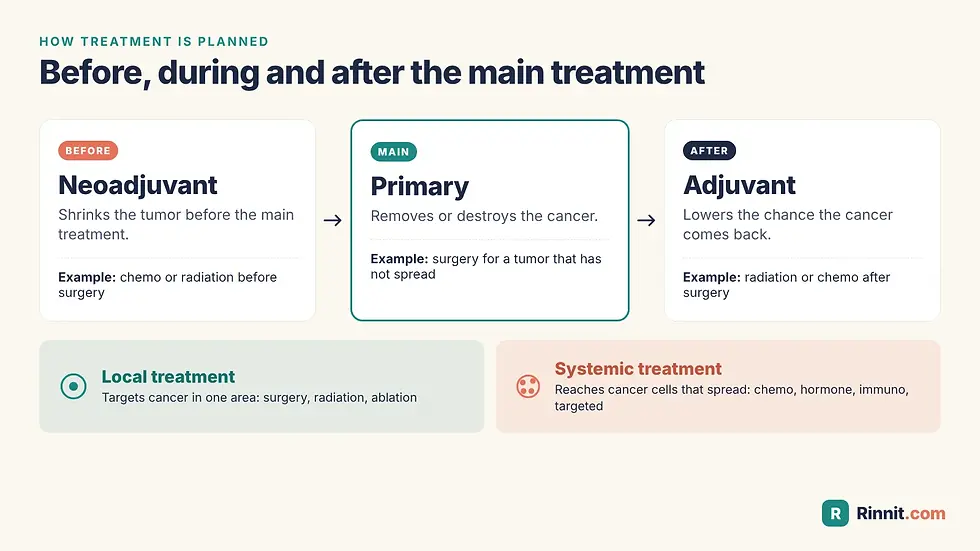
Primary therapy is the main cancer treatment, neoadjuvant therapy comes before it, and adjuvant therapy comes after it. [1]
Term | When it happens | Purpose | Common example |
Neoadjuvant therapy | Before the main treatment | Shrinks the tumor first | Chemo or radiation before surgery |
Primary treatment | The main treatment | Removes or destroys the cancer | Surgery for tumors that have not spread |
Adjuvant therapy | After the main treatment | Lowers the chance the cancer comes back | Radiation or chemo after surgery |
What is the difference between local and systemic cancer treatment?
Local treatment targets cancer in one part of the body, while systemic treatment reaches cancer cells throughout the body. [1]
Local treatments remove tumors or destroy cancer cells in a specific area. Surgery, radiation and ablation are examples.
Systemic treatments destroy cancer cells that have broken away from the original tumor and spread, including metastatic cancer in distant parts of the body. Chemotherapy, hormone therapy, immunotherapy and targeted therapy work this way.
How is cancer treatment given?
Cancer treatment is given through procedures that target the cancer directly or through medicines taken by mouth, on the skin, through a vein or by injection. [1]
Delivery method | What it involves |
Open surgery | Major surgery with large cuts to reach organs and body cavities |
Laparoscopy | Minimally invasive surgery with smaller cuts |
Precision technologies | Radiation and ablation methods that aim energy at cancer while sparing healthy tissue |
Oral | A pill, capsule, tablet or liquid you swallow |
Topical | A cream applied to the skin |
Intravenous (IV) infusion | Medicine released slowly into the bloodstream through a vein |
Injection | A shot given directly into tissue |
How long does cancer treatment last?
Cancer treatment can last for a set period with a clear end point or continue for an ongoing, open-ended time. [1]
Set duration is common when the goal is to cure the cancer.
Ongoing treatment is common for cancers that are not curable. It may focus on symptom relief and can continue until side effects become too hard to tolerate or the treatment stops working.
Treatment may be a single surgery or many sessions. Most courses involve repeated sessions over time. For example, chemo is often given in "rounds" or "cycles": treatment days followed by recovery days. This on-off pattern gives the medicine time to work and your body time to heal.
Ask your care team what your course will involve and how long it will take to know whether it is working.
What are the benefits of cancer treatment?
The main benefit of cancer treatment is that it can save lives, and doctors increasingly use the word "cure" for some early-stage cancers after treatment. [1]
A growing number of people are living past the five-year survival mark. This milestone matters because most cancers that stay in remission for five years do not come back.
Even for advanced cancers that have spread, treatment can still help. It can relieve cancer-related symptoms and help people live longer. Your care team should explain the expected benefits of each treatment they recommend.
What are the side effects of cancer treatment?
Cancer treatment side effects happen because therapies that kill cancer cells can also damage healthy cells. [1]
Treatment is often split into cycles or sessions to give your body time to recover. Still, side effects are common. Not everyone gets the same side effects, even with the same treatment, and different therapies carry different risks.
What are the short-term side effects?
The most common short-term side effects of cancer treatment are fatigue, anemia, nausea and vomiting, and pain. [1]
Common short-term side effect | What to know |
Fatigue | Feeling exhausted during and after treatment is common |
Anemia | Low red blood cell levels, which also cause tiredness |
Nausea and vomiting | One of the most common side effects across treatment types |
Pain | May affect bones, nerves, soft tissues or other areas |
Other short-term effects can include:
Hair loss
Diarrhea or constipation
Mouth sores and inflammation of the mouth and gut (mucositis)
Brittle fingernails
Headaches
Loss of appetite
Skin dryness, itching or rash
Slow wound healing or blood clots
Getting infections more easily (a weakened immune system)
What are the long-term side effects?
Long-term side effects of cancer treatment are effects that last after treatment ends or appear days, weeks or months later. Most side effects stop when treatment ends, but some continue. [1] [5]
Body system | Possible long-term effects |
Bones and joints | Joint pain, weakened bones (osteoporosis) |
Brain and thinking | Trouble remembering or concentrating (chemo brain) |
Digestive system | Trouble absorbing nutrients |
Heart | High blood pressure, irregular heartbeat (cardiotoxicity) |
Mental health | Depression, post-traumatic stress disorder (PTSD) |
Nerves | Nerve damage (neuropathy) |
Reproductive system | Changes in sex drive, early menopause, infertility |

Your care team should talk you through likely side effects before treatment starts.
How can you make cancer treatment easier?
You can make cancer treatment easier by learning about your diagnosis, asking questions and leaning on every source of support available. [1]
Learn about your diagnosis. Ask loved ones to learn with you.
Ask every question. Nothing is too small, including how to plan for changes to your daily life.
Use your care team. They can help manage side effects and adjust treatment.
Lean on family and friends. Practical and emotional help both matter.
Join a cancer support network. People who have lived through treatment often understand in ways others cannot.
When should you call your doctor during cancer treatment?
You should call your doctor during cancer treatment if you notice new symptoms or if existing symptoms get worse. Call right away for a fever of 100.4°F (38°C) or higher, because treatment can weaken your defenses against infection. [1]
Your provider may explain how to manage the symptom at home. Or they may change your dose or switch you to a different treatment.
Your care team needs to know not only whether treatment is working, but also how it affects your overall well-being. Protecting your quality of life is an essential part of cancer care.
Conclusion
Cancer treatment today reflects about 250 years of research, and it is helping many people live longer, fuller lives. Your plan will be built around your cancer type, stage, health and personal goals, and it will most likely combine more than one approach. Side effects are common but vary widely, and your care team can help manage them. Most of all, you are not alone: your care team, loved ones and support networks are part of your treatment, too.
Preparing for an oncology appointment? Save or print this guide, write down your questions, and bring it with you. Explore more plain-language guides in our Diseases & Conditions library, and if you found this helpful, share it with someone who is starting treatment.
Frequently asked questions
What is the most common treatment for cancer?
Surgery is the most common treatment for cancer that has not spread. For cancer that has spread, returned or is likely to return, chemotherapy is one of the most common and effective options. Most people receive a combination of treatments.
Can cancer be cured with treatment?
Yes, some cancers can be cured. Doctors increasingly use the word "cure" for some early-stage cancers that have not spread. Most cancers that stay in remission for five years do not come back.
Why do most people get more than one cancer treatment?
Combining treatments helps attack cancer in different ways. For example, chemotherapy or radiation may shrink a tumor before surgery, and radiation may destroy remaining cancer cells after surgery.
How long does chemotherapy last?
Chemotherapy is usually given in several cycles of treatment days followed by recovery days. The total length depends on your cancer type, stage and goal of treatment, so ask your oncologist what your course involves.
Do cancer treatment side effects go away?
Most side effects end once treatment is finished. Some, such as nerve damage, heart changes or memory problems, can last longer or appear weeks or months later.
When should I consider a clinical trial?
Your doctor may suggest a clinical trial if standard treatments have not helped or are not an option, or if emerging research suggests a newer treatment may work better for your cancer type.
What is the difference between chemotherapy and immunotherapy?
Chemotherapy uses drugs that kill fast-growing cells, including cancer cells. Immunotherapy helps your own immune system find and destroy cancer cells.
What does remission mean?
Remission means the signs and symptoms of cancer have gotten smaller or gone away. It can be partial or complete, and your doctor will keep checking for any return.
Is palliative care only for the end of life?
No. Palliative care eases symptoms and stress at any stage of cancer, and you can get it alongside treatment meant to cure or control the cancer.
Can I keep working during cancer treatment?
Many people keep working, sometimes with a lighter schedule. It depends on your treatment, your side effects and your job, so talk with your care team.
Related Reading
Cancer Staging and Grading: What They Are, Why They Matter, Tests and Results explains how doctors stage and grade cancer and why the results guide treatment.
References
Cleveland Clinic. Cancer Treatment: Types, Options & What To Expect. Cleveland Clinic. Last updated September 27, 2024. https://my.clevelandclinic.org/health/treatments/cancer-treatment
Mustian KM, Alfano CM, Heckler C, et al. Comparison of Pharmaceutical, Psychological, and Exercise Treatments for Cancer-Related Fatigue: A Meta-analysis. JAMA Oncol. 2017;3(7):961-968. PMID: 28253393. https://doi.org/10.1001/jamaoncol.2016.6914
Schwaederle M, Zhao M, Lee JJ, et al. Impact of Precision Medicine in Diverse Cancers: A Meta-Analysis of Phase II Clinical Trials. J Clin Oncol. 2015;33(32):3817-3825. PMID: 26304871. https://doi.org/10.1200/JCO.2015.61.5997
Haun MW, Estel S, Rücker G, et al. Early palliative care for adults with advanced cancer. Cochrane Database Syst Rev. 2017;6(6):CD011129. PMID: 28603881. https://doi.org/10.1002/14651858.CD011129.pub2
Emery J, Butow P, Lai-Kwon J, et al. Management of common clinical problems experienced by survivors of cancer. Lancet. 2022;399(10334):1537-1550. PMID: 35430021. https://doi.org/10.1016/S0140-6736(22)00242-2
National Cancer Institute. Cancer Staging. Cancer.gov. Reviewed October 14, 2022. Accessed October 20, 2026. https://www.cancer.gov/about-cancer/diagnosis-staging/staging
National Cancer Institute. Palliative Care in Cancer. Cancer.gov. Reviewed November 1, 2021. https://www.cancer.gov/about-cancer/advanced-cancer/care-choices/palliative-care-fact-sheet
Medical disclaimer
This article is for general education only and is not a substitute for professional medical advice, diagnosis or treatment. Always talk with your doctor or oncology team about your specific situation. If you have a medical emergency, contact your local emergency number right away.



Comments