Understanding Proton Therapy: Precision Radiation for Cancer Treatment

Updated: 2 days ago
Medically reviewed by Dr. Baraa Alnahhal, MD · Last reviewed: October 2026
Quick Answer: What Is Proton Therapy?
Proton therapy is a specialized radiation treatment in which a cyclotron sends high-energy protons toward a tumor. Its main advantage is precision: the beam stops at the tumor instead of passing through the body, limiting radiation to healthy tissue. This helps protect areas such as the brain and spinal cord and suits tumors near critical organs and some childhood cancers. [1]
What the research says
In children, proton therapy has matched or exceeded photon survival in several cancers. A meta-analysis of 18 studies in pediatric neuroblastoma (6 proton, 12 photon) found 2-year overall survival of 92.0% with proton therapy versus 81.3% with photon radiotherapy, and 2-year progression-free survival of 86.1% versus 64.5%, though differences in patients and protocols may have influenced the results (Nitta et al., Cancer Med, 2026).
In medulloblastoma, survival was similar, with fewer minor complications. A meta-analysis of 9 cohorts (889 children) found no significant difference in 5-year overall survival (OR 0.86, 95% CI 0.46 to 1.62) and no significant difference in major complications, while minor complications were less likely with proton therapy (OR 0.11, 95% CI 0.04 to 0.31) (Palavani et al., Childs Nerv Syst, 2025).
Proton therapy is not risk-free, and benefits vary by tumor. In a meta-analysis of 30 studies of skull base chordoma, particle beam therapy had higher 5-year progression-free survival than photon radiotherapy (67.8% vs 40.2%), but brain necrosis was reported in 8 to 50% of patients after particle therapy versus 0 to 4% after photon-based treatment, and the authors called for more studies (Saito et al., Cancers, 2024).
Research summaries are based on article abstracts retrieved from PubMed.
How does proton beam therapy achieve its precision?
Proton therapy shifts the focus from broad radiation exposure to targeted treatment. Traditional photon radiation uses X-rays that travel through the body, affecting healthy tissue in front of and behind the tumor. Proton beams are made of heavy, positively charged particles that can be controlled to release most of their energy at a chosen depth. This is known as the Bragg peak, and it allows the radiation dose to be concentrated in the tumor while limiting the dose to healthy tissue beyond it. [1]
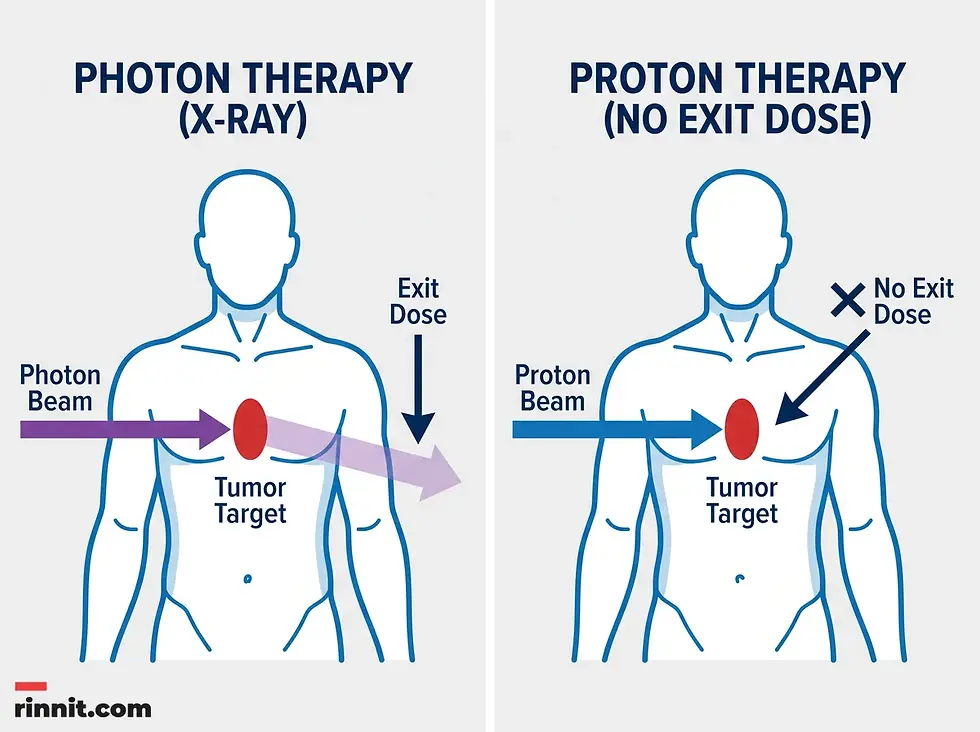
Key Differences Between Treatment Types
The choice between proton and traditional radiation depends on the tumor's location and your overall health. The table summarizes the main differences. [1]
Feature | Proton Therapy | Photon (Traditional) Therapy |
Particle Type | Positively charged protons | High-energy X-ray photons |
Beam Behavior | Stops delivering radiation at the tumor | Passes through the body and hits tissue along its path |
Exit Dose | Small | Radiation continues past the tumor |
Healthy Tissue Impact | Less radiation to tissue beyond the tumor | Healthy tissue along the beam path is also exposed |
Primary Use Case | Tumors near critical or sensitive areas, and several childhood cancers | A wide range of cancers |
What is proton therapy used for and what are its benefits?
Because it can spare healthy tissue, proton therapy is an option for tumors close to sensitive areas of the body, including the brain, eye, liver, lung, prostate, and spinal cord. It is also used for several childhood cancers. Radiation can affect how a child's body develops and may cause health problems years after treatment ends, and proton therapy reduces that risk. [1]

Proton therapy may offer several benefits. Because it hits the tumor directly, providers may be able to use higher doses. Less exposure to radiation can mean fewer or less severe side effects and may reduce the risk of a second cancer after treatment. It may also be used as a follow-up treatment when cancer comes back. It is a specialized treatment, though, and researchers are still studying when it is the best choice. [1]
What happens during proton therapy treatment?
Proton therapy begins with a planning session, where your care team explains what will happen. Treatment takes place in a special room. Imaging scans help the team direct the beams, and the protons are delivered by a device on a mechanical arm called a gantry, which rotates around you to deliver treatment from the best angles. [1]
Positioning: You get into position on the table or chair for treatment.
Imaging: Scans help your team confirm the beam's direction.
Monitoring: Your team leaves the room but can see and hear you throughout.
Delivery: The gantry rotates around you to deliver the protons. A session may take about 30 minutes.
You may have daily sessions over several weeks. The length of treatment depends on the type of cancer, the size of the tumor, and how well the treatment works. [1]
What is recovery and the long-term outlook after proton therapy?
Recovery from proton therapy may take a few weeks, and your healthcare provider will review your recovery timeline with you. Proton therapy can still cause side effects, most commonly fatigue and skin changes. Other side effects depend on where the tumor is. For example, treatment for brain cancer may cause headaches or memory loss. [1]
To support recovery, ask your healthcare provider about cancer rehabilitation. A physical therapist, for example, may suggest activities to build strength before you start radiation therapy, and palliative care can help you manage symptoms and side effects. [1]

There is no single success rate for proton therapy, because it is used for many kinds of cancer. Studies of specific cancers, such as those described in the research section above, give a more useful picture, and research on where proton therapy works best is continuing. [1]
Conclusion
Proton therapy is a precise form of radiation that can limit exposure of healthy tissue, which matters most for tumors near critical organs and for children. It is not the right choice for every cancer, and researchers are still working out where it offers the greatest advantage. If you need radiation therapy, your healthcare provider will recommend the treatment that is right for you. [1]
Frequently Asked Questions
What makes proton therapy different from regular radiation?
Traditional (photon) radiation passes through the body and also hits healthy tissue along the way, while proton therapy stops delivering radiation as soon as it reaches the tumor.
Is proton therapy more effective than traditional radiation?
Not necessarily. It is more precise, which can limit exposure of surrounding organs, but researchers are still studying where it works better than photon therapy. Your healthcare provider will recommend the treatment that is right for you.
Which cancers can be treated with proton therapy?
Proton therapy is an option for tumors close to sensitive areas such as the brain, eye, liver, lung, prostate, and spinal cord, and for several childhood cancers.
How long does a proton therapy session take?
A session may take about 30 minutes, including getting into position and having imaging scans.
What are the side effects of proton therapy?
Common side effects include fatigue and skin changes. Other side effects depend on the type of cancer and where it is, for example headaches or memory loss with treatment for brain cancer.
Can children receive proton therapy?
Yes. It is used for several childhood cancers because radiation can affect how a child's body develops and may cause health problems years after treatment. Proton therapy reduces that risk.
How long will I need treatment?
You may have daily sessions over several weeks. The length of treatment depends on the type of cancer, the size of the tumor, and how well the treatment works.
What is a cyclotron in proton therapy?
A cyclotron is the machine that sends high-energy, positively charged particles (proton beams) to destroy the tumor.
How long is the recovery period after treatment?
It may take a few weeks to recover. Your healthcare provider will review your recovery timeline with you.
Is proton therapy used for recurrent cancer?
Proton therapy may be used as a follow-up treatment if cancer comes back. Whether it is appropriate depends on your situation, so talk to your care team.
Related Reading
External Beam Radiation Therapy (EBRT): Types and What to Expect explains external beam radiation for cancer.
Radiation Therapy: Types, How It Works and Side Effects explains how radiation therapy treats cancer.
References
Cleveland Clinic. Proton therapy. Cleveland Clinic. Last updated June 26, 2026. https://my.clevelandclinic.org/health/treatments/17882-proton-therapy
Nitta H, Mizumoto M, Maruo K, et al. Proton beam therapy versus photon radiotherapy for pediatric neuroblastoma: a systematic review and meta-analysis (TRP-2025 Neuroblastoma). Cancer Med. 2026;15(3):e71701. PMID: 41803035. DOI: https://doi.org/10.1002/cam4.71701
Palavani LB, Borges PGLB, Semione G, et al. Proton versus photon radiation therapy for pediatric medulloblastomas: a systematic review and meta-analysis. Childs Nerv Syst. 2025;41(1):266. PMID: 40848062. DOI: https://doi.org/10.1007/s00381-025-06916-z
Saito T, Mizumoto M, Oshiro Y, et al. Systematic review and meta-analysis of particle beam therapy versus photon radiotherapy for skull base chordoma: TRP-Chordoma 2024. Cancers (Basel). 2024;16(14):2569. PMID: 39061207. DOI: https://doi.org/10.3390/cancers16142569
Medical disclaimer
This article is for informational purposes only and is not a substitute for professional medical advice, diagnosis, or treatment. Always seek the advice of your physician or other qualified health provider with any questions you may have about a medical condition.



Comments