External Beam Radiation Therapy (EBRT): Types and What to Expect

Updated: 2 days ago
Written and medically reviewed by Dr. Baraa Alnahhal, MD · Last reviewed: November 2026 · How we review
Quick Answer
External beam radiation therapy (EBRT) is the most common type of radiation treatment for cancer, in which a machine outside the body aims precisely shaped beams of radiation at the tumor. The machine never touches you, and treatment is painless. Treatments are usually given daily over several weeks. The most common side effect is fatigue.
What the research says
One week of breast radiation worked as well as three: in the FAST-Forward trial of 4,096 people after early breast cancer surgery, 5 treatments over 1 week controlled cancer as well as 15 treatments over 3 weeks, with similar long-term side effects (Murray Brunt A et al., Lancet, 2020) [2]
Shorter schedules were gentler on the breast: in the START trials of 4,451 women, 3 weeks of radiation controlled cancer as well as 5 weeks over 10 years, with less breast shrinkage and swelling (Haviland JS et al., Lancet Oncology, 2013) [3]
Key takeaways
EBRT aims radiation beams at a tumor from outside the body.
It's painless, and the machine never touches you.
Treatments are usually daily for several weeks.
Fatigue is the most common side effect.
Newer schedules can shorten treatment for some cancers.
What is external beam radiation therapy?
EBRT is one type of radiation therapy. It damages cancer cells so they can't grow. Radiation has been used to treat cancer for more than 100 years, and today's machines shape beams to protect nearby healthy tissue. Sources: [1]
Why it's used
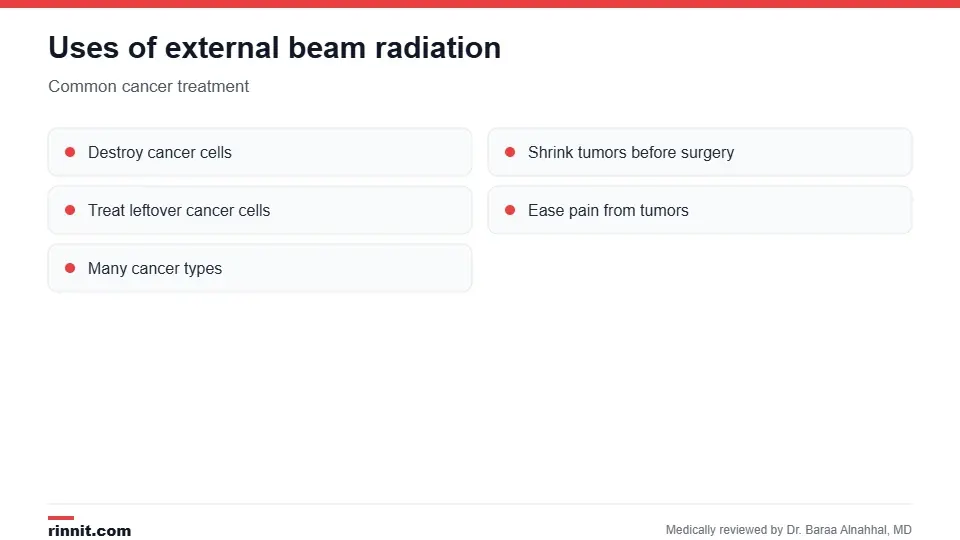
It's most often used for cancer in one area of the body.
Destroy cancer cells or keep them from spreading.
Shrink a tumor before surgery.
Treat cancer cells left after surgery or chemotherapy.
Ease pain from tumors.
Treat breast, prostate, lung, colon, uterine and head and neck cancers, leukemia and lymphoma. Sources: [1]
Types of EBRT

Most treatments use photons from a linear accelerator.
Technique | What it does |
Shapes 2 to 4 beams to match the tumor | |
Varies beam strength to protect healthy tissue | |
Uses imaging to target tumors that move | |
Uses protons instead of X-rays | |
Stereotactic radiosurgery and SBRT | High, precise doses in few sessions |
Radiation during surgery |
Most EBRT uses photons from a linear accelerator. Electron beams treat skin and surface cancers. Sources: [1]
Planning (simulation)

Simulation takes about 30 minutes to 2 hours.
At a simulation visit, you lie in your treatment position while a CT, MRI or PET scan maps the area.
Tiny, freckle-sized skin marks and a mask or cast help line you up each time.
Your team designs your plan over the next days or weeks.
Treatments begin, usually daily over several weeks. Sources: [1]
What a treatment session is like
A therapist positions you, then leaves the room and watches by camera and intercom. The machine moves quietly around you and delivers short bursts of radiation. Stay still but breathe normally. You won't feel anything, though you may hear clicks or whirring, see flashes of light or notice an odor, all of which are normal. Sources: [1]
Side effects
Type | Examples |
Most common | Fatigue |
Depending on the area | Skin irritation, hair loss in the treated area, nausea, loss of appetite, headaches, trouble swallowing, shortness of breath |
Timing | Side effects often build over the course of treatment |
Learn about radiation burns. Rest, a balanced diet and plenty of fluids help. Sources: [1, 2, 3]
Recovery
Some people keep their usual routine, while others need more rest. After treatment ends, some recover in a few weeks, and others need several months. Sources: [1]
When to call your provider
Severe or unexpected symptoms.
Side effects that suddenly get worse.
Fever or chills.
Trouble breathing or chest pain. Sources: [1]
Conclusion
External beam radiation therapy is a precise, painless way to treat many cancers and ease symptoms. Knowing what to expect at each visit and reporting side effects early helps you get through treatment more comfortably.
Keep learning: read about radiation therapy and proton therapy.
Frequently asked questions
What is external beam radiation therapy?
Radiation aimed at a tumor from a machine outside the body.
Does EBRT hurt?
No. You won't feel the radiation.
Will I be radioactive after EBRT?
No.
How long does treatment last?
Usually daily sessions over several weeks.
What is a simulation?
A planning visit with scans to map exactly where to aim.
What are the side effects?
Fatigue, plus effects that depend on the area treated.
Can I work during EBRT?
Many people keep their usual routine.
What machine is used?
Usually a linear accelerator.
What cancers does EBRT treat?
Breast, prostate, lung, colon, uterine, head and neck cancers and more.
How long do side effects last?
Some ease in weeks; others take months.
Related Reading
Radiation Therapy: Types, How It Works and Side Effects an overview of radiation treatment.
Understanding Proton Therapy: Precision Radiation for Cancer Treatment radiation using protons.
Precision Cancer Care: Understanding Intensity-Modulated Radiation Therapy (IMRT) radiation shaped to the tumor.
Stereotactic Body Radiation Therapy (SBRT): What It Is, How It Works and What to Expect high-dose, precise radiation.
Understanding Radiation Burns: Symptoms, Care, and Recovery skin effects from radiation.
References
Cleveland Clinic. External Beam Radiation Therapy (EBRT). Cleveland Clinic. Last updated July 7, 2025. https://my.clevelandclinic.org/health/treatments/24008-external-beam-radiation-therapy-ebrt
Murray Brunt A, Haviland JS, Wheatley DA, et al. Hypofractionated breast radiotherapy for 1 week versus 3 weeks (FAST-Forward): 5-year efficacy and late normal tissue effects results from a multicentre, non-inferiority, randomised, phase 3 trial. Lancet. 2020;395(10237):1613-1626. PMID 32580883. https://doi.org/10.1016/S0140-6736(20)30932-6
Haviland JS, Owen JR, Dewar JA, et al. The UK Standardisation of Breast Radiotherapy (START) trials of radiotherapy hypofractionation for treatment of early breast cancer: 10-year follow-up results of two randomised controlled trials. Lancet Oncology. 2013;14(11):1086-1094. PMID 24055415. https://doi.org/10.1016/S1470-2045(13)70386-3
Medical disclaimer
This article is for general education only and does not replace advice from a qualified healthcare professional. Talk to your doctor about your own diagnosis and treatment, and seek emergency care right away for severe or sudden symptoms.



Comments