Chemotherapy: How It Works, Side Effects, and What to Expect

Updated: 6 days ago
Written and medically reviewed by Dr. Baraa Alnahhal, MD · Last reviewed: October 31, 2026 · How we review
Quick Answer: What is chemotherapy?
Chemotherapy is a cancer treatment that uses drugs to destroy cancer cells and stop them from multiplying. It is usually given through a vein, but can also be a shot, pill or cream. It may be used alone or with surgery or radiation, and it can cure, control or ease cancer, though side effects are common. [1]
What the research says
Adjuvant chemo cuts breast cancer deaths by about a third. A pooled analysis of 123 randomized trials covering about 100,000 women found that modern chemotherapy regimens after surgery lowered breast cancer death rates by roughly one-third, largely regardless of age or tumor features (EBCTCG, Lancet, 2012).
Nerve symptoms are common but often ease over time. Across 31 studies of 4,179 patients, 68% had chemo-related nerve symptoms in the first month, 60% at 3 months and 30% at 6 months or longer (Seretny et al., Pain, 2014).
Scalp cooling can protect hair during chemo. In a randomized trial of women with early breast cancer, 50.5% of those using a scalp-cooling device kept most of their hair (under 50% loss) after four cycles, compared with 0% without cooling (Nangia et al., JAMA, 2017).
Key takeaways
Chemotherapy destroys fast-growing cancer cells and keeps them from dividing.
It can be used before surgery, after surgery, to cure cancer, or to ease symptoms.
Most people get chemo through an IV as an outpatient and go home the same day.
Treatment usually comes in rounds, with rest periods so your body can recover.
Many side effects fade after treatment ends, but some can appear months or years later.
What is chemotherapy?
Chemotherapy is a type of cancer treatment that uses drugs to fight many kinds of cancer. People often call it "chemo." [1]
It is one of several drug-based cancer treatments. The others work differently:
Drug therapy | How it works |
Chemotherapy | Destroys cancer cells and stops them from multiplying |
Hormone therapy | Blocks certain cancers from getting the hormones they need to grow |
Helps your immune system fight cancer | |
Targeted therapy | Changes how cancer cells multiply and behave |
A medical oncologist — a doctor who specializes in chemo and other cancer drugs — oversees your treatment. Chemo can also be paired with cancer surgery or radiation therapy. [1]
How does chemotherapy work?
Chemotherapy works by destroying cancer cells, which grow and divide out of control, and by preventing them from multiplying. [1]
Your oncologist may use chemo with one of four goals in mind:

The four ways chemotherapy may be used in a treatment plan. Image: Rinnit.com
Goal | When it's used | What it aims to do |
Neoadjuvant | Before surgery or radiation | Shrink a tumor first |
Adjuvant | After surgery or radiation | Destroy any cancer cells left behind |
Curative | Alone or with radiation and/or surgery | Eliminate the cancer so it does not return |
Palliative | When cure is not the goal | Shrink tumors and ease symptoms |
What types of cancer can chemotherapy treat?
Chemotherapy can treat a wide range of cancers, both primary cancer (cancer that hasn't spread) and metastatic cancer (cancer that has spread to other parts of the body). [1]
The type of chemo you receive depends on:
Where the cancer is located.
The stage of the cancer, or how advanced it is.
Your overall health.
How is chemotherapy given?
Chemotherapy is most often given through a vein (IV), but it can also be a shot, a pill or liquid, or a skin cream. Most chemo is systemic, meaning the drug travels through your whole body. [1]
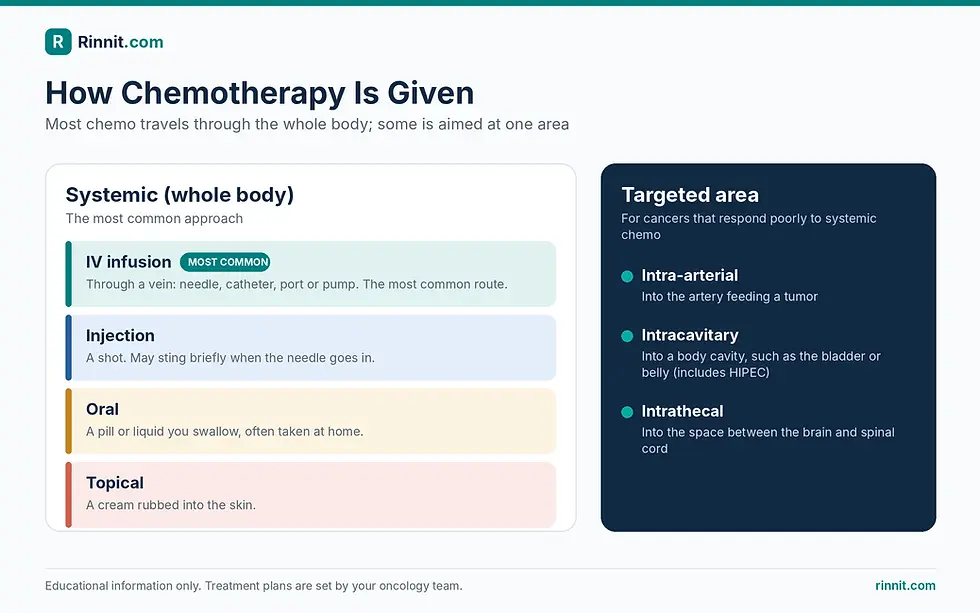
Systemic chemo reaches the whole body; targeted chemo is aimed at one area. Image: Rinnit.com
Systemic chemotherapy
Intravenous (IV): An infusion through a vein. This is how most people receive chemo.
Injection: A shot.
Oral: A pill or liquid you swallow.
Topical: A cream you rub into your skin.
Chemotherapy aimed at one area
Some cancers don't respond well to systemic chemo. In these cases, chemo may go straight to one area: [1]
Intra-arterial: Into a single artery that feeds a tumor.
Intracavitary: Into a body cavity, such as the bladder or belly. One form, HIPEC, places heated chemo in the abdomen after surgery.
Intrathecal: Into the space between the brain and spinal cord.
How is IV chemotherapy delivered?
IV chemotherapy is delivered through one of four devices:
Device | What it is |
Needle | Usually placed in your arm |
Catheter | A thin, flexible tube attached to a vein, usually in the chest |
Port | A small disc placed under the skin (minor surgery); a catheter connects to it |
Pump | Attaches to a catheter or port and controls how much drug you receive |
Catheters and ports help if you need many rounds. They spare you repeated needle sticks and can also deliver other medicines, such as antibiotics or anti-nausea drugs. [1]
How long does chemotherapy take?
A single chemotherapy session can last from a few minutes to a few hours, depending on the drugs used. Some people need a continuous infusion that lasts several days, which may start at the hospital and continue at home. [1]
Most people need several rounds. A round may include days or weeks of treatment, followed by a break with no chemo so your body can recover. Then the cycle repeats. Depending on your plan, treatment may be daily, weekly or monthly. [1]
Where do you get chemotherapy?
Chemotherapy is usually an outpatient treatment, so you go home the same day. You may receive it: [1]
In a clinic or infusion center.
In your oncologist's office.
In a hospital.
At home, if you take a pill or liquid form.
How do you prepare for chemotherapy?
Preparing for chemotherapy starts with tests your oncologist runs to make sure you're healthy enough for treatment. Meanwhile, these steps can help: [1]
Step | Why it helps |
Learn about your treatment | Ask which drugs you'll get, their benefits and possible side effects, and where to find trusted resources and support groups |
Plan for side effects | For example, arrange a wig, scarves or head wraps if hair loss is likely, or gentle skin products if skin sensitivity is expected |
Visit a dentist | Chemo can cause mouth sores and taste changes, so start with healthy teeth and an infection-free mouth |
Ease financial stress | Check what your insurance covers and ask about patient assistance programs |
Make arrangements at work | Ask how treatment may affect your job, then plan time off, remote work or a modified schedule |
Build a treatment routine | Ask how long sessions take, pack a lunch or something to pass the time, and consider a snack about an hour before treatment to help prevent nausea |
For practical and financial help, you can search a national directory of cancer support organizations.
What are the side effects of chemotherapy?
Chemotherapy side effects happen because the drugs target all fast-growing cells, not just cancer cells. Blood cells and cells in the skin, hair follicles and digestive tract also divide quickly, so these areas are affected most. [1]

Common and late side effects of chemotherapy, with how nerve symptoms change over time. Image: Rinnit.com
Common side effects during treatment
Anemia (low red blood cells)
Bleeding
Constipation
Diarrhea
Fatigue
Hair loss
Infection
Loss of appetite
Nausea and vomiting
Talk to your care team early about ways to manage these side effects. Call your care team right away if you get a fever of 100.4°F (38°C) or higher during chemo, because a low white blood cell count can let an infection become dangerous quickly. [1]
How long do chemotherapy side effects last?
Many chemotherapy side effects go away after treatment stops. Others, called late effects, may not appear until months or years later: [1]
Late effect | What it means |
Problems with memory and thinking | |
Early menopause | Periods stop earlier than expected |
Cardiotoxicity | Heart problems caused by cancer treatment |
Symptoms of nerve damage, such as numbness or tingling | |
Infertility | Difficulty having children |
Many people find cancer rehabilitation helpful for managing these effects. [1]
What are the benefits of chemotherapy?
Chemotherapy has been an effective, reliable cancer treatment for decades. It can clear cancer from the body completely, improve quality of life by easing symptoms, or make other treatments like surgery and radiation work better. [1]
In early breast cancer, for example, large trial data show modern chemo after surgery reduces breast cancer deaths by about one-third. [2]
Can cancer come back after chemotherapy?
Cancer can come back after chemotherapy, as it can after any cancer treatment. That's why your care team schedules follow-up visits once treatment ends. If cancer returns, your oncologist may recommend more cycles of chemo. [1]
Conclusion
Chemotherapy is one of the most common cancer treatments. It can work alone or alongside surgery, radiation or other drug therapies, and the plan you receive depends on your cancer's type, stage and location, as well as your overall health. Side effects are real, but many fade after treatment, and there are concrete steps you can take to prepare.
Before your first session, write down your questions and bring this guide to your oncologist. Ask which drugs you'll receive, what your treatment goal is, and how your team will help you manage side effects. Explore our other cancer treatment guides to understand every option on the table.
Frequently asked questions
Is chemotherapy painful?
Most people feel no pain during chemotherapy sessions, especially with pills or creams. A shot may sting when the needle goes in, and you may feel slight burning as the drug enters, which usually eases during treatment. [1]
Can chemotherapy cure cancer?
Yes. Some cancers are sensitive to chemotherapy and go away completely after treatment. Doctors use the word "cure" carefully because cancer can return, but many survivors are cancer-free thanks to chemo. [1]
At what stage of cancer is chemotherapy given?
There is no single stage for chemotherapy. It may be a first-line treatment for cancers that respond well to it, or it may be used after other treatments haven't worked. The drugs, dose and timing depend on your situation. [1]
How long does one chemotherapy session take?
One session can take a few minutes to a few hours. Some continuous infusions last several days and may continue at home. [1]
How many rounds of chemotherapy will I need?
Most people need several rounds. Each round is a period of treatment followed by rest so your body can recover. Your oncologist sets the number and schedule. [1]
Can I prevent hair loss from chemotherapy?
Not always, but scalp cooling can help some people. In one trial, about half of women using a scalp-cooling device kept most of their hair after four cycles. Ask your team whether it suits your treatment. [4]
Does nerve damage from chemotherapy go away?
Often it improves. Research shows nerve symptoms affect about 68% of people in the first month, falling to about 30% at six months or more. Report numbness or tingling early. [3]
Can I keep working during chemotherapy?
Many people keep working, sometimes with a lighter schedule. It depends on your treatment, side effects and job, so talk with your care team.
Can I drive myself to chemotherapy?
Some medicines given with chemo can make you drowsy. Plan for a ride at least for your first session, and ask your care team whether driving is safe.
Can cancer come back after chemotherapy?
Yes, cancer can come back after any treatment. That's why your care team schedules follow-up visits after treatment ends.
Related Reading
Neoadjuvant Therapy: Types, Uses and Benefits explains neoadjuvant cancer therapy.
Antibody-Drug Conjugates (ADCs): How They Work and Side Effects explains antibody-drug conjugates for cancer.
Adjuvant Therapy: What It Is, Types and Why It's Used explains adjuvant cancer therapy.
Chemotherapy for Breast Cancer: Types, Timing and Side Effects explains chemotherapy for breast cancer.
Radiation Therapy: Types, How It Works and Side Effects explains how radiation therapy treats cancer.
Echocardiogram With Strain: How Strain Imaging Spots Early Heart Damage explains the strain echo that spots early heart muscle changes.
References
Cleveland Clinic. Chemotherapy. Cleveland Clinic Health Library. Last updated October 20, 2022. https://my.clevelandclinic.org/health/treatments/16859-chemotherapy
Early Breast Cancer Trialists' Collaborative Group (EBCTCG); Peto R, Davies C, Godwin J, et al. Comparisons between different polychemotherapy regimens for early breast cancer: meta-analyses of long-term outcome among 100,000 women in 123 randomised trials. Lancet. 2012;379(9814):432-444. PMID 22152853. https://doi.org/10.1016/S0140-6736(11)61625-5
Seretny M, Currie GL, Sena ES, et al. Incidence, prevalence, and predictors of chemotherapy-induced peripheral neuropathy: A systematic review and meta-analysis. Pain. 2014;155(12):2461-2470. PMID 25261162. https://doi.org/10.1016/j.pain.2014.09.020
Nangia J, Wang T, Osborne C, et al. Effect of a Scalp Cooling Device on Alopecia in Women Undergoing Chemotherapy for Breast Cancer: The SCALP Randomized Clinical Trial. JAMA. 2017;317(6):596-605. PMID 28196254. https://doi.org/10.1001/jama.2016.20939
Medical disclaimer
This article is for educational purposes only and does not replace professional medical advice. Always talk with your oncologist or healthcare provider about your diagnosis and treatment.



Comments