Antibody-Drug Conjugates (ADCs): How They Work and Side Effects

Updated: 2 days ago
Written and medically reviewed by Dr. Baraa Alnahhal, MD · Last reviewed: November 2026 · How we review
Quick Answer
Antibody-drug conjugates (ADCs) are cancer treatments that combine targeted therapy and chemotherapy in one drug. A monoclonal antibody attaches to cancer cells, then a linker releases a chemotherapy drug inside them, helping spare healthy cells. ADCs treat some blood cancers and tumors such as certain breast, lung and ovarian cancers. They don't cure cancer.
What the research says
An ADC extended survival in HER2-low breast cancer: in a trial of 557 people with HER2-low metastatic breast cancer, trastuzumab deruxtecan extended median survival to 23.4 months versus 16.8 months with chemotherapy, though 12.1% had drug-related lung disease (Modi S et al., New England Journal of Medicine, 2022) [2]
An ADC nearly doubled survival in triple-negative breast cancer: in a trial of 468 people with metastatic triple-negative breast cancer, sacituzumab govitecan gave median survival of 12.1 months versus 6.7 months with chemotherapy, with more severe low white cell counts (51% vs. 33%) (Bardia A et al., New England Journal of Medicine, 2021) [3]
Key takeaways
ADCs combine targeted therapy with chemotherapy.
The antibody delivers chemo directly to cancer cells.
They treat certain blood cancers and solid tumors.
They're often used when other treatments haven't worked.
They can extend life but don't cure cancer.
What are antibody-drug conjugates?
ADCs are sometimes called "magic bullets" or "biological missiles." They join a monoclonal antibody to a chemotherapy drug. Examples include brentuximab vedotin (Adcetris), trastuzumab emtansine (Kadcyla) and sacituzumab govitecan (Trodelvy). Sources: [1]
How ADCs work

Each ADC has three parts.
Part | Job |
Monoclonal antibody | Finds and attaches to cancer cells |
Linker | Holds the drug in place, then releases it inside the cancer cell |
Chemotherapy drug | Destroys the cancer cell |
This targeted delivery helps spare nearby healthy cells. Sources: [1]
Cancers ADCs treat
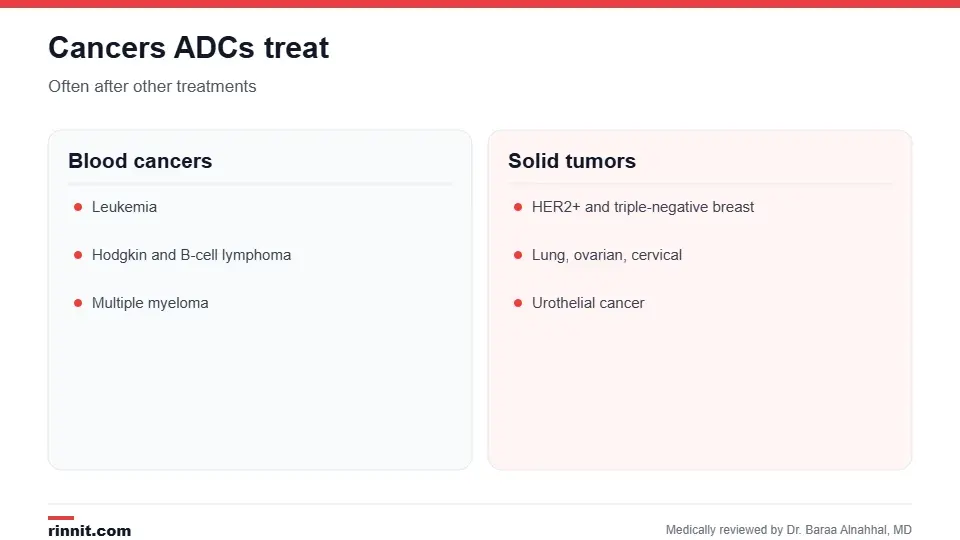
More than 100 clinical trials are underway.
Blood cancers | Solid tumors |
Acute lymphoblastic and myeloid leukemia | HER2-positive and triple-negative breast cancer |
Hodgkin lymphoma and B-cell lymphoma | Lung cancer |
Ovarian and cervical cancer | |
Anaplastic large cell lymphoma | Urothelial cancer |
Sources: [1, 2, 3]
Side effects
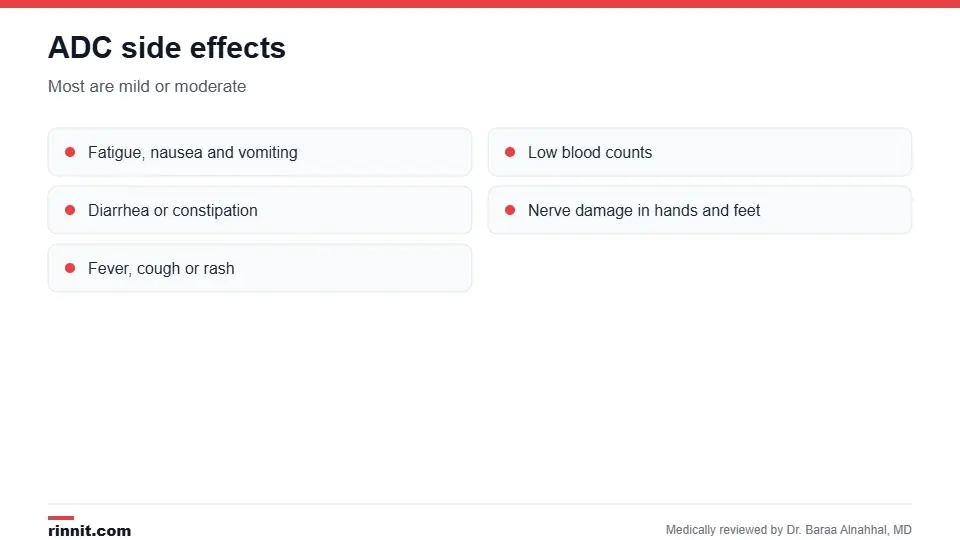
Most side effects are mild or moderate.
Fatigue, nausea, vomiting and loss of appetite.
Diarrhea or constipation.
Low blood counts, including anemia and low platelets.
Fever, cough or pneumonia.
Rash or headache.
Nerve damage in the hands and feet (peripheral neuropathy).
Low potassium or bleeding. Sources: [1]
Most side effects are mild or moderate, but some can be life-threatening. Severity depends on the cancer type, stage and your overall health. Sources: [1, 3]
Outlook
Studies show people receiving ADCs live longer than people with the same cancer receiving standard chemotherapy. Your outlook depends on your cancer's type and stage and your overall health. ADCs can't cure cancer. Sources: [1, 2, 3]
When to call your care team
Contact your care team if side effects are worse than expected, such as nausea and vomiting you can't control. Sources: [1]
Conclusion
Antibody-drug conjugates deliver chemotherapy straight to cancer cells, helping many people live longer when other treatments fail. Ask your oncologist whether an ADC fits your cancer.
Keep learning: read about monoclonal antibodies and targeted therapy.
Frequently asked questions
What are antibody-drug conjugates?
Cancer drugs that join an antibody to chemotherapy.
How do ADCs work?
The antibody finds cancer cells and releases chemo inside them.
What cancers do ADCs treat?
Some leukemias, lymphomas, myeloma and breast, lung, ovarian and other cancers.
When are ADCs used?
Often when cancer returns, spreads or doesn't respond to other treatment.
Are ADCs better than chemotherapy?
Studies show people live longer on ADCs than on standard chemo.
Can ADCs cure cancer?
No.
What are common side effects?
Fatigue, nausea, low blood counts and nerve damage.
How many ADCs are approved?
More than a dozen have FDA approval.
What is an example of an ADC?
Trastuzumab emtansine (Kadcyla) or sacituzumab govitecan (Trodelvy).
Do ADCs harm healthy cells?
They're designed to spare most healthy cells.
Related Reading
Monoclonal Antibodies: What They Are, How They Work, Uses and Side Effects the antibody part of ADCs.
Targeted Therapy for Cancer: How It Works, Types, Side Effects and Outlook an overview of targeted therapy.
Chemotherapy: How It Works, Side Effects, and What to Expect how chemotherapy works.
Navigating HER2-Negative Breast Cancer: Types, Treatments, and Outlook a breast cancer ADCs may treat.
What Is Multiple Myeloma? A Plain-Language Guide to Symptoms, Causes, and Treatment a blood cancer ADCs treat.
References
Cleveland Clinic. Antibody-Drug Conjugates (ADCs). Cleveland Clinic. Last updated March 28, 2024. https://my.clevelandclinic.org/health/treatments/antibody-drug-conjugates
Modi S, Jacot W, Yamashita T, et al. Trastuzumab deruxtecan in previously treated HER2-low advanced breast cancer. New England Journal of Medicine. 2022;387(1):9-20. PMID 35665782. https://doi.org/10.1056/NEJMoa2203690
Bardia A, Hurvitz SA, Tolaney SM, et al. Sacituzumab govitecan in metastatic triple-negative breast cancer. New England Journal of Medicine. 2021;384(16):1529-1541. PMID 33882206. https://doi.org/10.1056/NEJMoa2028485
Medical disclaimer
This article is for general education only and does not replace advice from a qualified healthcare professional. Talk to your doctor about your own diagnosis and treatment, and seek emergency care right away for severe or sudden symptoms.



Comments