What Is Multiple Myeloma? A Plain-Language Guide to Symptoms, Causes, and Treatment

Updated: 2 days ago
Medically reviewed by Dr. Baraa Alnahhal, MD · Last reviewed: October 17, 2026
Quick Answer: Key Facts About Multiple Myeloma
Multiple myeloma is a cancer of plasma cells, a type of white blood cell, in which cancerous cells build up in the bone marrow and crowd out healthy blood cells. [1] [3] It may cause bone pain, tiredness and infections, and the typical age at diagnosis is about 65. Treatment ranges from close watching to medicines and transplant. [2]
Question | Answer |
What is it? | A cancer of plasma cells — a type of white blood cell — where cancerous cells build up in the bone marrow and crowd out healthy blood cells. |
What does it feel like? | Often nothing at first. When symptoms appear, they can include bone pain (especially in the spine, chest, or hips), tiredness, infections, nausea, constipation, and frequent urination. [1] |
Who is at higher risk? | The typical age at diagnosis is about 65. Men, Black people, and anyone with a sibling or parent who has multiple myeloma are at higher risk. Having MGUS also raises the risk. [1] |
What causes it? | |
How is it treated? | Sometimes with close watching only. When treatment is needed, a mix of medicines — targeted therapy, immunotherapy, corticosteroids, sometimes chemotherapy — possibly followed by a bone marrow transplant. |
What the research says
MGUS turns into myeloma slowly — about 1% a year. In a long-term Mayo Clinic study of 1,384 people with MGUS, followed for 11,009 person-years, 115 progressed to multiple myeloma or a related disorder. The cumulative probability of progression was 12% at 10 years, 25% at 20 years, and 30% at 25 years. (Kyle et al., N Engl J Med, 2002) [5]
Adding bortezomib to a standard drug combination improved survival. In the SWOG S0777 trial of 525 people with newly diagnosed myeloma who weren't planned for immediate transplant, adding bortezomib to lenalidomide and dexamethasone extended median progression-free survival to 43 vs 30 months and median overall survival to 75 vs 64 months. Overall response rates were 82% vs 72%, and grade 3 or higher adverse events were more common (82% vs 75%). (Durie et al., Lancet, 2017) [6]
What is multiple myeloma?
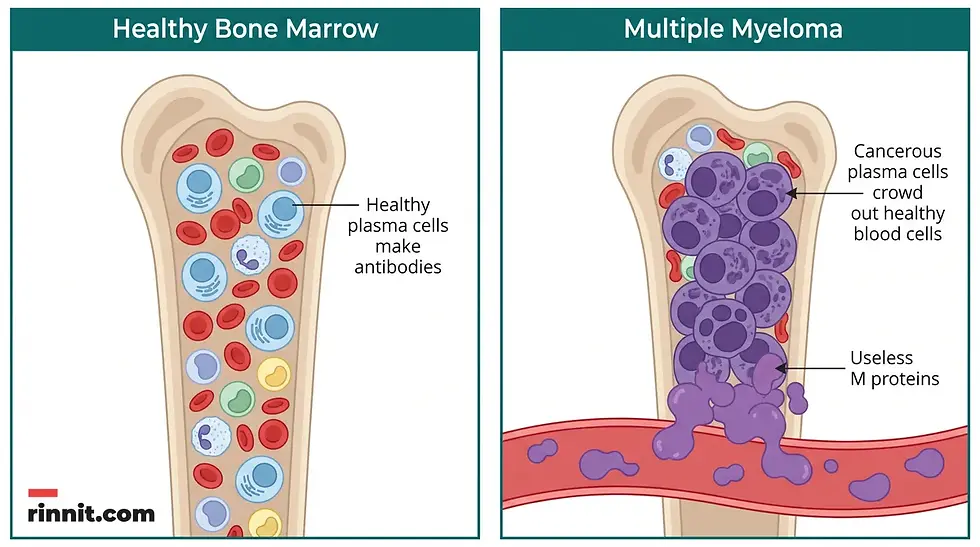
Multiple myeloma is a cancer that forms in a type of white blood cell called a plasma cell. Healthy plasma cells help fight infections by making proteins called antibodies. Antibodies find and attack germs. [1] [3]
In multiple myeloma, cancerous plasma cells build up in the bone marrow — the soft matter inside bones where blood cells are made. There, the cancer cells crowd out healthy blood cells. And rather than make helpful antibodies, the cancer cells make proteins that don't work right. This leads to complications. [1] [3]
The good news: treatment isn't always needed right away. If the cancer is slow growing and isn't causing symptoms, close watching might be the first step. For people who need treatment, there are a number of ways to help control the disease. [1] [2]
How does multiple myeloma start?
It begins with plasma cells in the bone marrow. Gene changes (mutations) turn plasma cells into cancerous myeloma cells. The myeloma cells then make more and more new myeloma cells that aren't needed and don't die quickly. [4]
Here is the key difference. Healthy cells grow at a set pace and die at a set time. Cancer cells don't follow these rules. They make a lot of extra cells, and they keep living when healthy cells would die. The result: the cancer cells build up in the bone marrow and crowd out the healthy blood cells, leading to tiredness and a reduced ability to fight infections. [3]
The myeloma cells also keep trying to make antibodies, as healthy plasma cells do. But the body can't use these antibodies. They are called monoclonal proteins, or M proteins for short. The M proteins build up in the body and cause problems, such as damage to the kidneys. Myeloma cells can also damage bones and increase the risk of broken bones. [1] [3]

What are the symptoms of multiple myeloma?
Early in multiple myeloma, there might be no symptoms at all. When signs and symptoms do happen, they can include: [1] [3]
Symptom | What it looks like |
Bone pain | Especially in the spine, chest, or hips [1] |
Tiredness | |
Infections | |
Weakness | |
Nausea | |
Constipation | |
Loss of appetite | |
Weight loss | Losing weight without trying |
Mental fogginess or confusion | |
Thirst and frequent urination |
When should I see a doctor?
Make an appointment with a healthcare professional if you have symptoms that worry you. [1] Because early multiple myeloma can cause no symptoms at all, persistent bone pain, unusual tiredness, or repeated infections are worth mentioning at your next visit.
What causes multiple myeloma?
The cause of multiple myeloma is not clear, and people who develop it did nothing to cause it. [1] What we do know is that gene changes turn plasma cells into myeloma cells, which make more and more new myeloma cells. [4] The cancer cells then crowd out healthy blood cells and produce M proteins the body can't use. [3] There is no known way to prevent multiple myeloma, and importantly: if you get multiple myeloma, you didn't do anything to cause it.
What is the connection between MGUS and multiple myeloma?
Multiple myeloma starts as a condition called monoclonal gammopathy of undetermined significance, also called MGUS. In MGUS, the level of M proteins in the blood is low, and the M proteins don't cause damage in the body. Only a small share of people with MGUS go on to develop multiple myeloma, but the cancer does begin there. [1] [5]
Who is at higher risk?
What complications can multiple myeloma cause?
Complication | How it happens |
Infections | |
Bone problems | Bone pain, thinning bones, and broken bones [1] |
Kidney problems | |
Anemia |
How is multiple myeloma diagnosed?
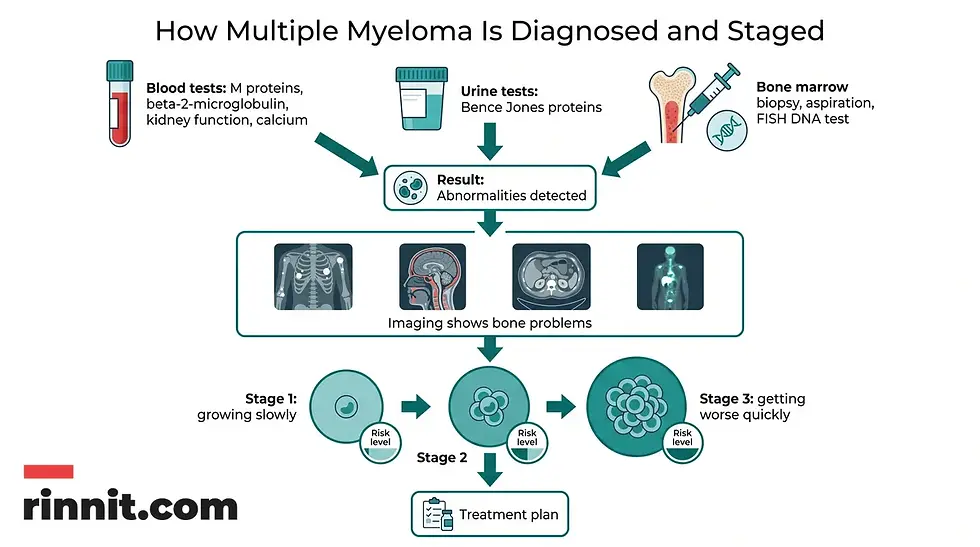
Sometimes a healthcare professional finds multiple myeloma during a blood test for another condition. Other times, symptoms lead to testing. [2] [3]
Test | What it checks |
Blood tests | |
Urine tests | M proteins can show up in urine samples, where they are called Bence Jones proteins. [2] |
Bone marrow biopsy | A needle collects a small amount of the solid bone marrow tissue, typically from the hip bone. [2] |
Bone marrow aspiration | A needle draws a sample of the liquid part of the bone marrow. [2] |
FISH test | |
Imaging tests |
What do the stages mean?
The test results help the care team decide the myeloma's stage. In multiple myeloma, the stages range from 1 to 3. The stage is based on the levels of two proteins in the blood: beta-2-microglobulin and albumin. A stage 3 multiple myeloma also has high levels of LDH (lactate dehydrogenase) or certain changes in the chromosomes. [3]
Multiple myeloma can also be given a risk level, such as standard risk or high risk. Results of the FISH test are one of the important factors in deciding it. [4] The care team uses the stage and risk level to understand the prognosis and plan treatment. [3]
How is multiple myeloma treated?
Treatment isn't always needed right away. If there are no symptoms, tests may be used to watch the myeloma and see if it gets worse. When multiple myeloma causes symptoms, treatment often starts with medicine. Treatment can relieve pain, control complications, and slow the growth of the myeloma cells. [2]
What is smoldering multiple myeloma?
Sometimes multiple myeloma doesn't cause symptoms. Doctors call this smoldering multiple myeloma. It might not need treatment right away. If the myeloma is at an early stage and is growing slowly, you might have regular checkups to monitor the cancer — with blood and urine tests to look for signs that the myeloma is getting worse. [1] [2] You and your care team might decide to start treatment when signs or symptoms appear, or sooner if the myeloma looks likely to turn into active myeloma soon. [3] [4]
What treatment options are available?
Treatment | How it works |
Targeted therapy | Medicines that attack specific chemicals in the cancer cells. Blocking these chemicals can cause cancer cells to die. [2] |
Immunotherapy | Medicine that helps the body's immune system kill cancer cells, which otherwise hide from the immune system. [2] |
CAR-T cell therapy | |
Chemotherapy | Strong medicines that kill cancer cells, including fast-growing myeloma cells. [2] |
Corticosteroids | |
Bone marrow transplant | |
Radiation therapy | Powerful energy beams (X-rays, protons, or other sources) kill cancer cells and can quickly shrink a growth of myeloma cells — useful if the cells form a mass called a plasmacytoma that is causing pain or destroying a bone. [2] |
How are treatments put together?
The treatment plan depends on whether a bone marrow transplant is likely. The care team considers how likely the myeloma is to get worse, your age, and your overall health. [2] [3]
When a transplant is an option: treatment often begins with a mix of medicines — targeted therapy, immunotherapy, corticosteroids, and sometimes chemotherapy. [2] After 4 to 6 cycles of this treatment, blood stem cells are collected. The transplant usually happens right after this first treatment, though some people choose or need to delay it. When possible, enough stem cells are collected for two bone marrow transplants. [4] After the transplant, targeted therapy or immunotherapy helps keep the myeloma from coming back. [2]
When a transplant isn't an option: treatment might still include a mix of medicines — targeted therapy, immunotherapy, corticosteroids, and sometimes chemotherapy. [3]
When myeloma comes back or doesn't respond: another course of the same treatment, or one or more of the other treatments available. Research on new treatments is ongoing, and a clinical trial may allow you to try treatments being tested — ask your care team what trials are available. [2]
How are complications treated?
Complication | Treatment options |
Bone pain | Pain medications, radiation therapy, and surgery [2] |
Kidney damage | Dialysis may be needed for severe kidney damage [2] |
Infections | Vaccines can help prevent infections such as the flu and pneumonia [2] |
Bone loss | |
Anemia | Medicines can increase the number of red blood cells to relieve ongoing anemia [2] |
What should I ask at my appointment?
If you have symptoms that worry you, make an appointment with a healthcare professional. Preparation helps. Before the visit, write down your symptoms and how long they have been going on, list every medicine, vitamin, and supplement with doses, bring notes on your personal and family medical history, and consider taking a family member or friend to help remember details.
Questions to ask | How to prepare |
What's the most likely cause of my symptoms? | A complete symptom list, including anything that seems unrelated |
What tests do I need? | Your medicine and supplement list with doses |
If it's myeloma, what stage and risk level is it? | Notes on when symptoms started and how they've changed |
Do I need treatment right away, or can we watch it? | A family member or friend to accompany you |
What treatment options are available, and are clinical trials an option? | A prioritized question list, most important first |
Conclusion and next steps
Multiple myeloma is a cancer of the plasma cells — the white blood cells that normally make antibodies. When plasma cells turn cancerous, the myeloma cells make more and more new myeloma cells, crowd out healthy blood cells in the bone marrow, and flood the body with M proteins that can damage the kidneys and bones. Bone pain, tiredness, and repeated infections are the most common warning signs. [4] There is no known way to prevent it, and no one causes it. [1] Many people need no treatment at first, while others have access to a growing toolkit of targeted therapy, immunotherapy, CAR-T cell therapy, transplant, and radiation. If you notice persistent, unexplained bone pain, unusual tiredness, or repeated infections, a conversation with a healthcare professional is the right first step.
Talk with a healthcare professional. If you or someone you love has persistent bone pain in the spine, chest, or hips, unusual tiredness that doesn't lift, repeated infections, or other symptoms that worry you, don't write them off. Multiple myeloma can be found early — sometimes on a routine blood test — and for many people, close watching, not immediate treatment, is the starting point. For plain-language guides to what each test means and what to ask at your appointment, explore the related articles on Rinnit.com.
Frequently Asked Questions
What is multiple myeloma in simple terms?
Multiple myeloma is a cancer of plasma cells, a type of white blood cell that normally makes antibodies. The cancerous cells build up in the bone marrow, crowd out healthy blood cells, and produce M proteins that can damage the kidneys and bones. [1] [3]
What are the first signs of multiple myeloma?
Early on there may be no symptoms at all. When symptoms appear, they can include bone pain (especially in the spine, chest, or hips), tiredness, infections, weakness, nausea, constipation, loss of appetite, and needing to urinate often. [1] [3]
Who is most likely to get multiple myeloma?
The typical age at diagnosis is about 65. Men, Black people, and people with a sibling or parent who has multiple myeloma have a higher risk. [1] Having MGUS — a condition with low levels of M proteins in the blood — also increases risk. [1] [3]
Can multiple myeloma be prevented?
There's no known way to prevent multiple myeloma. If you get multiple myeloma, you didn't do anything to cause it. [1]
What is MGUS, and how is it connected to myeloma?
MGUS (monoclonal gammopathy of undetermined significance) is a condition where the level of M proteins in the blood is low and doesn't cause damage. Multiple myeloma starts as MGUS, which is why having the condition increases the risk of the cancer. [1]
How is multiple myeloma staged?
Stages range from 1 to 3. The stage is based on blood levels of beta-2-microglobulin and albumin; stage 3 also involves high LDH or certain chromosome changes. A risk level, standard or high, may also be assigned, based partly on a FISH test. [4] The stage and risk level help the care team plan treatment. [3]
Is treatment always needed right away?
No. Some people have smoldering multiple myeloma — myeloma with no symptoms — and are watched closely with regular blood and urine tests instead of starting treatment immediately. [1] [2] Treatment usually starts when signs or symptoms appear, or sooner if the myeloma looks likely to become active soon. [3] [4]
What are the main treatment options?
Targeted therapy, immunotherapy, CAR-T cell therapy, chemotherapy, corticosteroids, bone marrow transplant, and radiation therapy — sometimes used alone, often combined, and sometimes paired with treatments for complications like bone pain, anemia, or kidney damage. [2] [3]
Related Reading
BiTE Therapy (Bispecific T-Cell Engagers): How It Works and Side Effects explains BiTE immunotherapy.
Antibody-Drug Conjugates (ADCs): How They Work and Side Effects explains antibody-drug conjugates for cancer.
Read next on Rinnit.com:
Kyphoplasty: Procedure, Recovery, Results and Risks explains the balloon-and-cement procedure for spinal compression fractures, recovery and risks.
Learn more in our guide to Bone Marrow Biopsy: Why It's Done, What to Expect, Pain and Recovery.
Flow Cytometry: What It Is, Why It's Done, How It Works and Results explains the lab test that sorts and counts cells by their surface markers to help diagnose and monitor blood cancers and immune conditions.
Globulin Blood Test: What It Measures, Normal Range and What High or Low Levels Mean explains the blood test that checks protein levels linked to this condition.
Learn more in our guide to Blood Tests for Cancer: Types, What They Can Show and What Results Mean.
Calcium Blood Test: Normal Range and What High or Low Calcium Means explains the normal calcium range and what high or low results mean.
Serum Protein Electrophoresis (SPEP): What It Tests, How It Works and What Results Mean explains the blood test that sorts and measures blood proteins to help detect conditions like MGUS and multiple myeloma.
Kappa Free Light Chain Test: Normal Ranges, Kappa/Lambda Ratio and What Results Mean explains the blood test that measures kappa and lambda light chains.
References
Mayo Clinic Staff. Multiple myeloma - Symptoms & causes. Mayo Clinic. August 22, 2026. https://www.mayoclinic.org/diseases-conditions/multiple-myeloma/symptoms-causes/syc-20353378
Mayo Clinic Staff. Multiple myeloma - Diagnosis & treatment. Mayo Clinic. August 22, 2026. https://www.mayoclinic.org/diseases-conditions/multiple-myeloma/diagnosis-treatment/drc-20353383
National Cancer Institute. Plasma Cell Neoplasms (Including Multiple Myeloma) Treatment (PDQ®)–Patient Version. National Cancer Institute. November 17, 2023. https://www.cancer.gov/types/myeloma/patient/myeloma-treatment-pdq
National Comprehensive Cancer Network. NCCN Guidelines for Patients: Multiple Myeloma (English Version 2026). NCCN. Accessed October 15, 2026. https://www.nccn.org/guidelines/guidelines-detail?category=patients&id=24
Kyle RA, et al. A long-term study of prognosis in monoclonal gammopathy of undetermined significance. N Engl J Med. 2002;346(8):564-569. PMID 11856795. https://doi.org/10.1056/NEJMoa01133202
Durie BGM, et al. Bortezomib with lenalidomide and dexamethasone versus lenalidomide and dexamethasone alone in patients with newly diagnosed myeloma without intent for immediate autologous stem-cell transplant (SWOG S0777): a randomised, open-label, phase 3 trial. Lancet. 2017;389(10068):519-527. PMID 28017406. https://doi.org/10.1016/S0140-6736(16)31594-X
Medical disclaimer
This article is for informational purposes only and is not medical advice. Always consult a qualified healthcare professional for diagnosis and treatment decisions.



Comments