BiTE Therapy (Bispecific T-Cell Engagers): How It Works and Side Effects

Updated: 2 days ago
Written and medically reviewed by Dr. Baraa Alnahhal, MD · Last reviewed: November 2026 · How we review
Quick Answer
Bispecific T-cell engager (BiTE) therapy is a type of immunotherapy that uses lab-made antibodies to link cancer-fighting T-cells to cancer cells so the T-cells can kill them. It's used when other treatments haven't worked for acute lymphoblastic leukemia, lymphoma, multiple myeloma, lung cancer and melanoma. The main risks are cytokine release syndrome and a nervous system reaction called ICANS.
What the research says
A bispecific antibody helped many people with hard-to-treat myeloma: in the MajesTEC-1 study of 165 people with heavily treated multiple myeloma, teclistamab produced responses in 63% (39.4% complete response or better) lasting a median 18.4 months; cytokine release syndrome occurred in 72.1%, but only 0.6% had severe CRS (Moreau P et al., New England Journal of Medicine, 2022) [2]
Blinatumomab nearly doubled survival in leukemia: in the TOWER trial of 405 adults with relapsed or refractory B-cell acute lymphoblastic leukemia, blinatumomab gave median survival of 7.7 months versus 4.0 months with chemotherapy, and complete remission in 34% versus 16% (Kantarjian H et al., New England Journal of Medicine, 2017) [3]
Key takeaways
BiTE therapy links T-cells to cancer cells so they can attack.
It's used when other treatments haven't worked.
It treats certain leukemias, lymphomas, myeloma, lung cancer and melanoma.
Doses start low and rise over a few days.
CRS and ICANS are the main risks, so you're monitored closely.
What is BiTE therapy?
BiTE therapy is a form of cancer immunotherapy. Its antibodies are related to monoclonal antibodies, but each one binds two targets. Researchers are testing it for prostate cancer and some digestive cancers. Sources: [1]
How it works

Each antibody binds two targets at once.
The antibody grabs a T-cell and a cancer cell at the same time.
The T-cell is activated and releases cytokines.
Cytokines call in and activate other immune cells.
These cells release proteins that enter the cancer cell.
The cancer cell is triggered to self-destruct. Sources: [1]
Cancers it treats
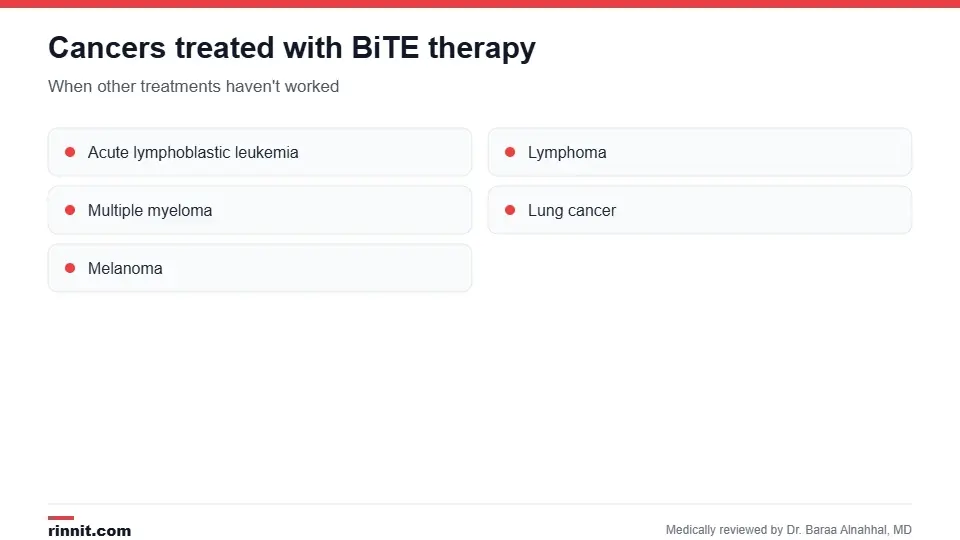
It's usually used when other treatments haven't worked.
Lung cancer.
Melanoma. Sources: [1, 2, 3]
How it's given
As a shot or through an IV.
Doses start low and increase over a few days.
You may stay in the hospital overnight or for several days after the first treatment. Sources: [1]
Side effects

You're monitored in the hospital for these reactions.
Reaction | Symptoms |
Cytokine release syndrome (CRS) | Chills, fever, joint and muscle pain, nausea, vomiting |
ICANS (neurotoxicity) | Confusion, trouble speaking, weakness, paralysis |
These can start right after treatment or a few weeks after the first dose. Learn more about cytokine release syndrome. Sources: [1, 2]
Outlook
There's no single success rate because each cancer uses different medicines. In one study of people with multiple myeloma whose other treatments failed, about 6 in 10 responded, nearly 4 in 10 had a complete response, and responses lasted a median of about 18 months. Sources: [1, 2]
BiTE therapy vs. CAR T-cell therapy
Both use T-cells to fight cancer. CAR T-cell therapy modifies your own T-cells in a lab, while BiTE therapy uses ready-made antibodies to connect your T-cells to cancer. Sources: [1]
When to call your provider
Call right away for any CRS or ICANS symptoms, including fever, confusion or trouble speaking, even if they appear weeks after your first treatment. Because ICANS can cause sudden confusion, don't drive or use heavy machinery for at least 48 hours after step-up doses, or longer if your team advises. Sources: [1]
Conclusion
BiTE therapy gives your immune system a direct link to cancer cells and offers hope when other treatments fail. Close monitoring helps catch side effects early.
Keep learning: read about cancer immunotherapy and CAR T-cell therapy.
Frequently asked questions
What is BiTE therapy?
An immunotherapy that links T-cells to cancer cells.
What does "bispecific" mean?
Each antibody binds two targets at once.
What cancers does it treat?
Certain leukemias, lymphomas, myeloma, lung cancer and melanoma.
When is it used?
Usually when other treatments haven't worked.
How is it given?
As a shot or through an IV.
Will I stay in the hospital?
Often after the first dose, for one or more nights.
What is cytokine release syndrome?
A reaction causing fever, chills, aches, nausea and vomiting.
What is ICANS?
A nervous system reaction causing confusion, trouble speaking or weakness.
Can side effects start later?
Yes, up to a few weeks after the first treatment.
How is it different from CAR T-cell therapy?
CAR T modifies your T-cells in a lab; BiTE uses ready-made antibodies.
Related Reading
Immunotherapy for Cancer: How It Works and What to Expect an overview of immunotherapy.
CAR T-Cell Therapy: How It Works, Side Effects, and Recovery another T-cell therapy.
Cytokine Release Syndrome (CRS): Symptoms, Causes, Grading, Treatment and Outlook a key side effect.
Acute Lymphocytic Leukemia: Symptoms, Diagnosis, Treatment and Support a cancer BiTE therapy treats.
What Is Multiple Myeloma? A Plain-Language Guide to Symptoms, Causes, and Treatment another cancer it treats.
References
Cleveland Clinic. Bispecific T-Cell Engager (BiTE) Therapy. Cleveland Clinic. Last updated November 13, 2025. https://my.clevelandclinic.org/health/treatments/bispecific-t-cell-engager-therapy
Moreau P, Garfall AL, van de Donk NWCJ, et al. Teclistamab in relapsed or refractory multiple myeloma. New England Journal of Medicine. 2022;387(6):495-505. PMID 35661166. https://doi.org/10.1056/NEJMoa2203478
Kantarjian H, Stein A, Gökbuget N, et al. Blinatumomab versus chemotherapy for advanced acute lymphoblastic leukemia. New England Journal of Medicine. 2017;376(9):836-847. PMID 28249141. https://doi.org/10.1056/NEJMoa1609783
Medical disclaimer
This article is for general education only and does not replace advice from a qualified healthcare professional. Talk to your doctor about your own diagnosis and treatment, and seek emergency care right away for severe or sudden symptoms.



Comments