CAR T-Cell Therapy: How It Works, Side Effects, and Recovery

Updated: 6 days ago
Written and medically reviewed by Dr. Baraa Alnahhal, MD · Last reviewed: October 31, 2026 · How we review
Quick Answer: What is CAR T-cell therapy?
CAR T-cell therapy is a type of immunotherapy that treats certain blood cancers by adding a lab-made gene to a person's own T cells so they can find and kill cancer cells. It is used when other treatments have not worked or cancer returns. The cells are given through an IV, and side effects need close hospital monitoring. [1]
What the research says
Most people with hard-to-treat large B-cell lymphoma responded. In a multicenter phase 2 trial, 111 people with refractory large B-cell lymphoma enrolled and 101 received CAR T cells. 82% responded, 54% had a complete response, and 52% were alive at 18 months. Severe cytokine release syndrome occurred in 13% and severe nervous-system events in 28%. (Neelapu et al., N Engl J Med, 2017)
Children and young adults with relapsed leukemia often reached remission. In a 25-center global study of 75 patients with relapsed or refractory B-cell acute lymphoblastic leukemia, 81% were in remission within 3 months and 76% were alive at 12 months. Cytokine release syndrome occurred in 77% and nervous-system events in 40%. (Maude et al., N Engl J Med, 2018)
A stem cell transplant after CAR T cells helped keep leukemia away. In 50 children and young adults with B-cell leukemia followed for a median of 4.8 years, 62% reached complete remission. Among those who then had a stem cell transplant, 61.9% were alive without relapse or other events at 5 years. (Shah et al., J Clin Oncol, 2021)
Key takeaways
CAR T-cell therapy uses your own T cells, changed in a lab to recognize a specific marker on cancer cells.
It treats certain blood cancers, usually when other treatments have not worked or the cancer has come back.
Making the cells takes about 3 to 6 weeks; the infusion itself takes 5 to 30 minutes.
Expect a 7- to 10-day hospital stay, to stay near your treatment center for at least 2 weeks, and no driving for at least 2 weeks, or longer if your team advises.
The two most common side effects are cytokine release syndrome and nervous-system effects, which can be life-threatening.
For some people it can cure the cancer; for others it extends life.
How does CAR T-cell therapy work?
CAR T-cell therapy works by giving your own T cells a new, lab-made receptor that locks onto a specific marker on cancer cells. "CAR" stands for chimeric antigen receptor.
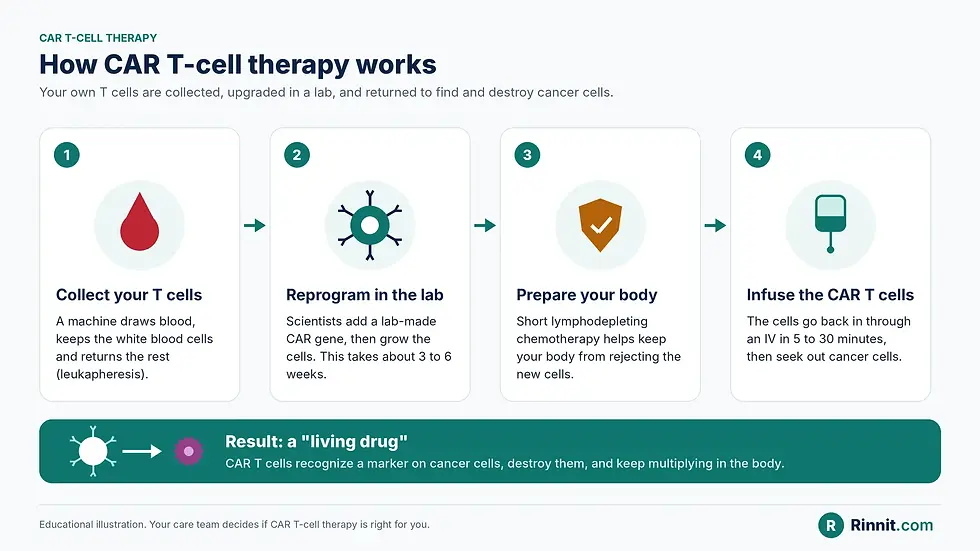
T cells are white blood cells in your immune system. They watch for invaders by checking proteins called antigens on the surface of cells. When a T cell's receptor spots an abnormal cell, the T cell switches on, destroys that cell, and calls in other parts of the immune system to help.
The problem is that normal T-cell receptors do not always recognize cancer cells. CAR T-cell therapy fixes this in four steps:
Scientists add a lab-made gene for the chimeric antigen receptor to your T cells.
The changed cells now recognize one specific antigen on cancer cells.
The cells are grown in the lab until there are enough to attack the cancer.
Once back in your bloodstream, they find and destroy cancer cells.
CAR T cells also keep multiplying inside your body, giving you a long-term supply of cells aimed at your cancer. That is why doctors call it a "living drug."
Which cancers can CAR T-cell therapy treat?
CAR T-cell therapy treats certain blood cancers when other treatments are not effective or the cancer comes back. These include:
Follicular lymphoma
High-grade B-cell lymphoma
Mantle cell lymphoma
Multiple myeloma
Primary mediastinal large B-cell lymphoma
Most of these are types of non-Hodgkin lymphoma. If you have a different kind of cancer, ask your care team whether a clinical trial of CAR T-cell therapy might fit you. More than 1,000 clinical trials are testing new CAR T-cell drugs.
Which CAR T-cell therapies are FDA-approved?
CAR T-cell therapies have had U.S. Food and Drug Administration (FDA) approval since 2017, and each one is approved for specific blood cancers.
Generic name | Brand name | Approved to treat |
Tisagenlecleucel | Kymriah® | Acute lymphoblastic leukemia in children and young adults |
Brexucabtagene autoleucel | Tecartus® | Mantle cell lymphoma |
Axicabtagene ciloleucel | Yescarta® | Several types of B-cell lymphoma |
Lisocabtagene maraleucel | Breyanzi® | Diffuse large B-cell lymphoma |
Idecabtagene vicleucel | Abecma® | Multiple myeloma |
Ciltacabtagene autoleucel | Carvykti® | Multiple myeloma |
Approvals change over time. The FDA keeps a current list of approved cellular and gene therapy products.
What happens before CAR T-cell therapy?
Before CAR T-cell therapy, your white blood cells are collected, turned into CAR T cells in a lab, and your body is prepared to receive them. Here is the order:
Cell collection (leukapheresis). A machine draws some of your blood, keeps the white blood cells, and returns the rest. Providers usually place a central venous catheter for this. Read more in our leukapheresis guide.
Making the CAR T cells. Your cells are sent quickly to a lab facility. Turning them into CAR T cells takes 3 to 6 weeks.
Bridging therapy (if needed). Some people have chemotherapy or radiation therapy during the wait to keep the cancer under control.
Lymphodepleting chemotherapy. Right before you get your new cells, a short course of chemotherapy helps keep your body from rejecting the CAR T cells.
What happens during a CAR T-cell therapy infusion?
A CAR T-cell infusion is a single IV treatment that takes 5 to 30 minutes and works much like a blood transfusion. You may need to stay in the hospital for it.
Your CAR T cells are stored in a medical bag until it is time.
A cell therapy nurse connects the bag to an IV line.
The new cells flow into your bloodstream.
What happens after CAR T-cell therapy?
After CAR T-cell therapy, most people stay in the hospital for 7 to 10 days so the team can watch closely for serious side effects. How long you stay depends on your situation and any side effects.
Once you go home, you should plan for:
What to plan | How long | Why |
Stay within driving distance of your treatment center | At least the first 2 weeks | So you can get back quickly if side effects appear |
A caregiver with you 24 hours a day | During recovery | Someone must be ready to act if side effects start |
Someone else to drive you | At least 2 weeks after infusion | Nervous-system side effects can affect driving |

What are the side effects of CAR T-cell therapy?
The two most common side effects of CAR T-cell therapy are cytokine release syndrome (CRS) and nervous-system (neurological) problems. Both can be serious.
Cytokine release syndrome is an inflammatory reaction that can cause:
Fever
Shortness of breath (dyspnea)
Low blood pressure
Heart or lung problems (very rare)
Neurological side effects can include:
Confusion
Difficulty speaking (aphasia)
Difficulty writing (dysgraphia)
Headache
Balance problems
Tremors or twitching
Seizures
Other possible side effects include:
An allergic reaction during the infusion
Fatigue
Bruising or bleeding more easily than usual
Low potassium (hypokalemia)
Low sodium (hyponatremia)
A higher risk of infection. Rarely, new cancers that start in T cells have been reported after treatment, so you will need lifelong follow-up

For more on how immune-based cancer treatments can affect the body, see our guide to immunotherapy side effects.
How successful is CAR T-cell therapy?
CAR T-cell therapy can cure some blood cancers and often helps people live longer, but it is not a cure for everyone.
Strong early results in children with leukemia. A 2020 study of children treated for acute lymphoblastic leukemia found that more than 85% had complete remission right after treatment, and 60% of those children were still cancer-free 12 months later.
Not a cure for many people. A review of CAR T-cell research concluded that for a significant share of patients, the therapy did not cure their condition.
Possible outcome | What it means |
Cure | For some people, the cancer does not come back |
Longer life | Many people live longer than expected with other options |
No lasting response | For a significant share, the cancer is not cured |
When should you call a doctor after CAR T-cell therapy?
Call your healthcare provider right away or go to the emergency room after CAR T-cell therapy if you have any fever, chills, dizziness, trouble breathing, confusion, trouble speaking, shaking or a seizure.
CAR T-cell side effects, especially cytokine release syndrome and some neurological problems, can be life-threatening. Before you leave the hospital, ask your care team exactly which symptoms should make you call or return.
CAR T-cell therapy at a glance
Question | Answer |
What is it? | Immunotherapy using your own T cells, changed in a lab to attack cancer |
Who is it for? | People with certain blood cancers that did not respond to treatment or came back |
How long to make the cells? | 3 to 6 weeks |
How long is the infusion? | 5 to 30 minutes, through an IV |
Hospital stay | Often 7 to 10 days |
After discharge | Stay near your center for at least 2 weeks; caregiver 24 hours a day; no driving for at least 2 weeks |
Most common side effects | Cytokine release syndrome and neurological effects |
Approved since | 2017 |
Conclusion
CAR T-cell therapy turns your own immune cells into a targeted, living treatment for certain blood cancers. It can bring remission and, for some people, a cure, especially when other treatments have stopped working. It also takes weeks of preparation, a hospital stay, and a support plan at home, and its side effects need fast attention.
If you or someone you love has a blood cancer that has not responded to treatment or has come back, ask your hematologist or oncologist whether CAR T-cell therapy or a clinical trial is an option. Bring this guide to your next appointment, and explore our lymphoma guide and cytokine release syndrome guide to prepare your questions.
Frequently asked questions
What does CAR T stand for?
CAR T stands for chimeric antigen receptor T-cell. The "CAR" is a lab-made receptor added to your T cells so they can recognize a specific antigen on cancer cells.
Is CAR T-cell therapy a type of chemotherapy?
No. CAR T-cell therapy is a type of immunotherapy that uses your own immune cells. You do receive a short course of lymphodepleting chemotherapy just before the infusion to help your body accept the new cells.
How long does CAR T-cell therapy take from start to finish?
Making the CAR T cells takes 3 to 6 weeks after collection. The infusion takes 5 to 30 minutes, followed by a hospital stay of 7 to 10 days, at least 2 weeks near your treatment center, and at least 2 weeks without driving.
Can CAR T-cell therapy cure cancer?
CAR T-cell therapy can cure some types of blood cancer. For many people it helps them live longer, but for a significant share of patients it does not cure the cancer.
Why can't I drive after CAR T-cell therapy?
Neurological side effects such as confusion, balance problems, and seizures can occur after treatment. For that reason, someone else should drive you for at least 2 weeks after you receive your cells, or longer if your team advises.
Why do I need a caregiver after CAR T-cell therapy?
Serious side effects can start after you leave the hospital. A caregiver with you 24 hours a day can spot warning signs early and get you to care quickly.
Can CAR T-cell therapy treat solid tumors?
Approved CAR T-cell therapies currently treat certain blood cancers. People with other kinds of cancer can ask their care team about joining a clinical trial.
What are the signs of cytokine release syndrome?
Cytokine release syndrome often starts with fever and chills and can cause low blood pressure, dizziness and trouble breathing. Get care right away if you notice these signs.
How long will I stay in the hospital after CAR T-cell therapy?
Most people stay about 7 to 10 days so the team can watch for serious side effects. The exact length depends on how you respond.
Do I need chemotherapy before CAR T-cell therapy?
Usually, yes. Most people get a short course of low-dose chemotherapy a few days before the infusion to prepare the body for the new cells.
Related Reading
BiTE Therapy (Bispecific T-Cell Engagers): How It Works and Side Effects explains BiTE immunotherapy.
References
Cleveland Clinic. CAR T-Cell Therapy: What It Is & How It Works. Cleveland Clinic. Last updated February 14, 2024. https://my.clevelandclinic.org/health/treatments/17726-car-t-cell-therapy
Neelapu SS, Locke FL, Bartlett NL, et al. Axicabtagene Ciloleucel CAR T-Cell Therapy in Refractory Large B-Cell Lymphoma. New England Journal of Medicine. 2017;377(26):2531-2544. PMID: 29226797. https://doi.org/10.1056/NEJMoa1707447
Maude SL, Laetsch TW, Buechner J, et al. Tisagenlecleucel in Children and Young Adults with B-Cell Lymphoblastic Leukemia. New England Journal of Medicine. 2018;378(5):439-448. PMID: 29385370. https://doi.org/10.1056/NEJMoa1709866
Shah NN, Lee DW, Yates B, et al. Long-Term Follow-Up of CD19-CAR T-Cell Therapy in Children and Young Adults With B-ALL. Journal of Clinical Oncology. 2021;39(15):1650-1659. PMID: 33764809. https://doi.org/10.1200/JCO.20.02262
Medical disclaimer
This article is for educational purposes only and does not replace medical advice, diagnosis, or treatment. Always talk with a qualified healthcare professional about your health and treatment options.



Comments