Radiation Therapy: Types, How It Works and Side Effects

Updated: 2 days ago
Written and medically reviewed by Dr. Baraa Alnahhal, MD · Last reviewed: November 2026 · How we review
Quick Answer
Radiation therapy (radiotherapy) is a cancer treatment that uses high-energy radiation, usually X-rays, to damage the DNA of cancer cells so they stop growing and die. It can be used alone or with surgery and chemotherapy. The two main types are external beam radiation and internal radiation. The most common side effects are fatigue and skin changes.
What the research says
Radiation after lumpectomy saves lives: across 17 trials with 10,801 women, radiation after breast-conserving surgery cut 10-year cancer recurrence from 35.0% to 19.3% and 15-year breast cancer death from 25.2% to 21.4% (Early Breast Cancer Trialists' Collaborative Group et al., Lancet, 2011) [2]
Radiation helped control prostate cancer: in the ProtecT trial of 1,643 men followed for 15 years, prostate cancer deaths were low with all approaches, and radiation halved the spread of cancer compared with monitoring (5.0% vs. 9.4%) (Hamdy FC et al., New England Journal of Medicine, 2023) [3]
One week of breast radiation can replace three: in the FAST-Forward trial of 4,096 people with early breast cancer, 26 Gy in 5 treatments over 1 week controlled the cancer as well as the standard 15 treatments over 3 weeks, with similar side effects at 5 years (Murray Brunt A et al., Lancet, 2020) [4]
Key takeaways
Radiation therapy damages cancer cells' DNA so tumors shrink.
External beam radiation is the most common type.
Internal radiation includes brachytherapy and IV or oral treatments.
EBRT courses last up to six weeks.
Fatigue and skin changes are the most common side effects.
What is radiation therapy?
Radiation therapy is planned and delivered by a team that includes a radiation oncologist, a medical physicist, a dosimetrist and radiation therapists. Low doses are also used for some noncancerous conditions, such as osteoarthritis, certain heart rhythm problems and benign tumors. Sources: [1]
Why it's used
No single success rate applies to everyone.
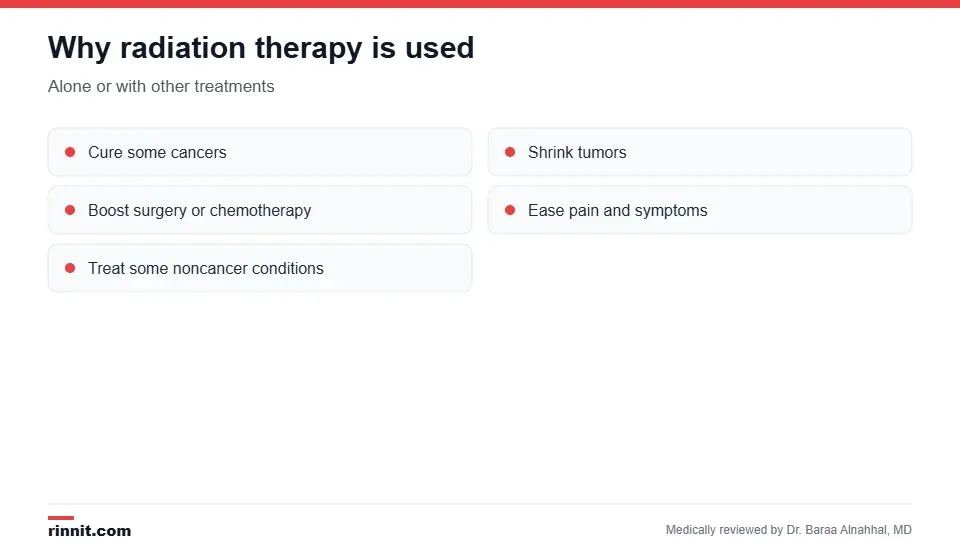
Treat cancer on its own.
Work with surgery or chemotherapy to make them more effective.
Cure some cancers.
Ease symptoms such as pain.
Treat some noncancerous conditions with low doses. Sources: [1]
Types of radiation therapy

Your team picks the type based on your cancer.
Type | Examples | How it works |
External beam (EBRT) | A machine outside the body aims beams at the tumor | |
Seeds or implants for head and neck, breast, cervix, uterus and prostate cancers | Radioactive material placed inside or next to the tumor | |
Systemic therapy | Radioactive liquid by IV or pill | Travels through the body to cancer cells |
Sources: [1]
How to prepare
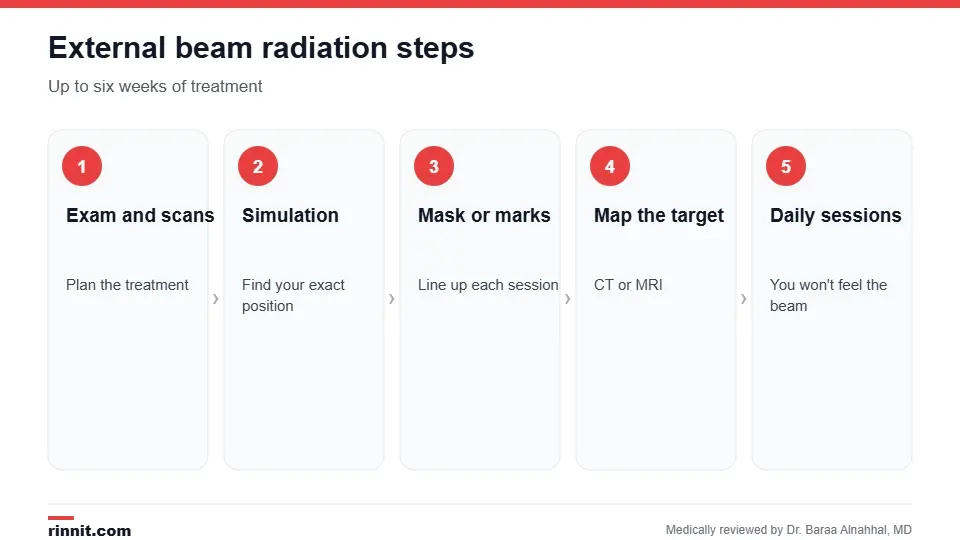
The machine never touches you, and you won't feel the radiation.
You'll have a physical exam and imaging, such as a CT scan.
For EBRT, a simulation session sets your exact treatment position.
You may get a mold or mask and tiny skin marks to help line up each treatment.
A CT or MRI maps the area to treat.
Treatments then take place over up to six weeks. Sources: [1]
What happens during treatment
During EBRT, the machine moves around you but never touches you, and you don't feel anything. For brachytherapy, a small flexible tube places the seed or implant, sometimes with anesthesia. After systemic or some internal treatments, you may be briefly radioactive and need to follow safety precautions; IV systemic therapy may require a one- to two-day hospital stay. Sources: [1]
Side effects
Type | Possible effects |
Most common | Fatigue, skin changes in the treated area |
Area-specific | Depend on the part of the body treated |
Long term | A small increase in the chance of a different cancer |
Internal or systemic | Trace radiation in sweat, saliva, blood or urine for a short time |
Your team can manage side effects with medicines or by adjusting your treatment. Learn about radiation burns and radiation therapy for breast cancer. Sources: [1]
Outlook
Radiation is one of the most effective cancer treatments, but there's no single success rate. Ask your care team about results for your specific cancer and treatment plan. Sources: [1, 2, 3]
When to call your provider
Side effects that are more severe than expected.
Side effects that don't improve.
Any new symptoms that worry you. Sources: [1]
Conclusion
Radiation therapy can cure some cancers, shrink others and ease symptoms. Knowing what to expect and staying in close contact with your care team helps you manage side effects and get the most from treatment.
Keep learning: read about brachytherapy and proton therapy.
Frequently asked questions
What is radiation therapy?
A cancer treatment that uses high-energy radiation to kill cancer cells.
How does radiation kill cancer?
It damages cancer cells' DNA so they can't grow.
What are the main types?
External beam radiation and internal radiation.
Does radiation therapy hurt?
No. You don't feel external beam radiation.
How long does treatment last?
External beam radiation usually lasts up to six weeks.
What are the side effects?
Mostly fatigue and skin changes.
Will I be radioactive?
Not with external beam; briefly with some internal treatments.
Can I work during radiation therapy?
Many people keep their daily routine.
What is brachytherapy?
Radiation from a seed or implant placed inside the body.
Can radiation treat noncancerous conditions?
Yes, low doses treat some conditions like osteoarthritis.
Related Reading
Neoadjuvant Therapy: Types, Uses and Benefits explains neoadjuvant cancer therapy.
External Beam Radiation Therapy (EBRT): Types and What to Expect explains external beam radiation for cancer.
Brachytherapy: What Internal Radiation Is, How It Works and What to Expect internal radiation treatment.
Understanding Proton Therapy: Precision Radiation for Cancer Treatment a precise type of external radiation.
Precision Cancer Care: Understanding Intensity-Modulated Radiation Therapy (IMRT) radiation shaped to the tumor.
Chemotherapy: How It Works, Side Effects, and What to Expect a treatment often combined with radiation.
References
Cleveland Clinic. Radiation Therapy: How Does It Work? Cleveland Clinic. Last updated April 10, 2026. https://my.clevelandclinic.org/health/treatments/17637-radiation-therapy
Early Breast Cancer Trialists' Collaborative Group (EBCTCG), Darby S, McGale P, et al. Effect of radiotherapy after breast-conserving surgery on 10-year recurrence and 15-year breast cancer death: meta-analysis of individual patient data for 10,801 women in 17 randomised trials. Lancet. 2011;378(9804):1707-1716. PMID 22019144. https://doi.org/10.1016/S0140-6736(11)61629-2
Hamdy FC, Donovan JL, Lane JA, et al. Fifteen-year outcomes after monitoring, surgery, or radiotherapy for prostate cancer. New England Journal of Medicine. 2023;388(17):1547-1558. PMID 36912538. https://doi.org/10.1056/NEJMoa2214122
Murray Brunt A, Haviland JS, Wheatley DA, et al. Hypofractionated breast radiotherapy for 1 week versus 3 weeks (FAST-Forward): 5-year efficacy and late normal tissue effects results from a multicentre, non-inferiority, randomised, phase 3 trial. Lancet. 2020;395(10237):1613-1626. PMID 32580883. https://doi.org/10.1016/S0140-6736(20)30932-6
Medical disclaimer
This article is for general education only and does not replace advice from a qualified healthcare professional. Talk to your doctor about your own diagnosis and treatment, and seek emergency care right away for severe or sudden symptoms.



Comments