Stereotactic Body Radiation Therapy (SBRT): What It Is, How It Works and What to Expect

Updated: 7 days ago
Written and medically reviewed by Dr. Baraa Alnahhal, MD · Last reviewed: October 2026 · How we review
Quick Answer: What is SBRT?
Stereotactic body radiation therapy (SBRT) is a cancer treatment that aims high doses of radiation at a small tumor with pinpoint accuracy, usually in 1 to 5 sessions over 1 to 2 weeks. It needs no cuts or anesthesia and can treat some small lung, prostate, liver and pancreatic tumors. Most people resume normal activities within 1 to 2 days. [1]
What the research says
SBRT controls early lung tumors about as well as surgery. A meta-analysis of 30 studies (29,511 patients) found similar 3-year local tumor control after SBRT and surgery (hazard ratio 0.97). Overall survival at 3 years favored surgery (HR 1.35), so SBRT is mainly used when surgery is not a good fit. (Viani et al., J Bras Pneumol, 2022)
Five SBRT sessions worked as well as weeks of standard radiation for localized prostate cancer. In a phase 3 trial of 874 men, 95.8% of the SBRT group were free of cancer return at 5 years vs. 94.6% with standard radiation. Late moderate or worse urinary side effects were more common with SBRT (26.9% vs. 18.3%). (van As et al., N Engl J Med, 2024)
Adding SBRT for a few metastases improved long-term survival. In a randomized trial of 99 people with 1 to 5 metastases, 5-year survival was 42.3% with stereotactic radiation plus standard care vs. 17.7% with standard care alone, with no loss in quality of life. (Palma et al., J Clin Oncol, 2020)
Key takeaways
SBRT targets one or a few small tumors with very precise, high-dose radiation.
Treatment usually takes 1 to 5 sessions over 1 to 2 weeks, instead of several weeks.
It is painless, needs no incision and most people return to daily life within 1 to 2 days.
It is used for some small lung, prostate, liver and pancreatic tumors, and for cancer that has spread to only a few spots.
Side effects depend on the area treated and are usually short-term.
What is stereotactic body radiation therapy (SBRT)?
Stereotactic body radiation therapy (SBRT) is an advanced form of radiation therapy that targets one tumor, or a small number of tumors, with highly concentrated beams. It belongs to the same family as stereotactic radiosurgery. [1]
The key idea is precision. SBRT gives a large dose to the tumor itself while sending as little radiation as possible to the healthy tissue and organs around it. Because each dose is so strong, the full treatment fits into days instead of weeks. [1]
Is SBRT surgery?
No, SBRT is not surgery, even though it is sometimes called radiosurgery. It removes or shrinks tumors with near-surgical accuracy, but no incision is made. You lie on a table while a machine delivers the radiation from outside your body. [1]
Which cancers can SBRT treat?
SBRT can treat small tumors of the lung, prostate, liver and pancreas, as well as cancer that has spread to only a few spots. Radiation oncologists may also recommend it when health problems make surgery too risky. [1]
Situation | What it means |
Primary cancer | The original tumor, where the cancer first started |
Oligometastatic cancer | Cancer that has spread, but only to a few small spots that can still be targeted (learn more about oligometastatic disease) |
Source: [1]
Common cancer types treated with SBRT include: [1]
Lung cancer, especially early-stage non-small cell lung cancer
Prostate cancer (see how the prostate works)
Liver cancer
Pancreatic cancer (learn about the pancreas)
New to cancer terms? Start with our guide to cancer symptoms, causes and treatment.
How is SBRT different from conventional radiation and IMRT?
SBRT differs from conventional radiation and intensity-modulated radiation therapy (IMRT) in target size, dose and schedule, although all are types of external beam radiation therapy (EBRT) delivered by a machine outside your body. [1] [2]
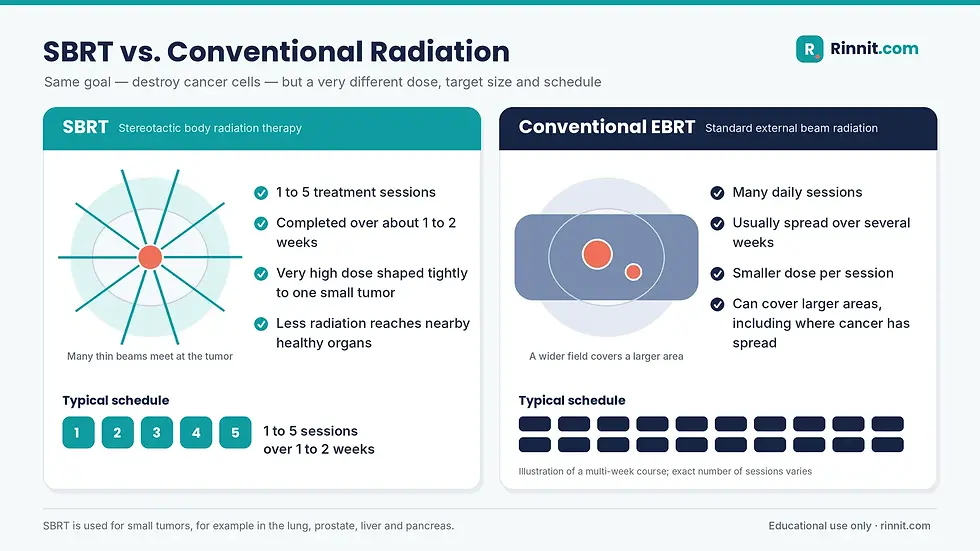
Feature | SBRT | Conventional EBRT (often uses IMRT) |
Target size | Select small tumors only | Can cover larger areas, including where cancer has spread |
Dose per session | Very high | Lower |
Number of sessions | 1 to 5 | Many |
Total time | About 1 to 2 weeks | Several weeks |
Source: [1]
Some people receive SBRT, some receive IMRT, and some receive both. Ask your care team why they recommend a specific option for you.
How do you prepare for SBRT?
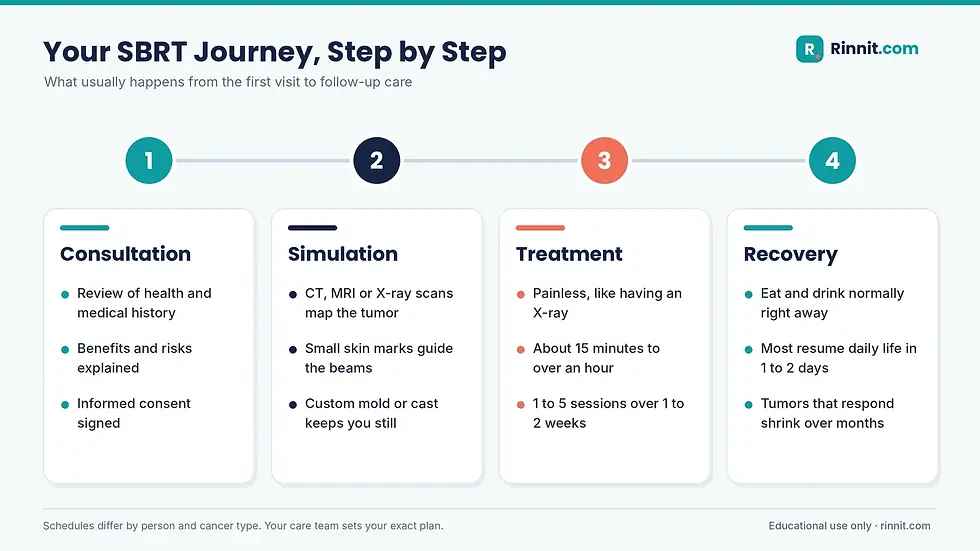
You prepare for SBRT by reviewing your health with your care team, signing a consent form and following their instructions on fasting, medicines, clothing and timing. [1]
Before treatment, your team will tell you: [1]
Whether to bring someone. Most people can drive themselves home, but a loved one can offer support.
Whether to fast or take medicines. You may need to stop eating and drinking the night before. Some people take anti-nausea, anti-inflammatory (NSAIDs) or anti-anxiety medicine beforehand.
What to wear. Choose comfortable clothes that are easy to change. You may be asked to leave wigs, jewelry, glasses and dentures at home.
How long it will take. Sessions typically last 15 minutes to more than an hour.
How to manage anxiety. Waiting for treatment is stressful. A book or puzzle can help, and your team may offer medicine if needed.
What happens during SBRT treatment simulation?
SBRT treatment simulation is a planning visit before your first real treatment, where your team maps the tumor with scans and designs your plan. [1]
Simulation step | Why it matters |
Imaging tests (CT, MRI, X-ray) | Pinpoint the tumor's exact location so the machine can be programmed to aim small beams at it |
Positioning | Your team decides how you will lie on the table and may place small marks on your skin to guide the beams |
Molds or casts | A custom immobilization device helps you stay still and in the same position for every session |
Source: [1]
Tell your team if a position feels uncomfortable or if staying still makes you anxious. They can adjust things to help.
What happens during and after SBRT?
During SBRT, you lie still on a table while a machine moves around you and delivers many small, high-dose beams, which feels much like having an X-ray and does not hurt. [1]
During a session
You lie on the treatment table in the exact position used during simulation.
Technicians run the machine from a nearby room, supervised by your radiation oncologist. They watch you on a screen and can talk to you over an intercom.
The machine delivers the radiation. A large arm moves around you at different angles. It sends many small, high-dose beams shaped to match your tumor.
You will not feel anything, though you may hear the machine move. You can ask to stop at any time if you feel anxious. [1]
After a session
The technicians help you off the table. Depending on your plan, this may be your only session, or you may return for a few more. Most plans involve 1 to 5 sessions over 1 to 2 weeks. Tumors that respond well usually shrink over the next few months. [1]
What are the side effects of SBRT?
The side effects of SBRT depend on the area treated and your overall health, and most are short-term. [1]

Area treated | Possible side effects | What helps |
Lung | Many people feel nothing unusual. Some notice tiredness, a mild cough or coughing up phlegm in the first weeks. | Report any sudden or unexpected breathing changes right away |
Prostate | Urgent or more frequent need to urinate; bowel changes, including timing, frequency or pain with bowel movements | Your team can suggest ways to manage these short-term changes |
Liver or pancreas | Nausea and diarrhea | Medicines and diet changes can reduce their impact on daily life |
Source: [1]
Rare long-term risks
In rare cases, SBRT can cause long-term effects if radiation damages healthy tissue. The effects depend on which organ was exposed, and SBRT's precision is designed to keep this risk low. [1]
All radiation therapy carries a very small risk of causing a new cancer later. SBRT limits radiation to healthy organs, and your team will check you regularly for new or returning cancer. [1]
What are the benefits of SBRT?
The main benefits of SBRT are precise tumor targeting without surgery, fewer treatment visits and a quick return to daily life. [1]
Precision: Targets tumors while limiting radiation to nearby organs and tissue.
No surgery: Treats tumors with near-surgical accuracy, without incisions.
Fewer visits: Needs fewer treatments than conventional radiation, which may lower the risk of side effects.
Quick recovery: Most people resume work and daily activities within 1 to 2 days.
An option when surgery is not: Helpful for people whose health makes an operation risky.
How successful is SBRT?
SBRT is an effective treatment for some cancers and can control some early-stage lung and prostate cancers about as well as surgery. For some people with cancer that has spread, it offers a noninvasive way to slow tumor growth. [1]
Results depend on the cancer type, tumor size, stage and your overall health. Not everyone benefits from SBRT, so it is worth discussing all options with your care team. [1]
How long is recovery after SBRT?
Recovery after SBRT is usually fast, and most people return to work and daily activities within 1 to 2 days. [1]
Eating and drinking: You can return to your normal diet right after treatment.
Work and daily life: Most people return within 1 to 2 days.
Follow-up: You will have regular check-ups to see how the tumor is responding and to discuss any side effects.
When should you call a doctor after SBRT?
Call your doctor after SBRT if your side effects are different from what you expected, and get help right away if you suddenly feel short of breath after SBRT for lung cancer. [1]
Conclusion
SBRT is a precise, noninvasive way to treat small, isolated tumors in the lungs, prostate, liver and pancreas. It packs a full course of radiation into just 1 to 5 sessions, protects nearby organs and lets most people return to daily life within a day or two.
It is not right for every person or every tumor. The best choice depends on your cancer and your health, so talk openly with your care team about SBRT, surgery and other options.
Want clear, doctor-reviewed answers about your treatment options? Explore more of our cancer guides on Rinnit.com, and save this article to bring your questions to your next appointment.
FAQ
What does SBRT stand for?
SBRT stands for stereotactic body radiation therapy. It is also called stereotactic ablative radiotherapy (SABR).
How many sessions of SBRT will I need?
Most people need 1 to 5 sessions of SBRT, completed over about 1 to 2 weeks.
Does SBRT hurt?
No, SBRT does not hurt. It is painless and feels similar to having an X-ray; you may hear the machine move, but you will not feel the radiation.
How long does each SBRT session take?
Each SBRT session typically lasts from about 15 minutes to more than an hour, depending on your treatment plan.
Can I drive home after SBRT?
Most people can drive themselves home after SBRT. Bringing a loved one for support is still a good idea.
What is the recovery time after SBRT?
Most people return to work and daily activities within 1 to 2 days after SBRT. You can eat and drink normally right after treatment.
What are the most common side effects of SBRT?
The most common side effects of SBRT depend on the area treated. Lung SBRT may cause tiredness and a mild cough, prostate SBRT may cause urinary urgency and bowel changes, and liver or pancreas SBRT may cause nausea and diarrhea.
Is SBRT as effective as surgery?
For some early-stage lung and prostate cancers, SBRT can control the tumor about as well as surgery. Your care team will compare both options based on your cancer and overall health.
What is the difference between SBRT and IMRT?
SBRT and IMRT are both external beam radiation, but SBRT uses stronger doses on select small tumors over 1 to 5 sessions. IMRT is usually part of conventional radiation, treats larger areas and takes several weeks.
When will I know if SBRT worked?
You will usually know if SBRT worked over the next few months, as tumors that respond well shrink. Your follow-up scans and visits will show how the tumor is responding.
Related reading
External Beam Radiation Therapy (EBRT): Types and What to Expect explains external beam radiation for cancer.
References
Cleveland Clinic. Stereotactic Body Radiation Therapy (SBRT). Cleveland Clinic. Last updated June 19, 2024. https://my.clevelandclinic.org/health/treatments/22298-stereotactic-body-radiation-therapy-sbrt
National Cancer Institute. External Beam Radiation Therapy for Cancer. National Cancer Institute (cancer.gov). Last updated May 15, 2025. https://www.cancer.gov/about-cancer/treatment/types/radiation-therapy/external-beam
Viani GA, Gouveia AG, Yan M, et al. Stereotactic body radiotherapy versus surgery for early-stage non-small cell lung cancer: an updated meta-analysis involving 29,511 patients included in comparative studies. J Bras Pneumol. 2022;48(3):e20210390. PMID 35508065. https://doi.org/10.36416/1806-3756/e20210390
van As N, Griffin C, Tree A, et al. Phase 3 Trial of Stereotactic Body Radiotherapy in Localized Prostate Cancer. N Engl J Med. 2024;391(15):1413-1425. PMID 39413377. https://doi.org/10.1056/NEJMoa2403365
Palma DA, Olson R, Harrow S, et al. Stereotactic Ablative Radiotherapy for the Comprehensive Treatment of Oligometastatic Cancers: Long-Term Results of the SABR-COMET Phase II Randomized Trial. J Clin Oncol. 2020;38(25):2830-2838. PMID 32484754. https://doi.org/10.1200/JCO.20.00818
Medical disclaimer
This article is for educational purposes only and does not replace advice from your oncologist or another qualified healthcare provider. Decisions about SBRT should be made with a care team that knows your cancer and medical history. If you suddenly feel short of breath after treatment, seek medical care right away.



Comments