Pancreas: Function, Location, Anatomy and Common Conditions

Updated: 3 days ago
Medically reviewed by Dr. Baraa Alnahhal, MD · Last reviewed: October 2026
Quick Answer: What does the pancreas do?
The pancreas has two main jobs: it helps digest food and helps regulate blood sugar. It sends digestive juice through ducts into the duodenum and makes hormones such as insulin and glucagon. Insulin helps lower blood sugar when it is too high, while glucagon helps raise it when it is too low. [1]
Pancreatic role | What it means |
Digestive, or exocrine, function | The pancreas makes enzyme-rich juice that helps break down food in the duodenum. |
Hormonal, or endocrine, function | The pancreas makes hormones that help control blood sugar. |
Insulin production | Insulin helps lower blood sugar when it is too high. |
Glucagon production | Glucagon helps raise blood sugar when it is too low. |
What the research says
Smoking raises pancreatic cancer risk, and quitting lowers it over time. A meta-analysis of 78 epidemiological studies found a pooled relative risk of pancreatic cancer of 1.8 (95% CI 1.7–1.9) for current smokers and 1.2 (95% CI 1.1–1.2) for former smokers, compared with never smokers. Risk rose sharply even with a low number of cigarettes and fell with time since quitting, reaching 0.6 (95% CI 0.5–0.7) compared with current smokers after 20 years, although it took almost 20 years to approach the risk of never smokers (Lugo et al., Eur J Cancer, 2018). [2]
The cause of pancreatitis affects the chance that it comes back. A systematic review and meta-analysis of 57,815 patients in 42 studies found a 19.8% (95% CI 17.5–22.1%) risk of recurrent pancreatitis after a first episode of acute pancreatitis. The risk was 11.9% after gallstone pancreatitis, 28.7% after alcohol-induced pancreatitis and 6.6% after cholecystectomy following gallstone pancreatitis (Hajibandeh et al., J Gastroenterol Hepatol, 2023). [3]

What is the pancreas?
The pancreas is a large gland in the back of the abdomen. It is part of both the digestive system and the endocrine system. It is a dual organ with two production lines: enzymes for digestion and hormones for blood-sugar control. [1]
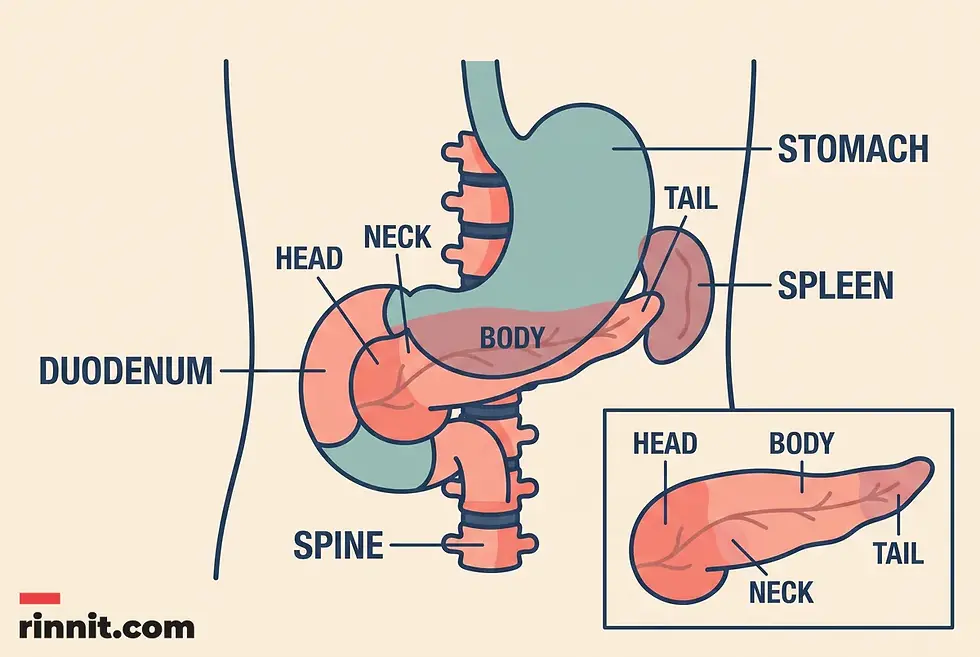
The pancreas is about the length of a hand and has a fish-like or tadpole-like shape. Its thicker end is connected to the first part of the small intestine, while its thinner end extends toward the spleen. [1]
How does the pancreas help digestion?
The pancreas makes enzyme-rich digestive juice. It makes about 1 to 4 liters each day, with the exact amount varying according to how much food a person eats. [1]
After food enters the stomach, pancreatic juice moves through small ducts into the main pancreatic duct. That duct connects with the bile duct. Bile from the liver and gallbladder and pancreatic juice then enter the duodenum, the first part of the small intestine, where they help break down food. [1]
Digestive step | Description |
1. Pancreatic juice forms | The pancreas makes enzyme-rich juice. |
2. Small ducts carry the juice | The juice moves through small ducts into the main pancreatic duct. |
3. The ducts connect | The main pancreatic duct connects with the bile duct. |
4. Fluids reach the duodenum | Bile and pancreatic juice enter the duodenum to help break down food. |

How does the pancreas regulate blood sugar?
The pancreas makes hormones such as insulin and glucagon. When blood sugar is too high, insulin helps lower it. When blood sugar is too low, glucagon helps increase it. [1]
Balanced blood sugar helps the body function properly and supports organs such as the heart, liver, kidneys and brain.
Where is the pancreas located?
The pancreas is behind the stomach and in front of the spine. The gallbladder, liver and spleen surround it. Because the pancreas is deep in the abdomen, it can be difficult to evaluate through physical examination alone. [1]
The head of the pancreas is on the right side of the body, beside the curve of the duodenum. The tail extends toward the left side, near the spleen. [1]
Pancreatic area | Location or description |
Head | The wider portion in the curve of the duodenum, on the right side. |
Neck | The short portion extending from the head. |
Body | The middle portion between the head and tail, extending upward. |
Tail | The thinnest portion near the spleen, on the left side. |
What does the pancreas look like and how much does it weigh?
The pancreas resembles a tadpole: thick at one end and thin at the other. Its outer texture is described as bumpy, like a cob of corn. It is around 6 inches long, approximately the length of a hand. [1]
An average healthy pancreas weighs about 91.8 grams, or 0.20 pounds, roughly comparable to a deck of playing cards. These are general descriptions rather than a way to interpret an individual scan or examination. [1]
Which conditions can affect the pancreas?
Type 1 diabetes, type 2 diabetes, hyperglycemia, hypoglycemia, pancreatitis and pancreatic cancer are among the disorders that can affect the pancreas. [1]
Condition | Description |
Type 1 diabetes | The pancreas does not produce insulin. |
Type 2 diabetes | The body makes insulin but does not use it correctly. |
Hyperglycemia | High blood sugar, usually because the body has too little insulin or cannot use insulin well. |
Hypoglycemia | Too much insulin causes low blood sugar. |
Enzymes begin working in the pancreas before reaching the duodenum; gallstones or alcohol use disorder may contribute, and the condition may be temporary or chronic. | |
Pancreatic cancer | Cancerous cells in the pancreas cause pancreatic cancer, which can be difficult to detect and treat. |
This list is not a self-diagnosis tool. A symptom or test result must be interpreted with a healthcare professional because different conditions can overlap.
What symptoms can happen with pancreatic conditions?
Possible symptoms of pancreatic conditions include abdominal pain, back pain, blurred vision, dark urine, light-colored or greasy stools, fatigue, extreme thirst, frequent urination, nausea or vomiting, tingling in the hands or feet, unexplained weight loss and jaundice, which is yellowing of the eyes and skin. [1]
Possible symptom | Why it may matter in a pancreatic-health discussion |
Abdominal or back pain | Pain may occur with a pancreatic condition. |
Nausea or vomiting | Digestive symptoms that may occur with pancreatic conditions. |
Dark urine or light-colored, greasy stools | Changes in urine or stool appearance. |
Jaundice | Yellowing of the eyes and skin. |
Fatigue or unexplained weight loss | General symptoms that may occur. |
Extreme thirst or frequent urination | Symptoms associated with blood-sugar disturbance. |
Blurred vision or tingling in the hands or feet | Other possible symptoms. |
These symptoms can have causes unrelated to the pancreas. New, persistent or concerning symptoms should be discussed with a healthcare professional rather than interpreted from a list alone.
How is the pancreas checked?
Because the pancreas sits deep in the abdomen, a healthcare professional may use tests in addition to a physical examination. These include imaging, blood testing and pancreatic-function tests. [1]
Test or evaluation | Purpose or description |
Physical examination | May be part of the evaluation, although the pancreas is difficult to examine directly because it is deep in the abdomen. |
Abdominal or endoscopic ultrasound | Imaging tests that may help evaluate the pancreas. |
Angiography | A vascular imaging test that may be used. |
Blood tests | May help assess pancreatic health. |
CT scan | An imaging test that may be used. |
ERCP or MRCP | Procedures or imaging approaches for evaluating the pancreatic and biliary systems. |
MRI | An imaging test that may be used. |
Fecal elastase test | Helps determine whether the pancreas makes enough digestive enzymes. |
Secretin pancreatic-function test | Measures the pancreas's ability to respond to secretin, a type of hormone. |
Surgery | May be used to look for issues in the pancreas. |
The appropriate tests depend on the clinical question. Results should be explained by the healthcare professional who ordered them.
How are pancreatic conditions treated?
Treatment depends on the condition. Insulin is needed for type 1 diabetes and is used for some people with type 2 diabetes, along with other medicines and lifestyle changes; chemotherapy, radiation and surgery for pancreatic cancer; and dietary changes, medications and sometimes surgery for pancreatitis. [1]
Some people may need a pancreas transplant or pancreatectomy, which is surgical removal of some or all of the pancreas. Less commonly, islet cells may be transplanted into the liver to help maintain insulin function. [1]
Condition or situation | Treatment examples |
Diabetes | Insulin replacement. |
Pancreatic cancer | Chemotherapy, radiation and surgery. |
Pancreatitis | Dietary changes, medications and sometimes surgery. |
Severe or complex pancreatic disease | In some cases, pancreas transplant or pancreatectomy. |
Maintaining insulin function after pancreatic surgery | Less commonly, islet-cell transplantation into the liver. |
These examples are not individualized treatment recommendations. Treatment choices depend on the diagnosis, overall health, risks and clinical goals.
Can a person live without a pancreas?
Yes, a person can live without a pancreas. Someone without a pancreas would need enzyme pills to digest food and insulin shots to control blood sugar for the rest of life. [1]
Complete removal is rare. Pancreatic cancer, major pancreatic injury and severe pancreatitis are situations in which surgeons may remove the entire pancreas. [1]
How can you support pancreatic health?
You can support pancreatic health by keeping a healthy weight, exercising regularly, choosing low-fat foods, watching alcohol intake, quitting smoking and getting regular checkups. [1]
Regular exercise and reducing excess weight can help prevent type 2 diabetes and gallstones that can cause pancreatitis. High-fat foods can lead to gallstones, obesity is a risk factor for pancreatic cancer, alcohol can increase the risk of pancreatitis and pancreatic cancer, and tobacco use can raise the risk of pancreatic cancer and chronic pancreatitis.
Care area | Rationale |
Weight and activity | A healthy weight and regular exercise may help prevent type 2 diabetes and gallstones. |
Food choices | Foods low in fat may reduce gallstone risk. |
Alcohol | Drinking alcohol may increase the risk of pancreatitis and pancreatic cancer. |
Tobacco | Tobacco, cigar smoking and smokeless tobacco may raise the risk of pancreatic cancer and chronic pancreatitis. |
Checkups | Regular exams may help find early signs of conditions such as pancreatic cancer and pancreatitis. |
These are general care areas, not a personalized prevention plan. A healthcare professional can help tailor decisions to your health and circumstances.
When should you contact a healthcare professional?
Contact a healthcare professional about new, persistent or concerning abdominal or back pain, jaundice, unexplained weight loss, repeated nausea or vomiting, unusual urine or stool changes, extreme thirst, frequent urination or other symptoms listed above. Pancreatic disease can be difficult to detect because of the organ's location.
Seek urgent medical assessment for severe or rapidly worsening symptoms. Get emergency care right away for sudden, severe upper belly pain that may spread to the back, especially with vomiting, fever, a fast heartbeat or yellowing of the skin or eyes, because these can be signs of acute pancreatitis or a blocked bile duct.
Conclusion: The pancreas has two essential jobs
The pancreas is a deep abdominal gland with both digestive and endocrine functions. It sends enzyme-rich juice into the duodenum to help break down food and makes insulin and glucagon to help regulate blood sugar. Its head, neck, body and tail sit near the stomach, duodenum, spleen and spine.
Because pancreatic conditions can cause symptoms that overlap with other health problems, a clear care conversation matters. Use this guide to prepare questions about symptoms, tests, treatment options and risk reduction, then ask a qualified healthcare professional to interpret your individual situation. Information is a starting point for better care, not a substitute for medical evaluation.
Frequently Asked Questions
What are the two main functions of the pancreas?
The pancreas helps digest food by making enzyme-rich juice and helps regulate blood sugar by making hormones such as insulin and glucagon.
Where is the pancreas located?
The pancreas is behind the stomach and in front of the spine. Its head is on the right near the duodenum, and its tail extends toward the spleen on the left.
What hormones does the pancreas make?
The pancreas makes insulin and glucagon. Insulin helps lower high blood sugar, while glucagon helps raise low blood sugar.
What is pancreatitis?
Pancreatitis occurs when enzymes begin working in the pancreas before reaching the duodenum. It may result from gallstones or alcohol use disorder and may be temporary or chronic.
What symptoms may be associated with a pancreatic condition?
Possible symptoms include abdominal or back pain, nausea or vomiting, jaundice, unexplained weight loss, fatigue, dark urine, light-colored or greasy stools, extreme thirst, frequent urination, blurred vision and tingling in the hands or feet.
What tests can check the pancreas?
Tests include ultrasound, endoscopic ultrasound, angiography, blood tests, CT, ERCP, MRCP, MRI, fecal elastase testing and a secretin pancreatic-function test.
Can someone live without a pancreas?
Yes. A person without a pancreas would need enzyme pills for digestion and insulin shots for blood-sugar control for the rest of life.
What is a pancreatectomy?
A pancreatectomy is surgical removal of some or all of the pancreas. Some people may need it, and complete removal is rare.
Can pancreatic conditions cause jaundice?
Jaundice, or yellowing of the eyes and skin, is a possible symptom of pancreatic conditions.
What habits may support pancreatic health?
Maintaining a healthy weight for you, exercising regularly, eating foods low in fat, watching alcohol intake, quitting smoking and getting regular checkups may help support pancreatic health.
Related Reading
Pancreas Ultrasound: Abdominal vs Endoscopic Ultrasound, Prep and Results explains the abdominal and endoscopic ultrasound scans of the pancreas.
Pancreas Blood Test: Amylase and Lipase for Pancreatitis explains the amylase and lipase blood tests used to diagnose pancreatitis.
Amylase Test: Blood and Urine Amylase, Normal Range and Results explains the blood and urine test for the digestive enzyme amylase.
References
Cleveland Clinic. Pancreas: Function, Location, Anatomy & Living Without One. Cleveland Clinic. Updated February 26, 2024. https://my.clevelandclinic.org/health/body/21743-pancreas
Lugo A, Peveri G, Bosetti C, et al. Strong excess risk of pancreatic cancer for low frequency and duration of cigarette smoking: A comprehensive review and meta-analysis. Eur J Cancer. 2018;104:117-126. PMID 30347287. https://doi.org/10.1016/j.ejca.2018.09.007
Hajibandeh S, Jurdon R, Heaton E, et al. The risk of recurrent pancreatitis after first episode of acute pancreatitis in relation to etiology and severity of disease: A systematic review, meta-analysis and meta-regression analysis. J Gastroenterol Hepatol. 2023;38(10):1718-1733. PMID 37366550. https://doi.org/10.1111/jgh.16264
Disclaimer
This article is for general educational purposes and is not a substitute for professional medical advice, diagnosis or treatment. Always seek the advice of a qualified healthcare professional with any questions about a medical condition or treatment.



Comments