Pancreas Ultrasound: Abdominal vs Endoscopic Ultrasound, Prep and Results

Updated: 2 days ago
Written and medically reviewed by Dr. Baraa Alnahhal, MD · Last reviewed: November 2026 · How we review
Quick Answer
A pancreas ultrasound is an imaging test that uses sound waves to create images of the pancreas and nearby organs. It helps find pancreatitis, pancreatic cysts and tumors. The two types are a transabdominal ultrasound and an endoscopic ultrasound (EUS), which gives clearer images and allows a biopsy. You'll need to fast beforehand.
What the research says
EUS biopsy is highly accurate for pancreatic tumors: a meta-analysis of fine-needle aspiration during endoscopic ultrasound found it identified cancer in solid pancreatic masses with 85% sensitivity and 98% specificity, rising to 91% sensitivity when suspicious results were counted (Hewitt MJ et al., Gastrointestinal Endoscopy, 2012) [2]
EUS and CT are similar for judging surgery: a meta-analysis comparing endoscopic ultrasound with CT for deciding whether pancreatic cancer could be removed surgically found both had a sensitivity of 87%, with specificity of 63% for EUS and 70% for CT, so the tests are often used together (Rahman MIO et al., Saudi Journal of Gastroenterology, 2020) [3]
Key takeaways
Uses sound waves to image the pancreas; no radiation.
Two types: transabdominal (on the belly) and endoscopic (EUS, through the mouth).
Fast for several hours before abdominal ultrasound, usually overnight before EUS.
EUS gives clearer images and allows a biopsy, but needs sedation and a ride home.
Results may be ready the same day or in a few days.
Why is it done?
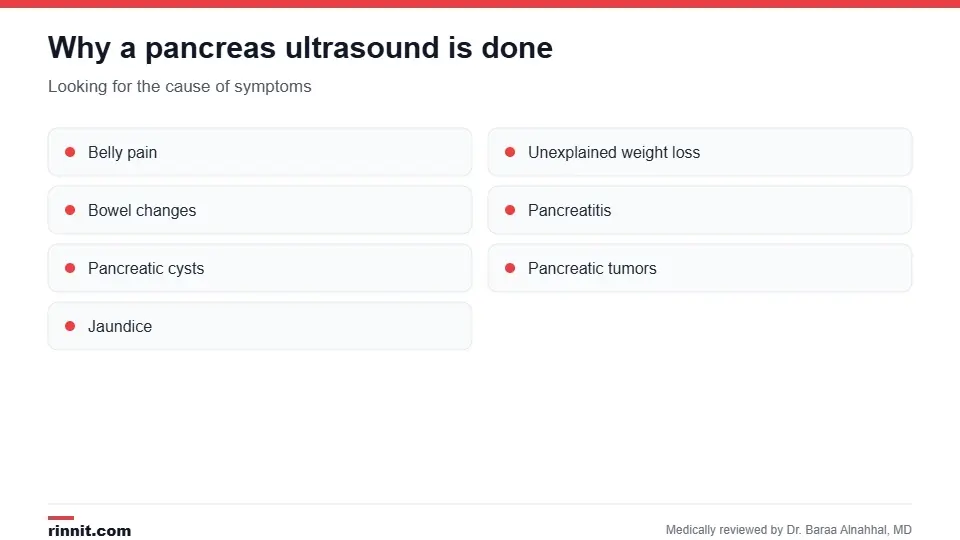
A pancreas ultrasound looks for the cause of symptoms.
Upper belly pain, unexplained weight loss or changes in bowel movements.
Suspected pancreatitis or its complications, such as pseudocysts.
Evaluating pancreatic cysts or a mass seen on a CT scan.
Diagnosing and staging pancreatic cancer, often with a biopsy.
Looking for gallstones or bile duct problems that can cause gallstone pancreatitis or jaundice. Sources: [1]
It's often ordered alongside blood tests such as lipase. Sources: [1]
Two types of pancreas ultrasound

EUS gives clearer images and allows a biopsy.
Feature | Abdominal ultrasound | Endoscopic ultrasound (EUS) |
How it's done | Probe moved over the upper belly | Scope passed through the mouth to the duodenum |
Sedation | None | Yes |
Time | Under 30 minutes | Up to 90 minutes including recovery |
Image quality | Can be blocked by gas or body fat | Clearer, close-up images |
Biopsy | No | Yes, with a fine needle |
Sources: [1]
The pancreas sits deep behind the stomach, so a regular abdominal ultrasound can't always see it fully. Endoscopic ultrasound places the probe right next to the pancreas. Sources: [1]
How do I prepare?
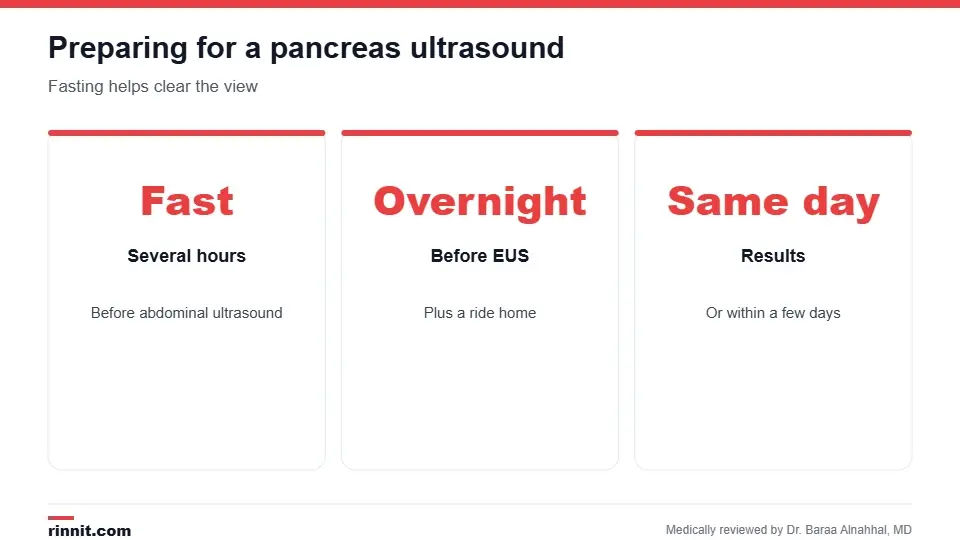
Fasting helps give a clearer view.
Abdominal ultrasound: don't eat for several hours beforehand, since food and gas block sound waves.
EUS: usually fast overnight, review your medicines, especially blood thinners and diabetes medicines, and arrange a ride home. Sources: [1]
What happens during the test?
Abdominal ultrasound: you lie on a table, gel is applied to your upper belly and a technologist moves a probe over the area; you can go home right away.
EUS: you change into a gown, get an IV and sedation, the scope is passed through your mouth and stomach into the duodenum, images and any samples are taken, and you rest about 30 minutes until the sedation wears off. Sources: [1]
Risks
Abdominal ultrasound is safe and painless. EUS carries small risks related to sedation and the scope, such as a sore throat, bleeding, infection, rarely pancreatitis after a biopsy, or a tear in the digestive tract. Sources: [1]
Understanding your results
Results may be available the same day or take several days, especially if a biopsy was taken. If images are unclear, your provider may order a CT, MRI, MRCP or blood tests. Sources: [1, 2, 3]
Conclusion
A pancreas ultrasound is a safe way to look at this hard-to-see organ. A belly ultrasound is quick and simple, while EUS gives a much closer view and can take a biopsy, making it a key test for pancreatic cysts and cancer.
Keep learning: read about pancreatitis and the endoscopic ultrasound.
Frequently asked questions
What does a pancreas ultrasound show?
The pancreas and nearby organs, including inflammation, cysts and tumors.
What are the two types?
Abdominal ultrasound and endoscopic ultrasound (EUS).
Do I need to fast?
Yes, for several hours before abdominal ultrasound and usually overnight before EUS.
Does it hurt?
Abdominal ultrasound is painless; EUS is done under sedation.
How long does it take?
Under 30 minutes for abdominal ultrasound; up to 90 minutes for EUS.
Can ultrasound detect pancreatic cancer?
It can find masses; EUS with biopsy can confirm cancer.
Why can't a regular ultrasound always see the pancreas?
The pancreas lies deep, and gas or fat can block the view.
Is there radiation?
No. Ultrasound uses sound waves.
Can I drive after EUS?
No. You'll need a ride because of sedation.
When will I get results?
The same day or within a few days.
Related Reading
Pancreatitis: Symptoms, Causes, and Treatment — A Clear Guide to Understanding and Managing the Condition inflammation a pancreas ultrasound can show.
Pancreatic Cancer: Symptoms, Causes, and Treatment — A Clear Guide for Patients and Families a cancer diagnosed with EUS and biopsy.
Understanding Pancreatic Cysts: Types, Symptoms, and Management fluid-filled growths found on ultrasound.
Endoscopic Ultrasound (EUS): Uses, Procedure, Recovery and Risks the scope-based ultrasound of the digestive tract.
Pancreas: Function, Location, Anatomy and Common Conditions how the pancreas works.
References
Cleveland Clinic. Pancreatic Ultrasound: Procedure Details & Results. Cleveland Clinic. Last updated March 10, 2026. https://my.clevelandclinic.org/health/diagnostics/pancreatic-ultrasound
Hewitt MJ, McPhail MJ, Possamai L, et al. EUS-guided FNA for diagnosis of solid pancreatic neoplasms: a meta-analysis. Gastrointest Endosc. 2012;75(2):319-331. PMID 22248600. https://doi.org/10.1016/j.gie.2011.08.049
Rahman MIO, Chan BPH, Far PM, et al. Endoscopic ultrasound versus computed tomography in determining the resectability of pancreatic cancer: a diagnostic test accuracy meta-analysis. Saudi J Gastroenterol. 2020;26(3):113-119. PMID 32436866. https://doi.org/10.4103/sjg.SJG_39_20
Medical disclaimer
This article is for general education only and does not replace advice from a qualified healthcare professional. Talk to your doctor about your own diagnosis and treatment, and seek emergency care right away for severe or sudden symptoms.



Comments