Abdominal Ultrasound: Why It's Done, How to Prepare, What to Expect and Results

Updated: 2 days ago
Written and medically reviewed by Dr. Baraa Alnahhal, MD · Last reviewed: November 2026 · How we review
Quick Answer: What is an abdominal ultrasound?
An abdominal ultrasound is an imaging test that uses sound waves to make pictures of the organs and blood vessels in the belly. It helps find the cause of belly pain and can show gallstones, kidney stones, fatty liver disease and an abdominal aortic aneurysm. It takes 30 minutes and uses no radiation. You may need to fast beforehand.
What the research says
Bedside ultrasound is very good at finding gallstones. A meta-analysis of 7 studies with 1,464 people found that point-of-care ultrasound detected gallstones with a pooled sensitivity of 94% and specificity of 93%. For gallbladder disease overall, sensitivity was 86% and specificity 92%. (Wu et al., Academic Radiology, 2024) [2]
Ultrasound is a useful first test for an inflamed gallbladder. A systematic review of 40 studies with 8,652 patients found ultrasound diagnosed acute cholecystitis with a pooled sensitivity of 71%, specificity of 85% and accuracy of 0.83, and scans by emergency physicians performed about as well as scans by radiologists. (Huang et al., World Journal of Emergency Surgery, 2023) [3]
Ultrasound screening lowers deaths from aortic aneurysm in older men. A Cochrane review of 4 trials with 127,891 men and 9,342 women found screening cut deaths from abdominal aortic aneurysm in men aged 65 to 79 (odds ratio 0.60) and lowered aneurysm rupture, but showed no clear benefit for women. (Cosford and Leng, Cochrane Database of Systematic Reviews, 2007) [4]
Key takeaways
An abdominal ultrasound uses sound waves, not radiation, to make pictures of the organs and blood vessels in your belly [1].
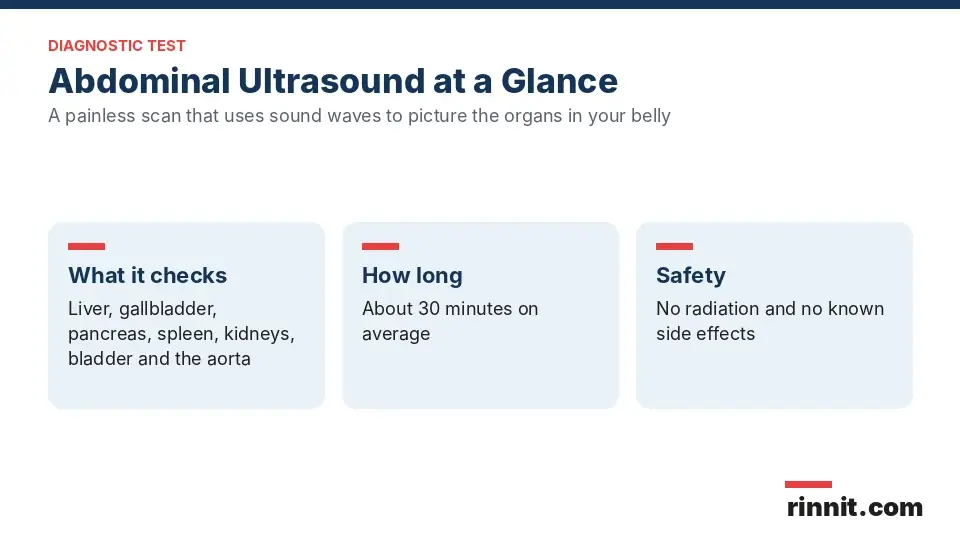
It can check the liver, gallbladder, pancreas, spleen, kidneys, bladder, aorta and inferior vena cava [1].
It helps find the cause of belly pain and can show gallstones, kidney stones, fatty liver disease, an aortic aneurysm and some tumors [1].
You may be asked to fast or drink water before the test, so follow your provider's instructions [1].
The test usually takes about 30 minutes and has no known side effects [1].
A radiologist usually reports the results to your primary care provider within about a week, or right away in an emergency [1].
What is an abdominal ultrasound?
An abdominal ultrasound is an imaging test that uses high-frequency sound waves to create pictures of the organs and blood vessels in your abdomen, or belly [1]. The word ultrasound refers to the test itself, while sonogram refers to the picture it produces [1].
Because it uses sound waves you cannot hear, the test is safe and noninvasive [1]. It is one of the most common ways to look at soft tissues in the belly without surgery or radiation [1].
What an abdominal ultrasound can look at
A complete abdominal ultrasound examines several organs and vessels in one visit [1]:
The most common reason for any ultrasound of the abdomen is to check a developing baby during pregnancy, which is called a prenatal ultrasound [1]. This article focuses on ultrasound of the belly organs.
Why you might need an abdominal ultrasound
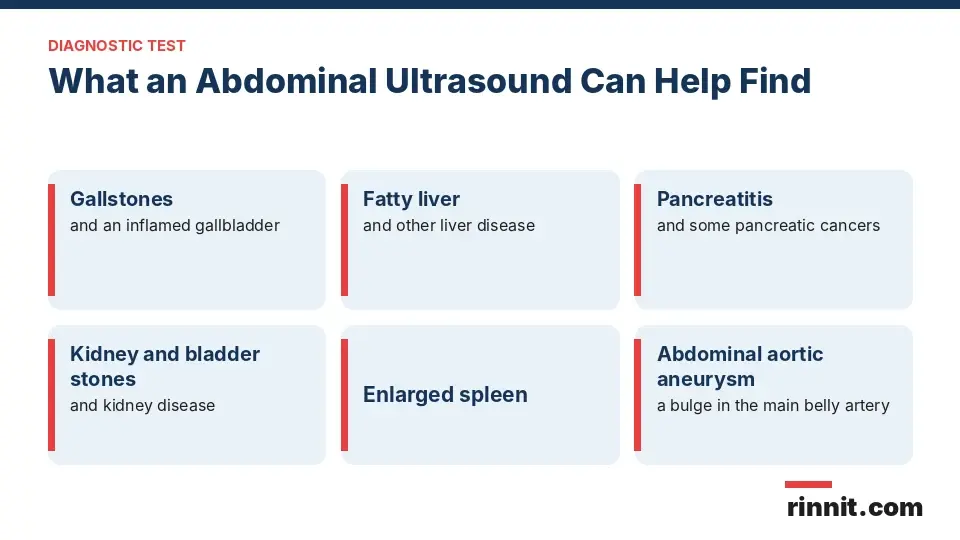
Your provider may order an abdominal ultrasound to find the cause of unexplained belly pain or to look more closely at a specific organ [1]. The table below lists conditions the test can help diagnose.
Organ or area | Conditions an ultrasound can help find |
Gallbladder | Gallstones and cholecystitis (an inflamed gallbladder) [1] |
Liver | Liver disease and fatty liver disease [1] |
Pancreas | Pancreatitis and some cancers, such as pancreatic cancer [1] |
Kidneys and bladder | Kidney stones, bladder stones, kidney disease and kidney cancer [1] |
Spleen | An enlarged spleen [1] |
Aorta | Abdominal aortic aneurysm, a bulge in the main artery in the belly [1] |
Anywhere in the belly | Abdominal cysts or tumors [1] |
Sources: [1]
How an abdominal ultrasound works
A provider moves a handheld wand called a transducer over your belly [1]. The machine sends sound waves that bounce off your organs, blood vessels and soft tissue, and a computer turns those echoes into pictures [1].
If your provider needs to check blood flow in your vessels, the test may include a Doppler ultrasound, which shows how blood moves inside the vessels [1].
How to prepare for an abdominal ultrasound
Preparation depends on why you are having the test, so follow your provider's instructions closely for the most accurate results [1]. Depending on your case, you may be asked to:
Fasting matters because a full or empty bladder or stomach can sometimes blur the images [1]. Your provider may ask you to fast for 8 hours, although small sips of water to take your daily medicines are usually fine [1]. Check with your provider about what to do in the hours before your appointment [1].
What happens during an abdominal ultrasound
You lie on your back on an exam table and either pull up your shirt or change into a hospital gown [1]. Then the test follows a few simple steps:
Gel: The provider spreads a gel on your belly. It may feel cold, but it is harmless and will not stain your clothes [1].
Scanning: The provider moves the transducer back and forth over your skin until the areas of concern show clearly [1].
Instructions: You may be asked to roll onto one side or hold your breath for a few seconds [1].
Clean-up: The provider wipes off the remaining gel when the scan is finished [1].

How long does it take?
An abdominal ultrasound usually takes about 30 minutes on average, although it can take more or less time [1].
Is an abdominal ultrasound safe?
Yes. Ultrasound is a safe and accurate test [1]. Unlike X-rays, it does not use radiation, and it has no known side effects [1].
Abdominal ultrasound results
A radiologist, a doctor who specializes in reading medical images, reviews the pictures and writes a report for your primary care provider [1]. In most cases this takes about a week or less [1]. If an urgent problem is suspected, results may be available right away [1].
Your provider will explain what the images show and whether you need any other tests or treatment.
Questions to ask your provider
Conclusion
An abdominal ultrasound is a quick, painless and radiation-free way to look at the organs and blood vessels in your belly. It can help explain belly pain and find problems such as gallstones, kidney stones, fatty liver disease or an aortic aneurysm.
Follow your provider's instructions about fasting or drinking water before the test, and ask when and how you will get your results.
Keep learning: Read our overview of how ultrasound works and its types, our guide to Doppler ultrasound or our guide to the CT scan. For more background, see the RadiologyInfo guide to the abdominal ultrasound exam.
FAQ
What is an abdominal ultrasound?
It is an imaging test that uses sound waves to make pictures of the organs and blood vessels in your belly.
What organs does an abdominal ultrasound check?
It can check the liver, gallbladder, pancreas, spleen, kidneys, bladder, aorta and inferior vena cava.
What can an abdominal ultrasound detect?
It can help find gallstones, kidney stones, fatty liver disease, pancreatitis, an enlarged spleen, an aortic aneurysm, cysts and some tumors.
Why would a doctor order an abdominal ultrasound?
Most often to find the cause of unexplained belly pain or to look closely at an organ such as the gallbladder or liver.
Do I need to fast before an abdominal ultrasound?
You may. Some people are asked to fast for about 8 hours, because food or drink can blur the images. Follow your provider's instructions.
Can I drink water before an abdominal ultrasound?
Small sips of water to take daily medicines are usually fine, but ask your provider, since some tests need fasting and others need a full bladder.
Does an abdominal ultrasound hurt?
No. The gel may feel cold, and you may be asked to change position or hold your breath, but the test is painless.
How long does an abdominal ultrasound take?
It usually takes about 30 minutes on average, though it can be shorter or longer.
Is an abdominal ultrasound safe?
Yes. It uses no radiation and has no known side effects.
When will I get my abdominal ultrasound results?
A radiologist usually sends a report to your primary care provider within about a week, or right away in an emergency.
Related Reading
Liver-Spleen Scan: Nuclear Imaging of Liver and Spleen Function explains the nuclear scan that shows liver and spleen function.
Contrast-Enhanced Ultrasound (CEUS): Uses, Safety and What to Expect explains the microbubble ultrasound that shows blood flow without radiation.
Gallstone Pancreatitis: Causes, Symptoms, and Treatment explains how gallstones can inflame the pancreas, a problem an abdominal ultrasound helps find.
Fatty Liver Disease (MASLD): The Silent Liver Condition Linked to Weight, Diabetes, and Metabolic Health — Causes, Testing, and Treatment covers fatty liver disease, one of the liver conditions an abdominal ultrasound can show.
Abdominal Aortic Aneurysm (AAA): Complete Guide to Symptoms, Causes, Screening, and Treatment Options explains the aortic bulge that ultrasound is used to detect and monitor.
Kidney Stones: Symptoms, Causes, and Treatment Guide covers kidney stones, which an abdominal ultrasound can help diagnose.
Pancreatitis: Symptoms, Causes, and Treatment — A Clear Guide to Understanding and Managing the Condition explains pancreatitis, an inflamed pancreas that this test can help identify.
Enlarged Spleen: Symptoms, Causes, and Treatment covers an enlarged spleen, which an abdominal ultrasound can measure.
Liver Ultrasound: Why It's Done, How to Prepare, Types and What Results Mean explains the no-radiation scan used to check for fatty liver, cirrhosis and liver masses.
References
Cleveland Clinic. Abdominal Ultrasound: What It Is, Purpose, Procedure & Results. Cleveland Clinic. Last updated July 11, 2023. https://my.clevelandclinic.org/health/diagnostics/4994-abdominal-ultrasound
Wu X, Li K, Kou S, et al. The Accuracy of Point-of-Care Ultrasound in the Detection of Gallbladder Disease: A Meta-analysis. Acad Radiol. 2024;31(4):1336-1343. PMID 37838525. https://doi.org/10.1016/j.acra.2023.09.029
Huang SS, Lin KW, Liu KL, et al. Diagnostic performance of ultrasound in acute cholecystitis: a systematic review and meta-analysis. World J Emerg Surg. 2023;18(1):54. PMID 38037062. https://doi.org/10.1186/s13017-023-00524-5
Cosford PA, Leng GC. Screening for abdominal aortic aneurysm. Cochrane Database Syst Rev. 2007;(2):CD002945. PMID 17443519. https://doi.org/10.1002/14651858.CD002945.pub2
Medical disclaimer
This article is for general education only and does not replace advice from a qualified healthcare professional. Talk to your doctor about your own diagnosis and treatment, and seek emergency care right away for severe or sudden symptoms.



Comments