Gallstone Pancreatitis: Causes, Symptoms, and Treatment

Updated: 2 days ago
Medically reviewed by Dr. Baraa Alnahhal, MD · Last reviewed: October 2026
Quick Answer
Gallstone pancreatitis, also called biliary pancreatitis, is pancreatitis caused by a gallstone stuck in the bile ducts, making pancreatic enzymes back up and inflame the pancreas. Gallstones are the leading cause of acute pancreatitis. It causes severe abdominal pain and vomiting. It is treated in hospital, where the stone and usually the gallbladder are removed. Always seek immediate treatment. [4]
What the research says
Removing the gallbladder during the same illness sharply reduces repeat episodes in mild cases. A meta-analysis of 11 randomized trials (1,176 participants) found that early cholecystectomy reduced recurrent biliary events (relative risk 0.10; 95% CI 0.05 to 0.19) and recurrent pancreatitis (relative risk 0.21; 95% CI 0.09 to 0.51) compared with delayed surgery. The authors noted that more trials are needed for moderately severe and severe disease (Prasanth et al., World Journal of Surgery, 2022).
Early ERCP looked as safe as later ERCP. A meta-analysis of 8 studies including 8,801 patients found no notable differences in complications, mortality, or operation time between early and delayed ERCP, while hospital stay was notably shorter with early ERCP (Xiong et al., BMC Gastroenterology, 2024).
Not everyone needs ERCP, and choosing who does is still debated. A 2015 review explains that the role and timing of ERCP in acute biliary pancreatitis remain debated, that blood tests and imaging criteria are unreliable predictors of bile duct stones, and that endoscopic ultrasound is accurate and safe for diagnosing a blockage, which can help avoid unnecessary ERCP (Anderloni and Repici, World Journal of Gastroenterology, 2015).
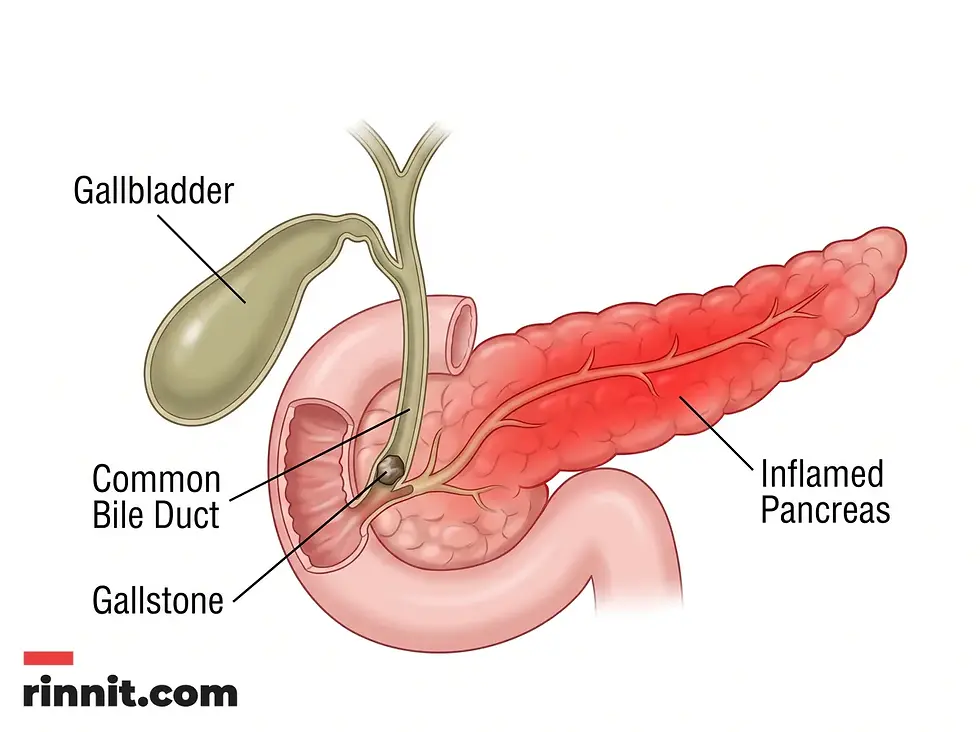
What Is Gallstone Pancreatitis?
Gallstone pancreatitis is inflammation of the pancreas caused by gallstones in the bile duct system. The pancreas makes digestive enzymes that help break down food, plus hormones that control blood sugar. Healthcare providers separate pancreatitis caused by gallstones from other types because how it happens and how it is treated are different. The gallstone has to pass or be removed to fix it.
Measure | Statistic |
People in the U.S. with gallstones | An estimated 10% to 15% |
Gallstone carriers who get pancreatitis | About 0.1% |
Share of acute pancreatitis caused by gallstones | About 35% |
Second leading cause of acute pancreatitis | Alcohol use |
How Gallstones Affect the Pancreas
The pancreas and gallbladder are connected by the common bile duct. Normally, bile and pancreatic enzymes flow through it into the small intestine. A gallstone can travel into the pancreatic duct, or block the duct system outside it. Experts describe two ways the blockage may cause pancreatitis.
Pressure and enzyme activation
Pancreatic enzymes are normally not activated until they reach the small intestine. A blockage in the pancreatic duct can cause so much pressure to build up in the duct and pancreas that it activates the enzymes early. These enzymes are highly corrosive, and unlike the small intestine, the pancreas has no thick protective mucus lining.
Bile backflow
A gallstone that blocks the common bile duct outside the pancreatic duct may cause bile to backwash into the pancreas. Bile is highly corrosive and irritates the pancreas.
Symptoms and Warning Signs
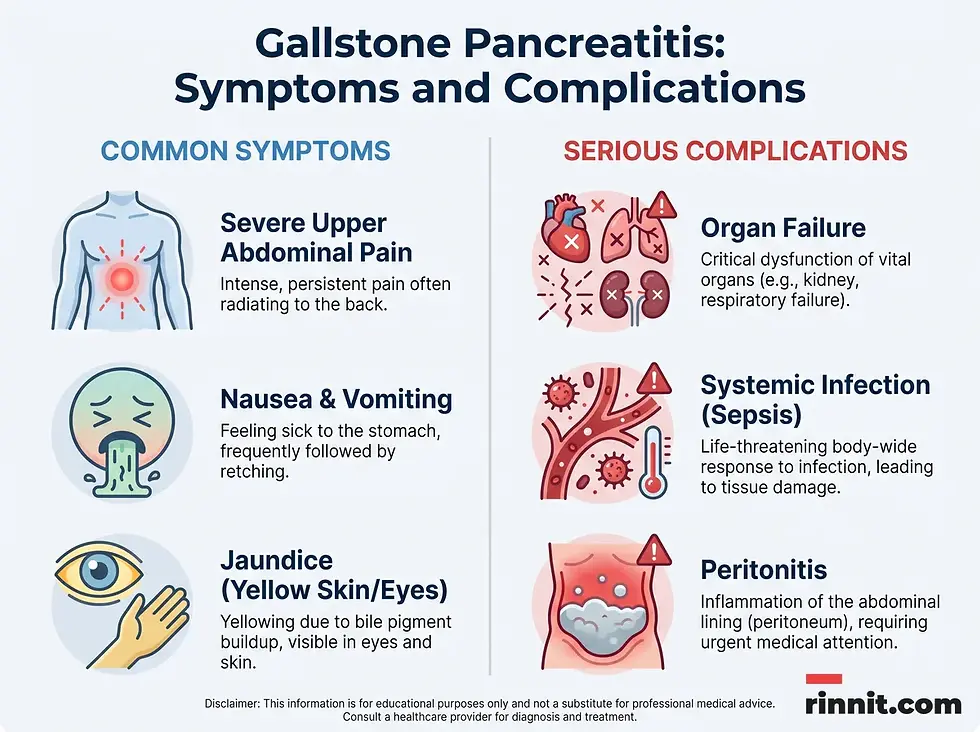
Typical symptoms
Severe abdominal pain: you may feel it on the upper left side, where the pancreas is. It might feel sharp or like squeezing inside, and it can spread to the chest, shoulder, or back.
Nausea and vomiting.
More advanced symptoms
A swollen abdomen
Dehydration
Fast heart rate
Fast breathing or shortness of breath
Low blood pressure
Low body temperature
Fever and chills
Jaundice (yellowing of the skin and eyes)
Complications of Untreated Pancreatitis
If the pancreas stays inflamed, its tissue can begin to scar and lose its blood supply, which can cause the pancreas to fail. Prolonged inflammation also makes fluid leak and build up in the tissues between your organs. That fluid can spread up into the chest, press on the lungs and heart, deplete your blood volume, and cause severe dehydration and, eventually, hypovolemic shock.
A gallstone stuck in the bile ducts causes its own problems. Bile can back up into the liver and gallbladder and cause gallbladder inflammation (cholecystitis) and liver disease. A blockage can also let bacteria from the small intestine wash back into the ducts. If the infection reaches the bloodstream, it can lead to sepsis and septic shock.
Diagnosis and Clinical Evaluation
If you come to the hospital with typical symptoms, your provider will use blood tests and imaging to confirm the diagnosis and judge how severe it is.
Blood tests: to check for pancreatic enzymes, and liver enzyme levels to see how much the liver is affected.
Abdominal ultrasound: can find gallstones in the ducts.
CT scan: can show more detail of the pancreas if needed.
Sometimes the stone that started the blockage has already passed by the time you seek care. If other gallstones are present, your providers know that was the cause.
Treatment and Recovery
If you are in a severe state, you will be taken to intensive care. Most cases (80%) are milder and begin with supportive care, which is the only treatment for the pancreatitis itself.
Supportive care
IV fluids: most people are dehydrated and need to rebuild their blood volume.
Pain relief: most people need strong pain relief by injection or through the IV.
Early feeding: in mild cases, guidelines now advise starting to eat again, often a low-fat diet, within about 24 hours as soon as pain and nausea allow, rather than a long period without food.
Nutritional support: depending on severity, glucose in your IV fluids, or nutrition through a nasogastric tube or the IV.
Additional treatments may include nausea medication, oxygen, and antibiotics if an infection is found. In milder cases, supportive care takes a few days and may help you pass a stone naturally.
Gallstone interventions
Sooner or later, any gallstone stuck in the ducts has to be removed, either as an urgent procedure or after supportive care. Even if the original stone has passed, other stones must be dealt with too.
ERCP: endoscopic retrograde cholangiopancreatography uses an endoscope and X-rays to explore the bile ducts, and tools can remove gallstones and place stents to relieve blockages.
Gallbladder removal (cholecystectomy): the only treatment for gallstones that cause problems. It can usually be done with minimally invasive laparoscopic surgery, though some people need open surgery.

Outlook and Recovery
A mild, uncomplicated case usually needs a few days of supportive care in the hospital. Recovery from a laparoscopic cholecystectomy takes about two weeks, and open surgery takes six to eight weeks. If your case isn't severe or complicated, you can expect to recover completely, and your digestive system can work well without a gallbladder.
About 20% of cases are severe or complicated. The damage in these cases is hard to undo, and despite intensive care up to 25% may be fatal. People who survive may need many weeks in the hospital.
Prevention
If you have had signs of gallstones, treat them as a warning and find out whether you have them. The red flag is biliary colic, an ache in the right side of the abdomen under the right rib cage that may come with nausea, often after eating, and comes and goes. It means a partial or occasional blockage in the gallbladder or bile ducts and could easily become something more serious. If you have gallstones that cause problems, having them removed can prevent gallstone pancreatitis.
Conclusion
Gallstone pancreatitis is serious but treatable when addressed promptly. Understanding how the gallbladder and pancreas are connected helps you recognize the warning signs of a blocked duct. With supportive care, ERCP when needed, and gallbladder removal, most people recover fully.
Next step: If you have sudden, severe abdominal pain with nausea, seek emergency medical care. If you have pain on your right side after meals that comes and goes, see your provider soon to find out whether you have gallstones.
Frequently Asked Questions
Is gallstone pancreatitis a medical emergency?
Yes. You should always seek immediate treatment for pancreatitis. Symptoms can be mild to severe, but they get worse the longer the condition goes untreated, and complicated or severe pancreatitis can be life-threatening.
How long does it take to recover from gallstone pancreatitis?
A relatively mild, uncomplicated case usually needs a few days of supportive care in the hospital, although you may still need to have a blockage removed. After that, most people need gallbladder removal, which takes about two weeks to recover from with laparoscopic surgery and six to eight weeks with open surgery.
Can gallstones cause permanent damage to the pancreas?
If inflammation continues, the pancreatic tissue can begin to scar and lose its blood supply, which can cause the pancreas to fail. Seeking treatment early improves the outcome.
Why do I need my gallbladder removed after an episode?
Once gallstones have brought you to the hospital, the chance of them causing trouble again is too high to risk. Gallbladder removal is the only treatment for gallstones that cause problems, and it is safe and effective.
What is the difference between biliary pancreatitis and gallstone pancreatitis?
Biliary pancreatitis and gallstone pancreatitis are two names for the same condition: pancreatitis caused by gallstones. “Biliary” refers to the bile duct system, where the gallstone causes the blockage.
Can I eat during treatment for pancreatitis?
Often yes, fairly soon. In mild cases, guidelines recommend starting to eat again within about 24 hours, often with a low-fat diet, as soon as pain and nausea allow; a feeding tube may be used in severe cases.
Does alcohol make gallstone pancreatitis worse?
Gallstones are the leading cause of acute pancreatitis, and alcohol use is the second leading cause. This article is about pancreatitis caused by gallstones, and your care team can advise you on alcohol in your situation.
What is an ERCP?
ERCP (endoscopic retrograde cholangiopancreatography) uses an endoscope and X-rays to see inside the bile ducts. Your provider can use tools passed through the scope to remove gallstones and place stents to relieve blockages.
Will I have digestive problems after my gallbladder is removed?
Gallbladder removal is considered a minor surgery with few complications, and your digestive system can continue to function well without your gallbladder. The liver keeps making bile, which flows into the small intestine.
What are the symptoms of gallstone pancreatitis?
The main symptom is sudden, severe upper belly pain that can spread to the back, chest or shoulder. Nausea, vomiting, fever, chills and yellow skin or eyes can also occur. Get emergency care right away for these symptoms.
Related Reading
Cholecystectomy (Gallbladder Removal): Surgery, Recovery and Risks explains why gallbladder removal is often advised after gallstone pancreatitis and what the operation involves.
ERCP (Endoscopic Retrograde Cholangiopancreatography): Why It's Done, What Happens and Risks explains the endoscopic procedure used to diagnose and treat bile duct problems.
Learn more in our guide to Lipase Blood Test: Normal Range, High and Low Levels and What They Mean.
Abdominal Ultrasound: Why It's Done, How to Prepare, What to Expect and Results explains how this painless, radiation-free scan checks the liver, gallbladder, kidneys, pancreas and other belly organs, and what the results mean.
Pancreas Blood Test: Amylase and Lipase for Pancreatitis explains the amylase and lipase blood tests used to diagnose pancreatitis.
References
Prasanth J, Prasad M, Mahapatra SJ, et al. Early versus delayed cholecystectomy for acute biliary pancreatitis: a systematic review and meta-analysis. World Journal of Surgery. 2022;46(6):1359-1375. PMID 35306590. https://doi.org/10.1007/s00268-022-06501-4
Xiong R, Xiong D, Wu Z, et al. Meta-analysis of the effectiveness of early endoscopic treatment of acute biliary pancreatitis based on lightweight deep learning model. BMC Gastroenterology. 2024;24(1):292. PMID 39198766. https://doi.org/10.1186/s12876-024-03361-1
Anderloni A, Repici A. Role and timing of endoscopy in acute biliary pancreatitis. World Journal of Gastroenterology. 2015;21(40):11205-11208. PMID 26527465. https://doi.org/10.3748/wjg.v21.i40.11205
Cleveland Clinic. Gallstone pancreatitis. Cleveland Clinic. May 3, 2022. https://my.clevelandclinic.org/health/diseases/22982-gallstone-pancreatitis
Medical disclaimer
This article was prepared for general information only and is not a substitute for professional medical advice.



Comments